Blog Archives

Kosher Sparkling wines for the end of 2020 – WINNERS from Drappier and Yarden
With 2020 coming to a close, I am posting the top sparkling wines, but to be clear, I drink sparkling wine all year round! We have been blessed recently with Yarden selling their Gilgal Sparkling wine for under 20 dollars a bottle! Honestly, there is no better deal out there and that is why they were the wines of the year last year! Yarden continues to impress with their 2014 entries and they are the sparkling wine producers to beat, for anyone entering this market.
How is Sparkling wine made?
There are many options – but the vast majority of sparkling wines fall into three categories:
- Le Méthode Champenoise (Méthode Traditionnelle)
- Methode Ancestrale
- The Charmat Method
Le Méthode Champenoise (Méthode Traditionnelle)
So, what is Champagne and how do we get all those cool bubbles? Well, it all starts with a grape of some sort, in most cases, Chardonnay, but we will get back to the other varietals further down. For now, like all wine on planet earth, Champagne starts with a grape. It is picked (often early to lower alcohol and increase acidity), then crushed, pressed, and allowed/encouraged to go through primary fermentation, exactly like all white wines on planet earth. At this point, most houses ferment the base wine in metal tanks or barrels. Some still use wood, but they are the minority.
Of course, like much of France (Bordeaux, Burgundy, Champagne), especially in Champagne, the wine can be chaptalized after racking, until an 11% ABV. Now before the heat waves that have covered much of this earth (call it what you wish), Bordeaux and Champagne prayed to hit their desired mark of ABV, and therefore they used to add sugar to bring up the ripeness on their fruit. Nowadays, Champagne is picking earlier and earlier, and Chaptalization is not a common thing anymore, as mother nature is taking care of the fruit’s ripeness all on her own!
Once the wine has been fermented the next question arises, should they let the base wine go through a wine’s second natural fermentation called Malolactic Fermentation? Most allow the fermentation to take place and require it, a fact that is easy nowadays with controlled winery environments, though some do not like it at all. Finally, the barrels/tanks are blended or in the rare case, kept aside as a Vintage Champagne, meaning the base wine used in it, is sourced from one vintage and not a blend of a few vintages.
So, at this point what we have is base wine, and while it may be an OK wine, it is far from what the final product will be like. Most base wines are nice enough, but it would be like licking on a lemon, these wines are highly acidic, and not normally well balanced at that point.
The next step is to bottle the wine, with yeast and basic rock sugar, which causes a second fermentation. The actual amount of the two added ingredients is a house secret. The wines are closed with a simple beer bottle cap. You will notice that ALL wines made in this manner have a lip around the top of the bottle, where the cap is attached to. Again, if the year is exceptional then the wine becomes vintage champagne and is aged for at least three years. If the vintage is normal then the bottle’s content is a blend of a few vintages and is aged for at least one and a half years.
All the while during this second fermentation process, the wine is aged and the wine becomes more complex from the yeast. The yeast breaks down as it eats the rock sugar, adding the effervescence, and while the yeast breaks down, it adds a lovely mouthfeel and rich complexity. This process is known as autolysis, releasing molecules that are slowly transformed as they interact with those in the wine.
The process is a dual transformational process. First, the yeasts are broken down, but if that occurred in a 100% hermetically sealed environment, we would have SERIOUS issues, like HS (Hydrogen Sulfide) and mercaptan (think nasty rotten eggs). Oxygen is a two-edged sword, with too much a wine oxidizes, and with too little, you get HS and nasty foul egg smell. So, the cap that covers the Champagne bottles as they rest for 18 months to 3 years in these cool racks, actually allow for a certain amount of oxygen to flow through, the caps are not hermetic seals. The special stoppers, AKA caps, allow the wine to mature on the lees, with a very slow feed of oxygen coming through, thereby allowing the wine to mature at a rate that is best for it. You can mature them quicker, with a different cap, but you would lose the value of a wine sitting long on the lees.
According to Wikipedia, the effects of autolysis on wine contribute to a creamy mouthfeel that may make a wine seem to have a fuller body. The release of enzymes inhibits oxidation which improves some of the aging potentials of the wine. The mannoproteins improve the overall stability of the proteins in the wine by reducing the number of tartrates that are precipitated out. They may also bind with the tannins in the wine to reduce the perception of bitterness or astringency in the wine. The increased production of amino acids leads to the development of several flavors associated with premium Champagne including aromas of biscuits or bread dough, nuttiness, and acacia. As the wine ages further, more complex notes may develop from the effects of autolysis.
Finally, it is at this stage, after the bottles have matured their proper time, based upon their label (blend or Vintage), we get to the final stage of Champagne, remuage (or “riddling” in English) and Dosage. To get rid of the lees (the dead yeast cells and other particulates), the bottles are hand or machine manipulated to convince the lees to move towards the cap. Then the neck of the bottle is frozen, and the cap is removed, the lees come flying out in a frozen format, and then the bottle is recapped with the famous champagne cork, but not before it is dosed with more sugar. This very last step is the reason for this post, but let’s leave that till further down in the post, for now, let’s talk varietals and color/style.
Color/style and Varietals
So, we have covered the how part of Champagne (well almost more on Dosage below), and now we need to talk color and grapes. The base grapes for Champagne are Pinot Meunier, and Pinot Noir, and Chardonnay. There are very few houses that also use Arbane, Petit Meslier, Pinot blanc, Pinot Gris. Champagne, like the rest of France’s wine industry, is controlled by the AOC (appellation d’origine contrôlée).
So, for Blanc de Blancs Chardonnay, which is white from white, Chardonnay is the only grape allowed. Meaning, that the juice from Chardonnay is 100% of a BdB Champagne, or in rare occasions from Pinot blanc (such as La Bolorée from Cedric Bouchard).
For Blanc de Noirs, the Champagne is made from either Pinot Noir or Pinot Meunier, or a blend of the two. Finally, for Rose Champagne, it can be a blend of the three grapes.
Late Disgorgement
This has been all the rave recently, LD or Late Disgorgement. All this means is that the house or winery (outside of Champagne) kept the bottles capped for a longer time. So the 2007 Yarden Blanc de Blancs was sold in 2014 or so. It is a lovely wine and recently Yarden released a 2007 LD Yarden Blanc de Blancs. It is the same wine, just held longer in capped format (another 4 years or so), and then recently they disgorged the wine, more on that below, and put in the dosage and the Champagne style cork and released it now. Essentially, for all intent and purpose, Yarden aged the Sparkling wine 4 more years and released it later on. The interesting thing will be to taste the two wines (the LD and normal 2007 Yarden BdB and see how 4 extra years of lying on lees helped/hindered/or did nothing). I will be doing that soon enough.
Read the rest of this entry
Three incredible Chablis from Dampt Freres, with two QPR WINNERS
Two years ago I tasted a bunch of Dampt Freres red and white wines with Nathan in France. Some of them were nice and others were passable. Then I heard that there were some Premier Cru Chablis released and I had to find a way to get them. While I was doing that I heard there was a Grand Cru! Like what? There has not been a kosher Grand Cru Chablis for a long time, I do not know the exact years, but I heard it was something like 25 years ago.
Dampt Freres is a winery with many vineyards throughout Burgundy and beyond and in 2017 they started to make some of those wines kosher. In 2017 they made a whole lineup that I tasted in 2018, including Pinot Noir and the such. The notes for those are here. However, I did not get to taste the Premier Cru at that time, which is understandable. So, when I heard they were here in the USA – I contacted the importer of the wines, Bradley Alan Cohen from Bradley Alan Imports. Bradley was very kind to send me three wines. The 2017 Premier Cru, the 2018 Premier Cru, and the brand new 2018 Grand Cru.
These are very special wines and two things JUMP at you when you see them. One, there is a QPR WINNER here, for Premier Cru wines, not easy. Secondly, the prices for the kosher are not that far off from the non-kosher prices, maybe a few dollars different. I was really impressed by these wines – this is what Chablis should be like. Screaming acid, crazy mineral, hints of mushroom and loads of dirt. The only con I can see is that these wines are going to be hard to find. Right now, there is little stock, but we hope more is coming soon. There are two or three places with the wines, so use wine-searcher and you will find them, or Google. They are not at the usual, kosherwine.com or onlinekosherwine.com, but they are all in the east coast and some are in Las Vegas as well.
My many thanks to Bradley, and I hope more of these wines will be brought in and that the prices will stay where they are, for the kosher one anyway. So, without too much more delay – let’s get to it! The wine notes follow below – the explanation of my “scores” can be found here:


2017 Dampt Freres Chablis, Premier Cru, Cote de Lechet – Score: 93 (QPR: WINNER)
OK, so, 2017 is the year for Chablis, and of what I had from Dampt Freres, two years ago, a few showed quite well. Those were Petit and a more minor vineyard. This wine is the 2017 Premier Cru and what a wine it is! My goodness, this is what Chardonnay, unoaked of course, ie meant to smell and taste like. It is pure mineral and fruit, with loads of dirt, smoke, and flint – a true joy – BRAVO!!!
The nose on this lovely wine is purely mineral notes, sure there is apple, peach, apricot, and some other white fruit, but who cares, what shines here is the mineral attack, shist, rock, flint, along with lovely white flowers, almonds, and hints of mushroom – I WANT THIS! The mouth on this medium-bodied wine is lovely, layers upon layers, come at you, with non-stop attack of mineral, fruit, earth, rich spices, and more mineral. The apricot, peach, yellow and green apple from the nose are present, as are hints of lychee, lovely Meyer lemon, and a tiny amount of crazy Kafir lime leaves and juice – WOW! The finish is so long, with incredible minerality, showing flint, rock, shist, and lovely straw, that brings the entire wine together – wow! A true joy – get this!! Drink until 2025.
2018 Dampt Freres Chablis, Premier Cru, Cote de Lechet – Score: 92+ (QPR: WINNER)
So, 2018, may have been a letdown for Chablis, and the crazy thing was that the 2018 Marrionners Chablis and Premier Cru were crazy great at release, and have really taken a step back, thankfully, this Chablis is still going strong.The nose is clearly riper, and though the ABV between 2017 and 2018 of the same wine is the same 13%, there is a clear impact of 2018 on this wine, in comparison to 2017’s mineral bomb. The nose on this wine is riper and indeed it does remind me of the 2018 Marrionners upon release, it has the riper fruit, more of pear, melon, orange blossom, yellow flowers, and such rather than the tart 2017 note, along with some mineral, but this vintage is more fruity than mineral-driven. BEWARE – this wine is still young, leave it time to open, the acidity and minerality will come out, but it needs time, at the start, it will feel short, but with time, it shows its beauty.
The mouth on this medium-bodied wine has more weight and structure than 2017, with the acidity and minerality is in your face at the start, but the finish is shorter, the mouth starts with layers of acid, lovely mineral, followed by pear, lime, lychee, melon, honeydew, and more sweet Meyer lemon, though none of that incredible Kafir lime, still a lovely rich and fuller mouthfeel, with incredible acidity, but less minerality than 2017. The finish is long (again, it starts short, give this wine time to open) with lovely acid, green notes, followed by ripe and waxy notes, with yellow apple, flint, richly dried straw, hay, along with hints of nectarine and orange, with orange rind, and earth galore. It is interesting truly a joy to taste these two vintages of the same wine – side by side, it allows me to better understand the vintages. The 2017 vintage is a mineral bomb, while 2018 is riper, but the hay and straw are more evident in 2018 than in 2017, fun. I want more of this as well – Bravo!! Drink until 2024.
2018 Dampt Freres Chablis, Grand Cru, Les Preuses – Score: 93+ (QPR: EVEN)
OK, let’s start with the obvious, this wine uses a secondary closure of wax, I HATE wax closures, they make such a huge mess. PLEASE, do not hurt yourself, do not try to take it off with a knife of something VERY stupid like that! Simply punch the corkscrew through the wax and remove the cork. Now, in 6 years, maybe that may not be the best idea, and we may well need to rethink it at that time, more of a reason for why I HATE wax closures. Until then, and even then, use the corkscrew, along with an Osso, and pray. OK, now to the wine!
WOW! WOW! I want this!! OMG, this is so much fun! This wine feels like a merger of 2017 Lechet and 2018 Lechet!The nose on this wine is ripe, like 2018 Lechet, but it has the minerality of 2017 Lechet, with notes of beautiful ripe melon, orange blossom, yellow flowers, ripe white and yellow fruit, with loads of minerality, earth, almonds, mushroom, and rich green notes – BRAVO!!! This wine is everything I want in Chablis! When you taste the 2017 Lechet it does not have this weight, when you taste the 2018 Lechet it does not have this intense minerality, when you taste the 2018 Grand Cru you get the best of both worlds, I know, I am repeating myself – OMG just get over it!
The mouth on this medium to full-bodied wine is rich, layered, incredible, with intense mineral and fruit focus from the start until the very end, and even after that, it lingers forever! The mouth starts with rich layers of nectarine, orange, Meyer lemon, lime, peach, and ripe yellow apple, mingled well with shist, rock, straw, and herbs, with incredible extraction and acidity, hints of tannin, loads of smoke, but what overpowers your senses is the sheer fruit and mineral focus, refreshing, acidic, focused, and deep, wow! The finish is super long, longer than any Chardonnay I have had without oak, with more acidity, mineral, flint, rich saline, ripe Kumquat, hints of lychee, but more Kumquat than Lychee and crazy tart lime/orange – WOW BRAVO!! Drink until 2026.

Tasting of Royal Wine’s 2018 and some 2019 French wines in California
Well, it is official, 2020 continues to take, and though my annoyances are minor in comparison to the pain others are feeling, it still has impacted my routine, which I guess is the story of 2020. For the past three years, I have been tasting Royal’s latest wines with the man in France for Royal, Menahem Israelievitch. Sadly, this year, no matter how much I planned and tried, it is a no go. So, for the first time, in a long time, the tasting will be here in Cali and it will only be a small part of the 2018 and 2019 wines, such is life.
So, no there will not be a picture with all the wines, and some of the wines from last year are still not here right now! But, I will post here what I did taste so far, and my overall feeling of the 2018 and 2019 vintages.
In a previous post about the most recent French wines (at that time in 2017) that were arriving on the market – I already spoke about pricing and supply, so there is no need to talk that over again in this post.
While the 2015 and 2016 vintages were ripe, and the 2017 vintage was not ripe at all, the 2018 vintage makes the 2015 ripeness look tame! Now that is a very broad-stroke statement that cannot be used uniformly, but for the most part, go with it!
I see no reason to repeat what Decanter did – so please read this and I will repeat a few highlights below.
For a start, the drought came later in 2018,’ says Marchal, pointing out that early July saw less rain in 2016. ‘But when it came in 2018, it was more abrupt, with the green growth stopping across the whole region at pretty much the same time’. He sees it closer to 2009, but with more density to the fruit. … and high alcohols!
Alcohols will be highest on cooler soils that needed a long time to ripen, so the Côtes, the Satellites, and the cooler parts of St-Emilion have alcohols at 14.5-15%abv and more. I heard of one Cabernet Franc coming in at 16.5%abv, but that is an exception. In earlier-ripening areas, such as Pessac-Léognan and Pomerol, alcohols are likely to be more balanced at 13.5% or 14%abv, as they will have reached full phenolic ripeness earlier.
‘Pessac-Léognan did the best perhaps because it’s an early ripening site,’ said Marie-Laurence Porte of Enosens, ‘so they were able to get grapes in before over-concentration. If you had to wait for phenolic ripeness, that is where things could get difficult’.
The final averages per grape, according to Fabien Faget of Enosens, are Sauvignon Blanc 13.5%abv, Sémillon 12.5%abv, Merlot 14.5%abv, and Cabernet Sauvignon 14%abv’.
The Mevushal push, from Royal wines, is continuing for the USA labels, a fact I wonder about more and more. Look, if you are going to force Mevushal wine down our throats, why not import BOTH? If you look at the numbers for wines like we will taste in the post, the majority of the buyers are not restaurants or caterers. Sorry! No matter how much Royal Wines wants to fool itself into thinking. Throw in COVID and FORGET about this INSANITY, please! I beg of you!
There is no denying that it affects the wine, it does. I have tasted the Chateau Le Crock side by side, the Mevushal, and non-Mevushal and while I feel that Royal does a good job with the boiling, it is still affected. If you want to have Mevushal wines in the USA, then bring them BOTH in! Royal does this for Capcanes Peraj Petita and the undrinkable Edom and others in Israel. So what Royal is saying is – that could not sell the Chateau Le Crock numbers that they import into the USA without boiling it? Why else would they feel forced to boil it and import it if not otherwise? To me, it makes me sad, and in a way, it disrespects what Royal is trying to do to its French wine portfolio, IMHO. They should, at minimum, import both! Allow for the caterers and restaurants (like anyone needs that nowadays – HUH???) to have the Mevushal version and sell the non-mevushal version to us, as you do with Edom and Petita. There I have stated my peace, I am 100% sure I will be ignored – but I have tried!
The Mevushal wines from France for the 2018/2019 vintage will be, the 2018 Barons Edmond et Benjamin de Rothschild, Haut-Medoc, 2018 Chateau Greysac, 2018 Chateau Chateau de Parsac, 2018 Les Lauriers, Des Domaines Edmond de Rothschild, 2018 Chateau Le Crock, 2019 Chateau Les Riganes, Red, 2018 Chateau Genlaire, along with the whites wines, the 2019 Bourgogne Les Truffieres, Chardonnay, the 2019 Les Marronniers, Chablis, and the 2019 Chateau Les Riganes, Blanc.
Now does mevushal impede the long-term viability of aging in regards to the wine? Well, that too is not something that we have scientific proof of. I have tasted a mevushal 1999 Herzog Special Edition and it was aging beautifully! So, would I buy the mevushal versions of the wines I tasted below – yes! Would I age them? Yes, I would hold them for slightly fewer years.
Other than the mevushal aspect, there are no differences between the European version of the wines and the USA version of the wines. While that sounds obvious, I am just stating it here. The wines will be shipped now and the temperature issues that affected Israel’s wines of old, have not been a factor here.
The “other” wines not here yet or I have not had
There is the just-released 2018 Château Cantenac Brown Margaux (will post that when I get it), along with these yet unreleased wines. The 2019 Chateau Gazin Blanc (2018 was/is INCREDIBLE), 2018 Chateau Fourcas Dupre, 2018 Château Meyney Saint Estèphe, 2018 Chateau Giscours, 2018 Chateau Lascombes, 2018 Chatyeau Tertre, and 2018 Chateau Royaumont.
I understand this is a sub-optimal situation and blog post. It does not cover Royal’s 2018/2019 European wine portfolio. Still, it covers what has been released (or very close to it), here in the USA, and hopefully, it will help you. One day soon, I hope and pray, things will return to some semblance of normalcy, and we will all travel around again. Until then, this is the best I can do. Stay safe!
Final comments, disclaimer, and warnings
First, there are a TON of QPR winners but there are also a LOT of good wines that I will be buying. Please NOTE vintages. The 20016 Haut Condissas is a disaster while the 2017 vintage is fantastic! So, please be careful!
These wines are widely available in the USA, so support your local wine stores folks – they need your help! If you live in a wine-drinking desert, like California, support the online/shipping folks on the side of this blog. They are folks I buy from (as always – I NEVER get a bonus/kickback for your purchases – NOT MY STYLE)!
Sadly, there was no plane trip, no hotels, no restaurants, nothing. So, no trip to talk about – just the wines and my lovely home! Stay safe all and here are the wines I have had so far. I have also posted many scores of 2015, 2016, 2017, and 2018 wines which are still for sale here in the USA. My many thanks to Royal Wine for their help in procuring some of these wines. The wine notes follow below – the explanation of my “scores” can be found here:




Tasting of Royal’s 2017 and some 2018 French wines in France
This is my third year tasting wines with Menahem Israelievitch in Paris and it is the first one that is not related to my visit to Bordeaux three years ago, almost to the date of this tasting (give or take two weeks). Three years ago, I was given the opportunity to taste many of the 2015 and 2016 wines from the barrel at each of the wineries in Bordeaux.
The 2014 vintage to me, was crazy fun because it is less ripe than the 2015 or 2016 vintages. They were also FAR cheaper. Then you had the 2015 wines which were more expensive and far riper than the 2014 vintage. This 2016 vintage is the best of both worlds, but it comes at a crazy high price. I warned you at that time, during the epic post of my visit to Bordeaux with Mr. Israelievitch, that you better start saving your money, sadly nothing has changed about that. The REAL shocker price-wise of the 2016 vintage was Chateau Malartic, which rose to almost 150 or more a bottle! That was close to double the 2014 vintage.
In a previous post about the most recent French wines (at that time in 2017) that were arriving on the market – I already spoke about pricing and supply, so there is no need to talk that over again in this post.

While the 2015 and 2016 vintages were ripe, the 2017 vintage is not like that at all. The 2017 vintage in Bordeaux, though this is a massive simplification and generalization of the 2017 vintage, was overall less ripe than the 2015/16 vintages and maybe even in some cases a drop less than the 2014 vintage. The 2017 vintage flowered early and then the frost came, which killed off a fair amount of the fruit from the vines (Grapevines are self-pollinating and as such the flowers are an all-or-nothing situation in regards to yield). Quality itself is not affected by the early frost which froze the flowers, while the rest of the season was mostly OK, except for the late rains that diluted some of the acidity, again this is an overall generalization, with varying degrees of difference between the Chateaus.
The Mevushal push, from Royal wines, is continuing for the USA labels. More wines are being made Mevushal and while I wonder if this is good overall for myself, it makes sense for Royal wines, which in the end, I guess is what matters to them. Will this be an issue? In the past, I have found that the mevushal work of Mr. Israelievitch is top-notch, and really just ages the wine rather than ruining it.
The Mevushal wines from France for the 2017 vintage will be, the 2017 Barons Edmond et Benjamin de Rothschild, Haut-Medoc, 2017 Chateau Greysac, 2017 Chateau Chateau de Parsac, 2017 Les Lauriers, Des Domaines Edmond de Rothschild, 2017 Chateau Le Crock, 2017 Cuvee Hautes Terres, Chateau Fourcas Dupre, along with the whites wines, the 2018 Bourgogne Les Truffieres, Chardonnay, the 2018 Les Marronniers, Chablis, and the 2018 Chateau Les Riganes, Blanc.
Now does mevushal impede the long-term viability of aging in regards to the wine? Well, that too is not something that we have scientific proof on. I have tasted a mevushal 1999 Herzog Special Edition and it was aging beautifully! So, would I buy the mevushal versions of the wines I tasted below – absolutely! Would I age them? Yes, I would hold them for slightly fewer years.
Other than the mevushal aspect, there are no differences between the European version of the wines and the USA version of the wines. While that sounds obvious, I am just stating it here. The wines will be shipped now and the temperature issues that clearly affected Israel’s wines of old, have not been a factor here.
Tasting in Paris
I landed in Paris, got showered and the such, and then made my way to lunch with Menahem Israelievitch. This year I was not alone in my tasting, I was joined by Avi Davidowitz from the Kosher Wine Unfiltered blog. After lunch, we went to a lovely home to do the tasting. The wines were all laid out in the order for the tasting, and one by one we went through the 30 wines. There was one missing wine, the 2018 Chateau Genlaire, Bordeaux Superieur and two of the wines were bad, I did taste them later in the week and they are listed here as if I tasted them at the tasting.
My many thanks to Menahem Israelievitch for going out of his way to help me to taste all the current French wines from Royal Wines before they were publicly released. The labels on the pictures may not all have a kosher symbol, but that was because they rushed some of the bottles to Mr. Israelievitch before they were properly labeled with supervision symbols attached. My many thanks to Mr. Israelievitch, Royal Europe, and Royal Wines for making this tasting possible in the first place, and secondly, for taking the time to taste the wines with me.
The wine notes follow below – the explanation of my “scores” can be found here:


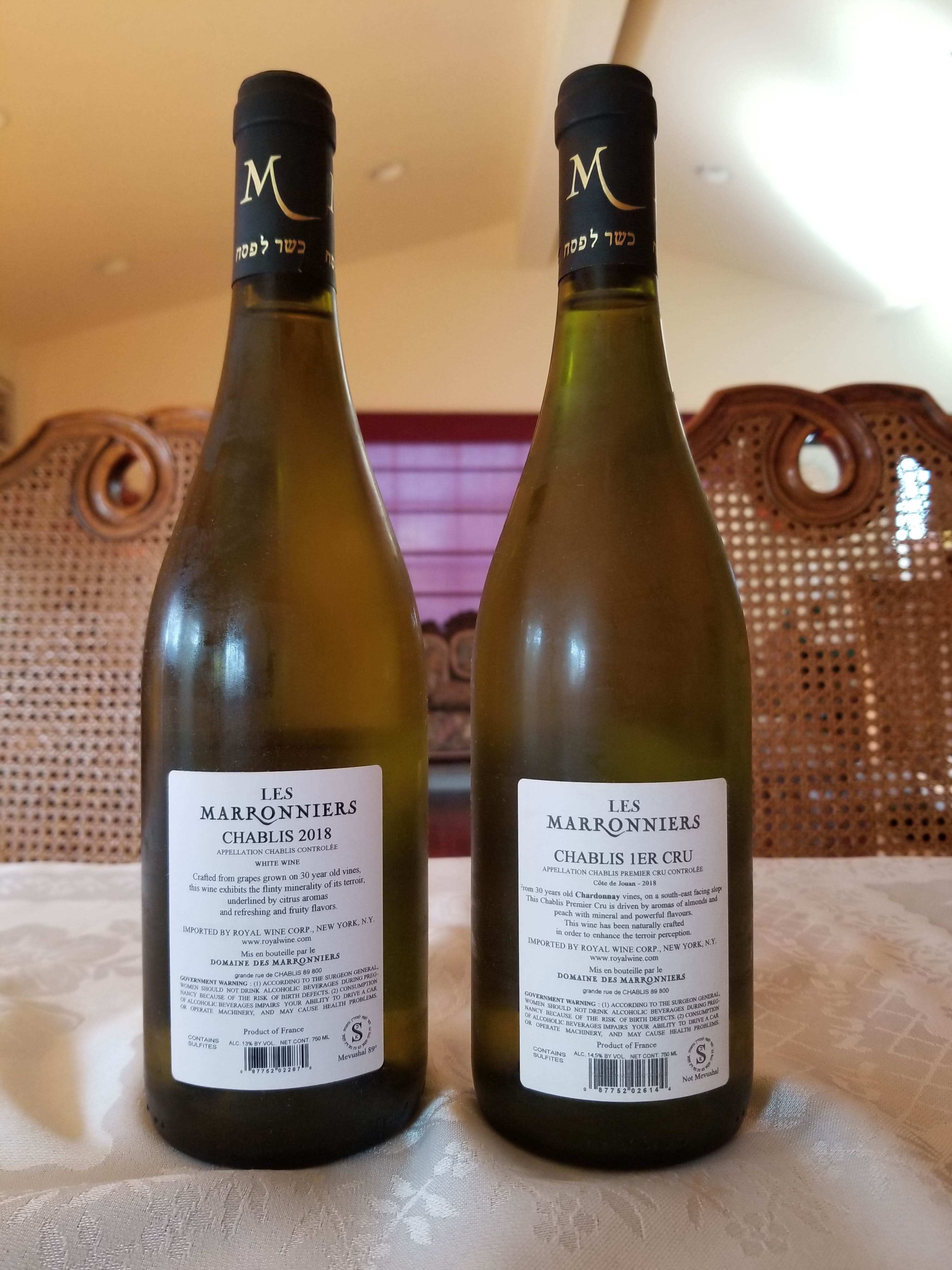
2018 Les Marronniers Chablis – Score: 93 (QPR madness) (Mevushal)
This wine is made with native yeasts and as little manipulation as possible. The nose on this wine is beautiful with orange blossom, yellow apple, and rosehip, with lemon curd, and yeasty and creamy notes. This is so much better than the 2016 or 2017 vintage, this is so much fun! The mouth on this medium-bodied wine is crazy fun, intense acidity, incredible salinity, piercing, almost painful, with lovely layers of lemon, grapefruit, with quince, and pie crust, with Anjou pear, and quince. The finish is long, crazy long, almost oily, mostly creamy, with baked pear and apple, cinnamon, nutmeg, and loads of mineral, with slate, rock, and saline. Bravo!! Drink until 2023 maybe 2024.
2018 Les Marronniers Chablis, Premier Cru, Cote de Jouan – Score: 92 to 93 (QPR)
The nose on this wine is closed, but it shows lovely notes of mineral, slate, blossom water, and loads of citrus, with apple, and smoke. The mouth on this medium-bodied wine is rich, layered, and impressive, with a rich oily mouthfeel, showing a lovely weight, with yellow apple, tart citrus, Asian Pear, and beautiful acidity that is well integrated with a strong mineral core, showing Orange pith, with tart citrus and slate and yellow plum, with saline, and more earth and hints of nectarines and orange. Lovely! Drink from 2020 to 2024 may be longer. Read the rest of this entry

My latest round of both new and old winners and some more losers for 2019
After my long hiatus, I am happy to say that this post brings me current to wines I want folks to know about, both good and bad. Thankfully for you, it does not include at least 45 roses, white, and red wines that were so horrible that I see no value in posting their NA scores here.
However, two wines that need warning are the 2017 Chateau Lacaussade Saint-Martin
and any wine from Capcanes Cellars made from 2015 and on, other than the 2015 Capcanes Pinot Noir and the lovely 2015 Capcanes Samso Carignan. To me, this is truly sad Capcanes was a rockstar and a perennial goto and QPR wine, other than there roses. Now, they have soldout to Parker’s view of wine and I cannot fathom for even a second what they gain from this. Their wines sold perfectly well so sales cannot be the reason. Yes, there is a new winemaker, Anna Rovira, who recently won the prestigious female winemaker of the year for the 2019 award from Selection magazine! Congratulations! She replaced the longtime winemaker of Capcanes Angel Teixidó. Sadly, from my perspective, the wines are far riper than they used to be, they also show less acid and less balance. They are wines that I no longer buy, the last Capcanes I bought was from the 2014 vintage. With that said, I hope this shift is a byproduct of some rough years and that the 2017 vintage will return to its old self, one can always hope!
On another aside, please folks – STOP drinking 2017 whites and 2018 roses – they are dead! I have had loads of 2018 roses recently, they are dead or on the way down from jumping off the cliff. Sure, there are whites that are still young from the 2017 vintage, like full-bodied Chardonnays or white Bordeaux, other than Lacussade. Sadly, many of the 2018 whites are on their way down as well. The 2018 Tabor Sauvignon Blanc is already losing its acid and so many others as well. Please be careful, taste before stocking up. The simple whites are like roses, drink them by fall.
On the good news side, the 2017 vintage from Bordeaux is so far so good! The much scorned 2017 vintage from Bordeaux so far is holding up very well. I really liked the 2017 Chateau Mayne Gouyon, which is simple and mevushal, and very tasty. The 2017 Chateau Moulin Riche was lovely, maybe even better than the 2016 vintage. I hear the 2017 Chateau Le Crock and the 2017 Chateau Royaumont are also showing very well, all-around great news for the much pooh-poohed 2017 vintage.
Finally, bravo goes to Herzog Wine Cellars, they continue to impress with their number one grape – Cabernet Sauvignon. They are predominantly Cabernet Sauvignon heavy, which makes sense given the current kosher wine market. When you go to KFWE and other wine events, just listen to people, their number one desire is the best Cabernet Sauvignon on the table or just whatever wine you have that is Cabernet Sauvignon-based. It is both sad and totally hilarious at times. So, sure Herzog goes where the money is. The accolades, at least from me, anyway, is for the raising of the bar and for the sincere effort that they put into making world-class Cabernet Sauvignon wines. Bravo!
I wanted to keep this simple, so the wine notes follow below – the explanation of my “scores” can be found here:


2014 Chateau Haut Condissas – Score: 91
This wine is ripe, and really oaky, with nice mineral, green notes galore, but front and center is mounds of dark fruit, sweet oak galore, and lovely garrigue. The mouth is lovely, and rich, with medium-bodied structure, showing with lovely sweet fruit, earth galore, and lovely extraction, that gives way to green notes, layers of sweet but balanced fruit, with blackberry, cassis, dark raspberry, and rich forest floor. The finish is long and mineral-based, with intense tobacco, mineral, pencil shavings, and sweet fruit that gives way to dill, earth, forest floor, mushroom, and sweet oak. Drink from 2023 until 2028
2013 Chateau Grand-Puy Ducasse, Pauillac – Score: 91
To me, the 2013 Moulin Riche and 2013 3 De Valandraud were two of the best wines from the poor 2013 Bordeaux vintage, though this one always held potential.
This wine has evolved now to show even more tertiary notes than when I had this two years ago. The nose on this wine is lovely but still stunted, with clear and lovely notes of mushroom, dirt, and loam, followed by ripe fruit, showing red and black, with floral notes of heather and English lavender, with foliage and sweet notes. The mouth is nice on this medium-bodied wine but it is thinner than the younger 2015 (which is a superstar), with a balanced mouth, showing nice acidity, followed by cherry, raspberry, blackberry, with more foliage and forest floor, lovely garrigue, graphite, sweet tobacco, sweet dill, nice mineral, and mushroom. The finish is long, tart, yet very fruity, with great balance and attack, though showing little complexity, more like a dirty and green/garrigue/foliage and herb-infused fruit-forward wine, with mineral, acidity, and nice mouth-coating tannin bringing it all together. Drink by 2024. Read the rest of this entry

2019 Bokobsa Sieva Wine tasting just outside of Paris


So, let’s start from the beginning. As I posted here, about the coming wine events of 2019, there were many options for you to get out and taste great wines almost across the globe. Well, recently, as you know well I have been focusing more on Europe, so I was in Paris later last year again to taste the new 2016 Bordeaux, and now I wanted to return to Bokobsa’s tasting, which is not officially part of the KFWE franchise. Avi Davidowitz, of kosher wine unfiltered, did every KFWE this year, Tel Aviv on the 4th of February, London on the 6th of February, and then on to NYC and L.A. I decided that I did not need to go to Sommelier this year and instead just focused on Bokobsa’s tasting which was on the same day as the KFWE Tel Aviv in Israel.
As I return home, Paris and London KFWE, NYC KFWE, and L.A.’s KFWE are in the rearview mirror. I will be posting on them separately, so I start with Bokobsa Paris.
To start the Bokobsa Tasting, from the company known in France as Sieva, happened in Paris (well not exactly Paris, more on the very outskirts of Paris to be exact) on Monday, Feb 4th, on the stunning grounds of the Pavillon des Princes in the 16th district. I arrived early and after taking a bunch of pictures I just relaxed and waited for the event to start. One of the issues from the tasting in past years was the wine glasses, but this year, Bokobsa had lovely glasses to truly appreciate the wines.
The ambiance and space were both far improved from the previous location, which was the basement of the Intercontinental Hotel in Paris. The table layout was far improved, it was truly a lovely event. The food was a bit mediocre, with it being essentially cold food, like Sushi and elegant salads on crackers, though they had warm chicken further along into the event.


The wines and the setting were the clear stars of the event, and with the lovely glasses, the wines did shine. My main issue with that some of the wines were the old and not showing well, which degrades the very purpose of a show/tasting like this. For example, they poured a 2013 Covenant Sauvignon Blanc and a myriad of older roses that were far over the hill and not showing well. Though at the same time, they poured some lovely Covenant Cabernet Sauvignon and Lavan, along with many of the top Royal Wines from France and Spain, and the new Champagne from Rothschild. There were a few older vintages of the French Royal wines that I do not remember now that were out of place, but they were still showing well. Read the rest of this entry

 Wine Musings Blog