Blog Archives

2020 Bokobsa Sieva Wine tasting just outside of Paris
Well, I am one post in and I have another 5 to go. As I stated in the first of my 6 posts on my trip to wine tastings in London, Paris, NYC, and L.A., I am truly thankful that my trips ended well for everyone, the news keeps getting uglier.
As I stated the kosher wine tasting season was upon us, and the first of my posts about the ones I attended was my London post. After a quick train ride to Paris, and a stop at the hotel, it was time for another tasting, the Bokobsa Sieva tasting.


The Bokobsa Tasting, is presented by the company known in France as Sieva, and it happened in Paris (well not exactly Paris, more on the very outskirts of Paris to be exact) on Tuesday, on the stunning grounds of the Pavillon des Princes in the 16th district. I arrived early and after taking a bunch of pictures I just relaxed and waited for the event to start. One of the issues from the tasting in past years was the older vintages of wines poured, along with the food that was cold and quite simple. This year, the food was nicer, they had warm food, and some very well put together dishes. Sadly, the vintages on the Royal wines were still strange, some new 2017 vintages while some wines were 2014 and 2015. However, the Bokobsa wines were all the latest, other than the 2018 Chablis which was not being poured.


One wine two Hecsher/Kosher Supervisions means two labels
One of the biggest shocks I had at the event was the realization that France is in a far worse place, in regards to kosher supervision than Israel and the USA. I have seen many times, where Badatz Edah HaChareidis and the OU would both be on the same bottle of wine, like Or Haganuz wines and others. However, in France, that seemingly is not an option! Understand that there are NOT multiple mashgichim (kosher supervisors) when there are multiple supervisions on a single bottle. Rather, the ONE/Two mashgichim all do the stringencies of one or both of the kosher supervisions. However, in France, this cannot work – I am not kidding! Clarisse showed me two bottles of the same Champagne made by Bokobsa Sieva. The difference between them, was not the overall supervision, as that was one the same, nor was it in any way a different vintage or winery, nope! They were EXACTLY the same wine – EXACTLY! The only difference was the name of the supervision on the back of the bottle! One had the kosher supervision of Paris Beit Din and the other had the kosher supervision of Rabbi Rottenberg.
So, I then asked the head of the supervising Rabbis, who was at the tasting, if the Paris Beit Din accepted to be on the same label with Rabbi Rottenberg, would Rabbi Rottenberg agree? He said no! OMG! I was speechless. ME! What question would you followup to that answer? I asked why? He said because they have different requirements. I said they are the same Mashgichim, so why would you care? In the end, he said that is how it is in France. Sadly, that is the state of affairs and I moved on.
Another fascinating difference between the labels is that the Paris Beit Din version of the wine has a different Cuvee name than the Rabbi Rottenberg version. That, I was told, was just for marketing, so that people would not be as shocked as I am now! Finally, there is also a pregnant lady with a slash through it, denoting that alcohol and pregnancy is not a good idea, the normal disclaimer wines have on their labels. On the Rabbi Rottenberg label, it was all in text, no images of a lady. Read the rest of this entry

Latest releases from Andrew Breskin and Liquid Kosher
I have had to travel to San Diego for business this year and thankfully on one of those trips I was able to connect with Andrew and hangout. Mr. Breskin is the founder of Liquid Kosher a wine curator and importer for a wide array of kosher wines, from French wines (like the famous Domaine Rose Camille to Israeli favorites). Andrew invited over a group of wine lovers and made a feast for the eyes and stomach with a wonderful array of food and wines, beautifully presented. It was great to hang with Andrew, which I normally get to do only once a year at KFWE Los Angeles.
Andrew has been the goto guy for access to French wines that are not imported into the United States by Royal or the other larger kosher wine importers. Andrew has brought us Burdungdies like Domaine Chantal Lescure, Domaine d’Ardhuy, along with the famous Domaine Roses Camille, which have been top scorers for many years now.
I had a few of these wines in France last year and they did not show as well as the last two times I have had them here in the USA. Maybe it was a bad wine in France, who knows. I recently tasted the current crop of wines from Liquid kosher and I found them to be lovely wines, which are almost ready now and which will also last for many more years.
One of the most exciting new arrivals into Breskin’s portfolio are the wines from Yaacov Oryah. I am so happy to see them here in the USA, I did not know that Andrew had imported them until he poured a couple of them at the dinner that night. I, of course, placed an order for them that week. Yaacov Oryah’s wines are beyond unique and they are wines that are lovely now but also have time to evolve.
To me, the shocker of the group is the 2015 Clos Lavaud – Lalande de Pomerol. To call a 45 dollar wine a QPR is a bit of a stretch, but to me, it is a no-brainer QPR wine. It is wonderful and a wine that you should stock up on for the price and the quality.
Many thanks to Andrew Breskin and his wife for hosting us and for sharing his time, home, and wines with us. The wine notes follow below – the explanation of my “scores” can be found here:


2014 Chateau Marquisat De Binet, Cuvee Abel – Score: 91
This wine is 100% Merlot. The nose on this wine is black, with loads of vanilla, with black and red fruit notes followed by lovely garrigue, green foliage, with nice mineral, sage, bright cranberry, and a mound of roasted herbs. The mouth on this medium to full-bodied wine is gripping, with mouth-coating/drying tannin, that gives way to screaming acid and lovely blackcurrant, plum, rich blackberry, with loads of tart and juicy raspberry, cranberry, and lovely loam, graphite, all wrapped in an elegant and gripping mouthfeel. The finish is crazy, with more gripping tannin, rich tart and juicy red and black fruit, more lovely green notes, foliage, with mushroom, and herb, with licorice and coffee lingering long. Nice! Drink until 2021.
2014 Echo de Roses Camille, Pomerol – Score: 92
The nose on this wine is not as fruit-forward as what I had last year in France, showing a nose of lovely red and black fruit, mint, and Oregano galore, tar, with forest floor, and earth. The mouth on this medium to full-bodied wine is lovely, showing a mouth that is lovely with core acidity, rich and layered, elegant and expressive fruit, blackberry, cranberry, tart pomegranate, and lovely tart and juicy red fruit of tart cherry, well balanced with freshly tilled loam that is wrapped in a mouth-coating tannin structure and layers of riper fruit that show with time and air, with salinity, more tactile tannin, and loads of mineral. The finish is long, red, green, and filled with mushroom, loam, tilled earth, and forest floor, with tobacco, and milk chocolate. Nice! Drink from 2020 until 2026.
2012 Domaine Roses Camille, Pomerol – Score: 93 to 94
Sheer elegance in a glass, this wine is almost there but still not ready. The nose is rich and earthy, with now loads of mushrooms, followed by red and green fruit, with hints of black in the background, with loads of sweet and ripe fruit, sweet dill, cedar, and rich dirt and deep fruit. The mouth on this full-bodied wine is riper than I would have wished for, but it is beautifully layered with incredibly concentrated dark fruit, with lovely extraction, showing candied strawberry, along with nice dirt, spice, more cedar, and rich layers of green foliage and ripe and juicy cassis, black cherry – that gives way to mineral, pencil, and great focus all underpinned by some nice acid, but I would have loved more acid, the other two wines that I tasted beside the big brother showed more acidity, and more mineral, all wrapped in elegant and mouth-draping tannin that is plush and elegant. The finish is long and green, with sweet notes of juicy and tart fruit, with more great acid, cocoa, tar, charcoal, and tobacco, wrapped in leather and spice. Bravo! Drink from 2020 till 2029. Read the rest of this entry

Tasting of Royal’s 2016 French wines in France

As I stated recently in my original post about my most recent trip to Israel, the reds of Israel are really not impressive, but thankfully I ended my trip by going to France to meet with Menahem Israelievitch and taste through all of Royal’s new 2016 and 2017 wines from France in Paris.
2016 Royal Europe French wines
Two years ago, I was given the opportunity to taste many of these wines from the barrel at each of the wineries in Bordeaux. Now, the 2015 wines were a bit more akin to the barrel notes when I tasted through the 2015 wines last year in Paris, but the 2015 wines were already in barrel for a year. However, since the trip was in 2016, the 2016 wines were barely finished fermenting and most had yet to even go through malo, but man even then it was easy to tell that the 2016 vintage was going to be something very special.
The 2014 vintage to me, was crazy fun because it is less ripe than the 2015 or 2016 vintages. They are also FAR cheaper. Then you had the 2015 wines which are more expensive and far riper than the 2014 vintage. This 2016 vintage is the best of both worlds, but it comes at a crazy high price. I warned you during the epic post of my visit to Bordeaux with Mr. Israelievitch, that you better start saving your money, sadly nothing has changed about that. The REAL shocker of the 2016 vintage will be the Chateau Malartic wine, get ready to see that at 170 or more a bottle! That will be close to double the 2014 vintage.
In a previous post about the most recent French wines that were arriving on the market – I already spoke about pricing and supply, so there is no need to talk that over again in this post.
Also, the 2015 vintage may have been ripe to many, but the 2016 right bank wines are even riper. That appears in the right bank because of the Merlot that was super ripe in 2016, but other wines with lots of Merlot also show that way, even on the left bank.
The interesting change this year for these wines is that more of them will be coming to the USA in Mevushal format. Will that be an issue? In the past, I have found that the mevushal work of Mr. Israelievitch is top-notch, and really just ages the wine rather than ruining it.
The Mevushal wines from France for the 2016 vintage will be, the 2016 Barons Edmond et Benjamin de Rothschild, Haut-Medoc, 2017 Chateau Mayne Guyon, 2016 Chateau Greysac, 2016 Chateau 2016 Chateau de Parsac, 2016 Les Lauriers, Des Domaines Edmond de Rothschild, along with the two whites wines, the 2017 Bourgogne Les Truffieres, Chardonnay and the 2017 Les Marronniers, Chablis.

Now does mevushal impede the long-term viability of aging in regards to the wine? Well, that too is not something that we have scientific proof on. I have tasted a mevushal 1999 Herzog Special Edition and it was aging beautifully! So, would I buy the mevushal versions of the wines I tasted below – absolutely! Would I age them? Yes, I would hold them for slightly fewer years. The only wine listed below that will be mevushal in the USA and that is NOT mevushal in France is the 2016 Chateau Le Crock. I will post my notes on the mevushal version when it is released here in the USA, they are currently selling the 2015 Chateau Le Crock, so that needs to sell out before the 2016 vintage is released.
Other than the mevushal aspect, there are no differences between the European version of the wines and the USA version of the wines. While that sounds obvious, I am just stating it here. The wines will be shipped now and the temperature issues that clearly affected Israel’s wines of old, have not been a factor here.
Tasting in Paris
I landed in Paris, got showered and the such, and then made my way to lunch with Menahem Israelievitch. After lunch, we went to a lovely home to do the tasting. The wines were all laid out in the order for the tasting, and one by one we went through the 29 wines. The only wine missing wines were the 2016 Les Lauriers, Des Domaines Edmond de Rothschild and the 2016 Chateau Greysac.
My many thanks to Menahem Israelievitch for going out of his way to help me to taste all the current French wines from Royal Wines before they were publicly released. The labels on the pictures may not all have a kosher symbol, but that was because they rushed some of the bottles to Mr. Israelievitch before they were properly labeled with supervision symbols attached. My many thanks to Mr. Israelievitch, Royal Europe, and Royal Wines for making this tasting possible in the first place, and secondly, for making the time to taste the wines with me.
The wine notes follow below – the explanation of my “scores” can be found here:


2017 Ramon Cardova Albarino, Rias Baixas – Score: 91
Lovely nose of rich mineral, with loads of straw, with which salinity, and lovely peach and dry apricot, with honeysuckle, lemongrass, with green notes galore. Lovely! The mouth on this lovely green and acid-driven wine, showing rich salinity, green olives, with lovely dry quince, green apples, but also with lovely lime and grapefruit, with a bit of sweet fruit of guava and rich acid that comes at you in layers. The finish is long and green, with gooseberry, passion fruit, and lovely round and tart with freshness and orange pith, and incredible acidity lingering long. Drink until 2021.
Interesting note on this wine, there is a thermosensitive logo on the label that shows ONLY when the wine is at the correct temperature, on the bottom right-hand corner of the front white label. This is a lovely wine and one that is worth the effort to enjoy at the correct temp. Cool!


2017 Chateau Lacaussade Saint Martin, Vignes Vignes – Score: 90
The wine is a blend of Semillon and Sauvignon Blanc. This wine is very slow to open, it may need a quick decanting, for an hour or so. The nose is slightly tropical in nature with lovely with melon, guava, and hints of passion fruit to start, over time it recedes to show lemongrass, straw, mineral, grapefruit, citrus, and honeysuckle notes. Just like the nose the mouth also starts off with crazy tropical notes that also recede with time, to show a very different wine. After some time, the mouth on this wine is not complex, but very nice, with rich acidity, showing a good balance of fruit, green apple, heather, tart pear, and mineral. The finish is long, super long, with southern tea, and rich acidity, and lovely pith. Drink until 2021. Read the rest of this entry

2017 Bokobsa Wine Tasting in Paris
m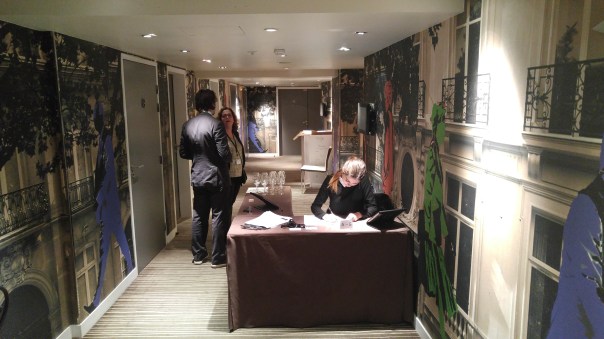 Well, if you read my previously posted notes of my one day at Sommelier in Israel, you may be wondering why I am posting about Paris France? The apropos answer to that question can be summed up with this beautiful pasuk from Psalms “Shomer petaim Hashem,” literally “God protects the foolish,”.
So, let’s start from the beginning. As I posted here, about the coming wine events of 2017, there were many options for you to get out and taste great wines almost across the globe. Well, this year I finally wanted to put more focus on France, so I was in Bordeaux later last year, and now I wanted to get to Paris again to taste through the new 2014 wines. My desire was to get to one day at Sommelier, and the Bokobsa wine tasting in Paris, but skip the epic Zur wine tasting this year, the first time since its inception 😦
Thankfully the plans worked out, and for that I thank God and my wife. Last year I was in Israel a total of 6 times, including a stop over in Bordeaux, where I tasted some of the best wines from the 2015/2016 vintage, thanks to Royal Europe. So, this year, we had to keep the number of round trips to Israel to a more reasonable number, and staying home a bit more was also on the table. That meant doing crazy things to get an elephant of activity, squeezed into a thimble sized amount of time. A total of five days, including travel both ways, to squeeze in a trip to Israel, a Monday in Israel for Sommelier, then a day trip to paris for the Bokobsa tasting (Tuesday), returning at 4AM on Wednesday back to Israel. Then going north to visit 5 wineries (Kishor, Matar, Adir, Lueria, and then Netofa part 1 of 2017). Then return back to sleep (preferably not in the car while driving). Get up Thursday, drive to a bris, then to my beloved sister (GREAT hanging with her), then to Tzora, Flam, and then flying home. So yeah, I have lots of posts coming soon, but for now, this is about Paris and France’s wines!
It started Saturday night, with a dash out the door to catch the 8PM direct flight to Israel. Thank God the plane was not packed and I arrived in time. We landed in Israel, and found my way to the hotel, where I would stay for two days. The next day was Sommelier, then dinner with friends, and then a half attempted night’s sleep. Then Tuesday, go to the airport and take the El Al flight to paris France for the Bokobsa tasting at the Intercontinental Hotel. By the way, charging 8 Euro at the hotel bar, for a cup of coffee is crazy, just an aside! Read the rest of this entry

Back to the Future – the kosher French wines available today
Well, I hope all of you enjoyed the Passover respite (some see it as a stressful time, I see it purely as a joyous time, and yes I do a lot of cleaning as well). This post I wanted to talk about the kosher French wines that I have tasted recently.
Now I must stress that these are the wines that I have tasted, not ALL the wines that are available. There are hundreds of kosher French wines, and the vast majority of them never make it to the USA. With that said, I really LOVE the new crop of 2011 and 2012 wines that have made their way to the US and around the world. But before we jump into the nitty gritty and the tastings we need to take a step back and talk about French wines for a second.
Let us start with some very basic concepts around France and its wines. To start it is one of the oldest wine making locations in the world. Sure, Israel, may well be the oldest, but it stopped making wine for a very long time – till around the 1870s or so. Even then, they did not start making real world class wines till the 1980s (ignoring the 1901 and 1970 successes of Carmel).
France is once again the largest wine producer in the world, as of 2014, and most of it is quality wine. It is hard to find another country that makes so many good wines, so many vastly different wines – each from their own terroir – with such a long and storied history. The wines I will be talking about today are mostly from Bordeaux, the home of the “noble grapes of the world” – Cabernet Sauvignon, Merlot, and Cabernet Franc (not on the official noble list), and Sauvignon Blanc. To be fair there are other noble grapes not in Bordeaux, like Pinot Noir and Chardonnay from Burgundy. Riesling – mostly from Alsace and Sauvignon Blanc again from Upper Loire. Toss in Syrah and Grenache from the Rhone and that comprises the wines that I am noting today.
I did not write Pinot Noir notes – I did that recently here and you can read my French wine notes there.
I have written often about the wines of the Rhone – because many of my favorite wines from California (Shirah and Hajdu) make most of their wines that comprise the region called Rhone. Those would be Syrah (as noted previously), Grenache, and Petite Sirah (not really Rhone at all, but the Rhone Rangers love it). With some Grenache Blanc and Viognier thrown in.
In case you have not yet realized it, but I have pretty much listed many of my own favorite varietals, and they all come from France. Truly France is the cradle of the wine world. Sadly, there was little to no kosher options in the 1980s, even though France itself was producing 10s of millions of cases of wine at that time.
Of course of all the varietals – Cabernet Sauvignon and Merlot tend to grab all the headlines. Rightfully so to some, but to many the wines of the Rhone and Burgundy are of more interest. So, how does all of this work? France long ago decided to control what varietals would be planted and within the regions of its country that would produce the best wines possible. It is a foreign thought to many still, even here in the USA. Terroir defines France. Essentially the 300 or so appellations d’origine contrôlee (AOC) within the country are so designed and controlled to allow for creating the best wines possible. Planting Syrah in Bordeaux can be done – but why? Syrah requires far more heat and sun that Bordeaux can dish out – so Syrah was defined as a southern grape location – AKA Rhone, where it can flourish in all of its glory. Read the rest of this entry

Lovely California, French, and Israeli Merlots that prove Miles Raymond wrong
This past weekend we had a few friends over for a lovely Friday night dinner, and I decided it was time to drink some great kosher Merlot wines. To be honest, to me Merlot is one of those wines that rarely find the sweet spot, it either boring, nondescript, or overly green. However, there are still many great Merlot wines out there. Of course this was Miles point in the now famous, but to me disgusting movie called Sideways. I felt that the subject matter was so poorly projected that I always feel sick when I think of that movie. Still, the debased yet highly quoted cult movie had a huge impact on the Merlot and Pinot Noir sales in the US. It was the average Merlot’s nondescript attributes that so viscerally turned the protagonist off of the grape variety. Clearly, as I have described many times, here most recently, and more in depth here, that his prized Cheval Blanc was made up of the very varieties he so deeply despised and dissed in the movie, being 66% Cab Franc, 33% Merlot, and 1% Malbec! We do hope that the irony is not lost on you, as it was certainly not lost on the producers!
A fair amount of the problem starts in the vineyard, as always wine is 90% vineyard management, 5% winemaker, and 5% science/luck (those number can be moved around a bit but not much). Some of the very best Merlot wines out there are French. For instance one of the famous kosher French Merlot wines out there are the 2005 and 2006 DRC – Domain Roses Camille. They hail from the Merlot dominated Pomerol wine region of Bordeaux. The DRC is mostly Merlot with a bit of Cabernet Franc thrown in, while the non kosher and world-famous Petrus – is mostly all Merlot with a bit of Franc thrown in some years.
There are two other French Pomerol kosher wines, the Chateau Montviel and the Chateau Royaumont. I recently tasted the two of them, and I loved the 2003 Chateau Montviel, while the 2011 Chateau Royaumont was nice enough, but at that price, a B+ wine is not worth the effort for me.
France has cool summers and some years are great while some are not so much. However, in other regions where heat is the not the issue, it is about elevation and the land that makes the grapes sing. For instance, to me, the best dollar for dollar kosher Merlot wine out there has to be Four Gates Merlot. The DRC is fantastic as is the Montviel, but the DRC is vastly more expensive and the Montiel is harder to find. That said, outside of Santa Cruz County, the next best option is Israel, and that is like saying the best place to play golf in the world would be in the middle of the Sahara Dessert!
With the high temperatures that Israel has, one legitimately has to ask – what were they thinking of planting Merlot there? The answer “Location, Location, Location” does not only apply to real estate prices, it matters in the world on vineyards as well. When it comes to grapes, it is all about the vineyard, its location, its soil, and most importantly; its elevation. Read the rest of this entry

The regal kosher affair with the Sharpshooter, the Writer, the Winemaker, and the drinker

To start please excuse the obvious play on C. W. Lewis titles, as my ode to the wonderful Olympics that have just completed in Great Britain, and for Britain’s handling and medaling throughout the Olympic extravaganza. While, the games were closing down in London, a few of us were gathering for what can only be called the regal revelry in San Diego! No, we were not reveling over the medal haul of the United States or for anything related with the Olympics. Rather, it was a chance date that allowed the four of us to get down to San Diego and enjoy the insane hospitality of Andrew, the purveyor and manager of Liquid Kosher.
 I arrived first and was treated to a glass of Pommery Champagne which was light with a beautiful mousse and notes that remind one of a summer orchard filled with perfume of apple, ripe lemon creme, along with a ribbon of peach and spice. This is not mevushal and it belongs side by side my other favorite sparkler, the Drappier that is mevushal. Well, as I was enjoying the atmosphere and Champagne the regal gastronomic revelry began! I could not believe the effort that both Andrew and his wife went through for the three or four guests that appeared. The haute cuisine, that was impeccably implemented, would have made Gordon Ramsay blush! The gourmet menu consisted of seven courses and each one was better, if that was possible, than the next! I started on the Toast of Caramelized Apple and Tarragon, which was a beautiful example of what one can do with bread, butter, and a few herbs! The baguette was toasted with butter and herbs and then topped with caramelized Pink Lady apple and tarragon! What a treat, as the caramelized pink ladies released their liquid gold and flavored the brioche with a mix of sweetness and bright acidity making for a well-balanced treat! The herb and cheese that topped the fruit brought with it salty earthiness that brought together the entire flavor profile.
 Read the rest of this entry

 Wine Musings Blog