Blog Archives

More simple white, red, and rose Kosher wines, with some mid-range reds – with more WINNERS
As I close out the QPR posts for each of the wine categories, I forgot a few of the simple white wines – so here is a post of them. Please look at the past simple white wines post for more on QPR and the simple white wine category. Again, QPR (Quality to Price Ratio) is where kosher wine needs to go. QPR means well-priced wines. Still, people do not get QPR. To me, QPR WINNER is what I describe and explain here. The overall revised QPR methodology is described here (and linked from the WINNER post as well).
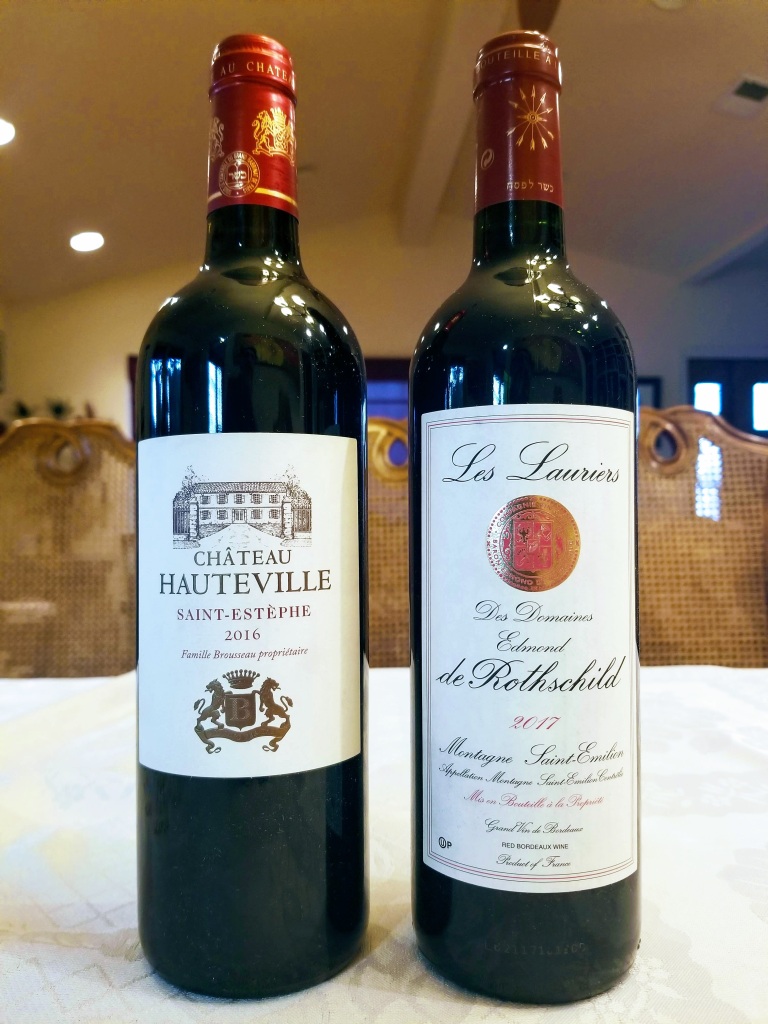
One more reminder, “Simple” white wines is a wine that will not age more than seven or so years. So, please no hate mail! There are many WINNERS here, enjoy! I also threw in a few roses with one WINNER, but it is a 2019 Rose, and 2020 roses are about to be released, so drink up those 2019 roses already. I also tasted a few reds, with the 2017 Les Lauriers de Rothschild getting a slightly higher score.
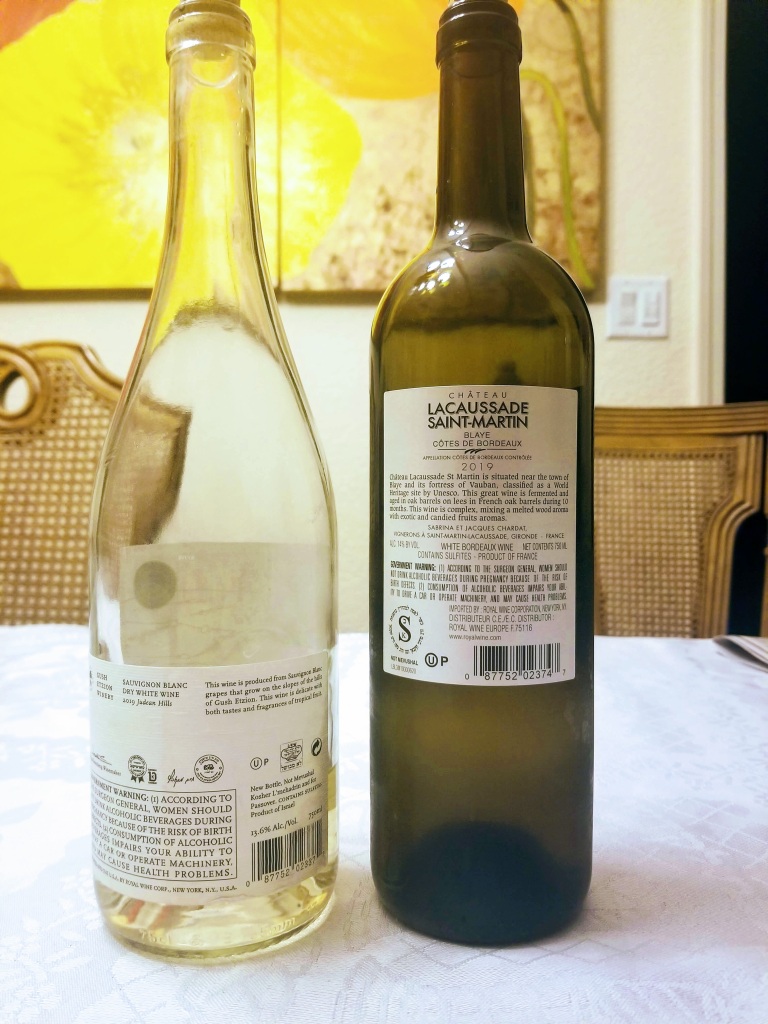
The clear WINNER of this tasting is the 2019 Chateau Lacaussade, Vieilles Vignes, Saint-Martin. That along with the 2018 Koenig Riesling, which I like more now than I did a year ago. Also, the 2017 Les Lauriers de Rothschild. The 2017 Les Lauriers de Rothschild, Montagne Saint-Emilion was a winner in my previous post, I just slightly raised the score on it.
The wine note follows below – the explanation of my “scores” can be found here and the explanation for QPR scores can be found here:




ROSE Wines (DRINK them now – if you must)
2019 Rubis Roc Rose – Score: 91 (QPR: WINNER)
This wine is a blend of 50% Cinsault and 50% Cabernet Sauvignon. This is a weighty and food-required style rose than a refreshing rose. The nose of this wine is fresh and alive, with meaty notes, showing red and blue fruit notes, with nice citrus, with good attack and herbs. The mouth on this medium-bodied wine is solid, a drop less acid than I would like, but still very good with hot peppers, green notes, blue fruit, raspberry, dried lime/lemon, with mineral, and nice spice. The finish is long, green, and enjoyable, with good structure and nice minerality, nice! Drink now. (tasted Oct 2020)
2019 Yaacov Oryah Pretty as the Moon Rose– Score: 89+ (QPR: POOR)
This rose is a blend of 45% Syrah, 40% Grenache, and 15% Petite Sirah. The nose on this wine is divine – a lovely nose of floral violet, loads of rosehip, followed by a bit of nice funk, dried and tart cranberry, along with loads of mineral, this smells like what I want from a Provence wine, with dried/tart red fruit, a bit of reductive oxidation, and green notes as well. The mouth on this medium-bodied wine is nice but the acidity is where the wine fails, it has acidity, but the wine’s profile, which has nice fruity and refreshing characteristics lacks the punch of bright acidity to bring it all together, still, showing mineral, and lovely red fruit, with tart strawberry, lovely green/tart apple, quince, watermelon, hints of passion fruit, and loads of mineral. The finish is long, complex enough, with slate, graphite, more flowers, and lovely freshness, WOW! Bravo! Drink now! (tasted Oct 2020)

Kosher Mid-Range aging red wines may well be the sweet spot for the kosher wine market – lots of WINNERS.
We are working our way through the QPR 2.1 and 2.0 wine categories and so far, outside of simple white wines, there has not been a lot of love or WINNERS to talk about. However, things start to change with the 2nd red wine category.
These wines are drinkable now but will improve a bit with time. They are not the undrinkable wine category, which will be next, but rather these wines are good now and may garner some of those tertiary notes we all love so much, with a bit of time in the bottle. These kinds of wines are normally more expensive, but this is where the QPR (Quality to Price ratio) sweet spot exists, IMHO.
As explained in my last post, the wine categorization is impacted by what I think the wine will last. Meaning that a poor wine will not be more enjoyable in 5 years if it is a painful date juice now. Nor will the wine be more ageable depending on the price of the wine. The length of time wine can live in the bottle is not scientific in any manner, it is subjective, much like the wine’s score, still, it is based upon this that the wines are judged for their QPR.
Mid-range aging Reds (4 to 11 years) – cellar saviors
As I have stated enough times now, the fact that a wine can “live” for 10 or so years, tells you that the wine is good to start with, or at least professionally made. Still, the next level up, High-end Red wines (11 and more years), come at a much higher price range. Yes, there are sweet spot wines there as well, but there are more here in the mid-range options. Also, these are the wines that will save your cellar. Look, I like wines like the 2019 Chateau Les Riganes, or the 2017 Chateau Mayne Guyon just fine! But when you want something with a bit more polish or elegance and you do not want to raid your high-end wines early, THIS IS the category to go to!
If you want that next level is quality but not the next level in price, per se, this is the category to hit. Here you will find wines like the 2017 Chateau Greysac, Medoc, the 2015 Louis Blanc Crozes-Hermitage, and the 2018 Terra di Seta Chianti Classico, which all scored 92 or higher and are all priced at 30 dollars or lower. While I would say these wines will improve with more time, they can at least be enjoyed now, without robbing the cradle of wine like 2015, 2017, or 2018 Chateau Fourcas Dupre.
On a Facebook post, I and many others were asked over and over about this wine or that wine, wines that were still far too young to be appreciated now. My response was the same over and over, stop opening bottles so early! I opened a bottle of 2007 Four Gates Cabernet Franc, 2 weeks ago, it was an absolute joy but also, a wine that was so young it was truly a crime! STOP opening wines early folks. Let the wines come to you! This wine category is where you will find the richer, more complex options, for a higher price than the Simple reds, but still at a lower price point overall than the higher-end reds. There are 20+ WINNERS here, between USA and France, BUY them and SAVE YOUR CELLAR!!!
Shirah Wines Post
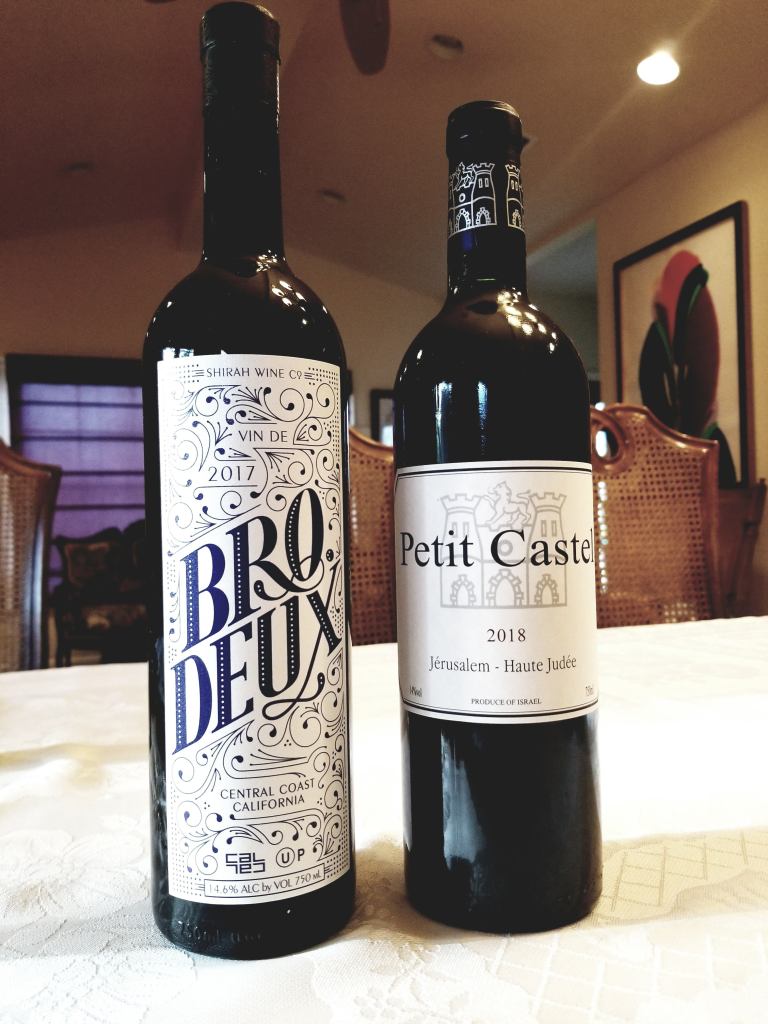
If one takes even a cursory look at this post and the wine notes below, the predominant winery/producer you will find is Shirah Wines. I got all the current wines in May of this year. It took me a bit of time to finally post them. As I stated last year, in my year in review, California had indeed turned its direction towards riper fruit and wines. Shirah contacted me and I bought the current wines to make 100% sure that my notes were in line with my comments, you can make your mind up from the notes.
I will stress THREE points here AGAIN, as I have done over a long time already:
- I crave the 2010 (AKA NV) /2012/2013/2014 Bro.Deux and the 2013 Syrah, and I FONDLY remember the old days of the One-Two Punch. Those were and still are VERY different wines than what is being sold now. I have had all of them recently and still have some bottles. They are wonderful, but they are not what the 2016 or 2017 Bro.Deux is like today.
- I strongly believe in Shirah Wines, I think the wines they produce are professionally made and are perfect for the bigger/flashier/riper palate that is the cornerstone of today’s kosher wine-buying public. They are just not the wines I want.
- Finally, there has been a clear and very big shift in the palate of the wines being made in California, today. Even Four Gates wines are getting riper. The issue here is all about balance. If I feel fruit is overripe and sticking out, to a point where I do not enjoy the wine, but rather think about the ripe fruit, I will move on. I understand this is a subjective way of seeing wine. I get that, and that is what makes wine so fascinating. Like all of art, it is not what is true or false as much as it is what one likes or dislikes.
WINNERS and other demarcations
As stated above, some wines will be winners in France/Europe and others will be WINNERS in the USA. I do not know the pricing in Israel or the wines or really anything about Israel for the last year+. Maybe Avi Davidowitz of Kosher Wine Unfiltered can make a post or two on this subject! HINT HINT!
Also, there are strange prices, distributions, and edge cases throughout Europe, and as such what is a good price in Paris may not be in London. Worse is wine in Belgium may be a better price than in Paris or London. The idea of “Europe” being a single country for commerce is a MASSIVE sham in the kosher wine market, in Europe anyway. In the USA it is equally messy, in regards to pricing throughout the states, L.A.’s wine prices are either non-existent (because there is no wine) or it is sky-high. I have seen better prices for California wines in NYC than in California! Like what now??? So, yeah, pricing is not as crisp, all the time, as I make it out to be here with my QPR posts, but I do the very best I can.
So, WINNER means USA (sorry this is a USA dominant blog), WINNER (F) means a WINNER in France. I will denote as well, in the wine post if the wine is only available in France or Europe, which is the same for me here, as London is the main outlier and it is not part of Europe anymore – sorry London! Enjoy the train!!! On a total aside, I did love taking the train from London to Paris, a few days AFTER they left the union! Moving on now.
So, without too much more delay – let’s get to it! Here is the list of cellar saviors and mid-level red wines. There are many WINNERS for buyers here in the USA and those in France! The wine notes follow below – the explanation of my “scores” can be found here:


2018 Terra di Seta Chianti Classico – Score: 92 to 93 (QPR: WINNER)
This is a fantastic wine, and with my new QPR scoring it is still is not as expensive as the median and its score is also above the median, so it is a GREAT QPR. This is a no brainer GREAT QPR wine and will sell out quickly BUY NOW!
This wine is incredible, it is better than the 2016 vintage and much better than 2017. It is even a bit better than the massively epic 2015 vintage. Bravo Daniella and Maria!!!
The nose on this wine is ripe, but the balance on it is incredible, the fruitiness exists but it hides behind a redolent garden of fresh mushroom, grass, dirt, loam, and lovely earth, with hints of barnyard, forest floor, and dark fruit, with balsamic vinegar, and roasted herbs galore. The mouth on this medium to full-bodied wine is incredible, layered, rich, extracted, and so balanced, with incredible acidity, intense saline, dark sour cherry, coffee, all balanced and plush, with rich blackberry, cherry, strawberry, salami, with lovely mouth draping tannin, with minerality, graphite galore, and a lovely tannin structure. The finish is long, green, and ripe but perfectly balanced, with lovely acidity, roasted coffee, graphite, scarping mineral, loads of smoke, and sweet tobacco on the long finish. Bravo!! Drink until 2027 maybe longer.
2017 Tassi Aqua Bona Toscana Rosso, Bettina Cuvee – Score: 92 (QPR: BAD)
This wine is meant to be bottled under the D.O.C.G. Rosso di Montepulciano, but because of some strange requirements that were not met to meet the body’s requirements it only has the I.G.T. Toscano Rosso moniker.
This wine producer/winery is quite famous in the non-kosher world. The wine is made from 100% Sangiovese.
The nose on this wine starts with a crazy cedar box, followed by a mound of fresh Cuban Cigar tobacco, followed by loads of anise, licorice, smoked meat, followed by black and red fruit, foliage, forest floor, and more sweet cedar/oak. The mouth on this medium-bodied to full-bodied wine is not as extracted as I expected though this wine is richly expressive with loads of smoke, earth, rich tannin, nice green notes from what I can imagine is what I would get from whole-cluster and stems fermentation, with loads of rich spice, heady roasted herbs, and lovely blackberry, dark cherry, rich umami notes of balsamic and mushroom, with loads of mineral, graphite, and rich fruit-structure and focus with lovely elegance and control. The finish is long, rich, layered, and smoky, with nice control, lovely acidity, and smoke, roasted herbs, smoked meats, and soy sauce followed by more cigar smoke, and freshly tilled earth. Nice!!! Drink from 2021 until 2026.

Final take on 2020’s crop of Kosher roses – 2 QPR Winners, but overall not great
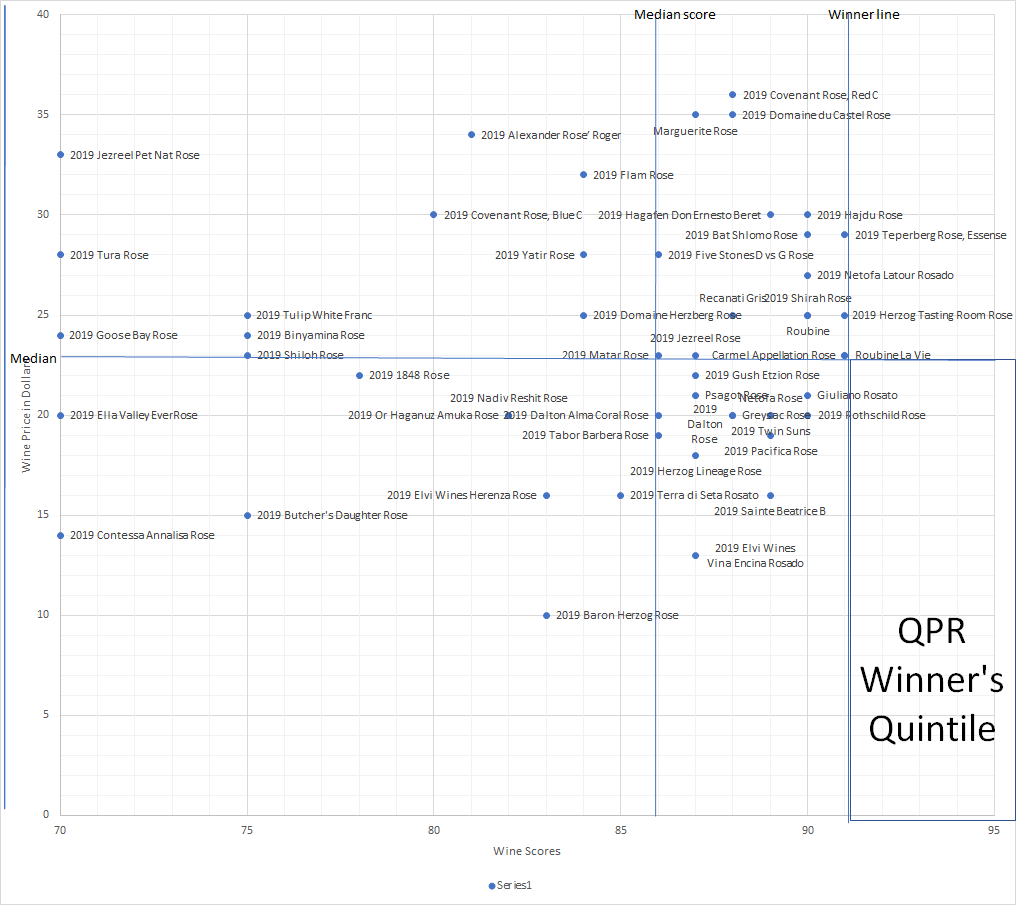
Kosher 2019 Roses charted by price and wine score (QPR)
So, as the image above shows roses are very expensive and the majority of the 28 of the 55 are at or above the median price of 23. This is not new, IMHO, roses overall have not been good or even very interesting this season.
Please read this post for my writeup on rose wines this year. I had a few follow-ups after that, including the one post with the QPR Rose for 2020, but this post will list all the rose wines I have had this year. Also, as I tasted more wines the price of the median went up and that allowed the Roubine La Vie to also become a QPR Winner. Again, the MARKET decides the QPR winners, not me! All I decide is the wine’s subjective quality score, and yes, that is subjective! The rest, the P part of QPR (Quality to Price Ratio) is decided upon by the market. Please read my revised QPR scoring here.
The image does not show the 2 QPR Winners as obvious winners, as the dot that represents the Carmel Rose and the Roubine La Vie Rose is on the top left of the winner box. These wines barely made their way into the Winner’s square, but with such a horrible vintage, rose-wise, 2 is better than NONE.
In regards to rose, look a lot of my friends and I do not agree. Look at the Cantina Giuliano Rosato, it is a VERy nice and classically made Gris style rose, but it has a bit of RS (Residual Sugar) in it, at least to my palate, and I have issues with that. Other wines that have more RS drive me nuts. My friends do not care about RS or ripe notes in rose as long as it is balanced. To me, rose, red, or white, I DO NOT want RS. The funny thing is that Kedel Jackson probably got away with1% RS in his Chardonnays for decades, and made it the classic style for Cali Chard, which brought on the famous ABC movement (Anything But Chardonnay). Which spawned Sauvignon Blanc, Riesling, and so many other great white wines here in California.
So, yes, there are two winners now, and there are a few 91 scored roses, but please look at the chart!! LOL! It is visually clear that the vast majority of the wines are not something I would look to buy. They are either too expensive or not interesting and that is what has gone wrong with the kosher rose market. Again, I have said it a few times, IMHO, the wineries have thrown in the towel and they make rose thinking it will sell, no matter what they release. This will eventually end badly. Only time will tell. Read the rest of this entry

The 2020 Kosher rose season is open and once again I am underwhelmed – part 1
It is not yet summer but here in NorCal, it feels more like summer than spring, and the weather is making shipments really hard at this time of year. Normally, I would have been in Israel by now, one way or the other, and I would have at least had two tastings with the gang. Sadly, with the times we live in now, neither of those wonderful ideas is possible. Sad and strange days we live in. Also, this is round 1, there will be another 15 roses I will get through over the next week or so.
While rose wine in the non-kosher market is exploding – especially Rose wine from Provence; a wine region of France, the kosher market this year will be more subdued. In the past, distributors brought in as much as 60+ kosher rose wines, this year with the issues I brought up in my previous post – there is less of an appetite for all those wines.
QPR and Price
I have been having more discussions around my QPR score with a few people and their contention, which is fair, in that they see wine at a certain price, and they are not going to go above that. So, instead of having a true methodology behind their ideas, they go with what can only be described as a gut feeling. The approaches are either a wine punches above its weight class so it deserves a good QPR score. Or, this other wine has a good score and is less than 40 dollars so that makes it a good QPR wine.
While I appreciate those ideals, they do not work for everyone and they do NOT work for all wine categories. It does NOT work for roses. Look, rose prices are 100% ABSURD – PERIOD! The median rose price has gone up this year and it is around 22 bucks – that is NUTS! Worse, is that the prices are for online places like kosherwine.com or onlinekosherwine.com, with free or good shipping options and great pricing, definitely not retail pricing.
As you will see in the scores below, QPR is all over the place and there will be good QPR scores for wines I would not buy while there are POOR to BAD QPR scores for wines I would think about buying, based upon the scores, but in reality, I would never buy another bottle because the pricing is ABSURDLY high.
Also, remember that the QPR methodology is based upon the 4 quintiles! Meaning, that there is a Median, but there are also quintiles above and below that median. So a wine that is at the top price point is by definition in the upper quintile. The same goes for scores. Each step above and below the median is a point in the system. So a wine that is in the most expensive quintile but is also the best wine of the group gets an EVEN. Remember folks math wins!
Still, many of the wines have a QPR of great and I would not buy them, why? Well, again, QPR is based NOT on quality primarily, it is based upon price. The quality is secondary to the price. So, wines that are drinkable with an 88 or 89 score, though wines that I would not buy, have a low enough price to get a GOOD or GREAT score. Does that mean that I would buy them because they have a GREAT QPR? No, I would not! However, for those that really want roses, then those are solid options.
Please remember, a wine score and the notes are the primary reason why I would buy a wine – PERIOD. The QPR score is there to mediate, secondarily, which of those wines that I wish to buy, are a better value. ONLY, the qualitative score can live on its own, in regards to what I buy. The QPR score defines, within the wine category, which of its peers are better or worse than the wine in question.
Finally, I can, and I have, cut and paste the rest of this post from last year’s rose post and it plays 100% the same as it did last year. Why? Because rose again is horrible. There is almost no Israeli rose, that I have tasted so far, that I would buy – no way! Now, I have not tasted the wines that many think are good in Israel, the Netofa, Vitkin, and Recanati roses. Yes, there is ONE rose I would “buy” by my qualitative scoring approach, which is why I used the word almost above. That wine would be the 2019 Bat Shlomo Rose, but at some 28 or more dollars a bottle, it is highway robbery for that score. Read the rest of this entry

The last round of winners and some more losers for 2019
So, I tasted a bunch of these at the KFWE in Miami and I spent my entire time there tasting through wines that made me cry. I mean they were so painful, all I could write was NO. Some I wrote nice and some I wrote good stuff. Overall, the Israeli wines were undrinkable and so painful that I had to go back to the French table just to clean my palate. It continues to make me sad to see such potential thrown out to meet the absolute lowest common denominator – fruity, loud, and brash wines.
Sadly, Cellar Capcanes continues its downward spiral. The 2018 Capcanes Peraj Petita is not very good at all. Far better than 2017 or 2016, but that is not saying much. So sad, to see such a storied franchise being thrown away for what I can only guess is the need for a new winemaker to make her mark.
Domaine Netofa continues to crush it and thank goodness it is selling well here in the USA, so that means I can stop schlepping Netofa from Israel! The 2015 Chateau Tour Seran was also lovely while the Chateau Rollan de By was OK, while the 2015 Chateau Haut Condissas showed far better than it did in France. The 2018 Pacifica Riesling, Evan’s Collection was nice but it was less of a WOW than the 2017 vintage, at least so far anyway.
At the tasting, the 2017 whites and 2018 roses were all dead, please stop buying them. Heck, even many of the simpler 2018 whites were painful.
So, here are my last notes before the year-end roundup and best of posts that I will hopefully post soon! These wines are a mix of wines I tasted at the KFWE Miami and other wines I tasted over the past month or so since my return from France. I wanted to keep this simple, so the wine notes follow below – the explanation of my “scores” can be found here:


2018 Capcanes Peraj Petita – Score: 87
This wine is a blend of 50% Grenache, 20% Tempranillo, 15% Merlot, and 15% Syrah. This wine is ripe really ripe, with dark blackberry, with loads of dark brooding fruit, floral notes, and herb, and heather. The mouth on this medium-bodied wine is sweet, ripe, and date-like, with dark cherry, sweet candied raspberry, smoke, candied black fruit, and sweet notes galore. The toast, earth, sweet fruit, and smoke finish long. Move on.
2018 Capcanes Peraj Petita – Score: 89 (Mevushal)
This wine is a blend of 50% Grenache, 20% Tempranillo, 15% Merlot, and 15% Syrah. This wine is far better than the not-Mevushal version. This wine is actually showing less ripe, with dark blackberry, with loads of red fruit, floral notes, and herb, and oak. The mouth on this medium-bodied wine is much less sweet, with dark cherry, sweet raspberry, smoke, candied black fruit, with nice tannin, and good acidity. The finish is long, slightly green, smoky, and herbal, with toast and red fruit. Very interesting how the mevushal is less ripe, go figure. Drink now.
2018 Domaine Netofa Latour, White – Score: 92+ (Super QPR)
Wow, what a lovely wine, this wine is 100% Chenin Blanc aged 10 months in oak barrels. The nose on this wine is pure heaven, but it is slow to open, once it does, the wine is lovely with loads of floral notes, yellow flowers, orange blossom, rosehip, and lovely white fruit, pear, peach, and smoke/toast. The mouth on this medium-bodied wine is lovely, with great acidity, clear and present, with layers of sweet and dry fruit, with candied and toasted almonds, hazelnuts, with hay and straw, followed by floral notes, tart melon, lemongrass, citrus galore, yellow apple, quince, baked apple, and dry grass and earth, lovely! The finish is long, dry, tart, and butterscotch-laden, with toast, smoke, ginger, and marzipan, Bravo!! Drink from 2021 until 2025.
2018 Pacifica Riesling, Evan’s Collection – Score: 90 (QPR)
This is a drier wine than the 2017 vintage but it lacks the petrol level and funk of 2017, still a nice wine.The nose on this wine is almost dry, with lovely notes of floral notes and loads of melon, sweet fruits, and stone fruit. The mouth on this medium-bodied wine is nice with lovely pith, hints of saline, with hints of petrol, dry flowers, with lovely peach, guava, and loads of citrus and mineral. The finish is long, dry, with hints of sweet notes, funk, and pith that is fun. Nice. Drink by 2022. Read the rest of this entry

The 2019 Kosher rose season is open but I am underwhelmed at best
It is not yet summer and here in NorCal, it feels more like winter with these strange May storms with thunder and hail. Sorry, but in NorCal, we do not get thunder, it is very strange indeed! Anyway, enough with my meteorologist fanboy moment, the weather was not conducive for my last tasting here in San Jose with a group of folks, but Rose was on the docket so rose it was.
Rose wine in the non-kosher market is exploding – especially Rose wine from Provence; a wine region of France. Sadly, in the kosher wine market – that is not quite the case. I did not stress my previous statement with a suffix of AT ALL, even though I am not allowed to open a bottle of rose on my Shabbos table with guests – why? Well, that is simple – no one will drink it!!
Even worse, is that wine manufacturers may well have jumped the shark! There will be some 60+ kosher roses available in the USA this year! That may not sound like a lot, but when all you had was Herzog White Zinfandel 10 years ago – it is insane. The first high-end rose was Castel’s 2009 rose and that was only 10 years ago. Back then, there were few to no real Rose wine options, other than a handful of Israeli wines and almost no French Rose made it here. Now we will have tons of Rose, and I really think the real question here is will people drink it all?
Also, I want to bring up a topic I rarely talk about – price! Yeah, I hear you, Avi Davidowitz, of KosherWineUnfiltered, please quiet down, gloating does not suit you – (smiley face inserted here). The prices of Rose wines have gotten out of control. QPR (Quality to Price Ratio) has become nonexistent, essentially here in the USA, for the kosher rose market. Finally, I am sorry, but I really feel that wineries were either horribly hampered in some way with the 2018 rose vintage, or honestly, they just threw in the towel, The 2018 vintage is the worst one in the last 10 years. We have hit Peak Rose, we really have. Peak X is when X becomes so default within the construct of our lives, and the quality and quantity of X peaks. Clearly, calling peak kosher rose is a subjective call, but look around. The roses of 2018 feel commodity at best, they feel rushed, no real care, rhyme, or reason. They feel like we have peaked. They are nowhere near 2017, and 2017 was nowhere near 2016, and so on. I am sure next year may be another peak rose, and to be honest, many have called for Peak Oil and Peak TV, so maybe I am just projecting what I see around me, but this year’s crop of roses feel half-hearted pure cash cows, and really without love behind them.
As always, I will be chastised for my opinions, my pronouncements, and I am fine with that. This is wakeup post, there may be ONE or two roses I would buy, but respectfully, given the prices, I would rather buy, the 2018 Covenant Sauvignon Blanc, 2017 O’dwyers Sauvignon Blanc, the 2018 Goose Bay Sauvignon Blanc, and so on. Throw in the 2018 Tabor Sauvignon Blanc and the 2018 Or Haganuz Amuka Blanc Blend, and really who cares about a rose?
I was thinking about going with the title: 2018 kosher roses, thanks, but who cares? Because that is how I feel. This vintage is a massive letdown, prices are too high, quality has hit rock bottom, and overall professionalism, IMHO, has gone along with the quality. Wineries have been getting away with less and less quality for years, raising prices, and this is the worst I have seen in the rose market overall. So, yeah, who cares?
Wine Color
What is rose wine? Well, simply said, a rose is a wine that can best be defined as the wine world’s chameleon. Where white wine is a pretty simple concept – take white grapes, squeeze them, and you get clear to green colored juice. Yes, the white grape juice is clear – well so is red grape juice, but more on that in a bit. Read the rest of this entry

Israeli White and Rose wines along with a few others thrown in
As the weather starts to warm up, it is time to start enjoying the white and rose wines that come from Israel. With that said, there is a lot of buzz recently that 2018 is the new year for white and rose Israeli wines, well I can personally attest that the noise is a red herring and a gross over exaggeration.
Are there a few more wines that work in 2018 than in 2017, 2016, or 2015? Yes, but the 2018 vintage is NOTHING like the epic 2014 vintage for Israeli white and rose wines. Still, I am happy to say that there are a few wines that I have enjoyed and I am posting them here.
I had a large tasting with the Israeli/French/American wine tasting group in Jerusalem, and there were a few winners. I am posting here wines that I tasted with them, along with a few that I have tasted before and after the event. Also, since we had many wines, we did not write long notes for wines I disliked and some wines I liked elsewhere are either missing notes or I cannot find them, but I do my best to describe those as well.
Thanks to Avi Davidowitz of Kosher Wine Unfiltered, and the rest of the French wine group on Facebook for helping with the tasting, and a big shout out to Joel and his company for letting us have the tasting at his office.
Finally, as always! PLEASE only drink 2018 roses and finish them by October 2018 or so. Also, if you wish to read how rose wine is made, please read this post from last year. Same can be said for many of these simple white wines, other than where I give an actual drinking window.
The wine notes follow below – the explanation of my “scores” can be found here:


2018 Tabor Sauvignon Blanc – Score: 90
The nose on this wine is pure gooseberry, slate, mineral, lemon, and cat pee. The mouth on this medium bodied wine is nice, dry, and very good, with floral notes, of orange blossom, and lovely control with good acidity, fruit focus, and lovely passion fruit. The finish is long, green, and slate, with good salinity, and blossom. Nice!
2018 Segal Chardonnay, Wild Fermentation – Score: 80
The nose on this wine is boring and closed, with bits of peach, orange blossom, and not much else. The front and middle of this wine are flat as a crepe, with hints of hay and slate, with a bit of acidity on the end.
2018 Shiran Semillon – Score: NA
The nose is 100% apple juice, and not much else. The mouth is offensive. Candied quince with lemon juice, all over the place and nasty.
2018 Yarden Sauvignon Blanc – Score: 90
This is a nice wine, yay, it is a nice SB, nice gooseberry, passion fruit, and citrus. The mouth on this medium bodied wine is nice, really acidic, well balanced, with good fruit structure, with nice weight and structure, showing peach, hints apricot, and nice hay, and orange blossom, and orange pith, with good structure and balance. Nice! Pith, acidity, salinity, and nice ripe but balanced fruit linger long.
2018 Flam Blanc – Score: 86
The nose on this wine is boring, flat, no life, with hints of orange, blossom, and not much else. The mouth on this wine is pure lemon/lime/orange juice, and not much else, very little complexity, but nice acidity. Nice enough.
2018 Ramat Negev Sauvignon Blanc – Score: 70
This is another bummer wine, big pass. The mouth on this medium bodied wine is acidic quince juice. Boring, move on.
2018 Vitkin Gewurztraminer – Score: 91 to 92
This wine is dry and lovely pineapple, with ripe melon, and green notes and lychee galore, with funk and hints of soap, incredible aromas, white pepper, smoke, flint, and redolence. The mouth on this wine is lovely, with grapefruit, citrus, lovely pith, with apple, pith galore, followed by complexity and bitter notes of melon, yellow Apple, lovely weight, slight tannin, with sweet notes honeysuckle, sweet pineapple, and balance. The finish is long and green and sweet and mineral balanced. Bravo! Drink by 2021. Read the rest of this entry

2019 Bokobsa Sieva Wine tasting just outside of Paris


So, let’s start from the beginning. As I posted here, about the coming wine events of 2019, there were many options for you to get out and taste great wines almost across the globe. Well, recently, as you know well I have been focusing more on Europe, so I was in Paris later last year again to taste the new 2016 Bordeaux, and now I wanted to return to Bokobsa’s tasting, which is not officially part of the KFWE franchise. Avi Davidowitz, of kosher wine unfiltered, did every KFWE this year, Tel Aviv on the 4th of February, London on the 6th of February, and then on to NYC and L.A. I decided that I did not need to go to Sommelier this year and instead just focused on Bokobsa’s tasting which was on the same day as the KFWE Tel Aviv in Israel.
As I return home, Paris and London KFWE, NYC KFWE, and L.A.’s KFWE are in the rearview mirror. I will be posting on them separately, so I start with Bokobsa Paris.
To start the Bokobsa Tasting, from the company known in France as Sieva, happened in Paris (well not exactly Paris, more on the very outskirts of Paris to be exact) on Monday, Feb 4th, on the stunning grounds of the Pavillon des Princes in the 16th district. I arrived early and after taking a bunch of pictures I just relaxed and waited for the event to start. One of the issues from the tasting in past years was the wine glasses, but this year, Bokobsa had lovely glasses to truly appreciate the wines.
The ambiance and space were both far improved from the previous location, which was the basement of the Intercontinental Hotel in Paris. The table layout was far improved, it was truly a lovely event. The food was a bit mediocre, with it being essentially cold food, like Sushi and elegant salads on crackers, though they had warm chicken further along into the event.


The wines and the setting were the clear stars of the event, and with the lovely glasses, the wines did shine. My main issue with that some of the wines were the old and not showing well, which degrades the very purpose of a show/tasting like this. For example, they poured a 2013 Covenant Sauvignon Blanc and a myriad of older roses that were far over the hill and not showing well. Though at the same time, they poured some lovely Covenant Cabernet Sauvignon and Lavan, along with many of the top Royal Wines from France and Spain, and the new Champagne from Rothschild. There were a few older vintages of the French Royal wines that I do not remember now that were out of place, but they were still showing well. Read the rest of this entry

My top 25 kosher wines of 2018 including wine of the year and best wine of the year awards
Like last year, I wanted to make this post short and sweet – so the criteria are simple I could care less about price, color, or where it was made. All that matters is that it is/was available this year sometime to the public at large and that I tasted it in a reliable environment, not just at a tasting, and that it was scored a 93 or higher. Also, there are a few lower scoring wines here because of their uniqueness or really good QPR. I also included some of the best wines I tasted this year – they are at the bottom.
We are returning with the “wine of the year”, and “best wine of the year”. Wine of the year will go to a wine that distinguished itself in ways that are beyond the normal. It needs to be a wine that is easily available, incredible in style and flavor, and it needs to be reasonable in price. It may be the QPR wine of the year or sometimes it will be a wine that so distinguished itself for other reasons. This year, it is one of the QPR Kings of 2018. Yes, last year, we had a single QPR King, this year, there are a few. Why? Because as I will discuss in my year in review, 2018 was about having more solid wines than having GREAT wines. Sure there is a clear Best wine of the year, which is revealed below, but 2018 will be remembered for having MANY very enjoyable wines, rather than a few GREAt wines.
Also, yes, the Wine of the year and the Best wine of the year, both made by Royal wines, such is life, and I could care less for the most part.
Again, the list is missing wines I have yet to taste, like the 2015/2016 Chateau Pape Clement, which I am sure would have been on this list if I had tasted them. There are also interesting wines below the wines of the year, think of them as runner-up wines of the year. There will be no rose wines on the list this year – blame that on the poor crop or rose wines overall, they did not even crack the interesting list. Also, this year, we were given a bounty of top wines and finding the list this year was really a task of removing then adding.
The supreme bounty comes from the fact that Royal released the 2015 and 2016 French Grand Vin wines a bit early! Throw in the incredible number of kosher European wines that are coming to the USA and being sold in Europe and this was truly a year of bounty for European kosher wines.
Now, separately, I love red wines, but white wines – done correctly, are a whole other story! Sadly, in regards to whites, we had no new wines from Germany. Thankfully, we had Domaine Netofa and Yaccov Oryah Wines to come to the rescue. On top of that, we had another EPIC year for 2016 Herzog Chardonnay, Reserve, Russian River. This year, quite deservedly, it cracked the top 25 wines of the year! The new Chablis is also nice, but the winner in the “very close” section has to be the 2016 Koenig Riesling – Bravo guys!
Some of these wines are available in the USA, some only in Europe, and a few only available in Israel.
Finally, some of these wines are hard to find and they may have different siblings – but they are worth the effort. The wine notes follow below – the explanation of my “scores” can be found here:
The 2018 kosher wine of the year – we have a TIE!
This one was a NOT a no-brainer to me this year. It was really hard. I wanted to give it to the 2016 Chateau Larcis Jaumat, Saint-Emilion Grand Cru, straight up, but it is already sold out, between me and Gabriel Geller, we sold that wine out in no time. So, instead, we will share the winner with the almost impossible to find, aforementioned Larcis Jaumat, along with another from Europe, the 2015 Cantina Terra di Seta Chianti Classico, which is also QPR superstar as well! Congratulations to Cantina Terra di Seta and Royal Wines, and to Chateau Larcis Jaumat, along with an elevated nod of the chapeau to Menahem Israelievitch for finding and curating this wonderful QPR winery tucked into a corner of Saint-Emilion! Bravo!
2016 Chateau Larcis Jaumat, Saint-Emilion Grand Cru – Score: 92 (Crazy QPR)
This wine starts off open and then closes so tight like an oil drum, this thing is nuts. The wine is made of 90% Merlot and 10% Cabernet Franc, a classic right bank wine from Saint-Emilion. The nose on this wine is really bright, ripe, and intense, with rich intensity, mushroom, earth, but so much redolence, the nose is far more open than the mouth, showing rich blackberry, dark plum, and rich vanilla, followed by herb, mint, rosemary, and green notes galore. The mouth on this medium to full-bodied wine is crazy rich, it does at times remind me of Benyo’s Merlots with a fair amount of blackcurrant thrown in, which is never found on Benyo wines, but the mad acid, rich mouthfeel, closed tight fruit structure has me reminded often of a Four Gates wine, with intense notes, they scream because of the acid, that gives way to rich tannin structure that is searing and yet inviting, with rich cranberry, cherry, and crazy earth, that will give way to mushroom and forest floor with time. The finish is long, really long, lingering, and intense, with gripping tannin, acid, tobacco galore, mounds of blackcurrant, vanilla, herb, foliage, and green notes, that give way to a gripping mouthfeel that will crush anything, with tar, menthol, and more earth. OMG, this Benyo in France! Wow!! Drink from 2021 to 2030.
2015 Terra di Seta Chianti Classico – Score: 92
The nose on this wine is ripe, at first, the wine starts off with heat, but that blows off, but it is also well balanced, with lovely earth, mineral, dirt, with dark cherry, coffee, and lovely dark fruit. The mouth on this medium to full-bodied wine is beautiful, complex, well layered, with rich concentration, nice extraction, all balanced and plush, with rich blackberry, currant, lovely mouth draping tannin, with lovely foliage, and some nice earthy and fruit bite. With time, it shows its ripeness, but also intense minerality, saline, graphite galore, and lovely tannin structure. The finish is long, green, and ripe but balanced, with lovely acid, great texture, that gives way to more coffee, graphite, scarping mineral, and light almond bitterness on the long finish. Bravo!! Drink 2019 to 2023.
The 2018 best kosher wine of the year!
This one was really tough. First of all, the one I chose is not available yet for purchase in the USA. Also, in terms of score, it did not beat out the 2016 Chateau Giscours, 2016 Chateau Lascombes, 2016 Chateau Du Tertre, Margaux, 2016 Chateau Montviel, or 2014 Chateau Tour Seran, Medoc (NOT Mevushal), or the 2014 Chateau Cantenac Brown, which I somehow missed from last year’s top wines. In the end – for its sheer awesomeness it beat out a very crowded field. In the end, the winner of the BEST kosher wine of 2018 goes to the 2016 Chateau Malartic, and it deserves the crown – bravo!!
2016 Chateau Malartic Lagraviere, Pessac-Leognan, Grand Cru Classe – Score: 94
The 2016 Malartic-Lagraviere is a blend of 53% Cabernet Sauvignon, 40% Merlot, 4% Cabernet Franc and 3% Petit Verdot (at least in the non-kosher version). Wow, the nose is really ripe, not what I expect from a Malartic, but still lovely, with chocolate, black fruit, earth, and lovely hints of umami, with sweet oak, earth, and sweet blue fruit. The mouth on this full bodied wine is rich, layered, and concentrated with nice control, expressive, with blackberry, blueberry, and what a change, Malartic with blueberry! Showing more raspberry, earth, and rich fruit, with a truly incredible plushness, that gives way to a rich mouth coating tannin that drapes and lifts the mouth, showing a precision, and an incredible professional touch, with plush fruit, loam, and lovely saline. The finish is long, and plush, with more blue, green, and red fruit, with leather, and power that belies its youth, a wine that will push long into its life, with tannin, licorice, and graphite/mineral that lingers long, Bravo!! Drink from 2025 until 2035. Read the rest of this entry

The 2018 Kosher rose season is open – part 3
Well, after the first post I stated that I would be doing this rose wine post a few times. The subsequent posts would have the original content, and the newly revised or added rose wines as well. Well, this is part 3, and I hope this is the last one! My schedule was insane, but it is now slowing down, thankfully, so I hope to be adding more posts as well!
It is still officially Summer, which means it is Rose time! Rose wine in the non-kosher market is exploding – especially Rose wine from Provence; a wine region of France. Sadly, in the kosher wine market – that is not quite the case. I did not stress my previous statement with a suffix of AT ALL, even though I am not allowed to open a bottle of rose on my Shabbos table with guests – why? Well, that is simple – no one will drink it!!
Even worse, is that wine manufacturers may well have jumped the shark! There will be some 50 dry-ish kosher roses available in the USA this year! That may not sound like a lot, but when all you had was Herzog White Zinfandel 10 years ago – it is insane. The first high-end rose was Castel’s 2009 rose and that was only 9 years ago. Back then, there were few to no real Rose wine options, other than a handful of Israeli wines and almost no French Rose made it here. Now we will have tons of Rose, and I really think the real question here is will people drink it all?
Wine Color
What is a rose wine? Well, simply said, a rose is a wine that can best be defined as the wine world’s chameleon. Where white wine is a pretty simple concept – take white grapes, squeeze them, and you get clear to green colored juice. Yes, the white grape juice is clear – well so is red grape juice, but more on that in a bit.
White wine is not about color – almost all color in a white wine comes from some oak influence of some sort. So, an unoaked Sauvignon Blanc or Pinot Gris can sometimes look almost clear, depending on the region and how the wine was handled. Now oaked Chardonnay, of course, is what most people use as an example of a dark white wine. As the Wine Folly linked above states, different wine regions oak their Chardonnay differently and as such, they are sold with different hues from the start. With age, the wine changes color and the light gold moves to darker gold shades.
The only real exception to the stated rule above – that white grape juice without the influence of oak is somewhere in the clear to green color spectrum, is – orange wines. We have spoken about orange wines – mostly thanks to Yaacov Oryah. Outside of Yaacov’s work there really is no orange wine in the kosher world to speak about. Orange wine is made exactly like red wine, which means that the clear grape juice is left to sit on the yellowish to dark yellow grape skins (depending upon what varietal is used to make the orange wine).
Red wine juice – straight from the grape comes out the same color as white grapes. You see the juice from grapes is mostly clear to greenish in color. The red wine color comes from macerating the juice on the grape skins. The longer the juice sits on the grape skins (wine must) the redder in color the wine becomes until it reaches its maximum red color potential.
The only real exception to the rule of a grape’s juice color is the Teinturier varieties. The grapes are called Teinturier, a French language term meaning to dye or stain. The list of grapes whose juice is actually red colored is long – but the list of kosher wine options that is a wine made from these grapes – is the Herzog Alicante Bouschet. The Gamay de Bouze is not a normal Gamay grape, it is one of those grape mutations that are very red in nature. Read the rest of this entry

 Wine Musings Blog