Blog Archives

California Dreamin’ about more 2021, 2022, 2023, and 2024 vintages and a Herzog Event
The last large post on California wines was at the beginning of 2025. Then life took over, and I have been dribbling posts out. It was time to get the next big California post out! This will not be a retrospective, like I did here. This will be more like the 2024 post I did here, covering the California wines I have recently enjoyed.
It has been a long time since my last post, and I am a good 100 wines behind, at this point, so these next few posts will be short and to the point.
In September, I got into my car and drove to Hagafen Winery. Covenant Winery sent me their samples. There are no new wines from Marciano Estates or Shadybrook Estates. I also had many wines shipped to me from Herzog and Shirah. I also went down to a large event at Herzog Wine Cellars and tasted all their new wines, more on that below. So, this is not as full a tasting of California wines as last time, but very close. This is NOT a list of available wines and scores for each of these wineries’ wines, but rather a set of tastings of what I have not yet had from these wineries. I have two Invei wines, too!
The plan here is to list the wineries and their wines in the order I tasted them (since I did taste some wines more than once). As I stated before, Covenant continues to impress, as does Shirah, recently, with some of their new wines, which are pretty remarkable!
Many thanks to each and every winery here for putting up with me and sharing their excellent wines.
My overall feelings about the California 2021, 2022, 2023, and 2024 vintages
Let us start with the facts: the 2021 vintage for California was the best I can remember. Yes, better than 2012 or 2014, and all around, everyone, and every winery came out with fantastic wines. Why? Because God gave each winery enough time to not screw it up, and even when they wanted to screw it up, he made sure they could not! DONE! Look, God gave them a raw deal in 2020, across the state – and we all know it! So, in 2021, he made up for it in spades (whatever that means)!
The 2021 vintage stood out in BOTH the Mevushal and non-Mevushal wine categories. For white and red wines. It was a shockingly good season all around, and everyone came out smelling like roses!
Fast forward to 2022, and yeah, things were quite different! The wines are classic Cali ripe, and while that works for some, I prefer my wines balanced and focused.
The 2023 vintage is looking good, but the REAL focus here is on the non-Mevushal wines! The Mevushal wines are showing success, but side-by-side with their non-Mevushal counterparts, they are paling in comparison. Add to that, scale and winery focus, and I am finding some REAL steals in 2023 and 2024! Read the notes, but focus primarily on the non-Mevushal wines in 2023, IMHO!
The 2024 vintage is a bit early to call. So far, I have found the white wines lovely, and some of the reds have exceeded my expectations. The vintage was smoking hot; I live here, so I would know. However, some wineries managed this by picking earlier, using water in the vineyards or in the wine, or improving canopy management. The intense heat waves came at the end of the very hot summer, but there were some cooler times in between. In the end, time will tell, but what I have enjoyed so far, and posted here, shows promise!
Read the rest of this entry
The Best and Top 20 Kosher Mevushal wines of 2024
If you have ever wondered what Kosher wine or the Mevushal process is, I made a post these many years ago and nothing has changed about those facts, because Kosher wine is Kosher wine! The Mevushal process has evolved a bit over the years, but the premise is still the same, and the best craftsman in this space are Hagafen Cellars and Herzog Wine Cellars.
Royal Wine Europe does a good job as well, though from time to time, the white wines do not show as well after they go through the Mevushal process. The red wines are indeed done very well.
The whole premise for Mevushal wine is really a U.S. concept. Europe and much of Israel do not care for or need the wine to be Mevushal to serve at restaurants or events. The USA Rabbinic leaders think that there are too many issues and potential concerns at events and restaurants – given the vast number of servers being non-Jewish. As such, they demand Mevushal wines be served at the events. I have been to events where the pourers were all Shomer Shabbat Jews and that is what they do in Europe and Israel, but those are far and few between, here in the USA.
Overall, the 20 Mevushal wines scored higher than my previous post of 2023 options. These top Mevushal wines scored between 92 and 93! The vast majority of these wines come from the Mevushal leader, Herzog, and Hagafen, from the 2021 and 2023 California vintages. This year we have more quality Mevushal wines and we can mainly thank Cali for that!
Last year we introduced the 2021 Covenant Cabernet Sauvignon, Black Label. This year we have its third iteration with the 2023 Covenant Cabernet Sauvignon, Black Label. Not only is it the Mevushal Wine of the Year but it is also a darn good cup of wine! Bravo!
Mevushal – done incorrectly absolutely does cause damage to wine, and I have had many a “cooked” Mevushal wine. However, Herzog and Hagafen do not have these issues. Royal Europe does a good job, but not as well as the previously mentioned wineries. The Covenant Mevushal Cabernet Sauvignon and the Pinot Noir (started in 2023) can be added to that growing list of trustworthy Mevushal Wine Producers.
Also, we do not have examples of Mevushal wines that scored 95 points, again, this is not a cause and effect but rather the issue that people do not yet have Mevushal Pontet-Canet! Mind you, as I stated before, it is not from a lack of desire, on behalf of Royal Wines, they would boil anything to be able to sell more Mevushal wines. Still, so far, of the top wines that I have scored, the highest-scored Mevushal wine is now the 2021 Herzog Cabernet Sauvignon, Alexander Valley, Special Reserve. Besides that bottle, we now have Covenant and the 2022 Royal French wines. Time will tell if we ever get a Mevushal wine with that kind of quality.
More and more wines are Mevushal to meet the needs of restaurants and caterers that want high-end Mevushal wines for their venues and events. The theme of the wines here is mostly Hagafen or Herzog with some smattering of European names as well.
Here is my list of the top 20 Mevushal wines that are available here in the USA. They are listed by score and after that in no particular order. The wine notes follow below – the explanation of my “scores” can be found here and the explanation for QPR scores can be found here:
2023 Covenant Cabernet Sauvignon, Black Label, Sonoma County, CA (M) – Score: 93 (QPR: WINNER)
WOW! This is the third Mevushal (Black Label) Covenant Cabernet Sauvignon, and it is lovely! I am also getting used to the amalgamated corks, and I am happy.
The nose of this wine is lovely, controlled, ripe, California, creamy, and rich. It shows iron shaving, minerality, rich smoke, tar, anise, black pepper, ripe black and red fruit, lovely pop, and dirt. Bravo. This is the best Mevushal one so far.
The mouth of this full-bodied wine is lovely, showing great acidity, nice mouthfeel, creamy and rich, but with good pop, blackberry, plum, cassis, beautiful minerality, graphite, nice smoke, mouth-draping tannin, rich and layered. This is an impressive showing for a Mevushal wine, showing power, plush mouthfeel, finesse, almost elegant (though with all this power it is tough), some sweet oak, but it is not in your face, and nice dirt. Bravo!
The finish is long, dirty, ripe, balanced, with sweet tobacco, milk chocolate, graphite, and lovely tannin/acidity. Bravo!!! Drink until 2034. (tasted January 2025) (in San Jose, CA) (ABV = 14.8%)

Herzog Winery Visit and KFWE VIP Experience 2024 – another successful event
Six-plus months ago, Kosher Wine had its start to the wine-tasting season, for 2024. First, it was a trade-only KFWE (Kosher Food and Wine Festival in New Jersey), then the Jewish Link Grand Wine Tasting (also in New Jersey), and then A Wine & Food Night by KWD, in Brooklyn. I wrote about the three-day extravaganza here in this post. In the long post, I wrote that I thought it was time to move from the public-laden KFWE Kiddush to the more nimble area-based tastings. The scale of the three tastings, even the KFWE-trade tasting was far more in line with what people needed to taste and be educated. Still, there was no public option for Royal wines, but actually, the two tastings were better for Royal than KFWE could ever be. The point of the area-focused tastings was to make sure that the people who live in those areas are represented by what they may wish to taste. I hope that in the coming years, the wine stores will be allowed to weigh in on what wines should be showcased at these area-specific events, from massive portfolio distributors, like Royal.
In the post, I wrote that the ball was now in Herzog Winery’s court to bring back the IFWF of old. The vast majority of the people at the KFWE VIP Experience 2024 event at the Herzog Winery in Oxnard, this past week, came and left experiencing EXACTLY what I hoped for 6+ months ago. Herzog did exactly what it was supposed to do, it highlighted the quality of their wines and the quality of their restaurant, and it allowed Royal to curate the wines it wanted to promote to the folks in Southern Califonia, whether that was actually implemented or not.
I will say, that I hope Herzog Winery continues this idea, having a more intimate interaction/experience for their customers, by hosting the event at the winery. It showcases what they do/have best. The naming (AKA KFWE) I think is a mistake. The point here is that it was NOT a KFWE, it was a Wine and Tierra Sur Tasting at Herzog Wine Cellars, with a smattering of other wines. That overall approach used to be called IFWF (International Food and Wine Festival). However, that was also a misnomer, as the focus was more on Herzog and some French wines, even in 2008. In the end, trying to sell this event as anything more than Herzog and Tierra Sur undermines what Herzog sells. With that said, no one left there unhappy, to me, and from whom I spoke at the event, it was a hit and it should be continued!
Herzog Wine Tasting
A few hours before the KFWE event took place, Elchonon Hellinger, owner of Elk Wines, and I made our way to Herzog Wine Cellars to taste some Herzog wines I had yet to taste. Before Elk arrived I was speaking with Joseph Herzog (Vice President and Partner) and David Galzignato (Director of Winemaking and Operations) about many a thing and the California 2021 vintage came up. Up until this tasting, I had tasted all of the 2021 wines that were released, except for a few. With all of them, I was highly impressed and posted about them a few times, here, here, and here. The wines before me, other than a few 2021 wines, were all from the 2022 vintage. I can tell you now, the 2022 vintage does not show as well as the 2021. Simple. It is riper, less controlled, and feels like one that may not age as well. That said, at the end of the wine tasting I made this statement, the work you have done over these past two years clearly shows that you have raised the floor for Herzog Wine Cellars. The issue I have is that fewer wines push the ceiling, at least these past two years, than in previous years. I am sure that has a lot to do with the viticulture and the direction of the winery, as a whole, and I think that overall it is a win.
With that said Herzog Winery continues to win as the top Mevushal wine option every year. They also do very well with the QPR (Quality to Price Ratio) Wines. I expect them to be on those lists every year, Herzog Wine Cellars excel at the Mevushal Process and they excel at making quality wines for a reasonable price, across their portfolio, and with the work of David and his team, they have raised the floor of those wines over the past two years.
The Yesod Wines, a new wine label, does not show the name Herzog anywhere on them. It is their first foray into making some of the best wines in the world. While tasting them I said that while I feel the work in these wines, the clear effort to raise the floor of the overall wine approach, it lacked the pop for me. The best wines in the kosher world, when you smell them, make you salivate, they make you want to taste more, and the alcohol levels on them allow you to do that without feeling off-kilter. The Yesod wines, in my opinion, are well-made wines for the sort of Kosher wine drinkers that are targeting. Classic Napa wines with a big body, enough acidity, and loads of fruit.
The wines I oohed and aahed about were the 2023 Herzog Chenin Blanc, Clarksburg Reserve (mevushal), and the 2022 Herzog Cabernet Sauvignon, Napa Valley, Special Reserve. Why? Because, in the past, these two wines (Herzog white wines in general) and the Napa Blue Label Special Reserve Cabernet Sauvignon, were rarely on point. These two wines showed me the biggest change, the raising of the floor, and the focus, overall. A steady-eddy approach to winemaking, which may not garner you as many ceiling-pushing wines, at the start, but an approach that raises everything and one that I am sure will eventually get Herzog to even further heights.
My many thanks to Joseph Herzog, and David Galzignato for setting up the meeting, sharing your wines with us, and taking time out of your busy schedule (the day of the event!) to meet with us. The wine notes follow below in the order they were tasted – the explanation of my “scores” can be found here and the explanation for QPR scores can be found here:
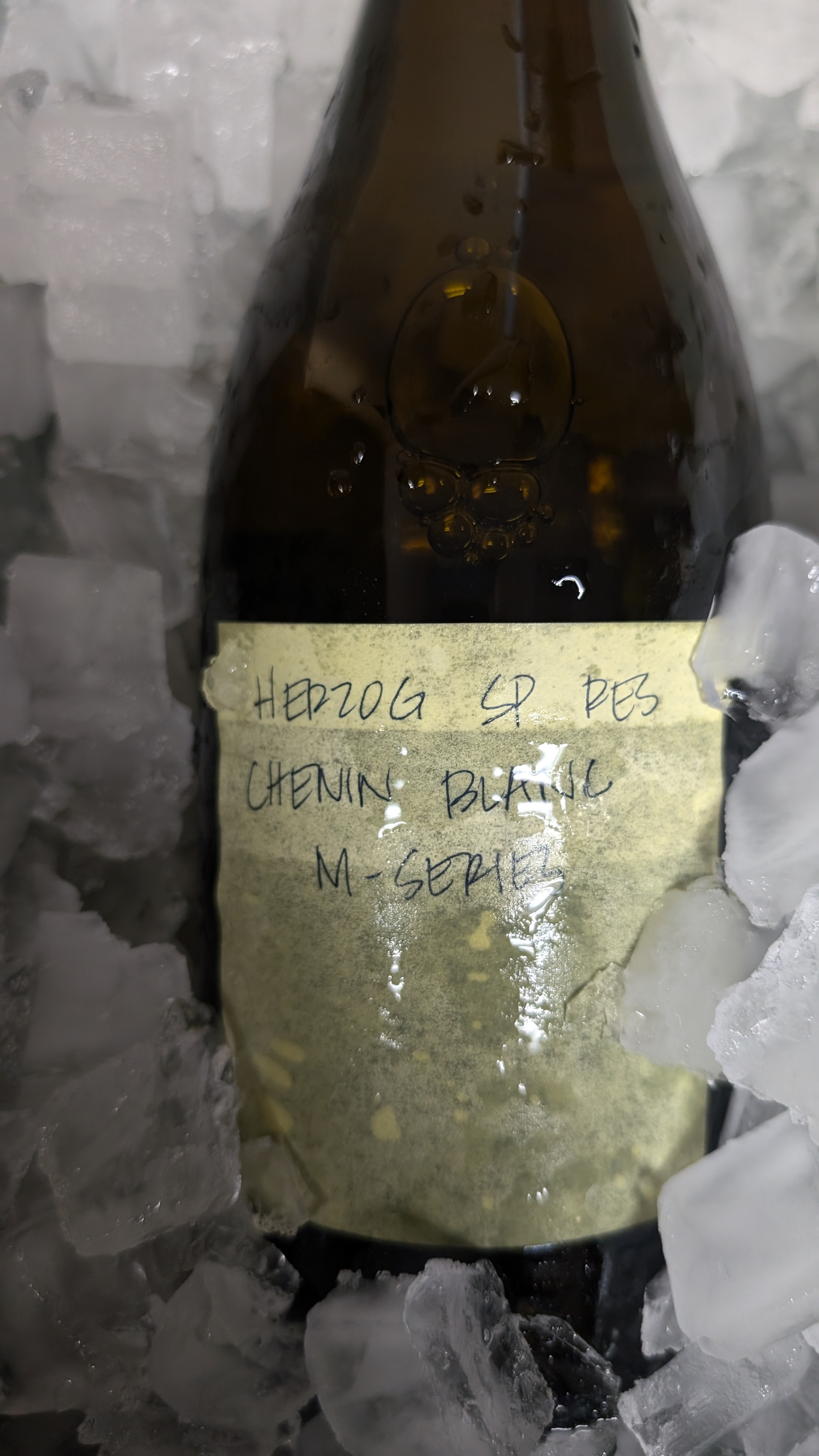
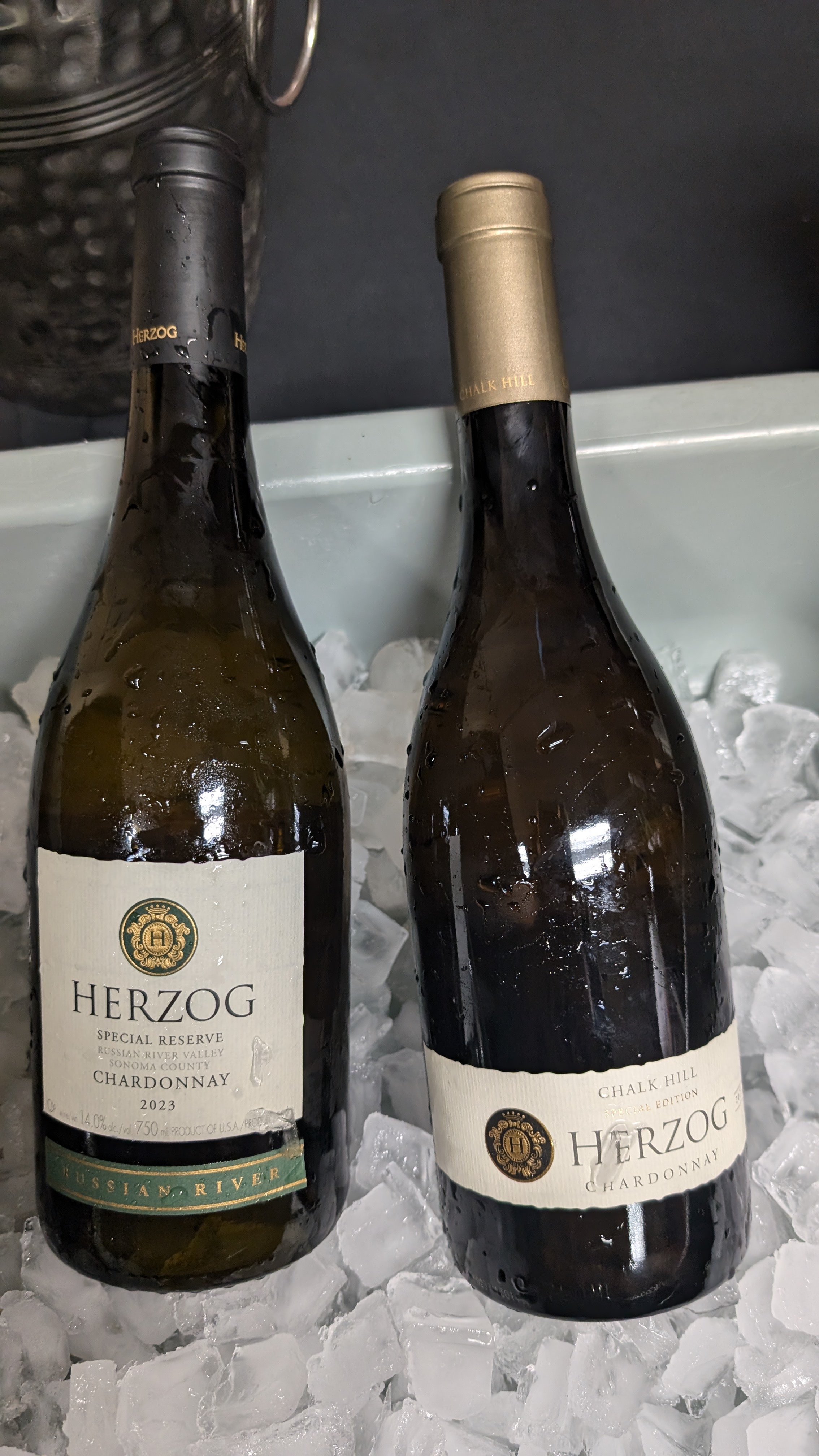
2023 Herzog Chenin Blanc, Clarksburg Reserve, Clarksburg, CA (M) – Score: 92 (QPR: WINNER)
The fruit had botrytis, modeled after Savennieres, old vines Chenin Blanc. The nose of this wine is lovely, showing white peach, pear, apricot, quince blossom, rich honeysuckle, pear blossom, sweet Lipton lemon tea, and sweet oak. The mouth of this medium-plus-bodied wine is fun, it is bone dry, showing great acidity, lovely mouthfeel, almost oily, with a lovely plush mouthfeel, starting with Lipton tea, honeysuckle, honeyed melon, pear, white peach, lovely mouthfeel, a true joy! The finish is long, tart, funky, and rich, with green notes, floral notes abound, and bone dry and rich sweet oak. Drink by 2028. (tasted September 2024) (in Oxnard, CA) (ABV = 14.50%)
2023 Herzog Chardonnay, Russian River, Russian River, CA (M) – Score: 92 (QPR: WINNER)
The nose of this wine is lovely, tropical, fruity, smoky, and ripe, with hickory, sweet vanilla, butterscotch, sweet dill, and peach/pear. The mouth of this medium-bodied wine is ripe, and balanced, with lovely acidity, with rich pear, apricot, sweet oak, butterscotch, buttery brioche, and sweet dill, with rich sweet fruit that works with the American Oak. The finish is long, ripe, and a bit candied, but balanced with great acidity, smoke, rich vanilla, hints of banana, and oak. Drink by 2028 (tasted September 2024) (in Oxnard, CA) (ABV = 14%)
2023 Herzog Chardonnay, Chalk Hill, Special Edition, Chalk Hill, CA (M) – Score: 92 (QPR: WINNER)
The nose of this wine is nice with great bright fruit, lovely tart peach, pear, melon, and great sweet oak. The mouth of this medium-plus-bodied wine is lovely, tart, and balanced, with rich acidity, nice smoke, and good weight, showing pear, peach, melon, and hints of tropical, but balanced, and nice focus with good oak. The finish is long, and tart, with no butter here, great wine, more Chablis than Burg in style. Nice! Drink by 2028 (tasted September 2024) (in Oxnard, CA) (ABV = 14.50%)

The Top and Best 28 QPR Kosher Wine WINNERS of 2023
In May 2020 I wanted to drive home the need for QPR (Quality to Price Ratio) wines. So I set out to create what I thought a QPR metric should be! Gone were arbitrary price ranges and such. Instead, I let the market define what the QPR price range should be. I did this by grouping the wines by their type (white, red, rose, sparkling, and dessert) and then further refined the grouping by age-ability within the white and red wines. This gave me the following groups:
- Drink “soon” White Wine (Simple whites)
- Rose Wine (always drink soon)
- Drink “soon” Red Wine (Simple reds)
- Mid-range aging Reds (4 to 11 years)
- High-end Red wines (11 and more years)
- High-end White wines (7 and more years)
- Sparkling Wine (No need here for extra differentiation)
- Dessert Wine
I then made the mistake of trying to create an Orange wine range/group – that was a HUGE mistake. Again, the wines themselves were not the issue, the issue revolved around trying to group such a small sample set into its group. They will go into their respective white wine category, next year.
Throughout the year, I posted many QPR posts, for almost all of the main categories. I will continue down this road until I find a better way to categorize and track wines that are QPR WINNERS. Talk about WINNERS, that secondary QPR score was a 2.1 revision to my QPR scoring, and that is explained in this post. All the wines listed here are QPR WINNERS from my tastings in 2023.
Let us discuss the approach
I have heard from a few of you. I do not understand your QPR (Quality to Price Ratio) scoring. So, let us take another shot at this! Every time a customer comes into a shop or goes online to buy kosher wine they have a choice of a few thousand wines, online, or many hundreds in a store. The question is how does a buyer differentiate one wine from the next?
If they like Terra di Seta wines, as I do, and it costs 30 dollars then he/she will compare other wines to that wine, in regards to the wine and the price. That is the same for any wine they like and any wine they are looking at buying. Price matters! Now, the real question is how can you compare two wines to each other. Any two wines in the world of kosher wines? What characteristics can you use to compare them?
Let us say they like the 2018 Elvi Wines Clos Mesorah, the 2022 wine of the year (AKA best-priced QPR wine). It is a red wine from Montsant, Spain. OK, what other wine can you compare with it? You can compare other Montsant kosher wines, like the Cellar Capcanes wines. However, the Cellar Capcanes wines have an issue – they have been poor for many years! As the ratio states it is QUALITY to price! Quality is primary; once you have a good wine, you can attempt to compare it with similarly good wines.
OK, so we need equal or comparably equal quality and that is it??? So, let us say there exists a rose from Montsant that scores the same quality score as Clos Mesorah are they comparable? What about a white wine – same? Can/should compare them? I will tell you that no one would act in such a manner. People will compare similar items. OK, so are we then forced to compare Montsant wines with Montsant wines – again I will tell you no! People will compare like-scored red wines with like-scored red wines. Further, there are literally SIX Monstant Kosher red wines on the market. How can one compare six wines to each other? It has no value.
OK, but what is “like” – that is the body of work that my QPR approach works to answer. If you agree that people will attempt to compare items that are similar in nature but not locale, region, or price, what is that characteristic that they will use to compare two arbitrary kosher wines? Price IS NOT the answer.
So, let us recap – we have two similarly scored wines (AKA quality) but they are very different in many ways. Let us look at three of the wines below, two of which are from the greater Medoc region:
- 2020 Chateau Clarke, Baron Edmond de Rothschild, Listrac-Medoc – Score: 92.5 (QPR: WINNER)
Drink from 2025 until 2032. - 2020 Chateau Fourcas Dupre, Listrac – Medoc – Score: 92.5 (QPR: WINNER)
Drink from 2024 until 2035. - 2019 Chateau Royaumont, Lalande de Pomerol – Score: 92.5 (QPR: WINNER)
Drink from 2024 until 2032.
These wines priced were between 38 dollars to 55 dollars. The question you need to ask is are they comparable? I would state they are and I would further state that wine buyers compare them every time they read my lists and other lists that like these wines. Again, the primary requirement is quality – and these all scored the same quality score.
So, next, would you at least compare two Listrac-Medoc wines to each other? The Chateau Fourcas Dupre and the Chateau Clarke? I would say yes for sure. Well, why is the Royaumont any different? They are very different wines, of course, but in the end, what do oenophiles buy such wines for?? To store them and share them at a later date, meaning that wine buyers classify wines by regions but ultimately they classify them by their ability to age gracefully or not! This means some wines age beautifully and many are good to enjoy in the coming years.
So, now you see the logic to the categories I use to compare wines – this is the list once again:
- Drink “soon” White Wine (Simple whites)
- Rose Wine (always drink soon)
- Drink “soon” Red Wine (Simple reds)
- Mid-range aging Reds (4 to 11 years)
- High-end Red wines (11 and more years)
- High-end White wines (7 and more years)
- Sparkling Wine (No need here for extra differentiation)
- Dessert Wine
Essentially, ignoring sparkling, rose, and dessert wines, there is white wine and red wine. Each of those two major categories is broken into their age-ability. Red wines have three age ranges while white wine has two. Then there are the other three aforementioned groups, rose, sparkling, and dessert wines.
Once you have scored a wine – IRRELEVANT to the price – this is KEY you are then required to place that wine into one of the 8 categories listed above. Once you have done that any wine in that category is available for comparison. Using the median approach wines are stacked and ranked by their price, within that category, and some rise above others, by having an equal or better quality for a lower or equal price. Please read more about this here and here.
The Summary
Before we get to the list of the best QPR wines for this past year – I wanted to give some raw stats. I tasted more than 1200 wines this past year. In actuality, it is probably far more, I just did NOT care to write notes on hundreds more because all it would have said was NO. I made sure to taste all the Israeli wines at three KFWE and almost none of them were worthy of a wine note. The pain was all I remember. In the end, of the actual number of wines I noted, 155 of them were scored with a QPR score of WINNER.
I have stated it over and over again now, there is no way we can buy all the good wines out there unless you have a local warehouse to store them and you drink two or more bottles a day. That is the great news about Kosher Wine today! I hope we have not yet hit peak QPR Winner. Remember, this INCLUDES the 2021 Bordeaux season which was a total failure on all accounts.
This year, the list came to a total of 28 names, and none had to dip below 93 in the scores, which is a large number and better scores overall than last year, but again, the pool from where they are culled continues to grow, and the diamonds in the rough are getting harder and harder to find. There are 28 or so QPR WINNER who scored 93 this year but not in a single area.
The 4 regions that encompass the 28 WINNERS are in order of size, France (11), USA (9), Italy (5), and Spain (3). Within France, it is not all Bordeaux! You have 6 from Bordeaux, Sancerre, Alcase, Burgundy, Languedoc, and Chateauneuf du Pape.
Of the 28 WINNER, 5 of them are white and 23 are red. However, at the lower price and quality QPR WINNERS (think 20 dollars 91 scoring wines), you will find that white wines are the majority!
This year there are no cross-WINNER scores. Meaning, a WINNER in Europe but not the USA. Many of the wines that are WINNER are not available in Europe, but I do not denote that.
Sadly, there were no new Sparkling or Rose wines to make it to the score of 93 and to meet its counterpart pricing. To me this is a HUGE issue in the kosher wine market! The kosher wine market has lifted up one of the previous sad wine categories, white wine! Which is HUGE! Sadly, we have not moved from there. We have a dominating red and white kosher wine scene. What is lacking sorely, is quality, sparkling wines! The rose wines will never reach the upper echelons, at least in the Kosher wine markets! But Sparkling wines – there is real demand there and sadly the products being sold are pathetic!
Maybe, Avi Davidowitz, from Kosher Wine Unfiltered, can create a list like that for Israel, this year, a bunch of wines became available there, and a proper QPR list would be worthwhile!
The wines on the list this year are all available here in the USA, and in Europe, and a few can be found in Israel, as well. The wine notes follow below – the explanation of my “scores” can be found here and the explanation for QPR scores can be found here:
2018 Elvi Wines Herenza Rioja, Reserva, Rioja – Score: 94+ (QPR: WINNER)
I crave this in wine – balance, complexity, elegance, and all bottled for a price that makes it a WINNER! The nose of this wine is beautiful, balanced, and complex, showing a drop hotter than in 2017, but still bold, rich, and expressive, with soy sauce, umami, rich mushroom, loam, spices, blue and red fruit, and sweet star anise, lovely!
The mouth on this medium-plus-bodied wine is lovely, balanced, juicy, elegant, herbal, smoky, and dirty, with intense acidity, juicy and ripe boysenberry, plum, spiced raspberry, and sweet spices that give way to a mouth-draping tannin structure, plush, nicely extracted, elegant, with soy sauce, sweet nutmeg, and cinnamon, beautiful. The finish is long, and balanced, with leather, root beer, sweet baking spices, cloves, cinnamon, sweet cedar, milk chocolate, soy sauce, and lovely acidity that brings this wine all together. Bravo!! Another smash! Drink from 2025 until 2032. (tasted May 2023) (in Paris, France) (ABV = 14.5.%)
2021 Herzog Cabernet Sauvignon, Special Reserve, Alexander Valley, Alexander Valley, CA (M) – Score: 94 (QPR: WINNER)
This may well be one of the best Alexander Valley wines in the past 10 years, better than 2014, just impressive. The 2021 vintage has been a blessing for California. The nose of this wine is ripe, it is even riper after a few hours as well, showing notes of ripe and juicy boysenberry, squid ink, black fruit, anise, white pepper, cocoa liqueur, sweet oak, milk chocolate, smoke, and nice minerality. The mouth of this ripe but balanced full-bodied wine has nice acidity, blackberry, ripe and juicy boysenberry, plush, rich, concentrated, extracted, and elegant, all at the same time, with nice tension, sweet oak, milk chocolate, elegant and draping tannin, and a plushness that helps to balance the extraction, with salinity and lovely minerality. The finish is long, ripe, extracted, balanced, and earthy, with nice loam, and smoke but the finish shines with its ribbons of graphite, saline, and tense tannin that lingers long. Bravo!! Drink until 2034. (tasted December 2023) (in San Jose, CA) (ABV = 14.5%)
2021 Chateau Olivier Blanc, Grand Cru Classe, Pessac-Leognan – Score: 94 (QPR: WINNER)
The nose of this wine is stunning, captivating, redolent, and elegant, with rich fruit, grapefruit, minerality, saline, dry grass, gooseberry, and passion fruit, a beautiful wine that hits the mark! BRAVO! The mouth of this medium-plus-bodied wine is stunning, layered, complex, plush, and concentrated with rich acidity, minerality, slate, flint, and saline wrapping the gooseberry, grapefruit, peach, orange peel, and passion fruit, showing an impressive complexity. The finish is long, mineral-driven, dense, weighty, and plush, with rich salinity, flint, wet rock, and slate, and extremely refreshing and mouthwatering. BRAVO!!! Drink by 2027. (tasted November 2023) (in Paris, France) (ABV = 13.5%)

The Best and Top 12 Kosher Mevushal wines of 2023
If you ever wondered what Kosher wine or the Mevushal process is, well I made a post these many years ago and nothing has changed about those facts, because kosher wine is kosher wine! The Mevushal process has evolved a bit over the years but the premise is still the same and the best craftsman in this space are Hagafen Cellars and Herzog Wine Cellars.
Royal Wine Europe does a good job as well, though from time to time, the white wines do not show as well after they go through the Mevushal process. The red wines are indeed done very well as I saw this past November 2023.
The whole premise for Mevushal wine is really a U.S. concept. Europe and much of Israel do not care for or need the wine to be Mevushal to serve at restaurants or events. The USA Rabbinic leaders think that there are too many issues and potential concerns at events and restaurants – given the vast number of servers being non-Jewish. As such, they demand Mevushal wines be served at the events. I have been to events where the pourers were all Shomer Shabbat Jews and that is what they do in Europe and Israel, but those are far and few between, here in the USA.
Overall, the 12 Mevushal wines scored higher than my previous post of 2021 options These scored higher without a single 91 or 91+ in the bunch! Of course, the 2021 California harvest has the majority of these wines (7 of the 12). You can find a single 2019 Rouge Bordeaux, a 2022 Blanc Loire Valley, and a 2023 White New Zealand Wine. The rest are still from the USA but from other vintages than 2021. To be clear, California makes up 9 of the 12 top-scoring Mevushal wines.
The new kid on the block is the 2021 Covenant Cabernet Sauvignon, Black Label. It is a lovely expression of Napa Valley.
Mevushal – done incorrectly absolutely does cause damage to wine, and I have had many a “cooked” Mevushal wine. However, Herzog and Hagafen do not have these issues. Royal Europe, does a good job, but not as good as the previously mentioned wineries. The new Covenant Mevushal Napa Cabernet Sauvignon, not their first entry into the Mevushal market, seems like a success, but we will need more examples to be sure.
Also, we do not have examples of Mevushal wines that scored 95 points, again, this is not a cause and effect but rather the issue that people do not yet have Mevushal Pontet-Canet! Mind you, as I stated before, it is not from a lack of desire, on behalf of Royal Wines, they would boil anything to be able to sell more Mevushal wines. Still, so far, of the top wines that I have scored, the highest-scored Mevushal wine is now the 2021 Herzog Cabernet Sauvignon, Alexander Valley, Special Reserve.
More and more wines are Mevushal to meet the needs of restaurants and caterers that want high-end Mevushal wines for their venues and events. The theme of the wines here is mostly Hagafen or Herzog with some smattering of European names as well.
Here is my list of the top 12 Mevushal wines that are available here in the USA. They are listed by score and after that in no particular order. The wine notes follow below – the explanation of my “scores” can be found here and the explanation for QPR scores can be found here:
2021 Herzog Cabernet Sauvignon, Special Reserve, Alexander Valley, Alexander Valley, CA (M) – Score: 94 (QPR: WINNER)
This may well be one of the best Alexander Valley wines in the past 10 years, better than 2014, and truly impressive. The 2021 vintage has been a blessing for California. The nose of this wine is ripe, it is even riper after a few hours as well, showing notes of ripe and juicy boysenberry, squid ink, black fruit, anise, white pepper, cocoa liqueur, sweet oak, milk chocolate, smoke, and nice minerality. The mouth of this ripe but balanced full-bodied wine has nice acidity, blackberry, ripe and juicy boysenberry, plush, rich, concentrated, extracted, and elegant, all at the same time, with nice tension, sweet oak, milk chocolate, elegant and draping tannin, and a plushness that helps to balance the extraction, with salinity and lovely minerality. The finish is long, ripe, extracted, balanced, and earthy, with nice loam, and smoke but the finish shines with its ribbons of graphite, saline, and tense tannin that lingers long. Bravo!! Drink until 2034. (tasted December 2023) (in San Jose, CA) (ABV = 14.5%)
California Dreaming – 2021 is quite the vintage
The 2020 fire-riddled vintage in much of Northern California has thankfully given way to a stunning vintage of 2021! After suffering drought, fire, and extreme temperature swings, Cali has been gifted a vintage that while low on yields, in some locals, is high on quality.
Tasting through much of Herzog Wine Cellars (it is really difficult at times to get wine), Covenant Wine, and Hagafen Wine Cellars, along with some Four Gates Wine as well, it is clear to see that 2021 is a true gift. The alcohol levels are all down, the acidity is brighter and the wines all show less oak and more balance. Herzog’s new winemaker, David Galzignato, has been championing different oak regiments but the vintage overall cannot be summed up with just the use of different oak. That can be said for all the wineries. The acidity shines and the fruit is balanced.
You can read more about the fabulous vintage here and here. Ok, on to the wine notes!
Wines in this post
The 2021 Herzog Napa wines were the best I have had in a long time. The Napa and the Rutherford wines were both lovely and I have never scored them this high. The 2021 Alexander Valley may well be the best one in a very long time, yes a bit better than 2014 and 2016.
Since I am posting about some 2021 California wines I thought I should also post the other wines I tasted at different wineries at the same time. Further, some of these wines were tasted at the wineries (like Hagafen and Covenant) and some were tasted at my home. The location is stated in the notes.
The wine notes follow below – the explanation of my “scores” can be found here and the explanation for QPR scores can be found here:


Hajdu Wines
2022 Hajdu Zinfandel, Ancient Vines, Califonia – Score: 90 (QPR: GOOD)
The nose of this wine is ripe, with a bit of heat, nice fruit, strawberry, raspberry, good dirt, loam, and floral notes. The mouth of this full-bodied wine is ripe, layered, and a bit over the top, but controlled enough, with classic strawberry, cherry cola, smoke, black plum jam, rich tannin, mouth-filling, almost refreshing, with lovely acidity. The finish is long, ripe, layered, and jammy, nice! Drink until 2027. (tasted August 2023) (in Berkeley, CA) (ABV = 14.5%)
2022 Hajdu Grenache, Califonia – Score: 90 (QPR: GOOD)
The nose of this wine is lovely, controlled, spicy, earthy, and smoky, with watermelon, root beer, and lovely red fruit. Nice! The mouth of this medium-plus bodied wine is ripe, layered, and not overly concentrated, with nice extraction, and good enough acidity, with lovely raspberry, cranberry, strawberry, ripe Kirsche cherry, mouth-draping tannin, and nice coffee. The finish is long, ripe, and controlled, with enough acidity, coffee, sweet tobacco, sweet spices, cinnamon, and cloves. Drink until 2027. (tasted August 2023) (in Berkeley, CA) (ABV = 14.5%)
2022 Hajdu Aglianico, Califonia – Score: 90 (QPR: GOOD)
The nose of this wine is ripe, fruity, smoky, and spicy, with raspberry, Red Oolong tea, root beer, red floral notes, and smoke. The mouth of this medium-plus-bodied wine is ripe, with enough acidity, red floral notes, dark raspberry, intense tannin, strawberry, and raspberry jam, with plum, candied berry, and sweet spices. The finish is long, spicy, ripe, and floral, with sweet tobacco, and sweet spices. Drink until 2027. (tasted August 2023) (in Berkeley, CA) (ABV = 14.5%)
Covenant Wines
2022 Covenant Chardonnay Lavan, Sonoma Mountain, Sonoma County – Score: 92.5 (QPR: WINNER)
The nose of this Chardonnay is lovely, showing melon, ripe peach, apricot, yellow apple, brioche, and bright fruit under a veil of smoke, oak, and sweet spices. Lovely! The mouth of this full-bodied wine is nice, with enough acidity, baked apple, smoke, brioche, elegance, smokey, and grippy, with a refreshing and captivating mouthfeel, rich, layered, and expressive, showing peach, melon, citrus, and sweet oak that lifts the wine and helps round out the lovely acidity, nice!! The wine is lush, balanced, elegant, round, yet acidic, tart, yet accessible, WOW! The finish is long, ripe, layered, and spicy, with sweet oak, more fruit, candied citrus, chamomille, and cinnamon/cloves. Nice!! Drink by 2027. (tasted August 2023) (in Berkeley, CA) (ABV = 13.9%)
2021 Covenant Solomon Cabernet Sauvignon, Lot 70, Napa Valley, CA – Score: 93 (QPR: GREAT)
The nose of this wine is lovely, ripe, controlled, elegant, and new-world, with intense minerality, iron shavings, graphite, and black and red fruit, lovely! The mouth of this full-bodied wine is ripe, layered, elegant, and balanced, with lovely acidity, minerality, blackberry, cassis, plum, earth, smoke, and dense, with layers of concentration, extraction, and rich smoke. Bravo!! The finish is long, dense, ripe, elegant, mineral-driven, and smoky, wow! With scraping minerality, sweet tobacco, dark chocolate, leather, and sweet spices/smoke. BRAVO!! Drink until 2033. (tasted August 2023) (in Berkeley, CA) (ABV = 14.5%)
2022 Covenant Solomon Blanc, Bennett Valley, Sonoma County, CA – Score: 92 (QPR: GREAT)
This is the 3rd year of this lovely wine, I think this one sits right between the 21 and 20 vintages, which means this is another WINNER. Bravo! The nose of this lovely wine is impressive with intense bright fruit, bright acid, tart lemon/lime, sweet orange blossom, lanolin, sweet bright pear, sweet Honeydew melon, and lovely oak influence. The mouth of this medium-plus bodied wine is intense, layered, and complex, with rich layers of tart orange, lemon/lime, melon, Asian pear, yellow apple, and piercing acidity, with an impressive expression, of fruit and oak, sweet oak, smoke, sweet mint, and sweet fruit. Bravo! Though I liked the wine at the start it felt a bit lacking with time. It may turn into what I hope, for now, a solid wine! The finish is long, tart, ripe, and fruity, with some oak influence, and hints of vanilla, but really the finish is a focus of acidity, melon, orange, and lemon, all wrapped up beautifully! Bravo!! Drink until 2030. (tasted September 2023) (in San Jose, CA) (ABV = 13.4%)
2021 Covenant Cabernet Sauvignon, Black Label, Napa Valley, CA (M) – Score: 92 (QPR: GREAT)
WOW! This is the first Covenant Cabernet Sauvignon that is Mevushal! OK, there is a first for everything! Also, this is the first vintage of Covenant Cabernet Sauvignon using an amalgamated cork. Just wondering – I drove for this for so long, just wondering.
At the start, the wine shows riper than I was expecting and used to from Covenant Cab, but with time it calms. The nose of this wine is ripe, dense, and fruity, with ripe purple and black fruit, dense smoke, tar, anise, chili pepper, white pepper, iron shavings, and an extremely spice-driven nose. The mouth of this full-bodied wine is on the edge of balance or anarchy. On one side, is an elegant bold wine showing dense fruit, with fruit focus, herbal notes, tart/sharp chili pepper, blackberry, blueberry, smoke, roasted herbs, anise, and a dense yet elegant mouth-draping tannin. On the other side is a wine that thankfully calms and becomes what I expect. The finish is long, fruity, ripe, dense, herbal, smoky, spicy, and mineral-driven, with lovely iron, graphite, intense and elegant mouth-draping tannin, juicy boysenberry, blackberry, Asian spice, cloves, vanilla, chili pepper, and anise lingering long. Lovely! Drink until 2030. (tasted September 2023) (in San Jose, CA) (ABV = 14.8%)

The Top 24 QPR Kosher Wine WINNERS of 2022
In May 2020 I wanted to drive home the need for QPR (Quality to Price Ratio) wines. So I set out to create what I thought a QPR metric should be! Gone were arbitrary price ranges and such. Instead, I let the market define what the QPR price range should be. I did this by grouping the wines by their type (white, red, rose, sparkling, and dessert) and then further refined the grouping by ageability within the white and red wines. This gave me the following groups:
- Drink “soon” White Wine (Simple whites)
- Rose Wine (always drink soon)
- Drink “soon” Red Wine (Simple reds)
- Mid-range aging Reds (4 to 11 years)
- High-end Red wines (11 and more years)
- High-end White wines (7 and more years)
- Sparkling Wine (No need here for extra differentiation)
- Dessert Wine
I then made the mistake of trying to create an Orange wine range/group – that was a HUGE mistake. Again, the wines themselves were not the issue, the issue revolved around trying to group such a small sample set into its group. They will go into their respective white wine category, next year.
Throughout the year, I posted many QPR posts, for almost all of the main categories. I will continue down this road until I find a better way to categorize and track wines that are QPR WINNERS. Talk about WINNERS, that secondary QPR score was a 2.1 revision to my QPR scoring, and that is explained in this post. All the wines listed here are QPR WINNERS from my tastings in 2022.
Let us discuss the approach
I have heard from a few of you. I do not understand your QPR (Quality to Price Ratio) scoring. So, let us take another shot at this! Every time a customer comes into a shop or goes online to buy kosher wine they have a choice of a few thousand wines, online, or many hundreds in a store. The question is how does a buyer differentiate one wine from the next?
If they like Terra di Seta wines, as I do, and it costs 30 dollars then he/she will compare other wines to that wine, in regards to the wine and the price. That is the same for any wine they like and any wine they are looking at buying. Price matters! Now, the real question is how can you compare two wines to each other? Any two wines in the world of kosher wines? What characteristics can you use to compare them?
Let us say they like the 2018 Elvi Wines Clos Mesorah, the 2022 wine of the year (AKA best-priced QPR wine). It is a red wine from Montsant, Spain. OK, what other wine can you compare with it? You can compare other Montsant kosher wines, like the Cellar Capcanes wines. However, the Cellar Capcanes wines have an issue – they have been poor for many years! As the ratio states it is QUALITY to price! Quality is primary; once you have a good wine, you can attempt to compare it with similarly good wines.
OK, so we need equal or comparably equal quality and that is it??? So, let us say there exists a rose from Montsant that scores the same quality score as Clos Mesorah are they comparable? What about a white wine – same? Can/should compare them? I will tell you that no one would act in such a manner. People will compare items. OK, so are we then forced to compare Montsant wines with Montsant wines – again I will tell you no! People will compare like-scored red wines with like-scored red wines.
OK, but what is “like” – that is the body of work that my QPR approach works to answer. If you agree that people will attempt to compare items that are similar in nature but not locale, region, or price, what is that characteristic that they will use to compare two arbitrary kosher wines? Price IS NOT the answer.
So, let us recap – we have two similarly scored wines (AKA quality) but they are very different in many ways. Let us look at three of the wines below, two of which are from the greater Medoc region:
- 2020 Chateau Clarke, Baron Edmond de Rothschild, Listrac-Medoc – Score: 92.5 (QPR: WINNER)
Drink from 2025 until 2032. (tasted November 2022) (in Paris, France) (ABV = 13.5%) - 2020 Chateau Fourcas Dupre, Listrac – Medoc – Score: 92.5 (QPR: WINNER)
Drink from 2024 until 2035. (tasted November 2022) (in Paris, France) (ABV = 12.5%) - 2019 Chateau Royaumont, Lalande de Pomerol – Score: 92.5 (QPR: WINNER)
Drink from 2024 until 2032. (tasted December 2022) (in San Jose, CA) (ABV = 15%)
These wine price from 38 dollars to 55 dollars. The question you need to ask is are they comparable? I would state they are and I would further state that wine buyers compare them every time they read my lists and other lists that like these wines. Again, the primary requirement is quality – and these all scored the same quality score.
So, next, would you at least compare two Listrac-Medoc wines to each other? The Chateau Fourcas Dupre and the Chateau Clarke? I would say yes for sure. Well, why is the Royaumont any different? They are very different wines, of course, but in the end, what do oenophiles buy such wines for?? To store them and share them at a later date, meaning that wine buyers classify wines by regions but ultimately they classify them by their ability to age gracefully or not! Meaning some wines age beautifully and many are good to enjoy in the coming years.
So, now you see the logic to the categories I use to compare wines – this is the list once again:
- Drink “soon” White Wine (Simple whites)
- Rose Wine (always drink soon)
- Drink “soon” Red Wine (Simple reds)
- Mid-range aging Reds (4 to 11 years)
- High-end Red wines (11 and more years)
- High-end White wines (7 and more years)
- Sparkling Wine (No need here for extra differentiation)
- Dessert Wine
Essentially, ignoring sparkling, rose, and dessert wines, there is white wine and red wine. Each of those two major categories is broken into their age-ability. Red wines have three age ranges while white wine has two. Then there are the other three aforementioned groups, rose, sparkling, and dessert wines.
Once you have scored a wine – IRRELEVANT to the price – this is KEY you are then required to place that wine into one of the 8 categories listed above. Once you have done that any wine in that category is available for comparison. Using the median approach wines are stacked and ranked by their price, within that category, and some rise above others, by having an equal or better quality for a lower or equal price. Please read more about this here and here.
The Summary
This year, the list came to a total of 24 names, and none had to dip below 92+ in the scores, which is a large number and better scores overall than last year, but again, the pool from where they are culled continues to grow, and the diamonds in the rough are getting harder and harder to find. There are 24 or so WINNER that scored 92+ this year but not in a single area.
Like last year, we return with QPR for France, the prices for many wines there, are dirt cheap! There is also QPR for the USA, which is the default. Finally, some wines are QPR here in the USA but not in France.
Of course, the first wine on the list is the 2022 Wine of the year! Elvi Wines is a perennial producer of QPR WINNER wines and a most deserving winner of the 2021 Winery of the year!
Maybe, Avi Davidowitz, from kosher wine unfiltered, can create a list like that for Israel, this year, a bunch of wines became available there, and a proper QPR list would be worthwhile!
The wines on the list this year are all available here in the USA, and in Europe, and a few can be found in Israel, as well. The wine notes follow below – the explanation of my “scores” can be found here and the explanation for QPR scores can be found here:
2018 Clos Mesorah, Montsant – Score: 94 (QPR: WINNER)
The nose of this wine shows more black fruit than the 2019 vintage, with lovely blackberry, smoke, root beer, and roasted animal, more than 2019, with some red fruit, a bit bluer, with white and pink flowers that emerge after time, raspberry, and mineral. The mouth on this full-bodied wine is rich, layered, elegant, and a bit riper than 2019, with rich salinity, sweet oak, black olives, blackberry, plum, boysenberry, root beer, dark currants, anise, and rich mouthfeel and fruit structure, that gives way to saline, roasted herbs, and graphite. The finish is long, dark, brooding, smoky, earthy, forest floor, and blackcurrants, with dirt, loam, clay, leather, and rich spices. Bravo!! Drink from 2027 until 2036. (tasted November 2021) (in Montsant, Spain) (ABV = 15.5%)
2020 Château Olivier Grand Cru Classe, Pessac-Léognan – Score: 94 (QPR: WINNER (France), GOOD (USA))
The nose of this wine is quite nice, a wine I would drink, with a bit of soy sauce, rich salinity, mushroom, earthy, and dirty, like a rich and redolent mud pen, with a bit of heat, and lovely smoke. With time, the heat drops off, ripe, muddy, mushroom haven, lovely! The mouth of the full-bodied wine is dense, layered, rich, and concentrated, with rich extraction, dark and brooding, with juicy blackberry, ripe strawberry, mushroom, forest floor, wet leaves, rich salinity, soy sauce, umami, just a fun, ripe, savory, and dirty wine. The finish is long, dark, and brooding, but well controlled, one of those rare ripe/dirty/earthy controlled monsters, with dense minerality, scraping graphite, ripe fruit, and leather, Bravo! Drink until 2035. (tasted November 2022) (in Paris, France) (ABV = 14.5%)
2019 Chateau Tour Seran, Medoc – Score: 94 (QPR: WINNER (France))
This is one of the best wines of our blind tastings here in the hotel. The nose of this wine is lovely, and perfectly balanced, with licorice, smoke, black and red fruit, char, toasty oak, loam, lovely mushroom (that comes out after a few hours), and forest floor. The mouth of this full-bodied wine is dense, ripe, layered, and rich with good acidity, richly extracted, but savory, not overly ripe, a real joy, with blackberry, ripe raspberry, currants, dense loam, forest floor, with scraping minerality, graphite, tar, and rock, this is too much fun! The finish is long, and mineral-driven, with good fruit focus, great graphite, and rock. Drink until 2036. (tasted November 2022) (in Paris, France) (ABV = 14%)
2019 Clos Mesorah, Montsant – Score: 93.5 (QPR: WINNER)
This wine is beautiful with lovely floral notes of rosehip, violet, tisane tea, and red and blue fruit, with roasted herb, smoke, roasted animal, rhubarb, dried cherry, and lovely forest floor notes. The mouth on this medium-plus bodied wine is lovely with screaming acidity, lovely dark raspberry, plum, tart currant, mouth-draping tannin, rhubarb, dark cherry, with lovely green notes, rich saline, mineral, spice, roasted herb, lovely blackberry, smoke, and rich graphite. The finish is long, green ripe, blackberry, with saline, smoke, blueberry, leather, cloves, cinnamon, and sweet oak, bravo!!! Drink from 2026 until 2034. (tasted November 2021) (in Montsant, Spain) (ABV = 15.5%)
2020 Chateau Lafon-Rochet, Saint-Estephe – Score: 93.5 (QPR: WINNER (FRANCE), USA(EVEN))
This wine is a blend of 55% Cabernet Sauvignon & 45% Merlot.
The nose of this wine is a less ripe wine, with savory notes, lovely green and red fruit, elegant redolence, minerality, lovely iron shavings graphite, beautiful pencil shavings, with incredible raspberry, cherry, and rich smoke. The mouth of this medium-bodied wine is lovely, elegant, extracted, rich, and beautiful with ripe and juicy cherry, elegant tart/juicy raspberry, beautiful smoke, intense and elegant charcoal/graphite, just lovely, with red fruit, loam, and mouth-scraping tannin. The finish is long, red, ripe, and smoky, with great tobacco, rosemary, savory notes, dark chocolate, loam, leather, and lovely smoke. Drink from 2023 until 2033. (tasted November 2022) (in Paris, France) (ABV = 13%)
2016 ElviWines Herenza Rioja, Reserva, Rioja – Score: 93.5 (QPR: WINNER)
This is what I crave in wine – balance, complexity, elegance, and all bottled for a price that makes it a WINNER! The nose of this wine is beautiful, balanced, complex, and lighter than 2014, but still bold, rich, and expressive, soy sauce, umami, rich mushroom, loam, spices, blue and red fruit, and sweet anise, lovely! The mouth on this medium-bodied wine is not as bold as the 2014 and it starts a bit ripe, with time the wine opens to show balance, dark blueberry, plum, candied/spiced raspberry, and rich sweet spices give way to a mouth-draping elegance, sweet tannin, plush mouthfeel, and rich loam, clay, and earth, beautiful. The finish is long, and balanced, with leather, sweet tobacco, root beer, sweet baking spices, cloves, cinnamon, sweet cedar, dark chocolate, and rich searing acidity that brings this wine altogether. Bravo!! Another smash! Drink from 2024 until 2032. (tasted November 2021) (in Montsant, Spain) (ABV = 14.5%)

Herzog Wine Cellars’ latest releases – August 2022
Like much of my posts I am a bit behind, I received these wines in June 2022 and sadly, it took until this week to post them. The truth is that the notes are written quickly, but the delay is caused by the amount of time spent writing the post, with all the metadata in and around the post and the images.
In case you missed the last Herzog Wine Cellars post – please check that out here, the story and background around Herzog Wine Cellars is truly imperative to better appreciate what they have accomplished these many years! One large change since the last post would be the hiring of David Galzignato as Director of Winemaking and Operations. Joe Hurliman is now Winemaker Emeritus. As always I have incredible respect and appreciation for what both Joseph Herzog and Joe Hurliman have done for Herzog Wine Cellars. Their vision, drive, and continued passion for improving the wines and the winery are truly incredible and one that we should all aspire to learn from.
In shortened story form Herzog Wine Cellars is a fascinating story. It started with Eugene Herzog immigrating to the US from Czechoslovakia in 1948 after the war and after communism took over his winery. He worked for a small winery in NY, and by 1958 he became the majority owner of it. In deference to his grandfather, they called it Royal Wines, as he was given the title Baron in Czechoslovakia. By 1985, the family decided that they needed a California presence, and so they hired the famous Wine Maker Peter Stern, to build their initial footprint in the world of high-end wines. After that, they moved to Santa Maria, hired Joe Hurliman, and leased space from Coast Wine Services (CWS), all the while knowing that they needed a place that they could call home. In the end, Joe went looking for a plot of land, that was as close to a Jewish Community as possible (for the Kosher Wine managers) and landed on Oxnard. Not a classic place to house a winery, but one that is close to the highways to truck in the grapes and one close enough to a Jewish Community to allow for full-time Jewish supervision. The winery opened in 2005, and three years later it started hosting the International Food and Wine Festival. In my last post about this year’s KFWE I threw down a gauntlet, I wonder if anyone read/saw it, I think it is time for Herzog Wine Cellars to bring back IFWF, in the summer for a throwback! Time is ticking – the ball is in your court guys!
Now to the wines. The 2017 vintage was tough, it was tough for all of Cali, it was a bad vintage. The 2018 vintage was far better, but still not as good as the 2016 or 2014 vintages. We were all interested in the full 2019 vintage to see if Herzog could break the odd-year curse that has hung over them since the nice 2013 vintage. I guess I will have to say, the answer is maybe. There are clear QPR WINNER wines, but they do not shine as bright as in the even years of 2014, 2016, or 2018. They are riper and less focused, and while they show minerality, it feels/seems secondary to the larger picture.
Generally, when we look at Herzog, and their success for a year, we use the big three, the Cabernet Sauvignon, Special Reserve, Alexander Valley, the Cabernet Sauvignon, Special Edition, Warnecke Vineyard, and the Cabernet Sauvignon, Special Edition, Clone Six. However, there is also the burgeoning Lake County Cabernet Sauvignon, and of course the lovely Edna Valley and Santa Rita Hills Pinot Noirs, from both Eagle’s Landing and the Reserve line. There are the second-level wines from the Variations collection, which also weigh in a bit on a successful year for Herzog, IMHO, but the main wines drive the success ratio the most.
Still, Herzog is never resting on their laurels, in the past they were driving hard with a yearly Single Vineyard Cabernet Sauvignon, to add to the Cabernet Sauvignon rotation. However, in 2016, they paused the Single Vineyard Program. The good news is that starting in 2021 the Single Vineyard program is back online! After that, they started sourcing Stag’s Leap fruit in 2018 and then expanded the Special Edition line with Oakville and Rutherford.
One final statement around two wines in the lineup. One is Choreograph, it is a wine that has been around for a long time, started in 2016, the earlier name Camouflage started in 2014. It is a serious sleeper in the Mevushal Lineage line. In the first few years, the wine tasted like the makeup of the wine a hodgepodge of grapes, one of the classic issues with large field blends. The larger the number of fruit the harder it is for them to all get together and make the wine work. However, in 2020 and 2021, whatever Herzog is doing, they have been hitting a home run for the price. This is the absolute PERFECT BBQ wine, IMHO. Mevushal, served cool, with meat, chicken, or even fish, all will work if grilled or smoked, just a perfect wine with great acidity and balance.
The other sleeper is the Lake County Cabernet Sauvignon. Napa is either at max or close to the max price, at least for now, though everything was high, price-wise in 2021 and the Napa fruit prices may max out in 2022. They are not pretty! Many a winery has dropped serious money into Lake County, look at Andy Beckstoffer, AKA, Mr. Tokalon. He bought into Lake County in 1997 and continues to invest. This line has been showing great promise from the start and every year the wine improves or keeps the previous vintage’s quality. Bravo! It is not at the quality yet of Alexander Valley Cabernet, but it quickly making its way into that quality level.
Finally, this is more of a PSA, please cool your red wines in the fridge, for say thirty minutes before enjoying them, if they are at, what we call room temperature. If the room is at 75 degrees Farenheight, 20 to 30 minutes in the refrigerator will help to bring the red wine temperature down to what it should be enjoyed at, which is 60 degrees, or so.
There will be no 2019 Cabernet Sauvignon from Stag’s Leap, but interestingly, there will be a 2020 vintage, as it was picked just before the fires. There will also be a bit of 2020 Alexander Valley and Rutherford. Overall, 2019 turned out to be the best odd-numbered year in a long time, and while it does not rise to the quality of 2014/2016/2018 it is a solid showing for a not-so-good vintage.
The wine notes listed below shows seven wines that garnered the QPR (Quality to Price) WINNER score. That is a lovely list of wines the majority of them are 2020 or 2021 wines. There are two 2019 QPR WINNER wines, and they are the ususal suspects, the Alexander Valley and the Warnecke Vineyard.
I will keep this short, so my many thanks to Joseph Herzog, David Whittemore, Joe Hurliman, and Alicia Wilbur for answering my many emails and calls. Be well all of you! The wine notes follow below – the explanation of my “scores” can be found here and the explanation for QPR scores can be found here:


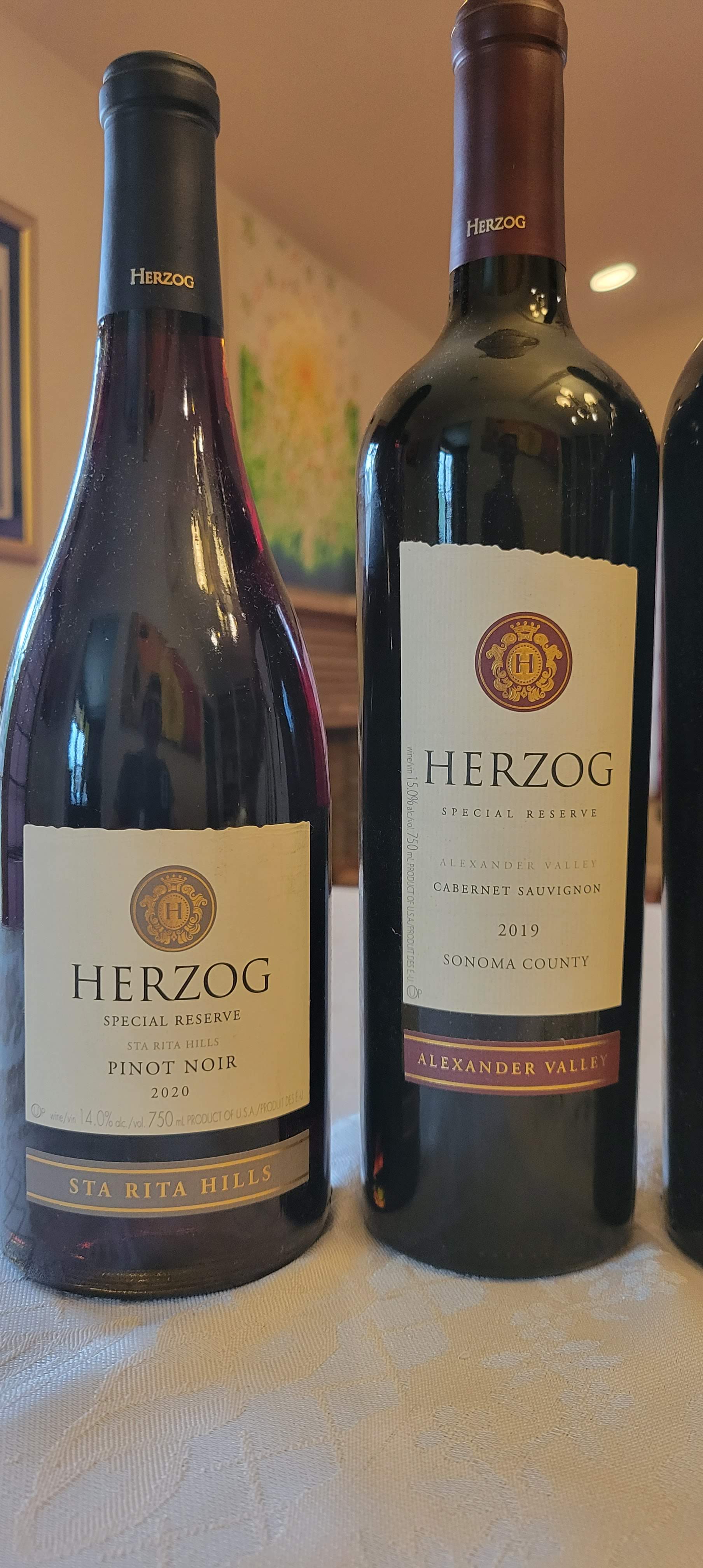


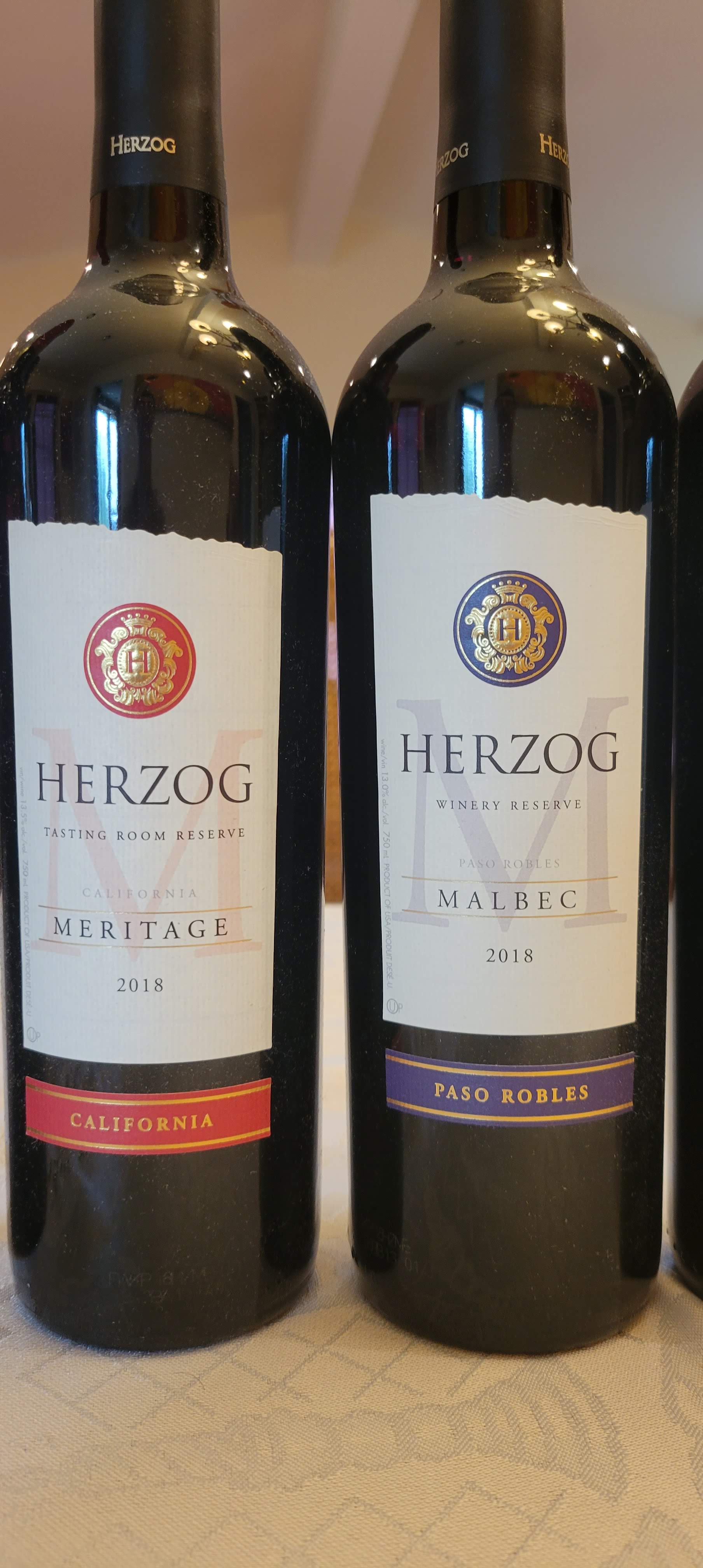
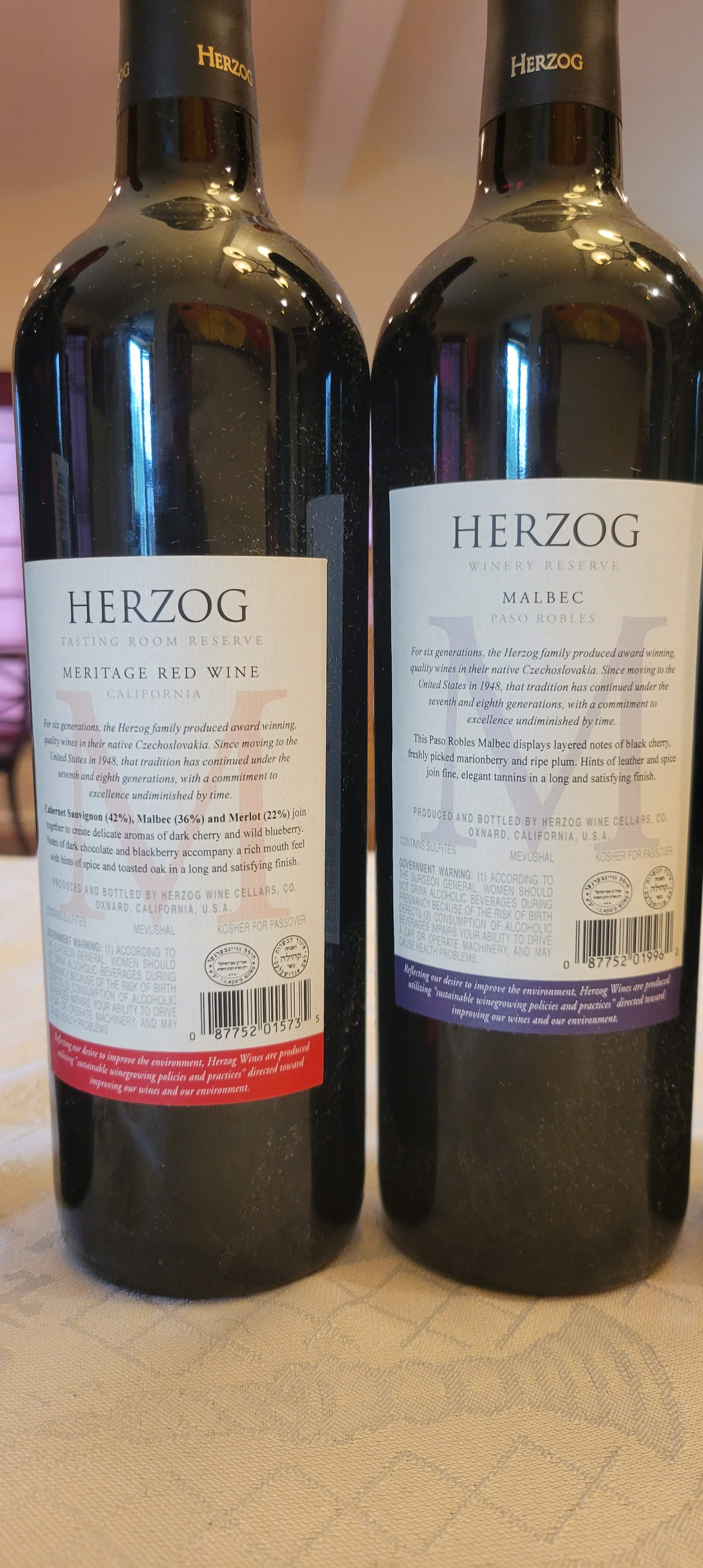
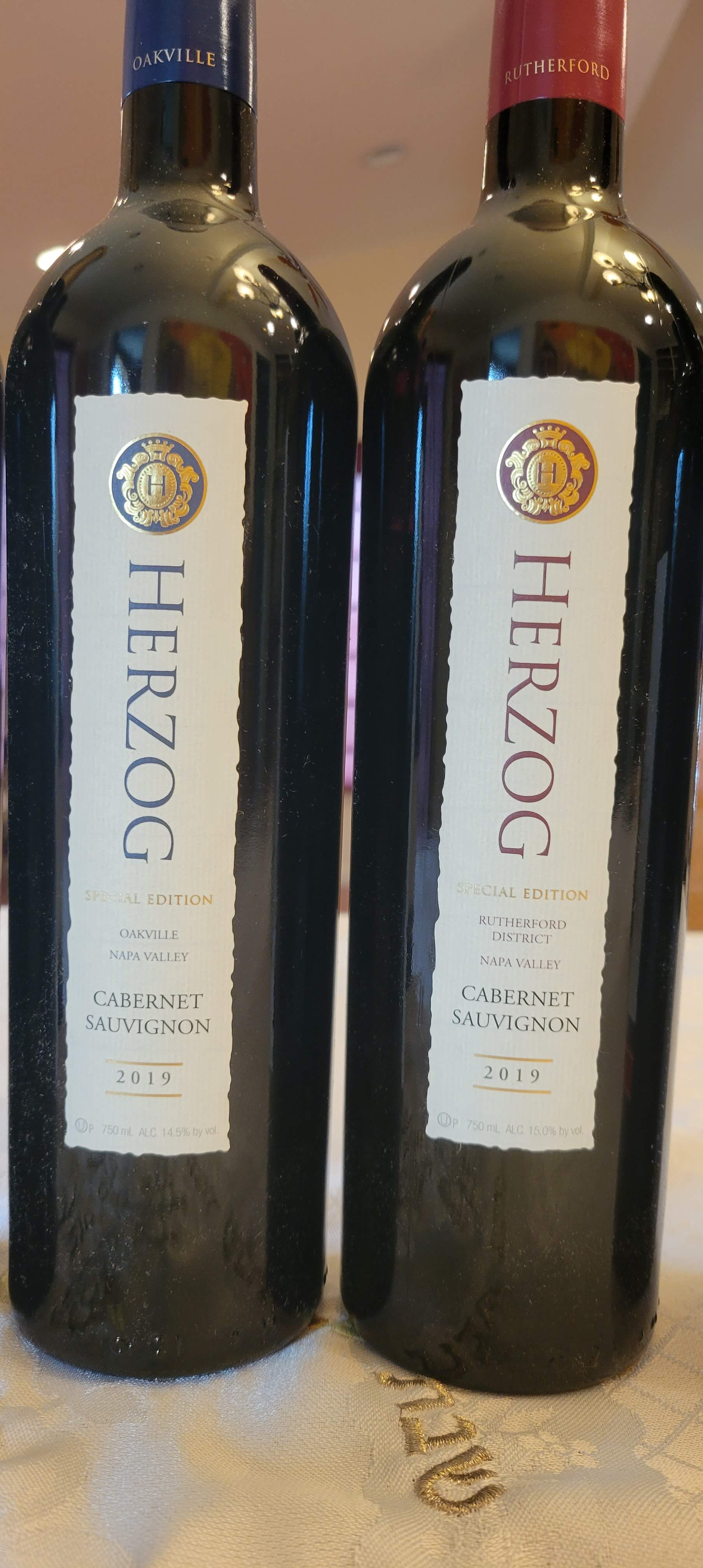
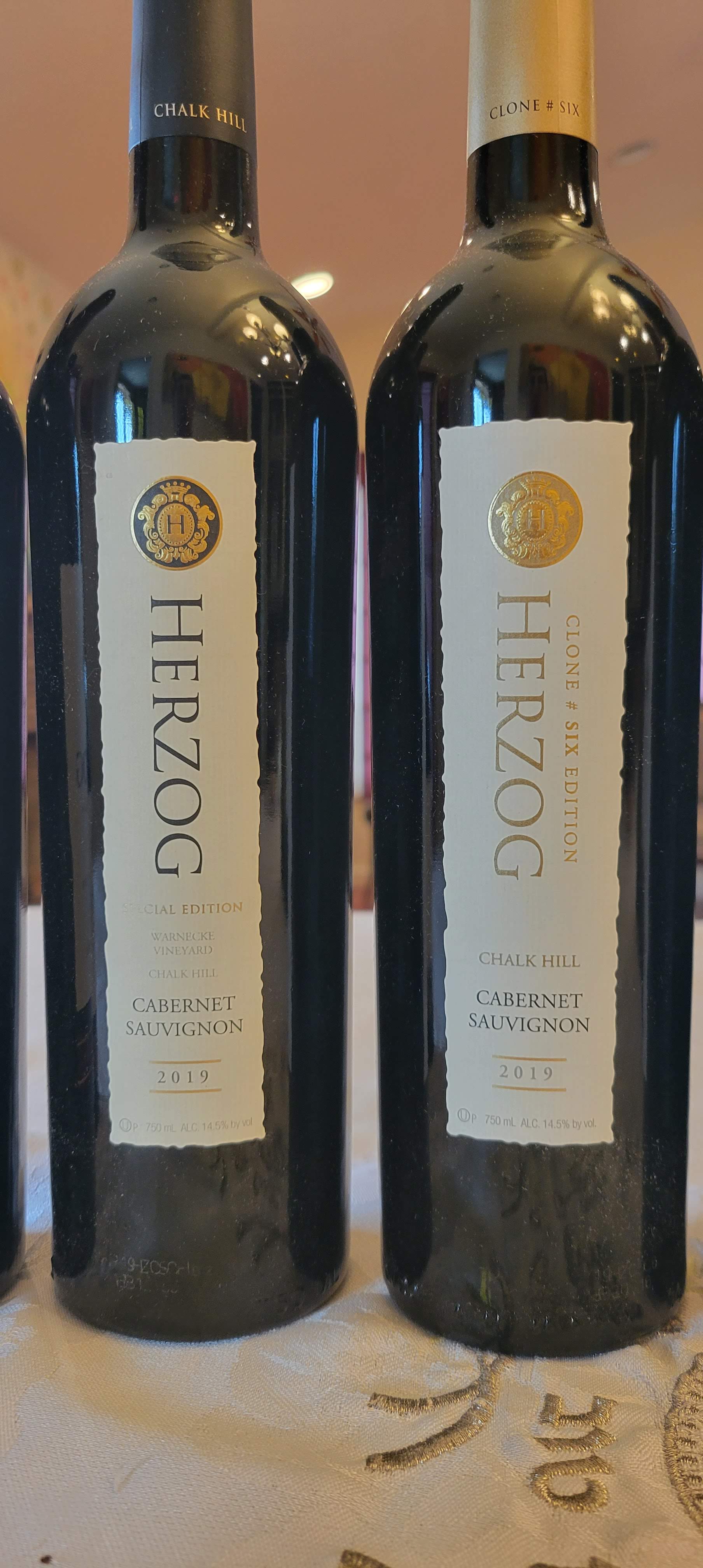


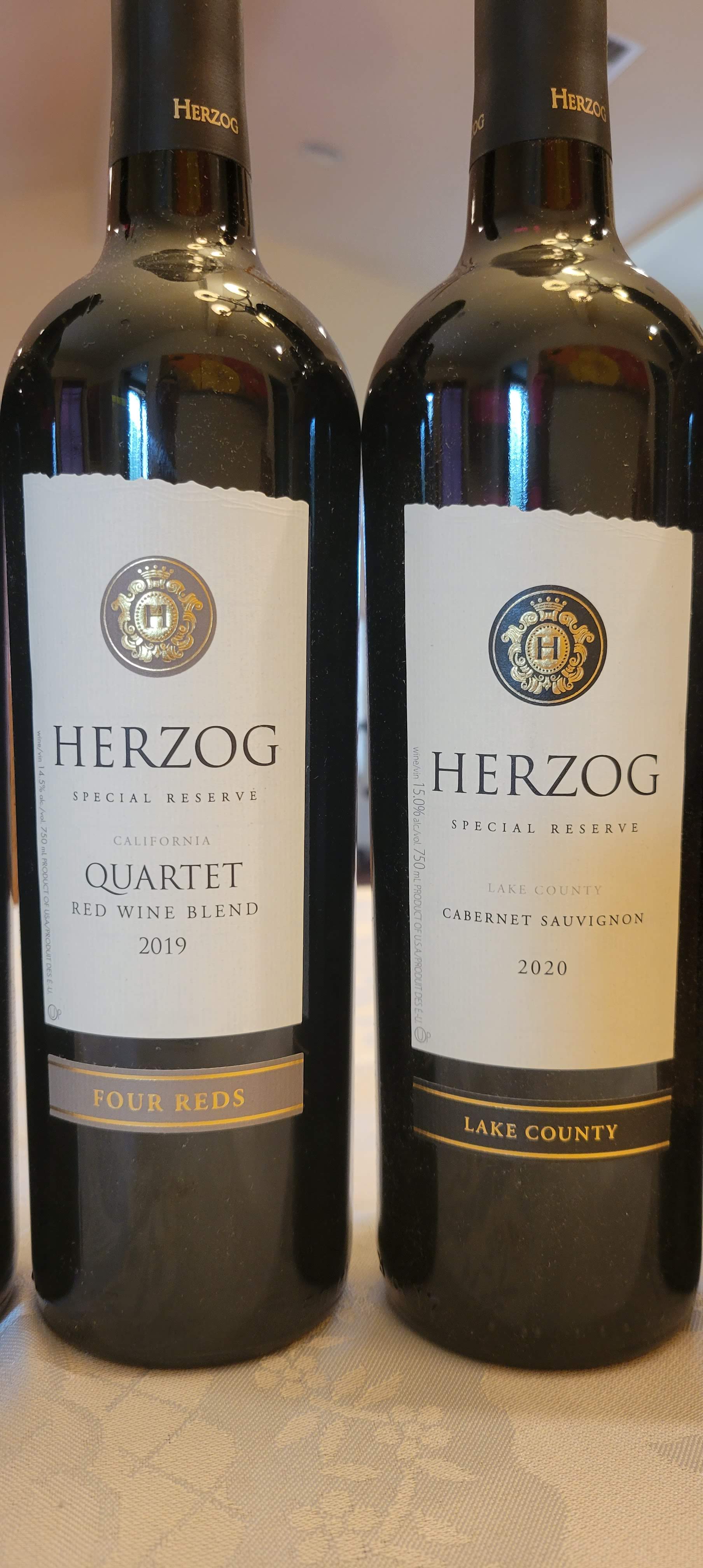
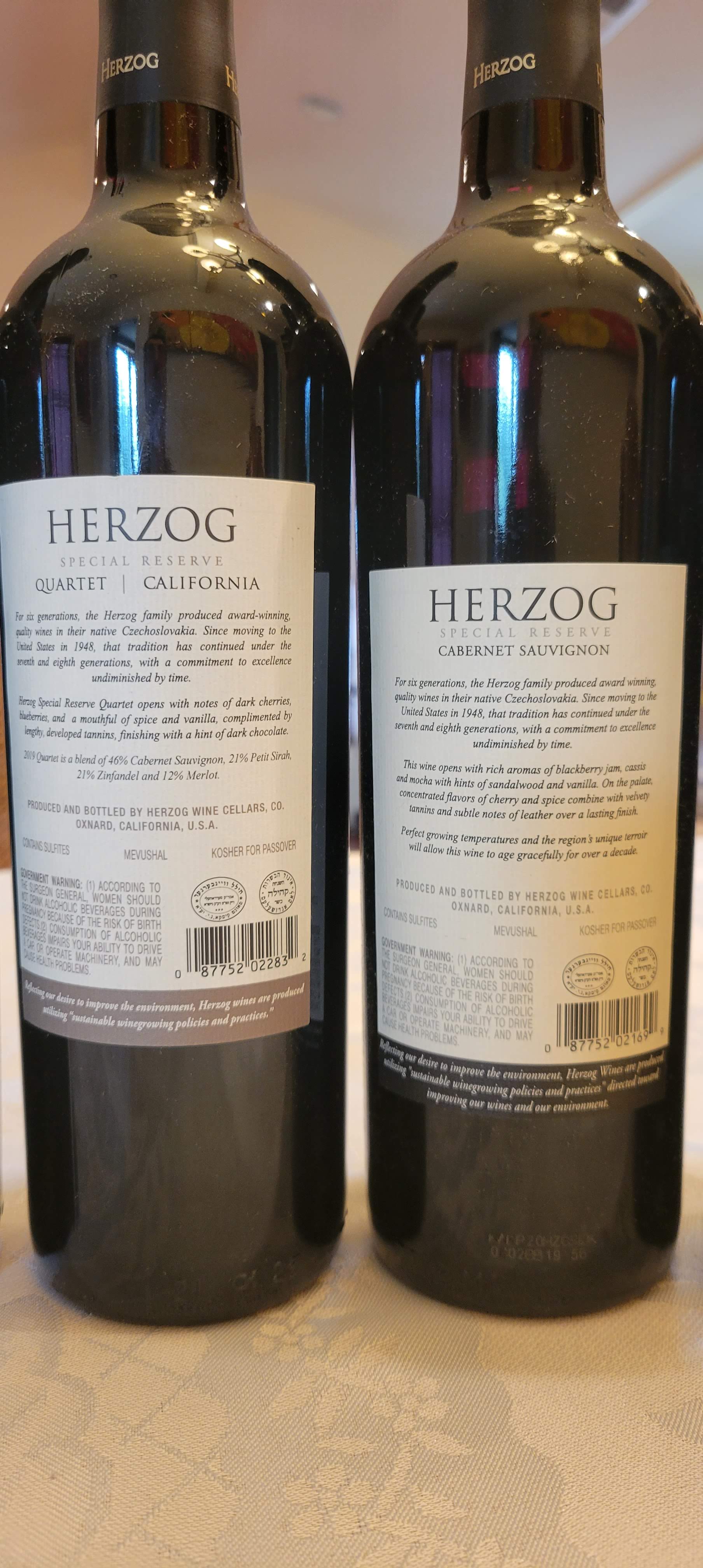
2021 Herzog Sauvignon Blanc, Lineage, Lake County, CA (M) – Score: 91 (QPR: WINNER)
The nose of this wine is more restrained than other Sauvignon Blanc out there, it is less ripe, it is dirtier, with mineral, floral notes, violet, rose, lemon, lime, yellow plum, and dryer sheet notes. The mouth of this medium-bodied wine is fun, refreshing, tart, acidic, and enjoyable, with green notes, lemon, lime, wet grass, mint, lemongrass, saline, hints of passion fruit, and otherwise, green notes, herbs, spices, flint, and rich mineral. The finish is long, green, spicy, and flinty, with saline, smoke, roasted herb, grass, and hay. BRAVO! Drink now. (tasted May 2022) (in San Jose, CA) (ABV = 14.5%)

Another round of QPR (Quality to Price Ratio) Hits and Misses, Six WINNERS – October 2021
To start – I really must state something in advance. I am sorry that I missed the chance to properly remember the 10th Yahrzeit of Daniel Rogov’s passing, which occurred on September 7th, 2011 (it may have been the 6th but Israel time and all).
I wrote two of my posts about the man, you can read them here and as such, I will simply say that I miss him as do most of the kosher wine drinking public. So much has changed in the past 10 years, since his passing, and I wonder what kosher wine would be like today if he was still with us. So much of the world is open to the kosher wine world, which was not the case 10 years ago. I wonder if Rogov would have embraced the opening. I wonder if he would have liked or disliked the fact that Israel is producing and importing loads of kosher wine from France and Italy, specially made for the Israeli kosher wine buying community.
I think, in the end, he would have loved all that is changing and we are all worse off by his lack of presence in our lives today. So I raised a glass of 2011 Yarden Blanc de Blanc in his memory and may we all be blessed for having known such a man!
QPR (Quality to Price Ratio) Wines
It has been a few months since my last QPR (Quality to Price Ratio) post and many people have been emailing me about some unique wine I have tasted and some lovely wines that are worth writing about.
Thankfully, no matter how garbage and pain I subject myself to, we are still blessed with quite a few wonderful QPR wines out there. This post includes superstars like Herzog Wines’s new 2019 Herzog Eagle’ Landing Pinot Noir, and a few others. It goes to show that when wineries reasonably price superior wines, even 46 dollar wines can be a QPR winner! Sadly, the Eagle’s Landing Pinot Noir is the most superior wine on this list. There are other nice wines to come but for now – this QPR wine list, overall, was not as good as previous lists.
We have an OK list of QPR WINNERS:
- 2019 Herzog Eagle’ Landing Pinot Noir
- 2017 Netofa Dor
- 2019 Chateau Genlaire Grand Vin de Bordeaux
- 2019 Elvi Vina Encina Blanco
- 2019 Pacifica Riesling, Evan’s Collection
- 2020 Domaine Guillerault Fargette Sancerre
There were also a few wines that are a slight step behind with a GREAT or GOOD QPR score:
- 2020 Domaine Joost de Villebois Pouilly Fume
- 2019 Domaine du Castel Grand Vin
- 2019 Nana Chenin Blanc
- 2019 Nana Cassiopeia
- 2015 Mad Aleph Blaufrankisch
- 2019 Aura di Valerie Zaffiro Super Tuscan
- 2020 Vitkin Israeli Journey, Red
- 2020 Domaine du Castel La Vie Blanc de Castel
- 2019 Herzog Malbec, Lineage, Clarksburg – GREAT Value for a varietal I am not a huge fan of
- 2020 Herzog Variations Be-leaf
- 2018 Binyamina Sapphire, The Chosen
- 2020 Tabor Sauvignon Blanc
- 2020 Bodegas Faustino VI Rioja
- 2020 Yatir Darom Rose
- 2020 Recanati Marselan Rose
- 2020 Arroyo del Imperio Chardonnay
There are a few wines that got a QPR Score of EVEN – meaning expensive or average:
- 2020 Herzog Sauvignon Blanc, Acacia Barrel Series – very unique but expensive
- N.V. Herzog Methode Champenoise, Special Reserve – Nice but expensive
- 2020 Herzog Chardonnay, Chalk Hill, Special Edition – Nice but expensive
- 2019 Castellare di Castellina Chianti Classico – very unique but expensive
- 2020 Matar Chardonnay
- 2019 Capcanes Peraj Ha’abib, Flor de Primavera – Still too ripe for me
- 2019 Weinstock Cabernet Sauvignon, Cellar Select
- 2020 Psagot Sinai, White
- N.V. Drappier Rose de Saignee, Champagne
- 2018 Les Lauriers de Rothschild
- 2020 Pacifica Rattlesnake Hills Viognier
- N.V. Vera Wang Party Prosecco, Brut
- 2019 Or Haganuz Elima
- 2019 Binyamina Chardonnay, Moshava
The others are essentially either OK wines that are too expensive, duds, or total failures:
- 2018 Covenant Cabernet Sauvignon, Lot 70 – Lovely wine but expensive for the quality
- 2019 Hagafen Family Vineyard Red Blend – Lovely wine but expensive for the quality
- 2020 Binyamina Moshava Rose
- 2019 Yatir Creek White
- 2019 Domaine du Castel La Vie, Rouge du Castel
- 2017 Barons Edmond & Benjamin de Rothschild
- 2018 Domaine du Castel M du Castel
- 2020 Padre Bendicho Rose
- 2020 Carmel Private Collection Rose
- 2020 Yatir Darom White
- 2019 Nana Chardonnay
- 2019 Segal Marawi Native
- 2019 Mia Luce Blanc
- 2019 Nana Tethys
- 2018 Odem Mountain 1060 Cabernet Franc
- 2018 Odem Mountain 1060 Red Wine
- 2017 Odem Mountain Alfasi, Special Reserve
- 2019 Mia Luce Syrah and Stems
- 2019 Mia Luce C.S.M.
- 2017 Tabor Merlot, Adama
- 2017 Tabor Cabernet Sauvignon 1/11,000, Limited Edition
- 2019 Chateau de Parsac
- 2019 Gurra di Mare Tirsat
- 2017 Tulip Espero
- 2019 Psagot Merlot
- 2019 Psagot Cabernet Sauvignon
- 2018 Jezreel Icon
- 2019 Psagot Edom
- 2017 The Cave
- 2018 Carmel Mediterranean
- 2020 Yatir Mount Amasa Rose
- 2020 Flam Camellia
- 2020 Netofa Latour, White
Some things that made me stand up and take notice (AKA QPR WINNERS):
The real WINNER here, from the entire list, is the lovely 2019 Herzog Eagle’s Landing Pinot Noir, another STUNNING Pinot Noir from Herzog – BRAVO!
There were other high-scoring wines in this overall list, nice wines from Covenant and others, but the prices of those wines put them at a disadvantage in comparison to others in their wine categories, and as such, they have poor to bad QPR wine scores.
In the end, IMHO, the overall list has less quality than the previous QPR list but there are a few nice wines here indeed.
The other WINNERS were the incredible 2019 Elvi Vina Encina Blanco, a lovely Macabeo for 13 dollars! Just lovely! The 2019 Pacifica Riesling, Evan’s Collection, is not as good as previous vintages – but another solid wine that many will enjoy. Finally, we have a Sancerre that I can get up and cheer about and that is the 2020 Domaine Guillerault Fargette Sancerre. It is here in the USA and it is nice!
Other wines worth of note (AKA QPR GREAT or GOOD):
Of these GOOD to GREAT wines – the most interesting of the list, for me, is the 2020 Domaine Joost de Villebois Pouilly Fume. No, it is not as good as the lovely 2019 Jean Pierre Bailly Pouilly Fume, still, it is a Mevushal wine that is reasonably priced, so it gets a solid QPR score. The 2019 Nana Chenin Blanc is nice, but for the price, it is not worth it, and it is DRINK NOW!
The 2019 Domaine du Castel Grand Vin, is nice, yes, but it is too ripe for me and the price is too much for the quality it is, so yeah, nice wine for those that like this style. The 2019 Nana Cassiopeia, is a wine that I found I could taste and at a decent enough price, so yeah, good going.
The 2015 Mad Aleph Blaufrankisch has so many stories revolving around it, that all I can say is, drink it if you like the style. I found it OK, but I do not need to buy any more.
The 2019 Aura di Valerie Zaffiro Super Tuscan is nice enough, but really, why did you need to put those words on the bottle? A Super Tuscon is a term used to describe red wines from Tuscany that may include non-indigenous grapes, particularly Merlot, Cabernet Sauvignon, and Syrah. The creation of super Tuscan wines resulted from the frustration winemakers had towards a slow bureaucracy in changing Italy’s wine law during the 1970s (from WineFolly). Why would you place those words on a wine bottle??
The 2019 Herzog Malbec, Lineage is a solid example of what reasonably priced wine from California can taste like! Finally, the newly released 2020 Herzog Variations Be-leaf – handily beats all other no-added sulfite options!
Read the rest of this entry
My top 25 kosher wines of 2020 including Wine of the Year, Winery of the Year, and the best Wine of the Year awards
Like last year, I wanted to make this post short and sweet – so the criteria are simple. I could care less about price, color, or where it was made. All that matters is that it is/was available this year sometime to the public at large and that I tasted it in a reliable environment, not just at a tasting, and that it was scored a 92 or higher. Also, there are a few lower scoring wines here because of their uniqueness or really good QPR.
We are returning with the “wine of the year”, “best wine of the year” along with categories I added last year, “Winery of the Year”, “Best White wine of the year”. Wine of the year goes to a wine that distinguished itself in ways that are beyond the normal. It needs to be a wine that is easily available, incredible in style and flavor, and it needs to be reasonable in price. It may be the QPR wine of the year or sometimes it will be a wine that so distinguished itself for other reasons. The wines of the year are a type of wine that is severely unappreciated, though ones that have had a crazy renaissance, over the past two years. The Best Wine of the year goes to a wine well worthy of the title.
This past year, I think I am pretty sure about my state on kosher wine overall. In the past, I had not yet tasted the pape Clement or other such wines. However, over the past year, those have been covered, and they were a serious letdown. As stated in the article, I truly believe the entire kosher production of the Megrez wines, following the EPIC 2014 vintage of the Pape Clement and others, to be below quality and seriously overpriced, and without value in every category, which is a true shame. The 2015 reds are all poor quality and the whites are not much better, in 2015 and 2016. The 2016 Pape Clement, while better, is a total ripoff for what it is. As I will talk about in my year in review post, 2014 will come out as the best vintage for the past decade in France. That is a hotly debated subject, but IMHO, in the world of kosher wine, there were FAR more best wine options in the 2014 vintage than any other vintage in the past decade. That may not be the case for non-kosher wines, but news flash, I do not drink non-kosher wines, or even taste them, and further this blog is about kosher wines. The 2018 vintage may well have some serious “best wine of the year” candidates, but sadly, not all of those wines are here and I could not travel to France to taste them all, as I do commonly.
There are also interesting wines below the wines of the year, think of them as runner-up wines of the year. There will be no rose wines on the list this year. If last year, I thought the roses were pure junk, this year, you can add another nail in the coffin of rose wines, IMHO. Thankfully, the task of culling the bounty of great wines to come to these top wines was more a task of removing then adding. We are blessed with a bounty of good wines – just not like a few years ago when that bounty included many 95 and 95+ scoring wines.
The supreme bounty comes from the fact that Royal released the 2018 French wines a bit early! Throw in the incredible number of kosher European wines that are coming to the USA and being sold in Europe and this was truly a year of bounty for European kosher wines.
Now, separately, I love red wines, but white wines – done correctly, are a whole other story! Sadly, in regards to whites, we had no new wines from Germany, still. Thankfully, we have some awesome new entries, from the 2017 and 2018 Dampt Freres Chablis, both Grand Cru and Premier Cru, and the new 2019 Meursault!
The wines on the list this year are all available here in the USA, in Europe, and a few can be found in Israel, as well.
Finally, some of these wines are hard to find and they may have different siblings – but they are worth the effort. The wine notes follow below – the explanation of my “scores” can be found here:
The 2020 kosher wine of the year – is a return to its greatness – the 2018 Elvi Wines EL26
Elvi EL26 is back! Back to the glory days and I have stocked up and sadly, it will sell out quickly, if it is not already sold out! Get a move on, there was not a huge production of this beauty!
So, why did EL26 win? Simple, it is a great wine, and then throw in its WINNER price, and this wine punches at two levels, at the same time! You can read more about this fantastic wine here, in my post about it. Enjoy!
2018 Elvi Wines EL26, Elite, Priorat – Score: 93 (QPR: WINNER)
This wine is a blend of 80% Garnacha (Grenache) and 20% Carignan. This wine is pure heaven, dirt, smoke, roasted animal, saline, mineral, juicy tart red, and blue fruit, with incredible precision and fruit focus – Bravo!
The nose on this wine is pure fun, showing tart red fruit, incredible fresh loam, and dirt, hints of mushroom, licorice, roasted animal, a whiff of oak, sage, rosemary, with dirt, and green notes. This wine is currently far more Bordeaux in style than that of a Spanish Priorat! The mouth on this medium-bodied wine is not overly extracted, but it is well extracted, with good mouth and fruit texture, with incredible acid, good fruit focus, showing dark cherry, plum, ripe and tart raspberry, strawberry, oak, vanilla, and garrigue, with green notes, and lovely mouth-draping tannin. The finish is long, green, yet ripe, with great control and precision, with lovely graphite, more roasted meat, scraping minerality, saline, rich smoking tobacco, and smoke, lots of char and smoke. Bravo! With time the wine opens more and shows its riper side, still very controlled, but the fun red and blue fruit become a bit fuller and richer in the mouth – quite an impressive wine! Drink from 2026 until 2036. (tasted December 2020)


 Wine Musings Blog