Blog Archives

A few new and old wines this past Shabbat. 2017 Petit Guiraud, Sauternes, 2010 Terra di Seta Chianti Classico, Reserva, and 2007 Tzora Vineyards Misty Hills were the winners
This past Shabbat we had some friends over and I opened many a wine, 13 to be exact. There were a few new wines, including the new 2017 Petit Giuraud, the 2nd of three wines that will be released from Chateau Giuraud. The first one was the G of Guiraud, which is a lovely dry wine. The second was the Petit Guigaurd, a Sauternes which has recently been released, and IMHO is better than the 2016 Chateau Piada. The third will be the 2016 Chateau Guiraud, which will be the first release since the 2001 vintage was released many years ago.
Besides, the Petit Guiraud, there was a 2nd tasting of the 2016 Matar Cabernet Sauvignon. We last tasted it in Israel, and it did not show well. Here it did not show well, but it showed better. It was less fruit-forward and absurdly ripe than at the tasting in Jerusalem.
The real winner of the evening, IMHO, was the 2010 Terra di Seta along with the 2007 Tzora Vineyards Misty Hills. It was a lovely wine and shows what Israel can produce when it wants to build wines for the future and not wines for the present alone.
My many thanks to all the folks who shared the dinner with me, and may we all be blessed to enjoy more meals together!
The wine notes follow below – the explanation of my “scores” can be found here:


2014 Roc des Moulins – Score: 88
Classic nose of the cheap Bordeaux Superieur wines, mushroom, dark cherry, rose, earth, and simple notes. At open this wine is very simple, not much complexity, but has solid acid, and nice fruit. With time, it opens nicely, to show a more complex mouth, still clunky and simple, with more cherry fruit, dark currant, and herb galore, along with saline, and mounds of bitter herbs, with tobacco, and forest floor. Nice. Drink by 2021.
2014 Chateau Roquettes, Saint-Emilion Grand Cru – Score: NA
We opened this wine before Shabbat, and it tasted like the notes below. We then tasted it at the Shabbat table, and it was oxidized. The cork is fine. I am not sure if this is an issue of bottle variation or just a bad bottle.
The nose on this wine is super closed and tight to start, with mounds of tobacco, smoke, herb, red fruit, and nice mushroom, showing lovely dark and red ripe fruit. The mouth on this full bodied wine is lovely, with lovely and rich extraction, with still ripping tannin, that is rich and layered, with concentrated fruit, dark plum, forest berry, with dark raspberry, and rich earth, mushroom, and lovely terroir, and nice sweet oak. The finish is long and rich, and layered, with rich minerality, lovely saline, forest floor, foliage, with graphite, tobacco, and saline. Bravo!!
2010 Terra di Seta Chianti Classico, Reserva – Score: 92
Wow, the nose on this wine is coffee, toffee, and heavy smoke, with crazy oak, and red fruit galore, hidden in the background, is dark red fruit, and lovely brightness. The mouth on this medium bodied wine is rich and layered, and really alive, with tart fruit, showing raspberry, cherry, and lovely herb, showing rich tobacco, herb, with mint, oregano, with lovely mouth draping tannin and rich mushroom, with wet forest floor, and great chocolate. The finish is long, and green, and herbaceous, with lovely dirt, and green notes. Drink by 2022. Read the rest of this entry

Tasting of Royal’s 2016 French wines in France

As I stated recently in my original post about my most recent trip to Israel, the reds of Israel are really not impressive, but thankfully I ended my trip by going to France to meet with Menahem Israelievitch and taste through all of Royal’s new 2016 and 2017 wines from France in Paris.
2016 Royal Europe French wines
Two years ago, I was given the opportunity to taste many of these wines from the barrel at each of the wineries in Bordeaux. Now, the 2015 wines were a bit more akin to the barrel notes when I tasted through the 2015 wines last year in Paris, but the 2015 wines were already in barrel for a year. However, since the trip was in 2016, the 2016 wines were barely finished fermenting and most had yet to even go through malo, but man even then it was easy to tell that the 2016 vintage was going to be something very special.
The 2014 vintage to me, was crazy fun because it is less ripe than the 2015 or 2016 vintages. They are also FAR cheaper. Then you had the 2015 wines which are more expensive and far riper than the 2014 vintage. This 2016 vintage is the best of both worlds, but it comes at a crazy high price. I warned you during the epic post of my visit to Bordeaux with Mr. Israelievitch, that you better start saving your money, sadly nothing has changed about that. The REAL shocker of the 2016 vintage will be the Chateau Malartic wine, get ready to see that at 170 or more a bottle! That will be close to double the 2014 vintage.
In a previous post about the most recent French wines that were arriving on the market – I already spoke about pricing and supply, so there is no need to talk that over again in this post.
Also, the 2015 vintage may have been ripe to many, but the 2016 right bank wines are even riper. That appears in the right bank because of the Merlot that was super ripe in 2016, but other wines with lots of Merlot also show that way, even on the left bank.
The interesting change this year for these wines is that more of them will be coming to the USA in Mevushal format. Will that be an issue? In the past, I have found that the mevushal work of Mr. Israelievitch is top-notch, and really just ages the wine rather than ruining it.
The Mevushal wines from France for the 2016 vintage will be, the 2016 Barons Edmond et Benjamin de Rothschild, Haut-Medoc, 2017 Chateau Mayne Guyon, 2016 Chateau Greysac, 2016 Chateau 2016 Chateau de Parsac, 2016 Les Lauriers, Des Domaines Edmond de Rothschild, along with the two whites wines, the 2017 Bourgogne Les Truffieres, Chardonnay and the 2017 Les Marronniers, Chablis.

Now does mevushal impede the long-term viability of aging in regards to the wine? Well, that too is not something that we have scientific proof on. I have tasted a mevushal 1999 Herzog Special Edition and it was aging beautifully! So, would I buy the mevushal versions of the wines I tasted below – absolutely! Would I age them? Yes, I would hold them for slightly fewer years. The only wine listed below that will be mevushal in the USA and that is NOT mevushal in France is the 2016 Chateau Le Crock. I will post my notes on the mevushal version when it is released here in the USA, they are currently selling the 2015 Chateau Le Crock, so that needs to sell out before the 2016 vintage is released.
Other than the mevushal aspect, there are no differences between the European version of the wines and the USA version of the wines. While that sounds obvious, I am just stating it here. The wines will be shipped now and the temperature issues that clearly affected Israel’s wines of old, have not been a factor here.
Tasting in Paris
I landed in Paris, got showered and the such, and then made my way to lunch with Menahem Israelievitch. After lunch, we went to a lovely home to do the tasting. The wines were all laid out in the order for the tasting, and one by one we went through the 29 wines. The only wine missing wines were the 2016 Les Lauriers, Des Domaines Edmond de Rothschild and the 2016 Chateau Greysac.
My many thanks to Menahem Israelievitch for going out of his way to help me to taste all the current French wines from Royal Wines before they were publicly released. The labels on the pictures may not all have a kosher symbol, but that was because they rushed some of the bottles to Mr. Israelievitch before they were properly labeled with supervision symbols attached. My many thanks to Mr. Israelievitch, Royal Europe, and Royal Wines for making this tasting possible in the first place, and secondly, for making the time to taste the wines with me.
The wine notes follow below – the explanation of my “scores” can be found here:


2017 Ramon Cardova Albarino, Rias Baixas – Score: 91
Lovely nose of rich mineral, with loads of straw, with which salinity, and lovely peach and dry apricot, with honeysuckle, lemongrass, with green notes galore. Lovely! The mouth on this lovely green and acid-driven wine, showing rich salinity, green olives, with lovely dry quince, green apples, but also with lovely lime and grapefruit, with a bit of sweet fruit of guava and rich acid that comes at you in layers. The finish is long and green, with gooseberry, passion fruit, and lovely round and tart with freshness and orange pith, and incredible acidity lingering long. Drink until 2021.
Interesting note on this wine, there is a thermosensitive logo on the label that shows ONLY when the wine is at the correct temperature, on the bottom right-hand corner of the front white label. This is a lovely wine and one that is worth the effort to enjoy at the correct temp. Cool!


2017 Chateau Lacaussade Saint Martin, Vignes Vignes – Score: 90
The wine is a blend of Semillon and Sauvignon Blanc. This wine is very slow to open, it may need a quick decanting, for an hour or so. The nose is slightly tropical in nature with lovely with melon, guava, and hints of passion fruit to start, over time it recedes to show lemongrass, straw, mineral, grapefruit, citrus, and honeysuckle notes. Just like the nose the mouth also starts off with crazy tropical notes that also recede with time, to show a very different wine. After some time, the mouth on this wine is not complex, but very nice, with rich acidity, showing a good balance of fruit, green apple, heather, tart pear, and mineral. The finish is long, super long, with southern tea, and rich acidity, and lovely pith. Drink until 2021. Read the rest of this entry

Kosherwine.com’s recent kosher French wine selection
As you can tell, I am finally getting to posting on my blog again. A few months ago, I had the opportunity to taste through Kosherwine.com‘s new French wine imports.
Look, I get it, most people do not care who imported what, they want to know what wine is available where. All, I am adding here is that these wines are kosherwine.com’s work and effort to import them.
A few of these names (like Louis Blanc) were imported in the past by either Victor Wines, out of Hollywood, FL, or others. To most, the only difference will be the change of the name on the back of the wine label.
I enjoyed the range of wines brought in, and I really enjoyed that many of them are reasonably priced, even if they are not crazy wines. Also, I liked the magnum sized wine they brought in, allowing for enjoying a casual dinner with friends and family, without needing to be pretentious and snooty, at the same time!
The wine notes follow below – the explanation of my “scores” can be found here:


2014 Louis Blanc Beaujolais, Moulin-A-Vent – Score: 88
This wine is made from 100% Gamay. The wine shows a nice nose of earth, red fruit, spice, and rich loam, with some good smoke. The mouth on this medium bodied wine is nice, light in weight, but with good acid and lovely sweet tannin, that is backed by good herb, menthol, foliage, and floral notes. The finish is nice with coffee, earth, red fruit, and spice. Drink till 2019
2015 Louis Blanc Beaujolais, Julienas – Score: 89
This wine is made from 100% Gamay. This is the next level in terms of Gamay, with really good bright fruit, red raspberry, currant, with smoke, loam, and great fruit. The mouth on this medium bodied wine is fuller in the mouth than the Moulin-A-Vent, with ripe red fruit, raspberry, black plum, and good nice tannin structure, with nice sweet strawberry, and crazy floral notes. The finish is long and sweet, with good fruit, tannin, and rich earth. Nice. Drink till 2020. Read the rest of this entry

A wine tasting of some incredible 2014 kosher French wines with Nathan Grandjean
When I last left off on the story of my trip to Israel and Europe, I had just ended with a classic run for the border to Weingut Von Hovel. After we returned from visiting Von Hovel we had a wine tasting. It included some new 2016 wines but it mostly involved French wines from the 2014 vintage and earlier.
As I posted here and here, I have been trying to get to all of the 2014 French wines and as many of the 2015 vintages that are released. With this last tasting, I have been able to get to most of the top 2014 kosher French wines that I know of. The two top 2014 kosher Bordeaux wines that I have been able to taste are the 2014 Chateau Pape Clement and the 2014 Smith Haut Lafitte (which I tasted here at this tasting). Right after those superstars come the 2014 Chateau Giscours, 2014 Chateau Malartic, the 2014 Chateau Tour Saint Christophe, the 2014 Chateau Soutard, and the 2014 Chateau Marsac Seguineau. In regards to Sauternes, the two winners are the 2014 Chateau Rayne Vigneau, 1er Cru Classe, and the 2014 Chateau La Tour Blanche, 1er Cru Classe.
I had not been able to taste the Smith Haut Lafitte or the 2014 Chateau La Tour Blanche, 1er Cru Classe, until this tasting and they were not a letdown in any manner. WOW, they were worth the trip and worth stocking up where and if possible.
If you are interested in these wines, they are mostly wines that are here or will be here eventually. If you cannot find them or do not want to wait – email Nathan Grandjean about how to get them: Contact@yavine.fr (I DO NOT work for wine stores, never have and never will. I get no kickback or payment for this). I state this here only as information. It also seems that kosherwine.com will soon have the 2014 Chateau La Tour Blanche, 1er Cru Classe as well.
We continued tasting these wines for more than a day, it was only after a long time that the great 2014 wines really opened up. Also, we tasted the Von Hovels throughout this time as well (I did not post the scores here again, as they are in their own post).
The rest of the wines at the tasting were either horrible, passable, or nice enough. My many thanks to JK, Nathan, and his family (for putting up with us). The wine notes follow below – the explanation of my “scores” can be found here:


2016 LI BI Rose, Cotes du Rhone – Score: 88
The wine is a rose made of 80% Grenache and 20% Syrah. Lovely nose of grapefruit, floral notes, with green apple, gooseberry, with nectarines, and good mineral. The mouth is nice enough, the acid is medium in nature, and while it is well balanced it is unidimensional, with good lemon, peach, and nice acid that does rise after a bit. The finish is long and floral with good saline, mineral, slate, and good spice. Drink up!
2016 Le Mourre de L’isle, White – Score: 87
The wine is a blend of 40% Roussanne, 30 Viognier, and 30% Grenache Blanc. Lovely nose of peach, and honeysuckle, floral notes, with green apple, and spice. The mouth is slow to open, with peach notes, good acid, and balance, with again little complexity but nice acid, with peach, grapefruit, and crazy floral notes. The finish is long with mineral and sweet spices, cinnamon, and cloves. Drink by 2018.
Read the rest of this entry

A birthday party long in the makings
Well, this past weekend I had a long-delayed birthday party at home, with friends and great wines. In honor of my birthday, I made the classic Tunisian Friday night dinner, but without all the classic trimmings; Couscous with boulettes.
This was one of my better couscous for a few reasons. First of all, the axiom – more is better, is truly meant to describe how much chicken you should throw into a chicken soup recipe. Second, I threw in a bunch of onions, zucchini, and ground up – oven roasted – mushrooms into the meatball recipe. Sadly, the makoud was lacking, because I refused to douse it with oil and eggs. The age old Tunisian cooking rule holds very true to makoud, if the dish does not look like an oil spill, you have done it all wrong. In this case, the lack of 12 eggs and an easy hand on the oil made for more of a potato mash than a souffle.
With that, the rest was up to me and Benyo, from Four Gates Winery to handle the rest of the wine duties. ER and HK brought apple cobbler dessert, while SR and JR brought some dessert that was hijacked by Rochel for later consumption. Fear not, they both know the drill, some things that are dessert based, never make it to the table, they are essentially Teruma to the goddess of the house. Read the rest of this entry

Back to the Future – the kosher French wines available today
Well, I hope all of you enjoyed the Passover respite (some see it as a stressful time, I see it purely as a joyous time, and yes I do a lot of cleaning as well). This post I wanted to talk about the kosher French wines that I have tasted recently.
Now I must stress that these are the wines that I have tasted, not ALL the wines that are available. There are hundreds of kosher French wines, and the vast majority of them never make it to the USA. With that said, I really LOVE the new crop of 2011 and 2012 wines that have made their way to the US and around the world. But before we jump into the nitty gritty and the tastings we need to take a step back and talk about French wines for a second.
Let us start with some very basic concepts around France and its wines. To start it is one of the oldest wine making locations in the world. Sure, Israel, may well be the oldest, but it stopped making wine for a very long time – till around the 1870s or so. Even then, they did not start making real world class wines till the 1980s (ignoring the 1901 and 1970 successes of Carmel).
France is once again the largest wine producer in the world, as of 2014, and most of it is quality wine. It is hard to find another country that makes so many good wines, so many vastly different wines – each from their own terroir – with such a long and storied history. The wines I will be talking about today are mostly from Bordeaux, the home of the “noble grapes of the world” – Cabernet Sauvignon, Merlot, and Cabernet Franc (not on the official noble list), and Sauvignon Blanc. To be fair there are other noble grapes not in Bordeaux, like Pinot Noir and Chardonnay from Burgundy. Riesling – mostly from Alsace and Sauvignon Blanc again from Upper Loire. Toss in Syrah and Grenache from the Rhone and that comprises the wines that I am noting today.
I did not write Pinot Noir notes – I did that recently here and you can read my French wine notes there.
I have written often about the wines of the Rhone – because many of my favorite wines from California (Shirah and Hajdu) make most of their wines that comprise the region called Rhone. Those would be Syrah (as noted previously), Grenache, and Petite Sirah (not really Rhone at all, but the Rhone Rangers love it). With some Grenache Blanc and Viognier thrown in.
In case you have not yet realized it, but I have pretty much listed many of my own favorite varietals, and they all come from France. Truly France is the cradle of the wine world. Sadly, there was little to no kosher options in the 1980s, even though France itself was producing 10s of millions of cases of wine at that time.
Of course of all the varietals – Cabernet Sauvignon and Merlot tend to grab all the headlines. Rightfully so to some, but to many the wines of the Rhone and Burgundy are of more interest. So, how does all of this work? France long ago decided to control what varietals would be planted and within the regions of its country that would produce the best wines possible. It is a foreign thought to many still, even here in the USA. Terroir defines France. Essentially the 300 or so appellations d’origine contrôlee (AOC) within the country are so designed and controlled to allow for creating the best wines possible. Planting Syrah in Bordeaux can be done – but why? Syrah requires far more heat and sun that Bordeaux can dish out – so Syrah was defined as a southern grape location – AKA Rhone, where it can flourish in all of its glory. Read the rest of this entry
Shirah, Four Gates, and a French wine for Shabbos Passover
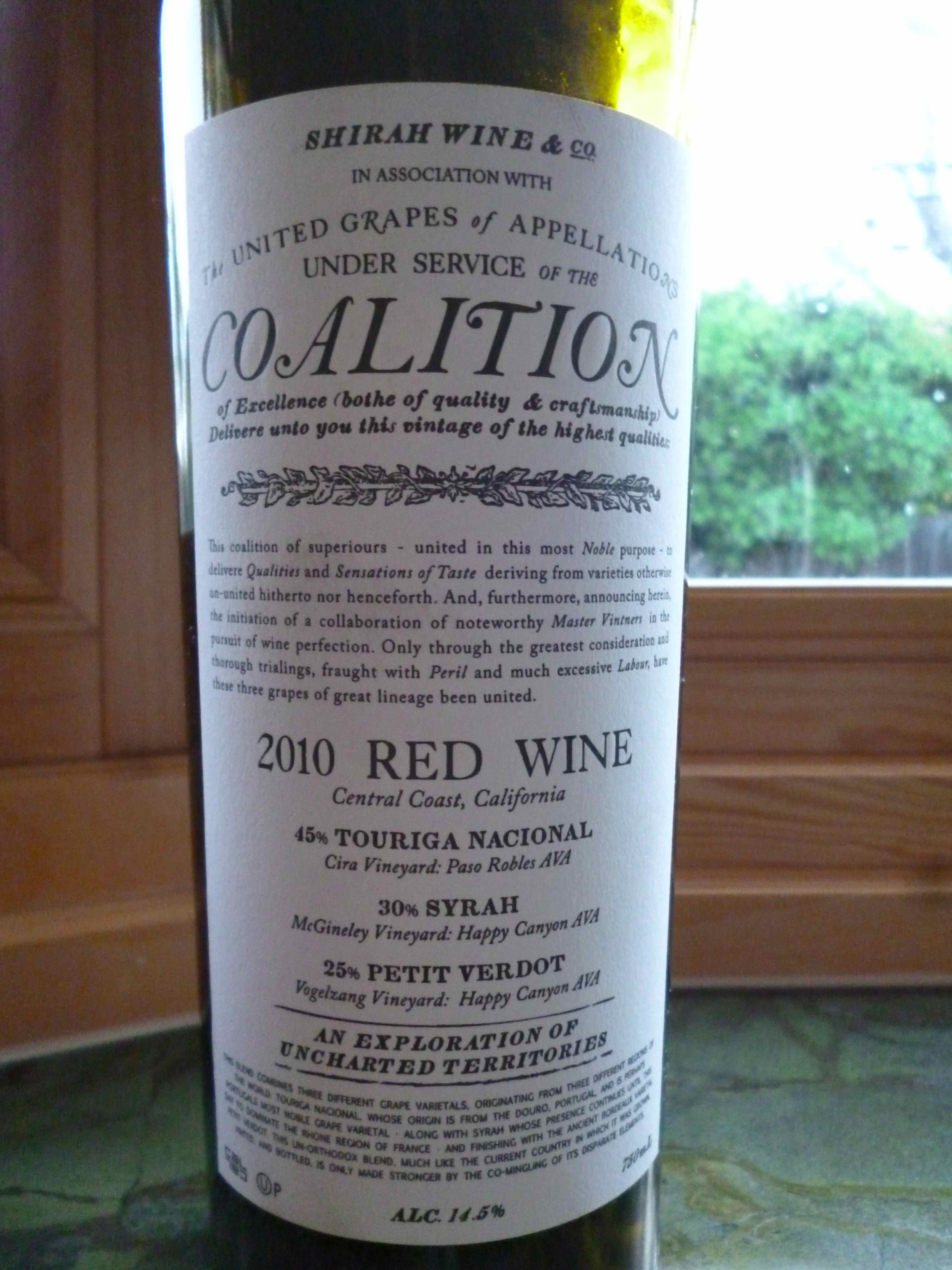 Truly Passover Shabbos was a two fold event, the chance to taste through my Shirah wines that I had been yearning to get to and the chance to taste a barrel sample of wine sent to me by Andrew of Liquid Kosher (a high-end kosher wine merchant). Andrew warned me that I needed to air the puppy out so indeed, I opened it Friday morning and it was still kicking Saturday night.
As, I already documented here, about all things Shirah, I was talking with Gabriel before Passover and we agreed that we would both open Shirah wines over Passover. To me, it was time to see if the Coalition, which I thought was severely lacking in the finish and mouth, had come around. Humorously, there are some that think my article on Shirah wines was a cheerleader post – but such is life, I really did feel passionately about the Weiss Brothers and I really do like their wines. We tasted through four of the Shirah wines that I had around, the two coalitions, from 2010 and 2011 and the 2008 10-2 punch and the 2010 Counterpunch. All four of the wines were truly unique, but the winner of the four was the 1-2 punch and the 2010 Coalition – the very wines, I though was truly lacking – how funny life can be sometimes.
Benyo came over for the Shabbos and brought over two oldie but goodies – 1996 Four Gates Merlot and 1996 Four Gates Chardonnay. Now, as you all know Four Gates Winery was “officially” founded in 1997, but that dos not mean he did not make wine in 1996 – actually he made a fair amount of wine in 1996, and all of his friends and family were the beneficiary of his abundant kindness! To me, the wines rival the 1997, 2003, and 2006 vintages. Though his best wines so far are still the 2012 releases (year wise – not vintage). Anyway, the 1996 Chardonnay was so good and clean and ripe, the real shocker was the color – pure light gold color, like a 2006 or a 2012 Chardonnay! Quite impressive as always – his older 1996 Chardonnay wines are truly unique. I did not take notes – sorry, but this one was not the soft, honeyed, caramelized Chardonnay that I come to expect from his stash of 1996 Chardonnays. This was bright and expressive – really like its color! Blind, I would have thought it was a 2000 or 2010 wine!
After that we enjoyed a march of red wines, one after the other, each one unique in their own right, with really no duds or holes, it was a really fun night. Friends brought over some wines, but none of them made the table, as I really wanted to taste through the Shirah wines, the Frenchie, and one Israeli wine. They brought over a Peeraj Habib – nothing to slouch over AT ALL, but I was single minded on my plan, and I did ask forgiveness afterwards. Read the rest of this entry

 Wine Musings Blog