Blog Archives

The Best and Top 25 Kosher Wines of 2024, including the Wine of the Year, Winery of the Year, the Best Wine of the Year, the Best Mevushal Wines of the Year, and Best QPR Wine of the Year Awards
First, I must start this by saying I am sorry for this being two months late. The late tasting of the 2022 wines in Paris pushed all the dates forward. Such is life! It was worth tasting those wines in their correct place. As stated below, I love at KFWE, but it is not a place to taste wines for a blog or a post. It is a place to taste wine and know if I should taste it in the correct setting. It is an excellent filter to help fine-tune the wines to sit down with.
Like last year, I wanted to make this post short and sweet – so the criteria are simple. I could care less about price, color, or where it was made. All that matters is that it is/was available this year sometime to the public at large, that I tasted it in a reliable environment, not just at a tasting, and that it scored a 94 or higher. PLEASE NOTE the improved quality of the top wines this year! This is the best year – that I have posted about – in regards to scoring. All 25 wines are 94 or above. The closest we had before was the 2021 blog year, which had a fair number of 93+ scored wines.
We are returning with the “Wine of the Year,” “Best Wine of the Year,” “Winery of the Year,” “Best White Wine of the Year,” “Best QPR Wine of the Year”, along with the – “Best Mevushal Wine of the Year.” Wine of the Year goes to a wine that distinguished itself in ways that are beyond the normal. It needs to be a wine that is readily available, incredible in style and flavor, and it needs to be reasonable in price. It may be the QPR wine of the year, or sometimes it will be a wine that has distinguished itself for other reasons. The wines of the year are a type of wine that is severely unappreciated, though ones that have had a crazy renaissance over the past two years. The Best Wine of the Year goes to a wine well worthy of the title.
The Mevushal wine of the year is something I dread. I understand the need for a wine that can be enjoyed at restaurants and events. Still, when we start seeing Château Gazin Rocquencourt and Chevalier de Lascombes go Mevushal – we know we have a problem. As I have stated in the past, if this is what needs to happen, then please sell both options as many do with Peraj Petita/Capcanes, Psagot wines, and many others. Still, it is a wine; as such, it needs a best-of-the-year moniker, so we do it again!
This past year, I tasted more wines than I have ever, in the past. Now, to be clear, I tasted thousands of Israeli (and other) wines but did not write notes on them. At this point, I refuse to post notes that demean the Israeli wine situation. I understand that goes against my long-term stance, but the situation there also goes against any logical or even human stance. As such, if the wine is good, I post. Otherwise, I am not adding value. I still think, long-term, Israel needs to change its winemaking style. However, as long as folks buy the wines, they will stay as they are. Enough said.
I spent a fair amount of time tasting all the US, French, Southern Hemisphere, and European wines I could get my hands on, and I feel that is where I added the most value, IMHO. For those who like the Israeli wine style – other writers/bloggers can point you in some direction. Thankfully, the 2022 vintage did pull up the overall quality from Europe, so we have some good options.
There are wines from the 2018 and 2020 Bordeaux vintages that snuck in, along with many from the 2022 vintage. Also, there are wines from around the United States and Europe. There are even a couple from the 2021 Bordeaux vintage. This proves wrong the idea that all of the 2021 vintage was a waste of time.
Now, separately, I love red wines, but white wines – done correctly, are a whole other story! Sadly, in regards to whites, we still had no new wines from Germany, still. Thankfully, we have some fantastic entries from ESSA, Domaine de Chevalier, Marciano Estates, Chateau de Rayne Vigneau, Domaine Raymond Usseglio & Fils, Chateau Gazin Rocquencourt, and Le Nardian. Some of these wines that scored well were ONLY the French versions. The USA versions of Chateau Gazin Rocquencourt are Mevushal and the Domaine Raymond Usseglio & Fils – it is a very different animal than what I tasted/enjoyed in Paris. However, they all scored a 93 or lower, and I do not see the point in putting a white wine in – just to cover that base. Therefore, this year, I am going with the “white” 2021 Tokaj-Hetszolo Tokaji Aszu 6 Puttonyos, Tokaj. I hope to post a roundup soon of the top white wines out there like I did last year.
The wines on the list this year are all available here in the USA, and in Europe, and a few can be found in Israel, as well. The wine notes follow below – the explanation of my “scores” can be found here and the explanation for QPR scores can be found here:
The 2024 Kosher Winery of the Year
This award continues to get harder and harder each year. The sad, cold, hard truth is that there are too few great kosher wineries. When I started this award some five years ago, I thought it would only get easier. Sadly, there are a few truths that limit my ability to give out this award.
First, as much as we have been blessed with great Kosher European wines in the past 6 years, most of those blessings come under the auspices of single-run kosher wines. Chateau Leoville Poyferre, Château Smith Haut Lafitte, you name it, are all based upon kosher runs. What we have in Europe, kosher-winery-wise, is Terra di Seta, Cantina Giuliano, and Elvi Wines (including Clos Mesorah), Domaine Roses Camille, which only became 100% kosher in 2020. Still, for all intent and purpose, Domaine Roses Camille has been producing the vast majority of their wines in kosher since 2011.
The requirements to receive this award are simple, the winery must be kosher, not a kosher-run, the quality must be consistent, and the wines must be readily available. The last requirement is the main reason why Four Gates Winery has yet to win the award, but at this point, it is only a matter of time, as kosher wine availability is becoming less of an issue overall, given the sheer number of cult-like kosher wineries that exist today. Also, I may be forced to start playing with percentages instead of wholly kosher wineries if the people understand what I mean.
This year’s winner starts to break down one of my unspoken laws. Never give awards to one of your best friends, but Josh and Chana Rynderman have forced my hands. No, they have not done so physically or even by voice; it is all in their work. This award is worthy on so many levels. I have written about ESSA Wine before, as well as Kos Yeshuos Winery. Both are worthy of this award, and one could not exist without the other.
It is crazy to think that Kos Yeshuos started “unofficially” in 2015! I was not even scoring wines with numbers back then! Ten years ago, Kos Yeshuos made a lovely Vin Gris from Cabernet Sauvignon, and the game was afoot! From there, he made wine for sale in 2016, the first “official” vintage of Kos Yeshuos, with two reds, a Syrah and a Grenache (I had just turned over to numerical scores and started to dabble with QPR). The 2016 Syrah was excellent last year!
Read the rest of this entry
Four Gates Winery’s January 2025 new releases
As you all know, I am a huge fan of Four Gates Winery, and yes, Benyamin Cantz is a dear friend. So, as is my custom, as many ask me what wines I like of the new releases, here are my notes on the latest wines.
I have often written about Four Gates Winery and its winemaker/Vigneron Benyamin Cantz. Read the post and all the subsequent posts about Four Gates wine releases, especially this post of Four Gates – that genuinely describes the lore of Four Gates Winery.
Other than maybe Yarden and Yatir (which are off my buying lists – other than SOME of their bubblies), very few, if any, release wines later than Four Gates. The slowest releaser may well be Domaine Roses Camille.
Four Gates grapes versus bought grapes
It has been stated that great wine starts in the vineyard, and when it comes to Four Gates wine, it is so true. I have enjoyed the 1996 and 1997 versions of Benyamin’s wines because of his care and control of his vineyard. The Cabernet Sauvignon grapes he receives from Monte Bello Ridge show the same care and love in the wines we have enjoyed since 2009. I recently tasted the 2014 Cabernet, and it is lovely while also being ripe, but the acidity there helps.
I have immense faith in Benyo’s wines, sourced from his and the Monte Bello Ridge vineyards. The other wines he creates from different sources are sometimes excellent, like the 2010 Four Gates Syrah I tasted recently. I would have sworn it was a Rhone wine, with crazy minerality, acid, and backbone, with fruit NOT taking center stage, though ever so evident, the way it is meant to be! While lovely on release, others may well not be the everlasting kind of Four Gates wines.
The wines in this release
This year, wines were missing, and you can blame the 2020 fires for that. Believe it or not, the 2020 fires affected Santa Cruz mountains as much as they did Napa Valley. In some ways, it was worse because the fires started earlier than in Napa.
This year, we have three Chardonnays, the PV, Malbec, and Pinot Noir, a Claret, and two Merlots. The Chardonnays are all very nice, some better than others, but I bought them all because I like aged Chardonnay with the kind of acidity that Four Gates has. As always, give these wines their time and due, and they will reward you for your patience.
The 2021 Petit Verdot and the Malbec are both from the Santa Cruz mountains but NOT from Benyo’s vineyards. These year’s wines almost tempted me to buy them, but I have too much wine and insufficient space. They are a step up from previous vintages, and most who buy them will appreciate them.
We have another vintage of the classic Four Gates fruit. The Chardonnays are from 2023. The Pinot Noir is from 2022. The Claret is from 2022, and it is okay, but give it some time to work itself out. The Pinot Noir is such a baby – good lord, give this time. The Merlot (the 2019 and 2021) are lovely wines, babies; leave them alone for a long time. The theme for Benyo wines made from his grapes (or the Cab, which is not for sale this year) is to leave them ALONE!
Prices and Quantities
I have heard it over and over again. That I and others caused Benyo to raise his prices. First of all that is a flat-out lie. I never asked for higher prices, but when asked about the value of his wines, the real answer I could give was more than 26 dollars.
Let us be clear, all of us who got used to 18/26 dollar prices and stocked up on his wines in those days should be happy. The fact that he raised prices, is a matter of basic price dynamics, and classic supply and demand. Four Gates has been seeing more demand for wines while the quantity of what is being made is slowing down.
The law of Supply and Demand tells you that the prices will go up, even if you beg for lower prices.
Four Gates Winery is one of the few cult wineries in the kosher wine world that releases wines yearly. Sure, there have been crazy cult wines, like the 2005 and 2006 DRC wines or some other rarities. His wines are in a class of their own, especially when it is his grapes, and there is less of it out there. This year, you can add more California wines like Tench, Addax, Yesod, and many others to the growing list of expensive California wines.
This year, the prices reached their highest Zenith again, and most of the wines sold out within minutes, with the highest-priced wines lasting a bit longer. Good wine has been working for Benyo in small quantities so far. No one knows how much longer this will go on. Until there is a clear successor, every year may well be the last one harvested. I am not trying to sound grim or load up on FOMO; this is just the apparent reality that all of us humans face throughout our lives.
The notes speak for themselves. Again, I did not buy the Malbec or Petit Verdot this year. The wine notes follow below, in the order they were tasted – the explanation of my “scores” can be found here, and the explanation for QPR scores can be found here:
2023 Four Gates Chardonnay, Ayala, Santa Cruz – Score: 92 (QPR: WINNER)
Ignoring labels, let’s talk wine! The nose of this wine is lovely, showing sweet pear, melon, sweet green apple, oak, lemongrass, and sweet garrigue. Lovely! The mouth of this plush, full-bodied wine is lovely, ripe, not candied, balanced with great acidity, sweet pear, melon, smoke, tart-ripe apple, lovely fruit attack with fruit focus, and so refreshing. With time, this will improve even more. The finish is long, ripe, and lovely, with sweet vanilla, sweet oak, and butterscotch on the long finish. It’s not an overly oaky wine at all; the acidity and balance are lovely! Drink from 2032 until 2036. (tasted November 2024) (in San Jose, CA) (ABV = 14.3%)

Four Gates Winery’s January 2023 new releases
As you all know, I am a huge fan of Four Gates Winery, and yes Benyamin Cantz is a dear friend. So, as is my custom, as many ask me what wines I like of the new releases, here are my notes on the new wines.
I have written many times about Four Gates Winery and its winemaker/Vigneron Benyamin Cantz. Read the post and all the subsequent posts about Four Gates wine releases, especially this post of Four Gates – that truly describes the lore of Four Gates Winery.
Other than maybe Yarden and Yatir (which are off my buying lists – other than their whites and bubblies), very few if any release wines later than Four Gates. The slowest releaser may well be Domaine Roses Camille.
Four Gates grapes versus bought grapes
It has been stated that great wine starts in the vineyard, and when it comes to Four gates wine, it is so true. I have enjoyed the 1996 and 1997 versions of Benyamin’s wines and it is because of the care and control that he has for his vineyard. That said, the Cabernet Sauvignon grapes he receives from Monte Bello Ridge show the same care and love in the wines we have enjoyed since 2009.
I have immense faith in Benyo’s wines which are sourced from his vineyard and the Monte Bello Ridge vineyard. The other wines, that he creates from other sources, are sometimes wonderful, like the 2010 Four Gates Syrah that I tasted recently, and I would have sworn it was a Rhone wine, crazy minerality, acid, and backbone, with fruit NOT taking center stage, though ever so evident, the way is meant to be! Others, while lovely on release may well not be the everlasting kind of Four Gates wines.
One new wine
This year we have the return of Petit Verdot is from the Santa Clara Valley AVA, and another Malbec from the same vineyard as in 2019, in Santa Cruz, but not from the Four Gates vineyards. There is a new Cabernet Franc, all the way from Santa Barbara County, not a location I normally associate with Cabernet Franc, but it is a REAL WINNER, in all ways!
That ends the list of wines I call – not Four Gates wines. I state this because the Four Gates Cabernet Sauvignon, is also not from the Four Gates vineyard, but for all intent and purpose, of what I care about, the quality is as good or better than the Four Gates vineyard and it has proven itself as such for more than a decade!
The rest of the wines are the normal suspects, though this year’s crop feels riper than the 2017s, still, the Cabernet and Merlot are incredibly beautiful wines. There are two Chardonnay and they are both sold under the Four Gates label, there is no Ayala this year. Next, you have the 2019 Pinot Noir, a bit riper than I like it but a solid wine. Then you have the 2018 Merlot and the 2018 Merlot, La Rochelle, both are beautiful wines! The true star of this release is the 2018 Cabernet Sauvignon, a shockingly ripe but true wine, the fruit is clean, expressive, and true to its nature, a lovely and very unique wine. Finally, there is the 2018 Frère Robaire, which while nice, is a step back from what I expect from a Frère Robaire.
Prices and Quantities
I have heard it over and over again. That I and others caused Benyo to raise his prices. First of all that is a flat-out lie. I never asked for higher prices, but when asked about the value of his wines, the real answer I could give was more than 26 dollars.
Let us be clear, all of us that got used to 18/26 dollar prices and stocked up on his wines in those days should be happy. The fact that he raised prices, is a matter of basic price dynamics, and classic supply and demand. Four Gates has been seeing more demand for wines while the quantity of what is being made is slowing down.
The law of Supply and Demand tells you that the prices will go up, even if you beg for lower prices.
Four Gates Winery is one of the few cult wineries in the kosher wine world that releases wines every year. Sure there have been crazy cult wines, like the 2005 and 2006 DRC wines, or some other such rarities. His wines are in a class of their own, especially when it is his grapes, and there is less of it out there.
This year, the prices reached their highest Zenith, and it took some 30 minutes to fully sell out. The lower-priced wines sold out in the usual 8 or so minutes while the Cabernet and Merlot and Frère Robaire were the last to go. Still, the crazy prices people paid for the Auction wines that just finished selling this past Sunday show the intense demand for Four Gates wines.
My thanks to Michel and Sima Rynderman for hosting the tasting and for putting up with me and Benyo crashing their home and keeping them both up far later than we should have!! Also, Michel’s awesome Apple phone was used to take lovely pictures – thank you, sir!!!
The notes speak for themselves. Again, this year, I “liked” all the options for sale, though I did not buy the Malbec in case anyone is asking. The wine notes follow below, in the order, they were tasted – the explanation of my “scores” can be found here and the explanation for QPR scores can be found here:


2021 Four Gates Chardonnay, Cuvee Rishon, Santa Cruz Mountains, CA – Score: 92 (QPR: WINNER)
This is a very unique wine from Four Gates. This is a Chardonnay that was picked early, hence the “Cuvee Rishon” name. It is very different than previous vintages – very cool! The nose of this wine is fruity, not oak-bomb, with rich gooseberry, guava, melon, and Asian Pear, very fun, with rich saline, orange blossom, jasmine, and spice. The mouth of this medium-plus-bodied wine is not in line with the nose, with a lovely mouthfeel, great acidity, sweet oak, spice, orange, nectarines, green/yellow apple, Asian pear, and lovely sweet oak, sweet baking spices, and more saline. The finish is long, tart, ripe, balanced, and refreshing, with lovely vanilla, cloves, nutmeg, sweet oak, and yellow blossom lingering long. Bravo!! Drink until 2030. (tasted December 2022) (in San Jose, CA) (ABV = 14.2%)
2021 Four Gates Chardonnay, Santa Cruz Mountains, CA – Score: 91.5 (QPR: GOOD)
The nose of this wine is fruity, not oak-bomb, with rich guava, melon, Asian Pear, honeydew, rich saline, orange blossom, jasmine, and spice. The mouth of this medium-plus-bodied wine is more in line with the nose, with a slightly fuller mouthfeel than the Cuvee Rishon, nice acidity, sweet oak, spice, orange, lemon/pomelo, yellow apple, Asian pear, and lovely sweet oak, sweet baking spices. The finish is long, tart, ripe, balanced, and refreshing, with lovely vanilla, cloves, nutmeg, sweet oak, and yellow blossom lingering long. Bravo!! Drink until 2028. (tasted December 2022) (in San Jose, CA) (ABV = 14.2%)
2020 Four Gates Petit Verdot, Santa Clara Valley, CA – Score: 91 (QPR: EVEN)
This is what Petit Verdot should smell and taste like, clean lines, not over the top, and well-balanced. The nose of this wine is lovely, with bright fruit, smoke, herbs, lovely baking spices, roasted animal, soy sauce, lovely violet, rosehip, and nice black, red, and blue fruit. Nice! The mouth of this medium to full-bodied wine is layered, and lovely, with ripe boysenberry, raspberry, ripe strawberry, and ripe plum, all wrapped in sweet tannin, cedar, smoke, and intense acid, well balanced, with gripping tannin, and nice fruit focus. Bravo! The finish is long, bright, tart, ripe, and balanced, with more smoke, leather, roasted meat, and great fruit. Drink until 2026. (tasted December 2022) (in San Jose, CA) (ABV = 14%)
2020 Four Gates Malbec, Santa Cruz Mountains, CA – Score: 88 (QPR: POOR)
The nose of this wine is too ripe for me but this will hit the spot for those that like this style. The nose of this wine changes quickly and turns very fruity, too ripe, with zinberry, ripe blackcurrant, leather, meat, smoke, tar, and over-the-top fruit. The mouth of this full-bodied wine is too ripe for me, almost fig-like, with dried fig, blackcurrant, smoke, dried plum, and mouth-draping tannin with nice sweet oak. The finish is long, ripe, over-the-top, and smoky. Drink by 2026. (tasted December 2022) (in San Jose, CA) (ABV = 15.2%)
2020 Four Gates Cabernet Franc, Santa Barbara County, CA – Score: 92.5 (QPR: WINNER)
This wine is sourced from Santa Barbara County and it shows. The nose of this wine starts with nice bell pepper, spice, cloves, cinnamon, gravel, hints of jalapeno, and nice red fruit. The mouth of this medium-bodied-plus is ripe, with nice ripe strawberry, raspberry, plum, and hints of elderberry, with a bit too much green notes, nice acidity, good fruit focus, nice acidity, refreshing, with good mouth-draping tannin, and some elegance, nice! The finish is long, tart, ripe, and fruity, with good acidity, nice leather, vanilla, and good red/blue fruit. Drink until 2030. (tasted December 2022) (in San Jose, CA) (ABV = 14.2%)

My top 25 kosher wines of 2022, including the Wine of the Year, Winery of the Year, the Best Wine of the Year, and the Best Mevushal wines of the year awards
Like last year, I wanted to make this post short and sweet – so the criteria are simple. I could care less about price, color, or where it was made. All that matters is that it is/was available this year sometime to the public at large and that I tasted it in a reliable environment, not just at a tasting, and that it scored a 93 or higher.
We are returning with the “wine of the year”, “best wine of the year” “Winery of the Year”, and “Best White wine of the year”, along with a last year’s new addition the – “Best Mevushal wine of the year”. Wine of the year goes to a wine that distinguished itself in ways that are beyond the normal. It needs to be a wine that is easily available, incredible in style and flavor, and it needs to be reasonable in price. It may be the QPR wine of the year or sometimes it will be a wine that so distinguished itself for other reasons. The wines of the year are a type of wine that is severely unappreciated, though ones that have had a crazy renaissance, over the past two years. The Best Wine of the year goes to a wine well worthy of the title.
The Mevushal wine of the year is something I dread. I understand the need for a wine that can be enjoyed at restaurants and events, but when we start seeing Château Gazin Rocquencourt and Chevalier de Lascombes go Mevushal – we know we have a problem. As I have stated in the past, if this is what needs to happen, then please sell both options as many do with Peraj Petita/Capcanes, Psagot wines, and many others. Still, it is a wine and as such, it needs a best-of-the-year moniker, so we do it once again!
This past year, I tasted more wines than I have ever, in the past. Now to be clear here, I did not taste many Israeli wines as they have proven to me over and over again, even with the much-ballyhooed 2018 vintage that they are not worth my spending my money on. Still, I did taste a large number of Israeli wines both in my home and at KFWE events. I spent a fair amount of time tasting all the French and European wines I could get my hands on and I feel that is where I added the most value, IMHO. For those that like the Israeli wine style – other writers/bloggers can point you in some direction. This past year, was a return to an above-average year but not as good as last year’s list because last year’s 2019 wines were incredible and precise.
Last year’s list was star-studded and was driven by the incredible 2019 vintage. This year’s list is solid and will highlight a few top 2020 wines, but the clear winner will highlight a 2019 wine that missed making last year’s list because it was released later.
There are also interesting wines below the wines of the year, think of them as runner-up wines of the year. There will be no rose wines on the list this year. If last year, I thought the roses were pure junk, this year, you can add another nail in the coffin of rose wines, IMHO. Last year’s list was stronger with some 123 WINNER wines, this year we had 95. Still, another overall solid year.
Royal Wines continues to impress with the wines they make or import. However, slowly, more lovely wines are being made from other sources though they are harder to find in the USA or outside of Europe.
Now, separately, I love red wines, but white wines – done correctly, are a whole other story! Sadly, in regards to whites, we had no new wines from Germany, still. Thankfully, we have some awesome entries, from the incredible 2020 Chateau Malartic Blanc to the lovely 2021 Covenant Solomon Blanc, to the beautiful 2021 Jean-Philippe Marchand Meursault.
Finally, this year is the year of the Clos! Between the awesome Wine of the Year – the 2018 Clos Mesorah and the Clos Lavaud from Domaine Roses Camille, the Winery of the year, long live the Clos!!!
The wines on the list this year are all available here in the USA, and in Europe, and a few can be found in Israel, as well. The wine notes follow below – the explanation of my “scores” can be found here and the explanation for QPR scores can be found here:
The 2022 Kosher Winery of the Year
This award continues to get harder and harder each year. The sad cold, hard truth is that there are too few great kosher wineries. When I started this award, some 4 years ago I thought it would only get easier. Sadly, there are a few truths that limit my ability to give out this award.
First, as much as we have been blessed with great Kosher European wines, in the past 6 years, most of those blessings come under the auspices of single-run kosher wines. Chateau Leoville Poyferre, Château Smith Haut Lafitte, you name it, are all based upon kosher runs. What we have in Europe, kosher-winery-wise, is Terra di Seta, Cantina Giuliano, and Elvi Wines (including Clos Mesorah). Along with this year’s winner, Domaine Roses Camille. Officially, Domaine Roses Camille only became 100% kosher in 2020, but for all intent and purpose, they have been producing the vast majority of their wines in kosher, since 2011.
The requirements to receive this award are simple, the winery must be kosher, not a kosher-run, the quality must be consistent, and the wines must be readily available. The last requirement is the main reason why Four Gates Winery has yet to win the award, but at this point, it is only a matter of time, as kosher wine availability is becoming less of an issue overall, given the sheer number of cult-like kosher wineries that exist today.
Domaine Roses Camille was one of those cult-like wineries at the start when they produced a stunning 2005 Pomerol. It hit that cult status when the late Daniel Rogov called it the best kosher wine he had ever had, at that point, anyway.
As always, my disclaimers. The U.S. importer of Domaine Roses Camille is Andrew Breskin, of Liquid Kosher, and a person I call a friend. This past week I spent two days with him tasting many a wine, that post will follow my year-in-review posts, along with the Four Gates Winery new releases post.
Domaine Roses Camille’s winemaker is Christophe Bardeau. I have had the honor of meeting him a few times and he always comes across as a kind and professional person. While the main two wines, Domaine Roses Camille and the Echo Roses Camille come from Pomerol, he also makes wines from other regions in Bordeaux, like the Clos Lavaud (Lalande de Pomerol), Chateau Moulin de la Clide (a wine that took on its cult-like status as it was sadly a one and done run), Chateau Marquisat de Binet, and others.
Now, to be clear, the Domaine Roses Camille, Echo Roses Camille, and Clos Lavaud – which are all in Pomerol are made in Domaine Roses Camille winery, the 2022 Winery of the year. The one-off Moulin de la Clide and the lovely Chateau Marquisat de Binet were/are made in those Chateaus. Christophe Bardeau made/makes all the other wines but I named them here for completeness.
Pomerol is a lovely location and the wines of Domaine Roses Camille continue to impress. The Clos Lavaud is a year-in-year-out QPR WINNER along with the Echo Roses Camille. They are both perennially great wines and wines we all are very lucky to have in the kosher wine market! The flagship wine, Domaine Roses Camille has never had a bad year, it is the model of consistency, and the only years it was not made kosher was during the lean years of the kosher wine market in France, 2007 – 2010 (inclusively). It does come in at a higher cost than other kosher Pomerol wines but the high-end quality of Domaine Roses Camille matches the prices and longevity potential of other high-end quality kosher wines that cost much more than the DRC does. Yeah, there, I slipped, we all call the Domaine Roses Camille, our kosher DRC, but yeah, we all know what the real DRC is and that is a different wine region and price, all together!
So, with mad props and great happiness, and hope for even more success, I say Bravo to Christophe Bardeau and Andrew Breskin for all the hard work and lovely wines. The quality of the wines that are here and will be coming, in the future (I tasted many of them over this past week), are impressive and I wish them only continued success!
Read the rest of this entryFour Gates Winery’s January 2020 new releases
Disclaimer – do not blame me for posting this AFTER Benyo sold his wines. That was not MY choice. I was asked to wait on my post until after the sale of the wines this year. Also, Four gates Winery and Benyamin Cantz (which are one the same), never saw or knew my notes until I posted them today.
As you all know, I am a huge fan of Four Gates Winery, and yes he is a dear friend. So, as is my custom, as many ask me what wines I like of the new releases, here are my notes on the new wines.
I have written many times about Four Gates Winery and its winemaker/Vigneron Benyamin Cantz. Read the post and all the subsequent posts about Four Gates wine releases, especially this post of Four Gates – that truly describes the lore of Four Gates Winery.
Other than maybe Yarden and Yatir (which are off my buying lists – other than their whites and bubblies), very few if any release wines later than Four Gates. The slowest releaser may well be Domaine Roses Camille.
Four Gates grapes versus bought grapes
It has been stated that great wine starts in the vineyard, and when it comes to Four gates wine, it is so true. I have enjoyed the 1996 and 1997 versions of Benyamin’s wines and it is because of his care and control that he has for his vineyard. That said, the Cabernet Sauvignon grapes he receives from the Monte Bello Ridge shows the same care and love in the wines we have enjoyed since 2009.
I have immense faith in Benyo’s wines that are sourced from his vineyard and from the Monte Bello Ridge vineyard. The other wines, that he creates from other sources, are sometimes wonderful, like the 2010 Four Gates Syrah that I tasted recently, and I would have sworn it was a Rhone wine, crazy minerality, acid, and backbone, with fruit NOT taking center stage, though ever so evident, the way is meant to be! Others, while lovely on release may well not be the everlasting kind of Four Gates wines.
The new wines
This year we have the return of 2017 Petit Sirah, along with a new 2017 Malbec, and blend called Mazal, it is Non-Vintage. There is the return of the 2018 Chardonnay but in a far drier format. Along with a new entry a 2015 Ayala Claret wine.
The rest of the wines are the normal suspects, but this year’s crop, like last year, is really impressive. First, you have the return of the 2016 Four Gates Cabernet Franc, followed by the 2016 Four Gates Pinot Noir, 2015 Four Gates Merlot, 2015 Four Gates Merlot, La Rochelle, and the 2014 Four Gates Frere Robaire. Read the rest of this entry

2007 Yarden Blanc de Blancs, Late-Disgorged Zero Dosage Sparkling wine, along with some impressive California wines
This past week a few new friends dropped by and we enjoyed some new and old wines together. Many thanks to Eli for getting the food together and to Beryl, Greg, and Ari for hanging out with us, and of course many thanks Benyo (AKA Benyamin Cantz) from Four Gates Winery for sharing from his wisdom, time, and wines with us all.
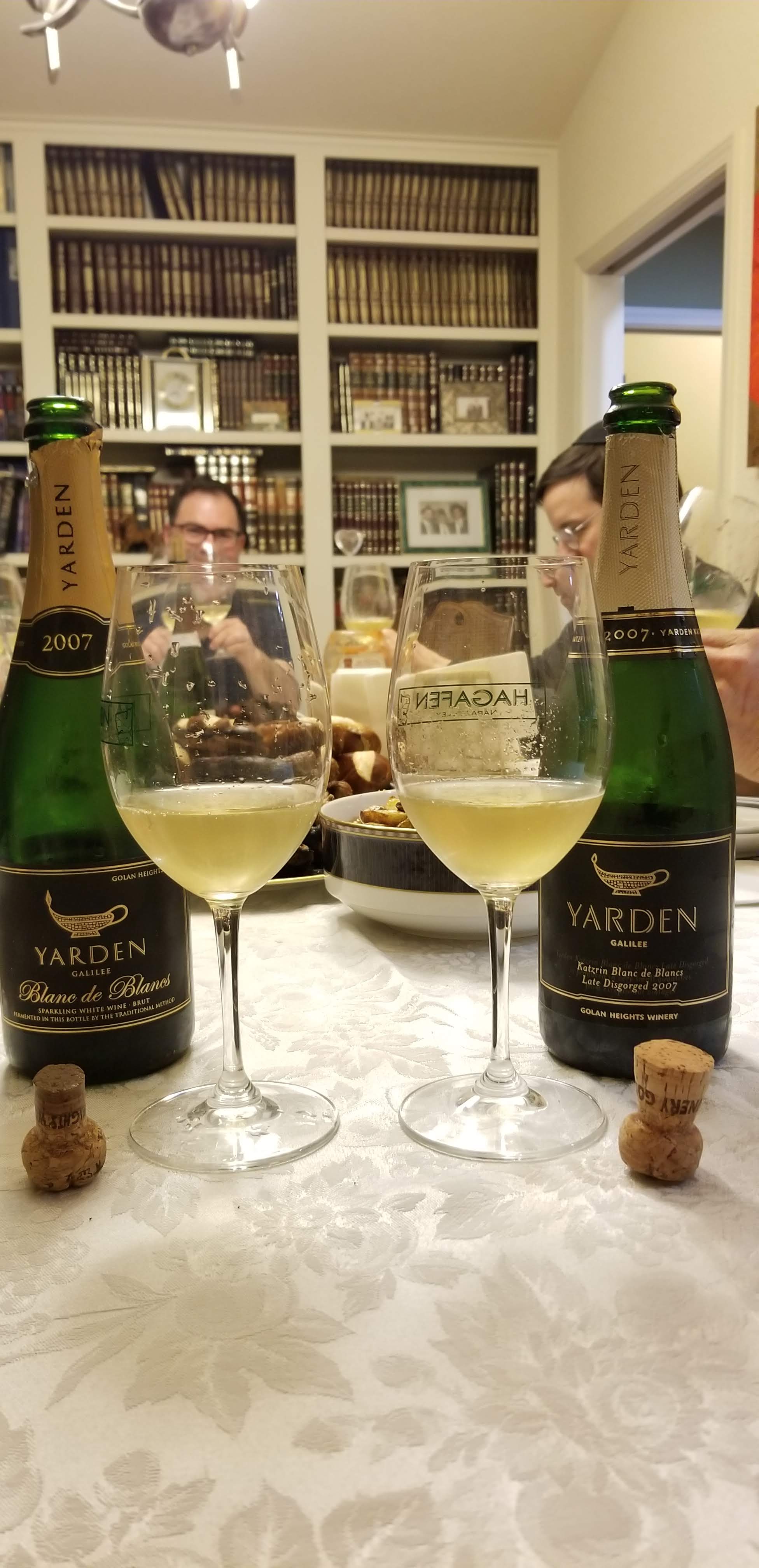
I used the tasting to do an interesting side by side comparison of the 2007 Yarden Blanc de Blancs and the newly released 2007 Yarden Blanc de Blancs late disgorged. What was interesting was that I did not know that the late disgorged Yarden wines were also Brut nature wines, AKA Zero Dosage wines!
If you are following the posts, I recently posted about Zero Dosage wines. My take away from them was that they are a DRINK NOW style wine. Overall, many of the French Champagnes that we have in kosher have been drink-now wines. The Drappier which is mevushal has been a Drink-now style wine, and again Drappier prints the dosage date, so use that to decide if the bottle in front of you is too old.
The Laurent Perrier was also having serious age issues here, as the Champagne was not moving fast enough here in the USA. The not-mevushal Rothschild was outstanding in France.
With all that said, the kosher Champagnes here in the USA are not built to age. However, the Yarden sparkling wines age far better, IMHO. The 2007 Yarden Sparkling Blanc de Blancs has been wonderful for many years now. So, when I had the chance to taste the newly released 2007 Yarden Blanc de Blancs Late Disgorged alongside the normal 2007 Yarden Blanc de Blancs I was really excited! I had bought the wines but I had no one to try them with, so when Eli and his friends said we are coming into the area, I told Benyo and we used it as a great opportunity to share some wines.
The notes speak for themselves, but to me overall, the Late disgorged is not worth the money. The wine is GREAT, but for 70+ dollars, not worth it. Still, to taste them side by side, you could see the same style of the wine, but while the normal bottling was still showing very well, the newly disgorged wine was screaming in tart and very bright fruit.
The color was also, lighter in color, and I loved how the 2007 cork was already very crushed, while the new late-disgorged wine showed a perfect sparkling wine cork. See, the image below, along with Eli, big head!!!!

My top 25 kosher wines of 2017 including wine of the year and best wine of the year awards
I wanted to make this post short and sweet – so the criteria are simple I could care less about price, color, or where it was made. All that matters is that it is/was available this year sometime to the public at large and that I tasted it in a reliable environment, not just at a tasting, and that it was scored an A- to A or higher. Also, there are a few lower scoring wines here because of their uniqueness or really good QPR. I also included some of the best wines I tasted this year – they are at the bottom.
This year I am adding the “wine of the year”, and “best wine of the year”. Wine of the year will go to a wine that distinguished itself in ways that are beyond the normal. It needs to be a wine that is easily available, incredible in style and flavor, and it needs to be reasonable in price. It may be the QPR wine of the year or sometimes it will be a wine that so distinguished itself for other reasons. This year, it is not the QPR King of 2017, that went to the 2016 Chateau Les Riganes. No, this year “the wine of the year” is indeed a QPR superstar, but not the king, it is the 2014 Herzog Cabernet Sauvignon, Special Reserve, Alexander Valley. The best wine of the year, well that was easy, it is the 2015 Chateau Leoville Poyferre. So, yes, that means that the top wines of the year are both made by Royal wines, such is life, and I could care less for the most part.
Again, the list is missing wines I have yet to taste, like the 2015 Chateau Pape Clement, which I am sure would have been on this list if I had tasted it, or the 2015 Hajdu Proprietary Red. There are also interesting wines below the wines of the year, think of them as runner-up wines of the year. There will be no rose wines on the list this year – blame that on the poor crop or rose wines overall, they did not even crack the interesting list. Also, this year, we were given a bounty of top wines and finding the list this year was really a task of removing then adding.
The supreme bounty comes from the fact that Royal released the 2014 and 2015 French Grand Vin wines within the same year! The 2014 vintage wines were released in 2017 and the 2015 wines were released (in France in 2017 as well)! Throw in the incredible number of kosher European wines that are coming to the USA and being sold in Europe and this was truly a year of bounty for European kosher wines.
Now, separately, I love red wines, but white wines – done correctly, are a whole other story! Sadly, in regards to whites all we had this year that were exceptional, were epic Rieslings from Germany (Von Hovel) and the fantastic sweet wines from Sauterne and Yaacov Oryah. But dry white wines from elsewhere in the world was sadly lacking. There were a few exceptions, and they were all Chardonnays, but to me, the winner in that story (dry white wine that was not a German Riesling), was the 2015 Herzog Chardonnay, Reserve, Russian River. It does not rate in the wine of the year list, but it is in the interesting wines below. The new Chablis is also nice, as is the Shirah Whites.
Some of these wines are available in the USA, some only in Europe, and a few only available in Israel.
Finally, some of these wines are hard to find and they may have different siblings – but they are worth the effort. The wine notes follow below – the explanation of my “scores” can be found here:
The 2017 kosher wine of the year!
This one was a no-brainer to me. The 2014 Herzog Cabernet Sauvignon, Special Reserve, Alexander Valley is a crazily affordable wine that got rave reviews from me and from the press. Congratulations to Herzog Winery and Royal Wines.
2014 Herzog Cabernet Sauvignon, Special Reserve, Alexander Valley – Score: 92 to 93 (QPR Superstar)
Lovely nose, impressive elegant and old world nose, peaking with a blackcurrant showing blackberry and lovely smoke and tar. The mouth is old world, wow, give me a break, in ways the wine is crazy better than the Warneke (Special Edition), but with years the Warneke will pass it. The mouth on this medium body, is great layered and rich, green, spicy, and rich with concentration, with sweet oak and sweet dill galore, with green notes, loads of foliage, showing dried strawberry, ripe raspberry, black forest berry, all wrapped in mouth coating and drying tannin, with earth and spice. The finish is long, and richly green, with nice spicy notes, leather and scraping mineral, showing bright and ripe fruit that is impressive, elegant, rich, and layered, with licorice, graphite, and forest floor that lingers long. Bravo!! Drink from 2020 till 2030.
The 2017 best kosher wine of the year!
This one was really tough. First of all, the one I chose is not available yet for purchase in the USA. Also, in terms of score, it did not beat out the Von Hovel Rieslings of 2014 or the 2014 Tour Blanche Sauternes, or the 2015 Chateau Giscours, or the 2014 Chateau Smith Haute Lafitte. In the end – for its sheer awesomeness it beat out a very crowded field. In the end, the winner of the BEST kosher wine of 2017 goes to the 2015 Chateau Leoville Poyferre, and it deserves the crown – bravo!!
2015 Chateau Leoville Poyferre – Score: 95
This wine was very close to what we tasted from the barrel. The nose on this wine is rich and black, with floral hints, smoke, mineral, and really pushed for now, but incredible and redolent with a perfume of ripe fruit, chocolate, and green notes. The mouth is rich and layered with an incredible finesse of perfection, richly extracted and incredible with rich mineral and saline that is so perfectly hedonistic it is impressive, with chocolate heaven, showing earth, loam, finesse, and elegance beyond explanation, showing soft yet focused with a tight-mouthfeel, with rich raspberry, blackberry, ripe plum, all focused and concentrated with perfection. The finish is long and rich and paired with an acid and mineral that is never-ending, almost ripe and tart at the same time, with draping tannin, graphite, and charcoal with expressive and focus. Drink from 2022 to 2040.
Rest of the top 25 kosher wines of 2017
2015 Chateau Grand Puy Ducasse – Score: 94
This wine was very close to what we tasted from the barrel. What a nose, this wine is mostly Cabernet Sauvignon and a drop of merlot. This nose is green and red and really mineral focused with dark but red fruit focused, showing lovely elegance, dirt, and herb. The mouth is medium bodied with rich extraction, rich currant, red fruit, with dirt in the background, wrapped in rich and searcing tannin mouthfeel, with roasted herb, and rich tobacco that is backed by elegance and control, blackberry, plum, that gives way to dark chocolate epic control, foliage, and oregano that lingers long with graphite, pencil shavings, and rich leather. Drink from 2024 to 2034
2015 Chateau Giscours – Score: 95
This wine was very close to what we tasted from the barrel. The nose on this lovely wine is super dry, with more of a classic Bordeaux nose, less ripe than some of the previous wines, with the ever classic blueberry notes of Giscours, with black and red fruit galore backed by roasted herb, rich mineral, and lovely saline. The mouth is rich, incredible, massive, full-bodied and incredibly extracted with rich saline, with layers of unstoppable concentrated fruit, with blackberry, raspberry, with blueberry, rich spice, mushroom, and herb. The finish is never ending with green notes, roasted herb, incredible drying tannin, with a deep fruit base followed by the mineral, black fruit, earth, graphite, and rich spice, cloves, and dark chocolate. BRAVO! Drink from 2023 to 2035
2015 Chateau Lascombes – Score: 94.
WOW, how this wine changed from when we tasted it in the barrel. This wine is a blend of 50% Cabernet Sauvignon, 46% Merlot, and 3 to 4% Petit Verdot. It is the flagship wine of Chateau Lascombes. The nose on this wine is even crazier than the Chevalier, showing more umami and soy sauce if that is possible, with incredible finesse, showing massive power, but great mineral and concentration, with black and red fruit, foliage galore with tar and roasted animal. The mouth is full bodied and incredible with the same style as the Chevalier, but with more finesse, mouth coating soft tannin that is extracted with blue fruit, earth, rich concentration, with more saline and power, yet showing incredible precision that is coating and impressive. The finish is long and lovely, with saline, mineral, tobacco, refined dark chocolate, and rich mushroom. Incredible! Drink from 2022 to 2032. Read the rest of this entry

Four Gates Winery’s January 2018 new releases
As you all know, I am a huge fan of Four Gates Winery, and yes he is a dear friend. So, as is my custom, as many ask me what wines I like of the new releases, here are my notes on the new wines.
I have written many times about Four Gates Winery and its winemaker/Vigneron Benyamin Cantz. Read the post and all the subsequent posts about Four Gates wine releases, especially this post of Four Gates – that truly describes the lore of Four Gates Winery.
Other than maybe Yarden and Yatir (which are off my buying lists – other than their whites and bubblies), very few if any release wines later than Four Gates. This year is a re-release of the 2014 Petite Sirah and 2014 Zinfandel in a blended format called – MPSZ. Of course, it includes the 2014 Mourvedre, which is also being released a single varietal under the Ayala label.
Another wine this year under the Ayala label is the NV Chardonnay, it is a nice wine that did not go through malolactic fermentation, so while it has creamy notes, the rich butter and butterscotch notes of previous chardonnays will not be found here.
The rest of the wines are the normal suspects, but this year’s crop, like last years, is really impressive. You have a 2014 Four Gates Pinot Noir, an NV Four Gates Cabernet Franc (a blend of the 2014 & 2015 vintages), the 2013 Four Gates Merlot, La Rochelle, the 2013 Four Gates Cabernet Sauvignon, Monte Bello Ridge, Betchart Vineyard, and the 2013 Four Gates Frere Robaire.
The notes speak for themselves. These are the wines I liked, there are two other wines that will be sold, but I am not a fan of them, I am sure others will be. The wine notes follow below – the explanation of my “scores” can be found here:


NV Ayala Chardonnay – Score: 90
Lovely nose of ripe melon, lovely lemon curd, with green and yellow apple, and spice galore. The mouth on this lovely medium to full-bodied wine is nice and richly acidic, with a creamy mouth, showing lovely green notes, sweet dill, with butter notes, lovely sweet and ripe fruit, and lovely sweet spices. The finish is tart, refreshing, lively, with acid madness, showing a style of sweet and tart fruit, and nice complexity. Drink by 2025
2014 Four Gates MPSZ – Score: 91
This wine is a blend of Mourvedre, Petit Sirah, and Zinfandel. This is a fun classic Cali wine, floral, sweet, spices galore, with sweet oak, and lovely red and blue fruit. The mouth on this medium bodied wine is fun with raspberry, plum, ripe juicy strawberry, blueberry, all wrapped in nice tannin, with nice mineral, spice, and zesty fruit. The finish is long and rich, with sweet notes, black olives, and cinnamon. Drink by 2021
2014 Four Gates Pinot Noir – Score: 92 to 93
This nose is a classic Four Gates Pinot, with chicken cherry cola, sweet raspberry, lovely spices, menthol, herb, and rich spice. The mouth on this full bodied wine is rich, layered, elegant, lovely, with green notes, lovely foliage, sweet oak, with sweet cherry, raspberry galore, and crazy Benyo acid, with smoke, vanilla, hints of mushroom (which will show more with age), earth, and loam. The finish is long and green, richly acidic, menthol galore, herb, coffee, loads of tart red fruit, and more smoke. Bravo!!! Drink from 2019 to 2027
NV Four Gates Cabernet Franc – Score: 93
This is a blend of 2014 and 2015 vintages. This wine is a classic Benyo special, what a wine, this is crazy fun, what a rich floral, raspberry nose, with violets, rich tart fruit, with cherry, chocolate, mushroom, and foliage galore. The mouth on this full-bodied wine is really fun, rich, layered, with a real mouthfeel that gives way to mushroom, rich tilled earth, with red fruit, plum, raspberry, vanilla, and lovely focus, that gives way to great acid and sweet forest floor. The finish is long and green, with bell pepper, foliage, with vanilla, leather, and heather. Bravo!!! Drink 2020 to 2027
2013 Four Gates Merlot, La Rochelle – Score: 94
The nose on this wine is plum heaven, with crazy truffle, mushroom, and rich tart raspberry, followed by black fruit, and rich dirt. The mouth on this full bodied wine is crazy, rich, layered, with layer after layer of concentrated fruit, nice extraction, and intense acidic, with tannin galore, perfectly balanced, with sweet red raspberry, plum, sweet currant, black forest berry, and dark cherry. The finish is long and green, with foliage, mushroom, vanilla, sweet oak, spice, with menthol, mineral, graphite, sweet red fruit, and acid plays well together. Bravo!! Drink from 2020 to 2030.
2013 Four Gates Cabernet Sauvignon, Monte Bello Ridge, Betchart Vineyard – Score: 94
Lovely nose of earth, dirt, green notes, caraway seeds, coffee grinds, with black fruit hiding behind good bright notes, and mineral. The mouth on this full bodied wine, is rich and layered, showing lovely extraction, rich blackberry, blackcurrant, with impressive fruit structure, showing elegance and attack, with great focus and spice, spicy oak wrapped in earth and mouth coating and expressive tannin, with so much tar that it feels like road work in the mouth, and green notes galore. The finish is long and green with focus and power, showing dark chocolate, foliage, with scraping mineral, graphite, and mounds of earth lingering long. BRAVO! Drink from 2021 to 2031.
2013 Four Gates Frere Robaire – Score: 94
Another stunning wine, come on, this wine will and always reminds me of Chateau Malartic, and depending on how long you age it, the Malartic vintage compares well. The nose on this wine is lovely, as it opens, it is ripe to start with loads of fruit, mounds of finesse, and sweet oak, with rich mineral, herb, black fruit, with a bit of red in the background, and lovely graphite, and spice. The mouth on this full bodied wine is ripe and opens slowly with rich layers upon layers of sweet fruit, followed by earth, tilled loam, with green notes galore, sweet blackberry, plum, with concentration and rich extraction that gives way to layers of mouth coating tannin, vanilla, and spice. The finish is long and earthy, with foliage, green notes, anise, earth, leather, rich sweet milk chocolate, mushroom, and loads of forest floor. Drink from 2021 to 2030.

A birthday party long in the makings
Well, this past weekend I had a long-delayed birthday party at home, with friends and great wines. In honor of my birthday, I made the classic Tunisian Friday night dinner, but without all the classic trimmings; Couscous with boulettes.
This was one of my better couscous for a few reasons. First of all, the axiom – more is better, is truly meant to describe how much chicken you should throw into a chicken soup recipe. Second, I threw in a bunch of onions, zucchini, and ground up – oven roasted – mushrooms into the meatball recipe. Sadly, the makoud was lacking, because I refused to douse it with oil and eggs. The age old Tunisian cooking rule holds very true to makoud, if the dish does not look like an oil spill, you have done it all wrong. In this case, the lack of 12 eggs and an easy hand on the oil made for more of a potato mash than a souffle.
With that, the rest was up to me and Benyo, from Four Gates Winery to handle the rest of the wine duties. ER and HK brought apple cobbler dessert, while SR and JR brought some dessert that was hijacked by Rochel for later consumption. Fear not, they both know the drill, some things that are dessert based, never make it to the table, they are essentially Teruma to the goddess of the house. Read the rest of this entry
Petite Sirah Round Two and a few very nice wines
 Two weeks ago, before I left for all of the Royal wine events, I went searching through my cellar for more Petite Sirah wines to make up for the sleeping beauties (at least they were beautiful before) I had to endure two weeks ago. Two weeks ago I posted about my failed attempt to find great Petite Sirah wines. Why? I do not know, these wines used to be great and I doubt they are dead, but rather in deep sleep. So, I tried to open all the Herzog Petite Sirah wines I had to see if they were any better. We did have a Herzog petite Sirah two weeks ago – the newest Herzog Petite Sirah that has been released, the 2010 Princeville PS, and it too was so-so, again I think something was wrong with my bottle or I and the rest of the table had an off day.
So, I tried a different table of people (mostly) and a different set of wines, and these came out better, but not awesome, other than the 2009 Baron Herzog Petite Sirah P.S. Limited Edition! That was a beast of a wine and lovely. The clear take away here is that these wines need a lot of time in a decanter and only then are they ready to play. Along with PS wines we also enjoyed three older wines from the Four Gates Winery, and a bottle of the 2005 Galil Yiron.
There was talk that the 2005 Yiron was going down hill, and I can say that the wine is fine and going nowhere but it was shocking when tasted side by side the 2005 Four Gates Merlot M.S.C. The Merlot was bracing with black fruit and acidity, while the Yiron was full of black fruit but flat in terms of acidity, and I think that is what people are concerned about the Yiron. The Yiron is much like many of the older Yarden or Galil wines, they are flabby, oaky/cedar, and black ripe/sweet wines.
It is a continued theme in Israeli wines, the sweet notes and ripe fruit that overpowers the palate and takes away from the other attributes of wines. Having tasted many Israeli wines during my trip to Israel, I have found many wineries who have found a way to calm the sweet or new world notes and show more bright and ripe flavors without overpowering sweetness or fruitiness. The Yiron wines are not one of those, they normally show sweeter notes, and planks of cedar, but they continue to be bold and enjoyable. This one was no different, very enjoyable but the wine’s clear lack of acidity was truly shocking. Read the rest of this entry

 Wine Musings Blog