Blog Archives

California Dreamin’ about more 2021, 2022, 2023, and 2024 vintages and a Herzog Event
The last large post on California wines was at the beginning of 2025. Then life took over, and I have been dribbling posts out. It was time to get the next big California post out! This will not be a retrospective, like I did here. This will be more like the 2024 post I did here, covering the California wines I have recently enjoyed.
It has been a long time since my last post, and I am a good 100 wines behind, at this point, so these next few posts will be short and to the point.
In September, I got into my car and drove to Hagafen Winery. Covenant Winery sent me their samples. There are no new wines from Marciano Estates or Shadybrook Estates. I also had many wines shipped to me from Herzog and Shirah. I also went down to a large event at Herzog Wine Cellars and tasted all their new wines, more on that below. So, this is not as full a tasting of California wines as last time, but very close. This is NOT a list of available wines and scores for each of these wineries’ wines, but rather a set of tastings of what I have not yet had from these wineries. I have two Invei wines, too!
The plan here is to list the wineries and their wines in the order I tasted them (since I did taste some wines more than once). As I stated before, Covenant continues to impress, as does Shirah, recently, with some of their new wines, which are pretty remarkable!
Many thanks to each and every winery here for putting up with me and sharing their excellent wines.
My overall feelings about the California 2021, 2022, 2023, and 2024 vintages
Let us start with the facts: the 2021 vintage for California was the best I can remember. Yes, better than 2012 or 2014, and all around, everyone, and every winery came out with fantastic wines. Why? Because God gave each winery enough time to not screw it up, and even when they wanted to screw it up, he made sure they could not! DONE! Look, God gave them a raw deal in 2020, across the state – and we all know it! So, in 2021, he made up for it in spades (whatever that means)!
The 2021 vintage stood out in BOTH the Mevushal and non-Mevushal wine categories. For white and red wines. It was a shockingly good season all around, and everyone came out smelling like roses!
Fast forward to 2022, and yeah, things were quite different! The wines are classic Cali ripe, and while that works for some, I prefer my wines balanced and focused.
The 2023 vintage is looking good, but the REAL focus here is on the non-Mevushal wines! The Mevushal wines are showing success, but side-by-side with their non-Mevushal counterparts, they are paling in comparison. Add to that, scale and winery focus, and I am finding some REAL steals in 2023 and 2024! Read the notes, but focus primarily on the non-Mevushal wines in 2023, IMHO!
The 2024 vintage is a bit early to call. So far, I have found the white wines lovely, and some of the reds have exceeded my expectations. The vintage was smoking hot; I live here, so I would know. However, some wineries managed this by picking earlier, using water in the vineyards or in the wine, or improving canopy management. The intense heat waves came at the end of the very hot summer, but there were some cooler times in between. In the end, time will tell, but what I have enjoyed so far, and posted here, shows promise!
Read the rest of this entry
Another round of QPR (Quality to Price Ratio) Hits and Misses, 21 QPR WINNERS – June 2025
I have been behind in posting. However, I am back in the swing of things, and after this post, I owe you a post on the new Royal Wines in Paris. Then an IDS post – with some CRAZY wines, and finally the Hotel wrap-up with some REAL SHOCKERS (in a good way) and of course some massive failures (AKA Classic Paris Hotel tasting).
This post is not as long as my last QPR (Quality to Price Ratio) post, but it still weighs in at 86 wines. The last one I did was in December 2024. That one had around 90 wines, and 17 of them garnered a QPR WINNER score. The latest post with the largest number of wines winning a QPR Score of WINNER was the May 2023 post, with 19 wines garnering a QPR score of WINNER. This one tops them all, in regards to QPR scores, with 21 wines winning the WINNER QPR score.
QPR (Quality to Price Ratio) Wines
It has been six or so months since my last QPR (Quality to Price Ratio) post, and many people have been emailing me about unique wines I have tasted and lovely wines that are worth writing about.
Thankfully, no matter how much garbage and pain I subject myself to, we are still blessed with several excellent QPR wines.
Throughout the year, I post many QPR posts for almost all of the main categories. I will continue down this road until I find a better way to categorize and track QPR WINNERS wines. People are still asking me what a QPR (Quality to Price Ratio) Wine is and what the score of WINNER denotes. Once again, those are explained here in this post.
Some things that made me stand up and take notice (AKA QPR WINNERS):
There are many wines here, as stated, and I have been behind on this. So, these wine notes are coming from a collection of times. Some of them are the actual notes from the KFWE events in February that I posted about in March. Some of these wine notes are from personal tastings. Finally, some of these wine notes are from group tastings with friends.
Terra di Seta
Terra di Seta has returned to that special place where its wines are TOP-Tier QPR WINNERS. The 2020 Terra di Seta Chianti Classico Riserva was just lovely! Follow that with the even more affordable, yet lovely, 2022 Terra di Seta Classico. Bravo guys! Here is a slight sneak peek. I tasted an even better terra di Seta in Paris, but that is still three posts away!
Kosherwine.com Wines
I tasted two wines from KW: the 2003 Clos de Menuts and the 2015 Chateau Lavagnac. I found both of them were lovely, though some other people told me I was lucky. Clearly, these wines are on the edge, as my notes state, and they may be good or may not. However, I found the Menuts to be truly enjoyable. Hoping you all have success.
There were more French/European wines from KW that I bought, but they were less interesting.
However, there were two Sleight of Hand (wines made by Ari Lockspeiser) wines that I think KW sells exclusively, and they were both solid. Fruity, with enough brightness to pull it together.
Hajdu Wines
I bought and tasted all the Hajdu current releases, and while I found the white wines WINNERS, more on that below, the red wines are not my cup of tea. They show more fruit and power than I wish for in my cup, but I am sure there are many who will love these wines!
Alex Rubin Wines
Like the Hajdu wines, I bought all of the current releases, and again, the red wines are Cali wines, and the white wines are incredible. The 2023 Arinto is a BLOCKBUSTER and should be sold out already. His Riesling, which was macerated, is also a solid wine that I posted back here. Still, his red wines are more controlled than other Cali producers and I think many people would appreciate them.
Covenant Wines
Jeff, Jonathan, and the gang continue to impress, with no breaks so far. The latest wines I tasted were the 2024 Covenant Rose, the 2024 Mensch Zinfandel, the 2022 Covenant Syrah Bien Nacido Vineyard, and the 2024 Mensch Roussanne.
The Rose is lovely, with no bitter notes, a thing I hate in rose wines. The balance and fruit are there as well. Further proof that even in a weak vintage, the Covenant team delivers value and quality! Great work, guys!
The 2024 Mensch Zinfandel is a Zin that I would buy. Zin used to be my favorite fruit, but that blew off quickly as the wines started getting unruly and unbalanced. Still, if you can create a wine like Covenant did in 2024, my hat’s off to you!!
The 2022 Covenant Syrah Bien Nacido Vineyard is another solid wine, garnering a 92 score and showing the power of California. It was a hot season, and while I found the wine lovely, it is a slight step behind the 2021 vintage, which may well be the best Syrah I have had out of California!
Finally, the Roussanne is solid enough; it is a bit too fruity, but overall, a solid quaff. Keep up the GREAT work, guys!
White Wine WINNERS:
Of the 21 WINNERS, 11 are White or rosé wines! We are getting better in this space, year after year!
I must START with one of the best white wines I have had recently, that is not a Sauvignon Blanc, Riesling, Semillon, or Chardonnay, and that is the 2023 Alex Rubin Arinto. This wine has not undergone maceration, although the mouthfeel suggests it may have had a touch. The wine overall is rich, layered, fruity, intensely acidic, refreshing, and a NO BRAINER BUY! Bravo Alex!
Herzog has two Chenin Blancs, and I posted about them back in September of last year. I tasted the Mevushal one in Oxnard, as the non-Mevushal one was not yet released. The wine does show the oak now, but I found those notes recede over time and show fun wines. These will require some patience, but you will be rewarded.
The 2023 O’Dwyers Creek Sauvignon Blanc continues its torrid run on the kosher wine market! There has yet to be a bad vintage, and while I know of people who are too snooty for the tropical notes, you guys ALL know who they are; these wines hit on all levels for me. This vintage is more steely, more citrus-driven, while still showing enough tropical notes to make me interested. Nice!
The two Hajdu white wines were lovely, the Vermentino and the Proprietary White (a new thing) showed well.
The Otter & Fox (a wine by David Edelman) showed quite nicely! Fruity, balanced, and controlled.
Israeli WINNERS
Yes, there were some good wines from Israel, and they were all Rose or Whites. The 2024 Puzzle Rose is lovely! As was the 2023 Dalton Sauvignon Blanc, Family Collection, the 2024 Netofa Latour Tzahov, White, and the 2024 Dalton Sauvignon Blanc, Fume. Solid choices to enjoy this Summer.
The outlier is the 2023 Matar Cumulus. The 2022 vintage was Shmita so I have no idea what that one tasted like, but the 2021 and the 2023 vintages were both QPR WINNERS! Good for them!
Two Outlier Wines
Every so often, the Vieux Chateau Chambeau Reserve has a good wine! I have tasted three of these wines, which were good, and the rest were not. They are a classic, Mevushal French wine, Russian Roulette. The 2015 was a solid wine, though not the reserve. 2018 was a WINNER under the Reserve label, and it happened again in 2022. The 2022 Vieux Chateau Chambeau Reserve, Lussac Saint-Emilion, has the same score and almost the same notes – perhaps they require a hot vintage to make the wine work; I have no idea.
The other outlier is the 2023 Quinta do Cerrado da Porta Troviscal Tinto, Reserva, Lisboa. Andrew Breskin, of Liquid Kosher, asked me to taste it, and thanks to him, the winery sent the wines to my hotel. I tasted them here in the USA, after they rested for a long time. I sent one or two to him as well, so we both enjoyed this WINNER. I am not sure if they want to export the wine. The notes indicate how much I enjoyed this wine, as does the score; however, it’s essential to understand that the price of this wine in Europe is incredibly affordable.
Read the rest of this entry
The Top and Best 34 QPR Kosher Wine WINNERS of 2024
In May 2020 I wanted to drive home the need for QPR (Quality to Price Ratio) wines. So I set out to create what I thought a QPR metric should be! Gone were arbitrary price ranges and such. Instead, I let the market define what the QPR price range should be. I did this by grouping the wines by their type (white, red, rose, sparkling, and dessert) and then further refined the grouping by age-ability within the white and red wines. This gave me the following groups:
- Drink “soon” White Wine (Simple whites)
- Rose Wine (always drink soon)
- Drink “soon” Red Wine (Simple reds)
- Mid-range aging Reds (4 to 11 years)
- High-end Red wines (11 and more years)
- High-end White wines (7 and more years)
- Sparkling Wine (No need here for extra differentiation)
- Dessert Wine
I then made the mistake of trying to create an Orange wine range/group – that was a HUGE mistake. Again, the wines themselves were not the issue, the issue revolved around trying to group such a small sample set into its group. They will go into their respective white wine category, next year.
Throughout the year, I posted many QPR posts, for almost all of the main categories. I will continue down this road until I find a better way to categorize and track wines that are QPR WINNERS. Talk about WINNERS, that secondary QPR score was a 2.1 revision to my QPR scoring, and that is explained in this post. All the wines listed here are QPR WINNERS from my tastings in 2023.
Let us discuss the approach
I have heard from a few of you. I do not understand your QPR (Quality to Price Ratio) scoring. So, let us take another shot at this! Every time a customer comes into a shop or goes online to buy kosher wine, they have a choice of a few thousand wines, online, or many hundreds in a store. The question is how does a buyer differentiate one wine from the next?
If they like Terra di Seta wines, as I do, and it costs 30 dollars, then he/she will compare other wines to that wine, in regards to the wine and the price. That is the same for any wine they like and any wine they are looking at buying. Price matters! Now, the real question is how can you compare two wines to each other. Any two wines in the world of kosher wines? What characteristics can you use to compare them?
Let us say they like the 2022 Elvi Wines Clos Mesorah. It is a red wine from Montsant, Spain. OK, what other wine can you compare with it? You can compare other Montsant kosher wines, like the Cellar Capcanes wines. However, the Cellar Capcanes wines have an issue – they have been poor for many years! As the ratio states it is QUALITY to price! Quality is primary; once you have a good wine, you can compare it with similarly good wines.
OK, so we need equal or comparably equal quality and that is it??? So, let us say there exists a rose from Montsant that scores the same quality score as Clos Mesorah, are they comparable (by the way no such wine exists!)? What about a white wine – same? Can/should someone compare them? The answer is no, of course. People will compare similar items. OK, are we then forced to compare ONLY Montsant wines with Montsant wines? Of course not, that is NOT how people think. People will compare like-scored red wines with like-scored red wines. Further, there are literally SIX Monstant Kosher red wines on the market. How can one compare six wines to each other? It has no value.
So, the question remains how do we compare two wines? What criteria can we use to compare them? The first step is for us to agree that people will compare wines that are similar in style, but not in locale, region, or price. So what is that characteristic that they will use to compare two arbitrary kosher wines? Price IS NOT the answer.
So, let us recap – we have two similarly scored wines (AKA quality) but they are very different in many ways. Let us look at three of the wines below, two of which are from the greater Medoc region:
- 2022 Chateau d’Agassac Cru Bourgeois, Haut-Medoc – Score: 93+ (QPR: WINNER)
Drink until 2038 - 2022 Chateau Fourcas Dupre, Listrac-Medoc – Score: 93 (QPR: WINNER)
Drink from 2034 until 2040 - 2022 Chateau Royaumont, Lalande de Pomerol – Score: 93 (QPR: WINNER)
Drink from 2030 until 2038
These wines sell for between 38 dollars and 60 dollars. So, are these wines comparable? I would state they are, and further state that wine buyers compare them every time they read my lists and other lists that like these wines. Again, the primary requirement is quality – these all scored roughly the same quality score.
So, next, would you at least compare two Medoc wines to each other? The Chateau Fourcas Dupre and the Chateau d’Agassac? I would say yes for sure. Well, why is the Royaumont any different? Of course, they are very distinct wines, but in the end, what do oenophiles buy such wines for?? To store them and share them at a later date, meaning that wine buyers classify wines by regions, but ultimately they classify them by their ability to age gracefully or not! This means some wines age beautifully, and many will be good to enjoy in the coming years.
So, now you see the logic to the categories I use to compare wines – this is the list once again:
- Drink “soon” White Wine (Simple whites)
- Rose Wine (always drink soon)
- Drink “soon” Red Wine (Simple reds)
- Mid-range aging Reds (4 to 11 years)
- High-end Red wines (11 and more years)
- High-end White wines (7 and more years)
- Sparkling Wine (No need here for extra differentiation)
- Dessert Wine
Essentially, ignoring sparkling, rose, and dessert wines, there is white wine and red wine. Each of those two major categories is broken into their age-ability. Red wines have three age ranges while white wine has two. Then there are the other three aforementioned groups, rose, sparkling, and dessert wines.
Once you have scored a wine – IRRELEVANT to the price – this is KEY, you must place that wine into one of the 8 categories listed above. Once you have done that, any wine in that category is available for comparison. Using the median approach, wines are stacked and ranked by their price, within that category, and some rise above others, by having an equal or better quality for a lower or equal price. Please read more about this here and here.
The Summary
Before we get to the list of the best QPR wines for this past year, I wanted to give you some raw stats. I tasted more than 1200 wines this past year. In actuality, it is probably far more, I just did NOT care to write notes on hundreds more because all it would have said was NO. I made sure to taste all the Israeli wines at three KFWE, and while some were worthy of notes, none garnered these scores. The pain was all I remember. In the end, 188 wines were scored with a QPR score of WINNER, for the blog year 2024.
I have stated it over and over again now, there is no way we can buy all the good wines out there unless you have a local warehouse to store them and you drink two or more bottles a day. That is the excellent news about Kosher Wine today! I hope we have not yet hit peak QPR WINNER Wine.
This year, the list came to a total of 34 names, and none had to dip below 93 in the scores, which is a large number and better scores overall than last year, but again, the pool from where they are culled continues to grow, and the diamonds in the rough are getting harder and harder to find. This year, there are 34 or so QPR WINNERS who scored 93 this year but not in a single area.
The 4 regions that encompass the 34 WINNERS are in order of size, France (27), Spain (4), USA (2), and Hungary (1). Within France, it is not all Bordeaux! There are wines from Bordeaux, Burgundy, and Chateauneuf du Pape.
Of the 34 WINNER, 4 of them are white, 28 are red, and 2 are sweet. However, at the lower price and quality QPR WINNERS (think 20 dollars 91 scoring wines), you will find that white wines are the majority!
This year we have 9 wines that are a WINNER in Europe and the rest of the world and NOT in the USA.
- The 2020 Chateau Haut Brisson) is because of pricing here in the USA.
- The 2023 Domaine Raymond Usseglio & Fils Chateauneuf du Pape, Blanc is not the same here in the USA as it is in Europe. I have no idea what happened to it but the quality is vastly different.
- The 2021 Tokaj-Hetszolo Tokaji Aszu 6 Puttonyos is because of pricing here in the USA.
- The 2020 Chateau Haut Brisson is because of pricing here in the USA.
- The 2022 Chateau Royaumont is because the wine is Mevushal here and not as good, though still a WINNER, but not at the same quality.
- The 2022 Les Roches De Yon-Figeac is because the wine is Mevushal here and not as good.
- The 2022 Chateau Gazin Rocquencourt is because the wine is Mevushal here and not as good.
- The 2022 Chevalier de Lascombes is because the wine is Mevushal here and not as good.
- The 2022 Château Olivier Grand Cru Classe is because of pricing here in the USA.
- The 2022 Chateau Haut-Marbuzet is not available at all here in the USA.
Sadly, there were no new Sparkling or Rose wines to make it to the score of 93 and to meet its counterpart pricing. To me this is a HUGE issue in the kosher wine market! The kosher wine market has lifted up one of the previous sad wine categories, white wine! Which is HUGE! Sadly, we have not moved from there. We have a dominating red and white kosher wine scene. What is lacking sorely, is quality, sparkling wines! The rose wines will never reach the upper echelons, at least in the Kosher wine markets! However, there is actual demand for sparkling wines, and sadly, the products being sold are nice, but the prices are too high, or the quality is too low.
Maybe, Avi Davidowitz, from Kosher Wine Unfiltered, can create a list like that for Israel, this year, a bunch of wines became available there, and a proper QPR list would be worthwhile!
The wines on the list this year are all available here in the USA, and in Europe, and a few can be found in Israel, as well. The wine notes follow below – the explanation of my “scores” can be found here and the explanation for QPR scores can be found here:
2022 Elvi Wines Clos Mesorah Garnatxa, Montsant – Score: 95 (QPR: WINNER)
The nose of this wine is lovely. It pops with intense brightness, followed by a massive attack of ripe but controlled fruit, dense minerality, rich salinity, intense graphite, lovely cloves, cinnamon, warm spices, loam, dirt, earth, lovely raspberry, strawberry, and ripe/bright red berries. WOW! With time, the wine becomes even more complex, showing floral notes, ripe fruit, and lovely sweet spices. Bravo!
The mouth of this medium-bodied wine is so elegant, complex, and singular in grape, and there is nowhere to hide in this bottle; it is complex, lithe, rich, and layered but intensely refreshing. This wine is the Pinot Noir of the Rhone and Spain; there is nowhere to hide, and yet the wine is so impressive. This wine is pure black magic; it is ripe, lithe, tart, acidic, elegant, and dirty, all in the same glass, and yet this is a wine that does not exist in Kosher. Sure, there are lovely blends, but a wine this ripe that is also elegant, lithe, and smoky, you want to drink it all!
The mouth is lovely, ripe, layered, elegant, and toasty, with sweet spices, lovely raspberry, and strawberry, nice umami, really fun, expressive, and captivating; it is so unique and special, with umami, and mouth-drawing elegance, WOW! Bravo! The finish is long, dirty, earthy, smoky, and umami-dense, with great graphite and ripe, mouth-draining tannin. Dirt, minerality, graphite, ripe and tart red fruit, and intense acidity linger long. Drink from 2030 until 2036. (tasted December 2024) (in Clos Mesorah, Spain) (ABV = 15%)

A quick post of four new Covenant Wines releases – January 2025
I just published a different post and wanted to catch up on the rest of my California wine notes with this post. Covenant Wines continues to excel year after year with wines that show what California has to offer. They have been slowly expanding their portfolio with two new Mevushal wines, the Black Label Cabernet Sauvignon (that started in 2021) and the Black Label Pinot Noir, which they just released in 2023. Since the start, Covenant Wines, led by Jeff Morgan, Jonathan Hajdu, Jodie Morgan, and the rest of the awesome Morgan family, have been making wines since their inaugural 2003 release. Not all the family was working on this effort, from the start, but they all joined slowly. Now, this is a family-run operation that continues to push on what I would call QPR (Quality to Price Ratio) WINNERs. They continue to prove that California does not need to be expensive, and they continue to prove that California can excel at making balanced and refreshing wines. Those two statements – quality wines and wines sold at reasonable prices (compared to their peers) is the VERY DEFINITION of QPR (Quality to Price Ratio) winemaking.
The good news continues with their newly released 2023 Cabernet Sauvignon, Black Label. So far, and I am already late closing my blog year, this is the Mevushal wine of the year. It is a wine that pops, shows no boil/cooked notes, and is clean, alive, fresh, and exciting. The same can be said for the 2024 Sauvignon Blanc, Red C, and the 2024 Viognier, Red C. Both wines are varietally authentic, showing great pop, acidity, and balance for California wine.
Finally, the newly released 2022 Covenant Cabernet Sauvignon, Solomon, Lot 70. It is a ripe wine, but give it time. The wine finds its place and is quite lovely!
I know this is a rushed piece, but I wanted to get it out there and move on to some very large-format posts—hint, hint. Best wishes to all, and prayers for the Hostages and for those suffering down south in SoCal. Prayers go out to all!
My many thanks to Jeff, Zoe, and the rest of the clan for sharing these wines with me. They are listed in the order I tasted them. The wine notes follow below – the explanation of my “scores” can be found here, and the explanation for QPR scores can be found here:

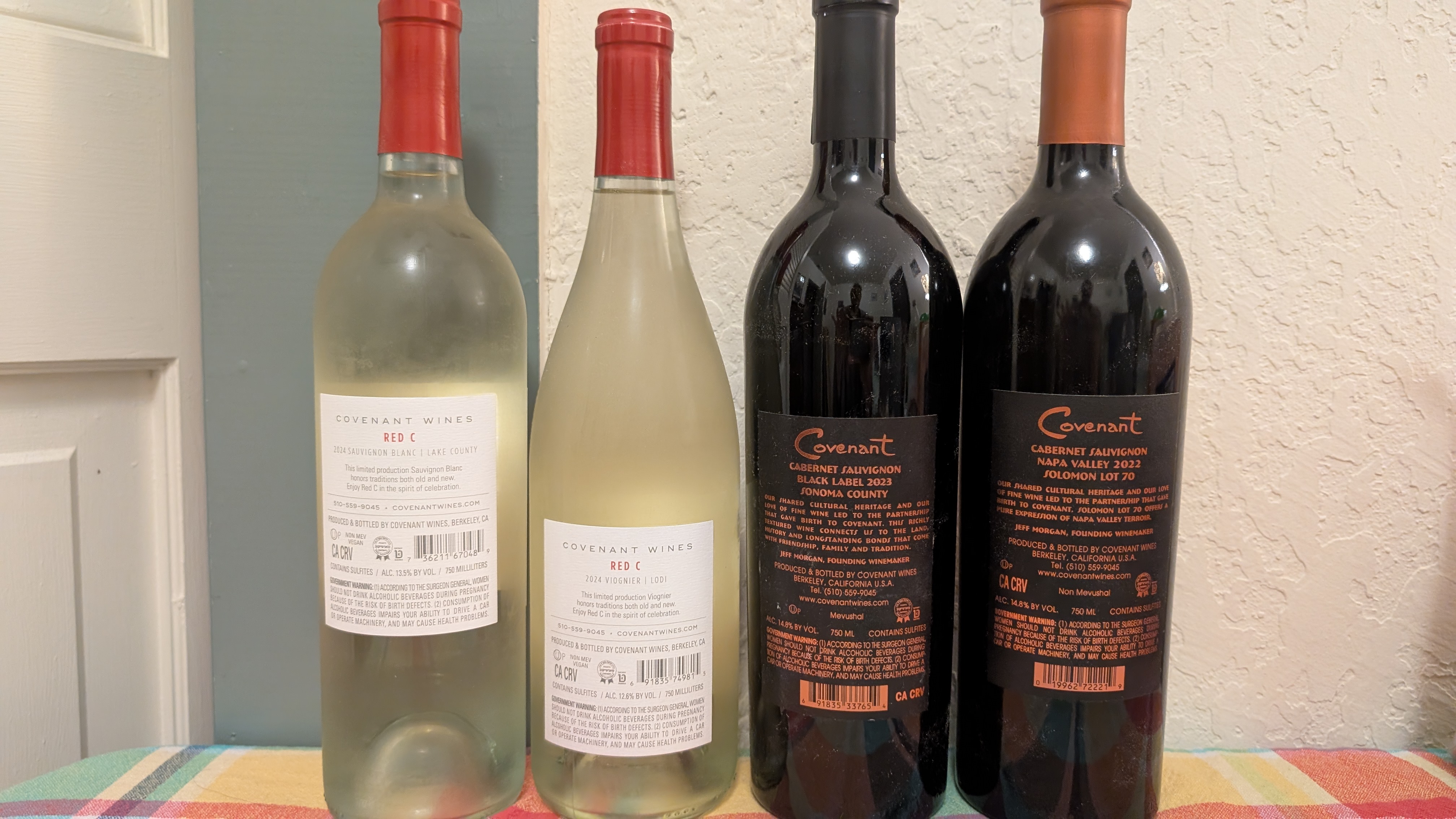
2024 Covenant Viognier, Red C, Lodi, CA – Score: 91+ (QPR: WINNER)
The nose of this wine is varietally true, with fresh and clean aromas of ripe and juicy yellow peach, lychee, grapefruit, and flint. The mouth of this medium-bodied wine is lovely, with almost no bitterness at all, refreshing and ripe at the same time, not too fussy, with great acidity, creamy with juicy peach, apricot, lychee, grapefruit, and slight tension. The finish is long, tart, ripe, and refreshing, with good ripe fruit and fruit-focused. Nice!. Drink now! (tasted January 2025) (in San Jose, CA) (ABV = 12.8%)
2024 Covenant Sauvignon Blanc, Red C, Lake County, CA – Score: 91+ (QPR: WINNER)
The nose of this wine is nice, showing notes of creamy lychee, grapefruit, gooseberry, passion fruit, and nice smoke.
The mouth of this medium-bodied wine is nice, but right out of the bottle, it has a bit of issues. Give this wine a few minutes, or it may be the bottle shock; either way, give this lovely wine a bit of time to breathe.
After 30 minutes, the wine has great acidity and a nice fruit focus; it has a creamier/fatter mouth than last year, with lemon/lime notes, nice gooseberry, loads of great flint, nice passion fruit, and lovely minerality, nice!
The finish is long, tart, and creamy, with lemongrass, flint, and lovely lemon/Lychee/flint notes lingering long. Nice! Drink now. (tasted January 2025) (in San Jose, CA) (ABV = 13.5%)
2023 Covenant Cabernet Sauvignon, Black Label, Sonoma County, CA (M) – Score: 93 (QPR: WINNER)
WOW! This is the third Mevushal (Black Label) Covenant Cabernet Sauvignon, and it is lovely! I am also getting used to the amalgamated corks, and I am happy.
The nose of this wine is lovely, controlled, ripe, California, creamy, and rich. It shows iron shaving, minerality, rich smoke, tar, anise, black pepper, ripe black and red fruit, lovely pop, and dirt. Bravo. This is the best Mevushal one so far.
The mouth of this full-bodied wine is lovely, showing great acidity, nice mouthfeel, creamy and rich, but with good pop, blackberry, plum, cassis, beautiful minerality, graphite, nice smoke, mouth-draping tannin, rich and layered. This is an impressive showing for a Mevushal wine, showing power, plush mouthfeel, finesse, almost elegant (though with all this power it is tough), some sweet oak, but it is not in your face, and nice dirt. Bravo!
The finish is long, dirty, ripe, balanced, with sweet tobacco, milk chocolate, graphite, and lovely tannin/acidity. Bravo!!! Drink until 2034. (tasted January 2025) (in San Jose, CA) (ABV = 14.8%)
2022 Covenant Cabernet Sauvignon, Solomon, Lot 70, Napa Valley, CA – Score: 93 (QPR: GREAT)
The nose of this wine is ripe, a bit more than I had hoped, but let’s watch this wine evolve over the next day or so.
The nose shows ripe notes of candied fruit, almost dried black fruit, with tar, anise, nice minerality, smoke, sweet oak, and dirt. The mouth of this full-bodied wine is ripe but not as candied as the nose. It has impeccable acidity, good pop, mouth-watering blackberry, cassis, and raspberry flavors, great salinity, minerality, rock, and graphite. The wine is mouth-draping, almost elegant, with nice black and red fruit and hints of green notes, while the heat/candied notes lurk.
Thankfully, with time, the fruit and heat calm, and the elegance comes out fully. The mouth is layered, rich, controlled, and elegant with mouth-draping tannin, good fruit, great focus, and refreshing, with more blackberry, cassis, and blackcurrant, all wrapped in sweet oak and lovely dirt. Bravo!
The finish is long, dark, brooding, smoky, and toasty, with dark chocolate, leather, smoke, and tobacco. Drink from 2028 until 2035. (tasted January 2025) (in San Jose, CA) (ABV = 14.8%)

California Dreaming about the 2020, 2021, 2022, and early-2023 vintages – a retrospective
In May 2024, WOW, I have to get used to the new 2025 thing; I wrote a post about wines I had tasted in the past month or two. However, after tasting through so many excellent California wines from 2021, I decided it required a retrospective.
Some of these wines will be new to the blog, some will be reposts, and some will be reposts with a change in the scoring (I will denote those clearly).
The 2020 vintage was blighted by many fires, smoke taint, and a poor overall showing. The 2021 vintage was far more controlled, with almost no heat spikes. Though there was little rain before it, the vintage came out smelling like a rose. In the 2022 vintage, we saw far too many heat spikes. Add in many days of over 100-degree weather, and it is shocking that anything good came out. Still, I found some winners. The 2023 vintage is looking like the best of BOTH worlds: rich, layered, with incredible balance. The California whites from 2023 outshined all of Europe and Israel, and we wait now for the release of the higher-end red wines to make a conclusive decision.
As you read through this post about the Kosher wineries that reside in California, understand that California is not Napa Valley. It is a vast state with many wine regions. California is massive. It has four main wine-growing regions and 147 viticultural areas (AVA). If California were a country, it would be the fourth largest in regard to wine production.
At the start, in 1985, when Robert Parker and Michel Rolland took over the world and drove wine production toward a more fruit-driven approach, Napa Valley was the poster child for what a “proper” wine should be. The fruit was very prominent, the tannins were round, not astringent, and the alcohol levels were high. If you watch and listen closely to the videos of Peter Koff, MW, and Dr. Pat Farrell, MW, you will learn so much! Listening to them, they describe the wine critics at the tasting/judgment of Paris who were looking for the ripest fruit.
Looking at current wines, I feel such a tasting would have very different outcomes. First of all, Bordeaux’s ABV is climbing, and there is no end in sight. This is not a choice by the wineries; instead, it is a choice of nature. Secondly, Napa Valley, which was the California area of choice, is even riper than in those days, and I think they would stick out badly. Many Napa Valley wineries are trying to bring their approach back to the middle, but they run up against the same issues Bordeaux is facing, and really the entire world.
When you look at the notes below, you will find three camps. One is the tried-and-true camp of Alexander Valley, AKA Sonoma. It has continuously shown control and power, though at times lacking acidity and finesse.
Next, you will find Napa Valley split between two camps: the bid, bold, in-your-face Robert Parker dream, fruit-forward, powerful, fleshy, and alcoholic to the max. The other side of this camp is the more controlled, sinewy, and acidic, though showing Napa’s power, with a steady hand and clear horizon towards Old-world style wines.
Finally, you find the wild-wild-west at its greatest in areas like Santa Barbara, Paso Robles, and the other regions to the south. Here is where folks like Shirah Wines live. Wines that are more Rhone-style, off-the-beaten-path varietals, exciting, and not yet fully commercialized ideas that bring a smile to most who try them.
As you read through the notes, you will find that I look for balance. I like power; I do not crave it. I desire a wine with rich acidity, balance, clean lines, power or not, but a wine that makes you want to take another sip, because it is refreshing. Balance is the definition of a glass of wine that clears your palate not by giving you a headache but rather by having acidity and pop that can have power but more assuredly has an acidity that works in conjunction with the fruit.
To that point, you will find wines below that get high scores because they are balanced. Examples of wines I bought, which is the highest proof of a wine I like, are the 2021 and 2022 Marciano Estate, 2021 Covenant Cabernet Sauvignon, 2021 Covenant Cabernet Sauvignon, Lot 70, 2022 Covenant Cabernet Sauvignon, and the 2021 Herzog Alexander Valley Cabernet Sauvignon. The 2021 Napa Valley Cabernet, Reserve is a clear WINNER and one you should all seek out.
The 2023 Pinot Noirs from Herzog and Covenant prove that this vintage has potential, but again, we will not know where it lines up until after the full lineup of red wines is released across California.
Finally, the higher-end white Sauvignon Blanc wines from Marciano, Covenant, and Hagafen are worth finding – they are lovely! I wrote a separate post, mid-2024, about the top white wines from 2021 through 2023, which are well worth buying!
Pricing
I am fine with writing about kosher wines, but we cannot talk about Kosher Napa Wines without addressing the large elephant in the room, which is the elevated prices. I stress Napa Valley because there are no Kosher California Wines above 130 dollars outside of the Herzog Sonoma Clone Six and the new Herzog Double Creek. Please do not talk to me about Four Gates Wine. Respectfully, it is a drop in the bucket and does not move any needles, industry-wise, other than for its quality.
The number of bottles produced at the price range that raises eyebrows is starting to make people like me wonder. How many people are buying wines priced at 200 or more dollars? Many of the wines listed below are 300 or more dollars. How do you build a brand and a list of people for wines at that price?
Yes, there are more expensive wines out there, but that is one or two, and they are from storied old-world marks and vineyards, meaning they have a track record. Of course, runs at cult-like Napa Wineries have been going on underground for a very long time. Now, we are seeing Kosher Napa Wines selling in the 200-plus to 360-dollar range on store shelves, and it is all new for the kosher-wine-buying public.
There is a clear cost to everything that happens in making a wine kosher, and those people deserve to be paid. A few hands in there also need to be paid for fronting the money, marketing, and so on. However, the per-bottle “kosher tax” does not need to be commensurate with the cost of the non-kosher base price. Again, there is a cost for working in Napa and making Kosher wine there, but as proven by Hagafen and Herzog, wine can be produced without those high Kosher wine taxes.
Ultimately, I am at the mercy of those who feed me. As always, I openly state that I go and taste wines; when I do, I do not pay to taste those wines. At the same time, I post what I taste and never change a score because of the situation in which I may be placed. There is a clear reason for why I have stopped going to specific wineries and regions to taste – because the outcome was getting too awkward, and the posts were becoming a chore. I am always very thankful for the chance to taste wine, and I am always honest about what I taste, and for the most part, I stay out of wine business commentary. However, when everyone asks me the same question, I suppose I cannot just ignore the elephant.
Criteria and Process for this post
I thought long and hard about how I would manage this post. At first, I thought I would do a total dump of all the wines across wineries from both the 2021 and 2022 vintages. However, that would end up as a massive mess; there are far too many wines. So, I decided to list all the wines from all the California wineries I tasted, scoring a 91 or higher from the 2021 and 2022 vintages. There are still a lot of wines, but that is the only way to get a list in one post, and that is not insane.
I will leave the red wines from the 2023 vintage alone for now. There are too few wines from that vintage at this time. Still, I will post some 2023 white wines as they are showing well, and they were tasted at the same time! Also, Four Gates has yet to release their top 2021 or 2022 wines, so we may need yet another retrospective after that. LOL, I think not. There is one exception, Kasher Wines, which I first tasted in November, has a 2020 Cabernet Sauvignon.
You will not find Four Gates Winery here because they have yet to release the 2021 vintages, and they are so small that it is impossible to really compare them with these other players. You can look here if you want to find my posts on Four Gates Winery. Other wineries make Kosher Wines in California but I did not find their 2021 vintages that interesting to me to make it into this post.
Closing Thoughts
This post is massive and took a crazy amount of time, thought, effort, and tasting! People ask me about wines and respectfully never really think about the amount of effort it takes to put it down on paper. Of course, none of this could have happened without the kindness and generosity of the wineries in sharing their time and wines, which took them far more effort to make. Many thanks to Elk (Elchonon Hellinger from Elkwine) for helping set up a lot of this. David Edelman for sharing his time and wines as well. Many thanks to all the wineries, Marciano Estates, Ka.sher Winery, Hajdu Wines, Shirah Wines, Herzog Wine Cellars, Covenant Wines, Hagafen Cellars, Tench Vineyards, and Addax Wines.
Read the rest of this entry
Best Kosher Whites Wines from 2021, 2022, and 2023
I have been complaining about Roses recently. Yes, we had a good slate of them, for those that need them. However, I state over and over, that White WInes are what we need more of and they fill the abilities that Rose wines were meant to help with. This post will be short and to the point. I hope you all use this to enjoy the crazy heat waves rolling over the world. White wine is the answer to some lovely meals with friends and family!
White Wines
I understand the thought that people have, that Rose wine will be more enjoyable with certain food/fare than a white wine. That thought is wrong, but I understand. People see the red hue and think it is a red wine that can be enjoyed with a burger. The truth is that Rose or white wine can do the same thing if they are dry and have intense acidity. The acidity is the main point here. Sadly, while some Roses will work, most of them lack the acidity for that to be an honest assessment. So, people buy the Roses, they lack the refreshing acidity and leave unhappy. The better option is white wines. They have a higher probability of existing with good acidity and they are just more enjoyable. The last point is 100% subjective and I understand that.
People see Rose as a way for people to learn about red wine without the need for Cabernet Sauvignon or what. While I see that as an approach and I appreciate it, soon enough, Red wine folks just go back to Red wine as they miss the tannin/sweet wine punch. Big, fat, even balanced Oaky wines can give you the closest thing to a wine that Red wine drinkers will appreciate.
The oak, fat fruit, and rich mouthfeel, followed by good tannin will make the Red Wine drinker happiest. The hope is eventually, they will jump on the ABC train (Anything But Chardonnay) that is slowly rising up again, given the heavy whites coming out of Cali. Hopefully, they will desire less oak, and more balance, and find the plethora of Kosher White wines that we are blessed with.
Peak Kosher White here or very near
We are currently blessed with an almost never-ending list of white wines. They may not all be great, they may have acid issues or balance issues, but we have so many options that it is impressive! We will see even more soon so I hope you are getting your white wine mojo going!
Methodology
So, the idea here is to post the new white wines that I have not already posted – some of which date back to March of this year. I will also post WINNER wines from the years 2021, 2022, and 2023, when/if they are for sale. That last part will be tough but I will use KosherWine and Google as my guide. Either way, they will be reposts of existing posts, so the info is always available.
Ok, that is a wrap, note, I have a TON of wine notes I still need to post after this, my guess is that will end up being a massive QPR post with loads of red wines.
The wine notes follow below – the explanation of my “scores” can be found here and the explanation for QPR scores can be found here:
2022 Covenant Solomon Blanc, Bennett Valley, Sonoma County, CA – Score: 93 (QPR: WINNER)
This is the third time I have tasted this wine and messed up, I admit, it is impressive, I scored it a 92 and then I backed off the WINNER QPR score. Mistake! This wine is rich, round, and not as piercing as in 2021, and I have put that wine on a pedestal This wine stands on its own, it has fruitier notes, OK, but it is also balanced, riper, rounder, and quite enjoyable. This is the 3rd year of this lovely wine, I think this one sits right between the 21 and 20 vintages, which means this is another WINNER. Bravo!
The nose of this lovely wine is impressive with intense bright fruit, bright acidity, tart lemon/lime, sweet orange blossom, lanolin, sweet bright pear, sweet Honeydew melon, and lovely oak influence. The mouth of this medium-plus bodied wine is intense, layered, and complex, with rich layers of tart orange, lemon/lime, melon, Asian pear, yellow apple, and piercing acidity, with an impressive expression, of fruit and oak, sweet oak, smoke, sweet mint, and sweet fruit. Bravo!
The finish is long, tart, ripe, and fruity, with some oak influence, and hints of vanilla, but really the finish is a focus of acidity, melon, orange, mineraity, white pepper, and lemon, all wrapped up beautifully! Bravo!! Drink until 2030. (Retasted July 2024) (in San Jose, CA) (ABV = 13.4%)
2022 O’Dwyers Creek Sauvignon Blanc, Marlborough (M) – Score: 92 (QPR: WINNER)
At the start, the wine feels/smells leaner than previous vintages but the fruit and style are absolutely similar, thankfully, O’dwyers Creek is so dependable, that it is fantastic. Still, the weight we expect is a bit lacking and the acidity here is just incredible. However, after a few hours, the wine is rich, tropical, layered, and complex, AKA Classic WINNER!
The nose of this wine is classically New Zealand in style, with cat pee, fresh-cut grass, foliage, gooseberry, passion fruit, pink grapefruit blossom, and bright fruit all over the place. After a bit of time, the ripe fruit appears, a classic New Zealand Banker!
The mouth on this medium-bodied wine is lovely, with intense acidity, the first thing that hits you is the acid, followed by nice flint notes, smoke, rock, saline, gooseberry, lemongrass, intense passion fruit, lychee, and sweet melon. The acidity hits you in waves and with time the weight comes to you as does the lovely sweet-cut grass. With time, the ripe mango, gooseberry, and passion fruit hit you in waves, with a richer mouthfeel, and the complexity we crave along with intense bracing acidity, it is just incredible! The finish on this wine shows more saline, rock, flint, smoke, mineral, gooseberry, freshly cut grass, and intense acid, so much fun!!! BRAVO!! Drink until 2028. (tasted April 2024) (in San Jose, CA) (ABV = 12.5%)

The 2024 Kosher Rose season is open – part 2
I started tasting some of these wines in January and February of this year and at the start, some of them were nice to GREAT. This year, brings the return of Israeli Roses and white wines, after the Shmita year of 2022.
While rose wine in the non-kosher market is exploding – especially Rose wine from Provence; a wine region of France, kosher roses have ebbed and flowed. Last year, the kosher market for roses went into a tailspin. It is now clear that 2022 was the year of Peak-Rose. The 2023 year had the Israeli Shmita year of 2022 wines, which meant a smaller number of Roses. However, what was VERY clear, was that the Kosher wine market was in Rose-fatigue. The good news is that the online merchants are dumping the older vintages, mostly, and we are seeing 2023 roses proliferate online. Stores are still an issue, at least outside of NY and NJ. The motherland of kosher wine, no not Israel, NY/NJ, is firmly in 2023 mode and there are some options.
Part one of my 2024 rose season posts can be found here. I stand by my statement that I do not need Rose wine, many still like it, and this post is for you!
QPR and Price
I have been having more discussions around my QPR (Quality to Price) score with a few people and their contention, which is fair, in that they see wine at a certain price, and they are not going to go above that. So, instead of having a true methodology behind their ideas, they go with what can only be described as a gut feeling. The approaches are either a wine punches above its weight class so it deserves a good QPR score. Or, this other wine has a good score and is less than 40 dollars so that makes it a good QPR wine.
While I appreciate those ideals, they do not work for everyone and they do NOT work for all wine categories. It does NOT work for roses. Look, rose prices are 100% ABSURD – PERIOD! The median rose price has risen a fair amount from last year, some are at 40 to 45 dollars – for a rose! So far, it is around 32 bucks, this year, up from 29 last year, that is NUTS!
As you will see in the scores below, QPR is all over the place and there will be good QPR scores for wines I would not buy while there are POOR to BAD QPR scores for wines I would think about drinking, but not buying, based upon the scores, but in reality, I would never buy another bottle because the pricing is ABSURDLY high.
Also, remember that the QPR methodology is based on the 4 quintiles! Meaning, that there is a Median, but there are also quintiles above and below that median. So a wine that is at the top price point is by definition in the upper quintile. The same goes for scores. Each step above and below the median is a point in the system. So a wine that is in the most expensive quintile but is also the best wine of the group gets an EVEN. Remember folks math wins!
Still, some of the wines have a QPR of great and I would not buy them, why? Well, again, QPR is based NOT on quality primarily, it is based on price. The quality is secondary to the price. For example, if a rose gets a score of 87 points, even though that is not a wine I would drink it if it has a price below 32 dollars (that is 10 dollars more than two years ago – like I said crazy inflation) – then the QPR score is GREAT. Again, simple math wins. Does that mean that I would buy them because they have a GREAT QPR? No, I would not! However, for those that still want roses, then those are OK options.
Please remember, a wine score and the notes are the primary reason why I would buy a wine – PERIOD. The QPR score is there to mediate, secondarily, which of those wines that I wish to buy, is a better value. ONLY, the qualitative score can live on its own, regarding what I buy. The QPR score defines, within the wine category, which of its peers is better or worse than the wine in question.
Finally, I can, and I have, cut and paste the rest of this post from last year’s Rose post and it plays 100% the same as it did last year (minus the 2022 Shmita story).
So, if you know all about roses and how it is made, skip all the information and go to the wines to enjoy for this year, of the wines I have tasted so far. If you do not know much about rose wine, read on. As stated, I stand by my opinion that Rose is a fad, at best, and now is the time to join team white wine! White wines have cheaper prices, better scores, and therefore a better overall value. IF YOU MUST have a rose wine stick to the few that I state below in my Best Roses section, right above the wine scores.
Read the rest of this entry
The 2024 Kosher Rose season is open – along with a bonus – the 2017 Yarden Rose Brut!
I started tasting some of these wines in January and February of this year and at the start, some of them were nice to GREAT. This year, brings the return of Israeli Roses and white wines, after the Shmita year of 2022.
While rose wine in the non-kosher market is exploding – especially Rose wine from Provence; a wine region of France, kosher roses have ebbed and flowed. Last year, the kosher market for roses went into a tailspin. It is now clear that 2022 was the year of Peak-Rose. The 2023 year had the Israeli Shmita year of 2022 wines, so that meant a smaller number of Roses. However, what was VERY clear, was that the Kosher wine market was in Rose-fatigue. There are TONS of 2022 Roses all over the market along with some 2021 vintage wines as well. I think we have seen the end of Rose as a fad and now, it is another wine that is out there.
Personally, I stand by my own feelings when it comes to Rose, which is, that I prefer white or Sprakling wines. Further, anyone trying to move 35-dollar or more roses will be in for a rude awakening this year, IMHO!
QPR and Price
I have been having more discussions around my QPR (Quality to Price) score with a few people and their contention, which is fair, in that they see wine at a certain price, and they are not going to go above that. So, instead of having a true methodology behind their ideas, they go with what can only be described as a gut feeling. The approaches are either a wine punches above its weight class so it deserves a good QPR score. Or, this other wine has a good score and is less than 40 dollars so that makes it a good QPR wine.
While I appreciate those ideals, they do not work for everyone and they do NOT work for all wine categories. It does NOT work for roses. Look, rose prices are 100% ABSURD – PERIOD! The median rose price has risen a fair amount from last year, some are at 40 to 45 dollars – for a rose! So far, it is around 32 bucks, this year, up from 29 last year, that is NUTS!
As you will see in the scores below, QPR is all over the place and there will be good QPR scores for wines I would not buy while there are POOR to BAD QPR scores for wines I would think about drinking, but not buying, based upon the scores, but in reality, I would never buy another bottle because the pricing is ABSURDLY high.
Also, remember that the QPR methodology is based on the 4 quintiles! Meaning, that there is a Median, but there are also quintiles above and below that median. So a wine that is at the top price point is by definition in the upper quintile. The same goes for scores. Each step above and below the median is a point in the system. So a wine that is in the most expensive quintile but is also the best wine of the group gets an EVEN. Remember folks math wins!
Read the rest of this entry
California Dreaming – 2021 through 2023 vintages are showing well
It has been a long time since my last post and I am a good 100 wines behind, at this point, so these next few posts will be short and to the point.
Before Passover and after it, as well, I got into my car and drove to Covenant Winery, Hajdu Winery, Hagafen Winery, Marciano Estates, and Shadybrook Estates to get a bottle of kosher wine they made called Monetin. I also had many wines shipped to me from Herzog and Mayacamas. Finally, I had dinner with Gabriel Weiss and Alex Rubin and I tasted their wines as well. So, yeah this is a full California tasting. This is NOT a list and scores of each of these winery’s wines, but rather a set of tastings of what I have not yet had from these wineries.
The plan here is to list the wineries and their wines in the order I tasted them (mostly as I did taste some of the wines more than once).
My many thanks to each and every winery here for putting up with me and sharing their wonderful wines.
Marciano Estates (Feburary 2024)
Elk was in town that week and I drove through the pouring rain to pick him up, that was the craziest day of driving since my trip to Northern Israel in a carwash of rain on those mountainous hills, just nuts! Thankfully, we arrived at Marciano Estates, quite alive, almost on time, I will leave that part of the story for another time! However I must state that Elk should never be allowed to travel without his gear working. My hearing is still recovering! We were met by Michael McMillan, the General Manager at Marciano, and we were given the wines to open. The three wines were the 2022 Marciano Estates Blanc, the 2021 Marciano Terra Gratia, and the 2021 Marciano Estates. They were all stunning wines, and while the prices are high for these kosher wines, so is the cost of land, fruit, production, and so on in Napa Valley.
As always the time spent in Marciano Estates is always fantastic, the estate is stunning, as is the wine and the surrounding area. My many thanks to the entire Marciano team for putting up with us, along with the frequent time changes, and so on. The wines and the scores speak for themselves, I personally bought a few of the Marciano Blanc, the 2022 and 2021 vintages. The wine notes follow below – the explanation of my “scores” can be found here and the explanation for QPR scores can be found here:
2022 Marciano Estates Blanc, Napa Valley, CA – Score: 93 (QPR: GREAT)
The nose of this wine is lovely, and bready, with smoke, oak, brioche, peach, apricot, yellow plum, and orange blossom. The mouth of this full-bodied wine is really lovely and ripe, with intense acidity, lovely mouthfeel, plush-styled, a beautiful expression of French white, with intense peach, complexity, sweet oak, apricot, sweet yellow plum, intense loam, verve, and beautifully tense, with sweet tannin, grapefruit, lemon/lime, really lovely! The finish is long, intense, layered, concentrated, and richly extracted, with incredible sweet blossom, and sweet vanilla, on the long finish. Incredible! Drink from 2028 until 2034. (tasted February 2024) (in Napa Valley, CA) (ABV = 14.1%)
2021 Marciano Terra Gratia, Napa Valley, CA – Score: 93 (QPR: GOOD)
The nose of this wine is lovely, balanced, ripe, and rich, with raspberry, strawberry, blackcurrant, plum, iron shavings, squid ink, rich minerality, loam, sweet spices, roasted herbs, and sweet oak, impressive. The mouth of this full-bodied Napa Cab blend is ripe, layered, extracted, and balanced with great acidity, and concentration, with lovely blackberry, cassis, raspberry, ripe strawberry, milk chocolate, rich tension, nice extraction, lovely plushness, a theme throughout the three wines we tasted today. Lovely! The finish is long, ripe, rich, extracted, and tense, with freshness, sweet oak, sweet tobacco, and sweet vanilla. This wine is incredibly accessible but please stay away from it for at least 3 years. Drink from 2026 until 2032 (tasted February 2024) (in Napa Valley, CA) (ABV = 14.8%)
2021 Marciano Estates Cabernet Sauvignon, Napa Valley, CA – Score: 94 (QPR: GOOD)
The nose of this wine is incredible, purer than the Gratia, rich, expressive, but far more elegant, showing ripe, milk chocolate, milky, with blackberry, plum, raspberry, tar, smoke, and rich sweet spices. The mouth of this full-bodied wine is ripe, layered, and extracted, with great acidity, lovely tension, sweet tannin, blackberry, plum, sweet oak, sweet vanilla, raspberry, strawberry, juicy strawberry/raspberry, sweet spices, nutmeg, sweet earth, plum, and sweet loam. The finish is long, dirty, earthy, ripe, and elegant, with juicy and ripe strawberries, sweet oak, vanilla, and sweet tobacco. Drink from 2027 until 2033. (tasted February 2024) (in Napa Valley, CA) (ABV = 14.8%)

The Top and Best 28 QPR Kosher Wine WINNERS of 2023
In May 2020 I wanted to drive home the need for QPR (Quality to Price Ratio) wines. So I set out to create what I thought a QPR metric should be! Gone were arbitrary price ranges and such. Instead, I let the market define what the QPR price range should be. I did this by grouping the wines by their type (white, red, rose, sparkling, and dessert) and then further refined the grouping by age-ability within the white and red wines. This gave me the following groups:
- Drink “soon” White Wine (Simple whites)
- Rose Wine (always drink soon)
- Drink “soon” Red Wine (Simple reds)
- Mid-range aging Reds (4 to 11 years)
- High-end Red wines (11 and more years)
- High-end White wines (7 and more years)
- Sparkling Wine (No need here for extra differentiation)
- Dessert Wine
I then made the mistake of trying to create an Orange wine range/group – that was a HUGE mistake. Again, the wines themselves were not the issue, the issue revolved around trying to group such a small sample set into its group. They will go into their respective white wine category, next year.
Throughout the year, I posted many QPR posts, for almost all of the main categories. I will continue down this road until I find a better way to categorize and track wines that are QPR WINNERS. Talk about WINNERS, that secondary QPR score was a 2.1 revision to my QPR scoring, and that is explained in this post. All the wines listed here are QPR WINNERS from my tastings in 2023.
Let us discuss the approach
I have heard from a few of you. I do not understand your QPR (Quality to Price Ratio) scoring. So, let us take another shot at this! Every time a customer comes into a shop or goes online to buy kosher wine they have a choice of a few thousand wines, online, or many hundreds in a store. The question is how does a buyer differentiate one wine from the next?
If they like Terra di Seta wines, as I do, and it costs 30 dollars then he/she will compare other wines to that wine, in regards to the wine and the price. That is the same for any wine they like and any wine they are looking at buying. Price matters! Now, the real question is how can you compare two wines to each other. Any two wines in the world of kosher wines? What characteristics can you use to compare them?
Let us say they like the 2018 Elvi Wines Clos Mesorah, the 2022 wine of the year (AKA best-priced QPR wine). It is a red wine from Montsant, Spain. OK, what other wine can you compare with it? You can compare other Montsant kosher wines, like the Cellar Capcanes wines. However, the Cellar Capcanes wines have an issue – they have been poor for many years! As the ratio states it is QUALITY to price! Quality is primary; once you have a good wine, you can attempt to compare it with similarly good wines.
OK, so we need equal or comparably equal quality and that is it??? So, let us say there exists a rose from Montsant that scores the same quality score as Clos Mesorah are they comparable? What about a white wine – same? Can/should compare them? I will tell you that no one would act in such a manner. People will compare similar items. OK, so are we then forced to compare Montsant wines with Montsant wines – again I will tell you no! People will compare like-scored red wines with like-scored red wines. Further, there are literally SIX Monstant Kosher red wines on the market. How can one compare six wines to each other? It has no value.
OK, but what is “like” – that is the body of work that my QPR approach works to answer. If you agree that people will attempt to compare items that are similar in nature but not locale, region, or price, what is that characteristic that they will use to compare two arbitrary kosher wines? Price IS NOT the answer.
So, let us recap – we have two similarly scored wines (AKA quality) but they are very different in many ways. Let us look at three of the wines below, two of which are from the greater Medoc region:
- 2020 Chateau Clarke, Baron Edmond de Rothschild, Listrac-Medoc – Score: 92.5 (QPR: WINNER)
Drink from 2025 until 2032. - 2020 Chateau Fourcas Dupre, Listrac – Medoc – Score: 92.5 (QPR: WINNER)
Drink from 2024 until 2035. - 2019 Chateau Royaumont, Lalande de Pomerol – Score: 92.5 (QPR: WINNER)
Drink from 2024 until 2032.
These wines priced were between 38 dollars to 55 dollars. The question you need to ask is are they comparable? I would state they are and I would further state that wine buyers compare them every time they read my lists and other lists that like these wines. Again, the primary requirement is quality – and these all scored the same quality score.
So, next, would you at least compare two Listrac-Medoc wines to each other? The Chateau Fourcas Dupre and the Chateau Clarke? I would say yes for sure. Well, why is the Royaumont any different? They are very different wines, of course, but in the end, what do oenophiles buy such wines for?? To store them and share them at a later date, meaning that wine buyers classify wines by regions but ultimately they classify them by their ability to age gracefully or not! This means some wines age beautifully and many are good to enjoy in the coming years.
So, now you see the logic to the categories I use to compare wines – this is the list once again:
- Drink “soon” White Wine (Simple whites)
- Rose Wine (always drink soon)
- Drink “soon” Red Wine (Simple reds)
- Mid-range aging Reds (4 to 11 years)
- High-end Red wines (11 and more years)
- High-end White wines (7 and more years)
- Sparkling Wine (No need here for extra differentiation)
- Dessert Wine
Essentially, ignoring sparkling, rose, and dessert wines, there is white wine and red wine. Each of those two major categories is broken into their age-ability. Red wines have three age ranges while white wine has two. Then there are the other three aforementioned groups, rose, sparkling, and dessert wines.
Once you have scored a wine – IRRELEVANT to the price – this is KEY you are then required to place that wine into one of the 8 categories listed above. Once you have done that any wine in that category is available for comparison. Using the median approach wines are stacked and ranked by their price, within that category, and some rise above others, by having an equal or better quality for a lower or equal price. Please read more about this here and here.
The Summary
Before we get to the list of the best QPR wines for this past year – I wanted to give some raw stats. I tasted more than 1200 wines this past year. In actuality, it is probably far more, I just did NOT care to write notes on hundreds more because all it would have said was NO. I made sure to taste all the Israeli wines at three KFWE and almost none of them were worthy of a wine note. The pain was all I remember. In the end, of the actual number of wines I noted, 155 of them were scored with a QPR score of WINNER.
I have stated it over and over again now, there is no way we can buy all the good wines out there unless you have a local warehouse to store them and you drink two or more bottles a day. That is the great news about Kosher Wine today! I hope we have not yet hit peak QPR Winner. Remember, this INCLUDES the 2021 Bordeaux season which was a total failure on all accounts.
This year, the list came to a total of 28 names, and none had to dip below 93 in the scores, which is a large number and better scores overall than last year, but again, the pool from where they are culled continues to grow, and the diamonds in the rough are getting harder and harder to find. There are 28 or so QPR WINNER who scored 93 this year but not in a single area.
The 4 regions that encompass the 28 WINNERS are in order of size, France (11), USA (9), Italy (5), and Spain (3). Within France, it is not all Bordeaux! You have 6 from Bordeaux, Sancerre, Alcase, Burgundy, Languedoc, and Chateauneuf du Pape.
Of the 28 WINNER, 5 of them are white and 23 are red. However, at the lower price and quality QPR WINNERS (think 20 dollars 91 scoring wines), you will find that white wines are the majority!
This year there are no cross-WINNER scores. Meaning, a WINNER in Europe but not the USA. Many of the wines that are WINNER are not available in Europe, but I do not denote that.
Sadly, there were no new Sparkling or Rose wines to make it to the score of 93 and to meet its counterpart pricing. To me this is a HUGE issue in the kosher wine market! The kosher wine market has lifted up one of the previous sad wine categories, white wine! Which is HUGE! Sadly, we have not moved from there. We have a dominating red and white kosher wine scene. What is lacking sorely, is quality, sparkling wines! The rose wines will never reach the upper echelons, at least in the Kosher wine markets! But Sparkling wines – there is real demand there and sadly the products being sold are pathetic!
Maybe, Avi Davidowitz, from Kosher Wine Unfiltered, can create a list like that for Israel, this year, a bunch of wines became available there, and a proper QPR list would be worthwhile!
The wines on the list this year are all available here in the USA, and in Europe, and a few can be found in Israel, as well. The wine notes follow below – the explanation of my “scores” can be found here and the explanation for QPR scores can be found here:
2018 Elvi Wines Herenza Rioja, Reserva, Rioja – Score: 94+ (QPR: WINNER)
I crave this in wine – balance, complexity, elegance, and all bottled for a price that makes it a WINNER! The nose of this wine is beautiful, balanced, and complex, showing a drop hotter than in 2017, but still bold, rich, and expressive, with soy sauce, umami, rich mushroom, loam, spices, blue and red fruit, and sweet star anise, lovely!
The mouth on this medium-plus-bodied wine is lovely, balanced, juicy, elegant, herbal, smoky, and dirty, with intense acidity, juicy and ripe boysenberry, plum, spiced raspberry, and sweet spices that give way to a mouth-draping tannin structure, plush, nicely extracted, elegant, with soy sauce, sweet nutmeg, and cinnamon, beautiful. The finish is long, and balanced, with leather, root beer, sweet baking spices, cloves, cinnamon, sweet cedar, milk chocolate, soy sauce, and lovely acidity that brings this wine all together. Bravo!! Another smash! Drink from 2025 until 2032. (tasted May 2023) (in Paris, France) (ABV = 14.5.%)
2021 Herzog Cabernet Sauvignon, Special Reserve, Alexander Valley, Alexander Valley, CA (M) – Score: 94 (QPR: WINNER)
This may well be one of the best Alexander Valley wines in the past 10 years, better than 2014, just impressive. The 2021 vintage has been a blessing for California. The nose of this wine is ripe, it is even riper after a few hours as well, showing notes of ripe and juicy boysenberry, squid ink, black fruit, anise, white pepper, cocoa liqueur, sweet oak, milk chocolate, smoke, and nice minerality. The mouth of this ripe but balanced full-bodied wine has nice acidity, blackberry, ripe and juicy boysenberry, plush, rich, concentrated, extracted, and elegant, all at the same time, with nice tension, sweet oak, milk chocolate, elegant and draping tannin, and a plushness that helps to balance the extraction, with salinity and lovely minerality. The finish is long, ripe, extracted, balanced, and earthy, with nice loam, and smoke but the finish shines with its ribbons of graphite, saline, and tense tannin that lingers long. Bravo!! Drink until 2034. (tasted December 2023) (in San Jose, CA) (ABV = 14.5%)
2021 Chateau Olivier Blanc, Grand Cru Classe, Pessac-Leognan – Score: 94 (QPR: WINNER)
The nose of this wine is stunning, captivating, redolent, and elegant, with rich fruit, grapefruit, minerality, saline, dry grass, gooseberry, and passion fruit, a beautiful wine that hits the mark! BRAVO! The mouth of this medium-plus-bodied wine is stunning, layered, complex, plush, and concentrated with rich acidity, minerality, slate, flint, and saline wrapping the gooseberry, grapefruit, peach, orange peel, and passion fruit, showing an impressive complexity. The finish is long, mineral-driven, dense, weighty, and plush, with rich salinity, flint, wet rock, and slate, and extremely refreshing and mouthwatering. BRAVO!!! Drink by 2027. (tasted November 2023) (in Paris, France) (ABV = 13.5%)

 Wine Musings Blog