Blog Archives

ESSA Wine’s latest wines – May 2025
This is my first post in some time, and my apologies for that, but I hope all is well with all of you. Until all the Jews around the world are safe, I often feel these posts are trite. Still, it is our duty to support those in need, and it seems that these posts help others. With all that said, expect changes in the near future for this site, but until then, let us get to the subject at hand!
ESSA Wines is helmed by the married duo of Josh and Chana Rynderman. I have spoken and written about my friends often. The ESSA Wine group produces a diverse list of great wines and was worthy of this year’s Winery of the Year award.
The history of ESSA and Kos Yeshuos can be found on this blog; however, I will repeat it here for completeness.
Kos Yeshuos History
It’s incredible to think that Kos Yeshuos started “unofficially” in 2015! I was not even scoring wines with numbers back then! Ten years ago, Kos Yeshuos made a lovely Vin Gris from Cabernet Sauvignon, and the game was afoot! From there, Josh made wine for sale in 2016, the first “official” vintage of Kos Yeshuos, with two reds, a Syrah and a Grenache (I had just turned over to numerical scores and started to dabble with QPR). The 2016 Syrah was excellent last year!
Then came the 2017 wines, a Viognier and a Syrah. We flew in for the wedding in January 2018 and suffered through some horrible wines for that Shabbat. Joburg in the “winter” (AKA glorious Summer) was not bad at all. The lack of good wine was unacceptable! Thankfully, that is no longer an issue for those who seek good wine!
In 2018, Kos Yeshuos evolved to more playful labels, with a woman’s touch to say it correctly. We had the California Kid and another Viognier. The move to whites was required to make the dual-hemisphere dream a reality. In 2018, ESSA Wine came to life, and the 2018 ESSA Malbec was sold here in the USA!
Then, in 2019, Kos Yeshuos released four white wines, including a Joburg Girl! Then, miraculously, we survived the world’s curse, and its reward was one more year with Josh and Kos Yeshuos, along with more new 2019 ESSA wines! The Orange Sidewinder was nice enough, but the Viognier was indeed on point. ESSA was now in full sprint, producing top-notch wines like the 2019 Cabernet Franc and the 2019 Emunah. I am sure Josh was happy to not be flying back and forth, and the dual-Hemisphere thing had run its course. With the added time, ESSA evolved and added the Altira, and then more red wines followed.
Current day Lineup
Today, ESSA stands at 10 wines, at least from my count. The Cabernet Sauvignon, Malbec, Emunah, Petit Verdot, Cabernet Franc, Riesling, Essa Liv & Luv Rose, Franschhoek Cabernet Sauvignon – Merlot, Fume Blanc, and Altira. A few new wines are coming, and I have a bottle of one of them here, the Semillon.
As you will see in the wine notes below, ESSA is excelling, almost across the board. Look, I may not love wines like the Petit Verdot, given their fruity style, but that does not mean it is a bad wine. The same can be said for Malbec. They are just grapes that rarely excite me. However, the classic grapes are doing very well under the care of Josh and Chana (yes, I know PV and Malbec are Bordeaux classic grapes, but who cares? They are rarely used, and when they are, it is a rounding error).
No matter the fact that Josh is a friend, he makes good wines, guys, and that is plain to see. What confuses me is why the red wines do not sell as well as they should. You have the big red wines (PV and Malbec) for that kind of folks. You have a crazy QPR with the Cab/Merlot mix. Then you have the higher-end reds with the Emunah, Cabernet Franc, and so on. Let alone the crazy white wines – each of them is a CRUSHING WINNER! Folks, taste the wine and tell me what I am missing!
The wine notes follow below – the explanation of my “scores” can be found here and the explanation for QPR scores can be found here:
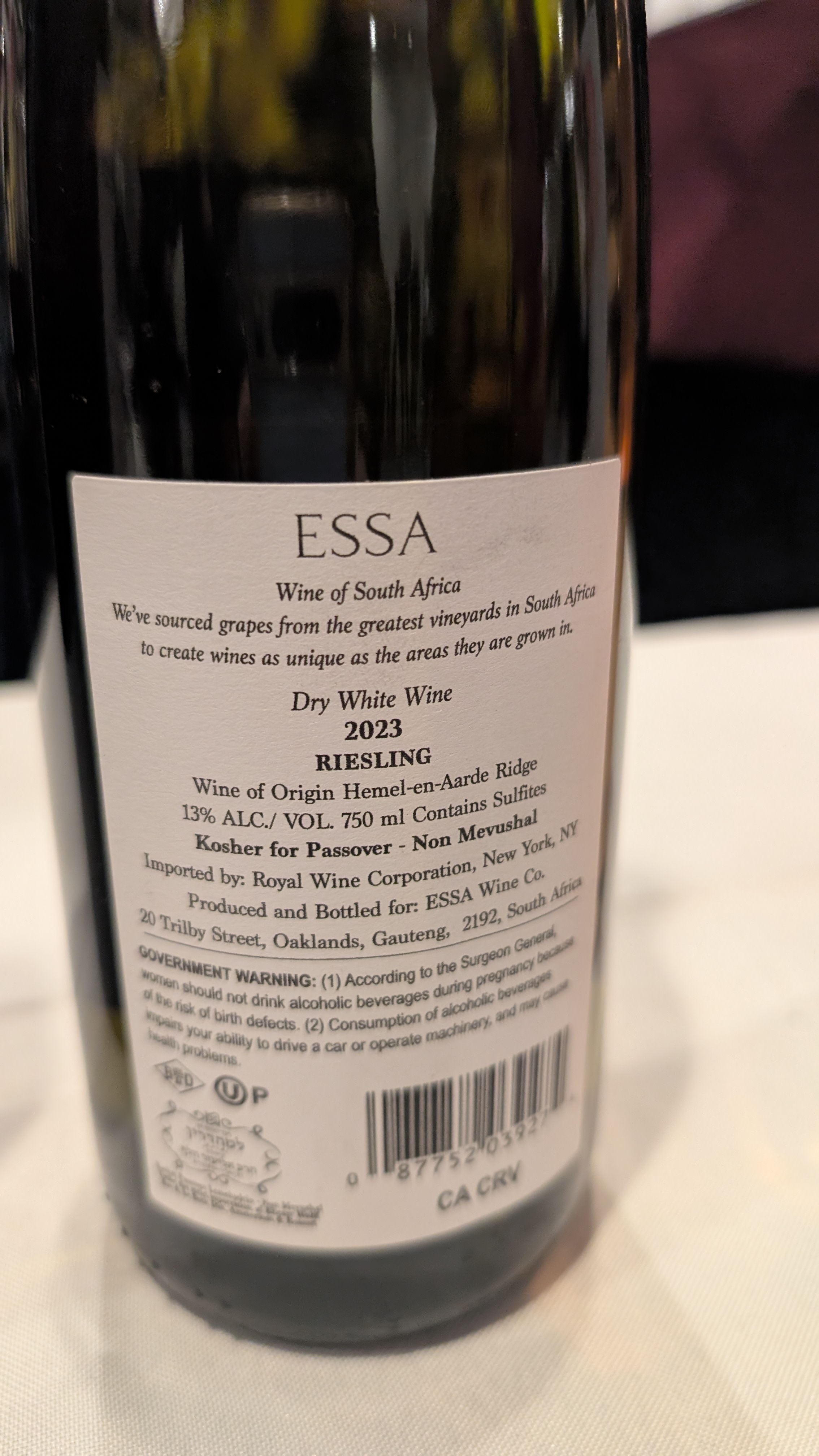
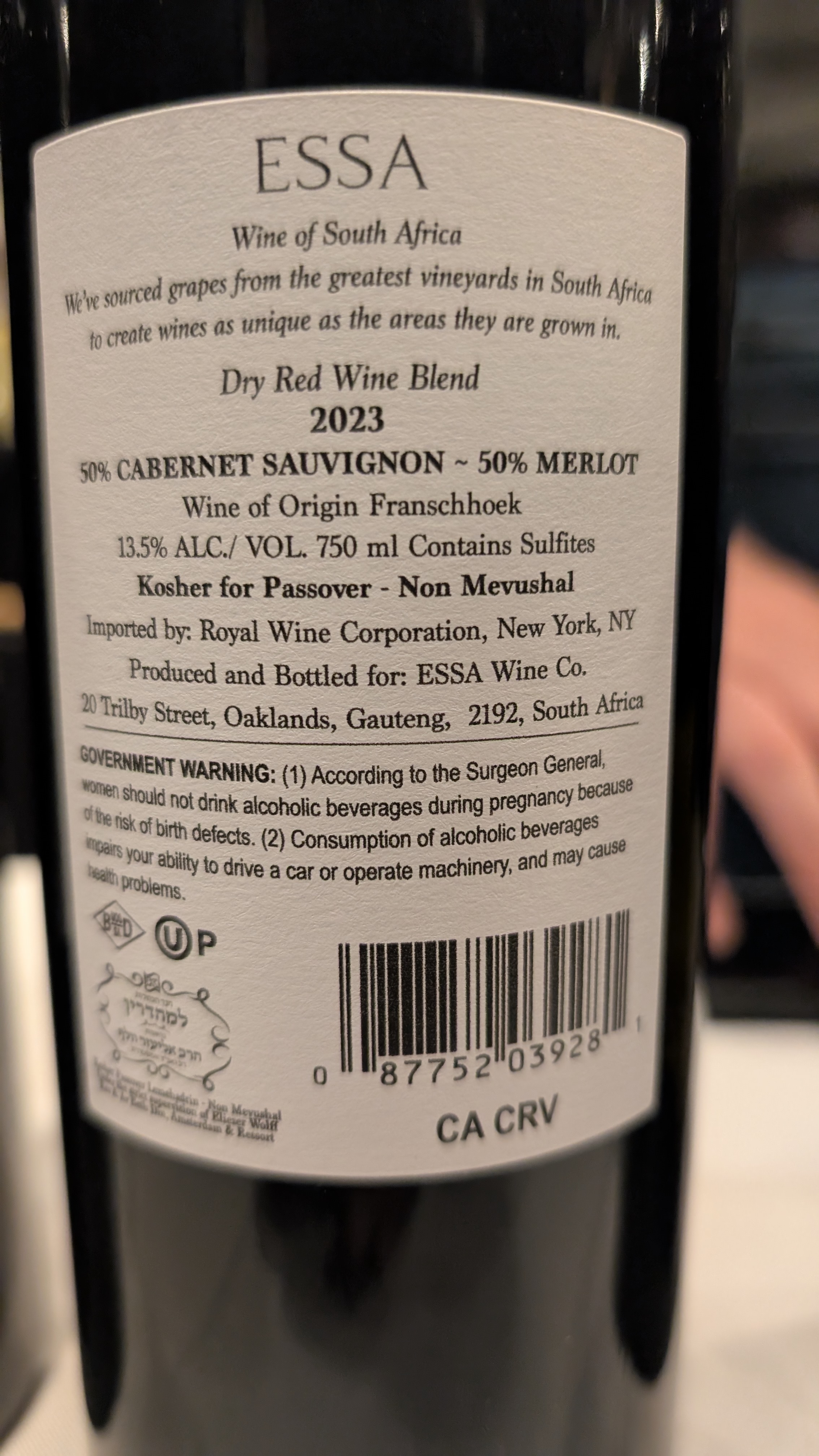
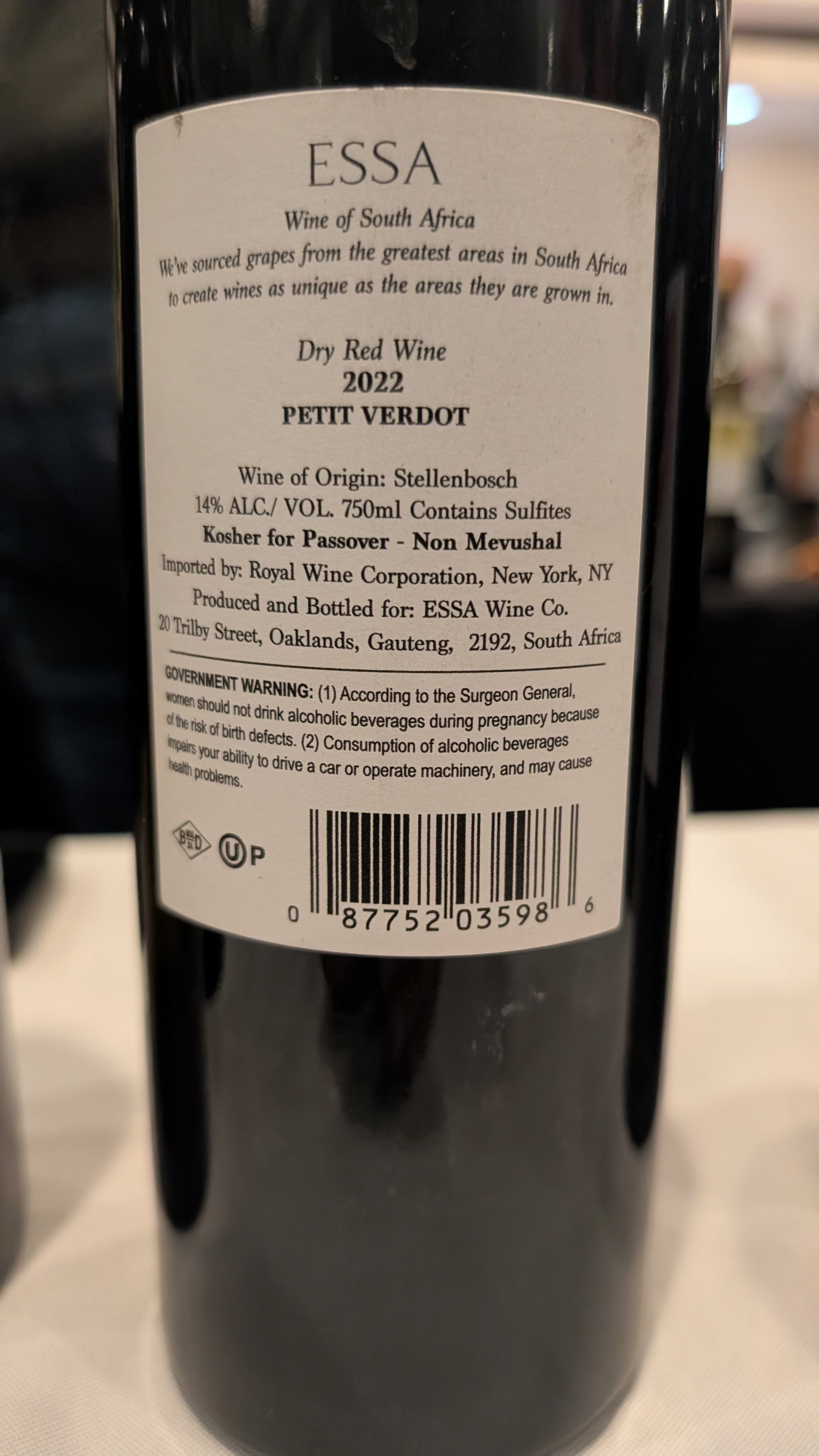
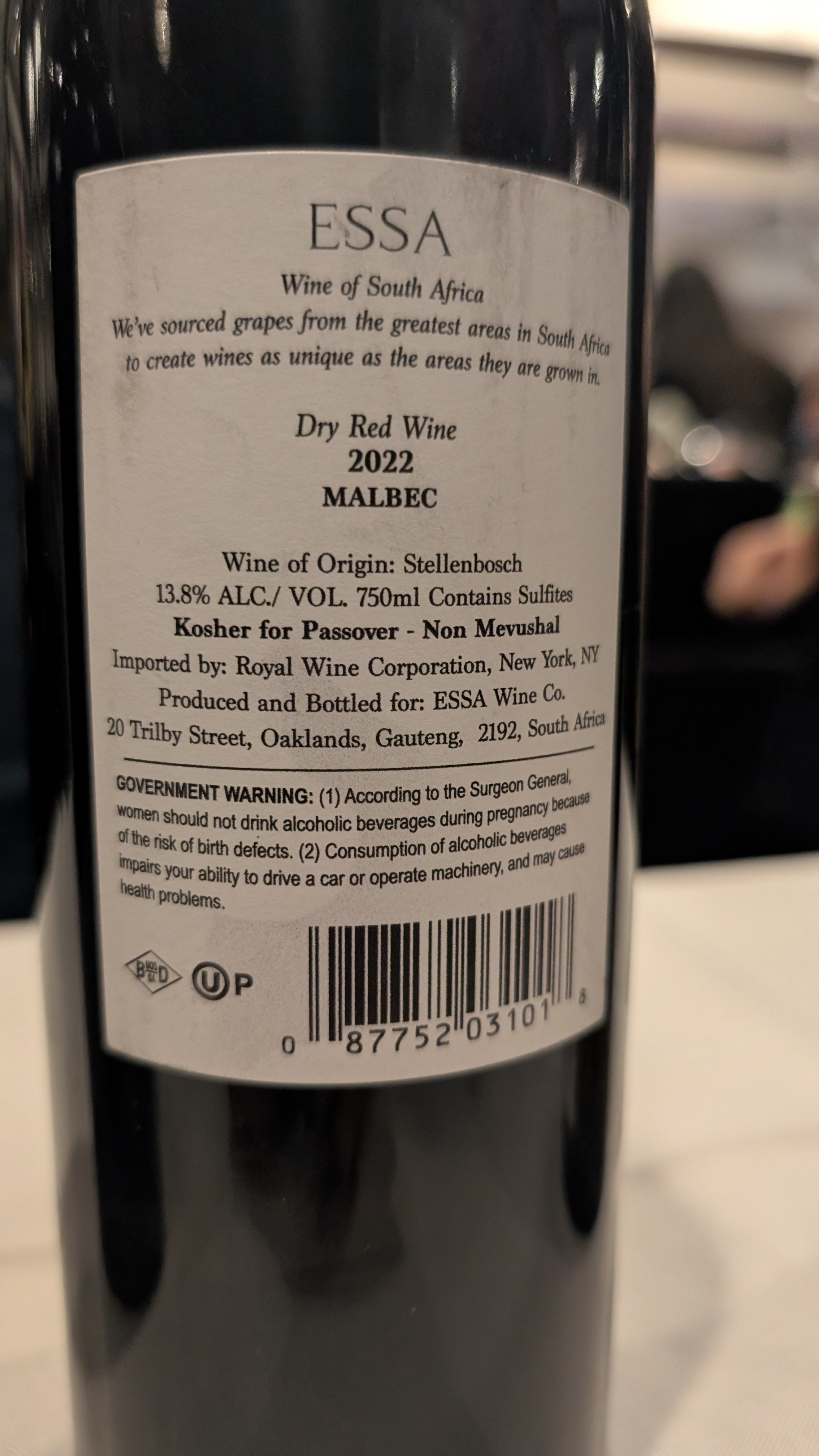
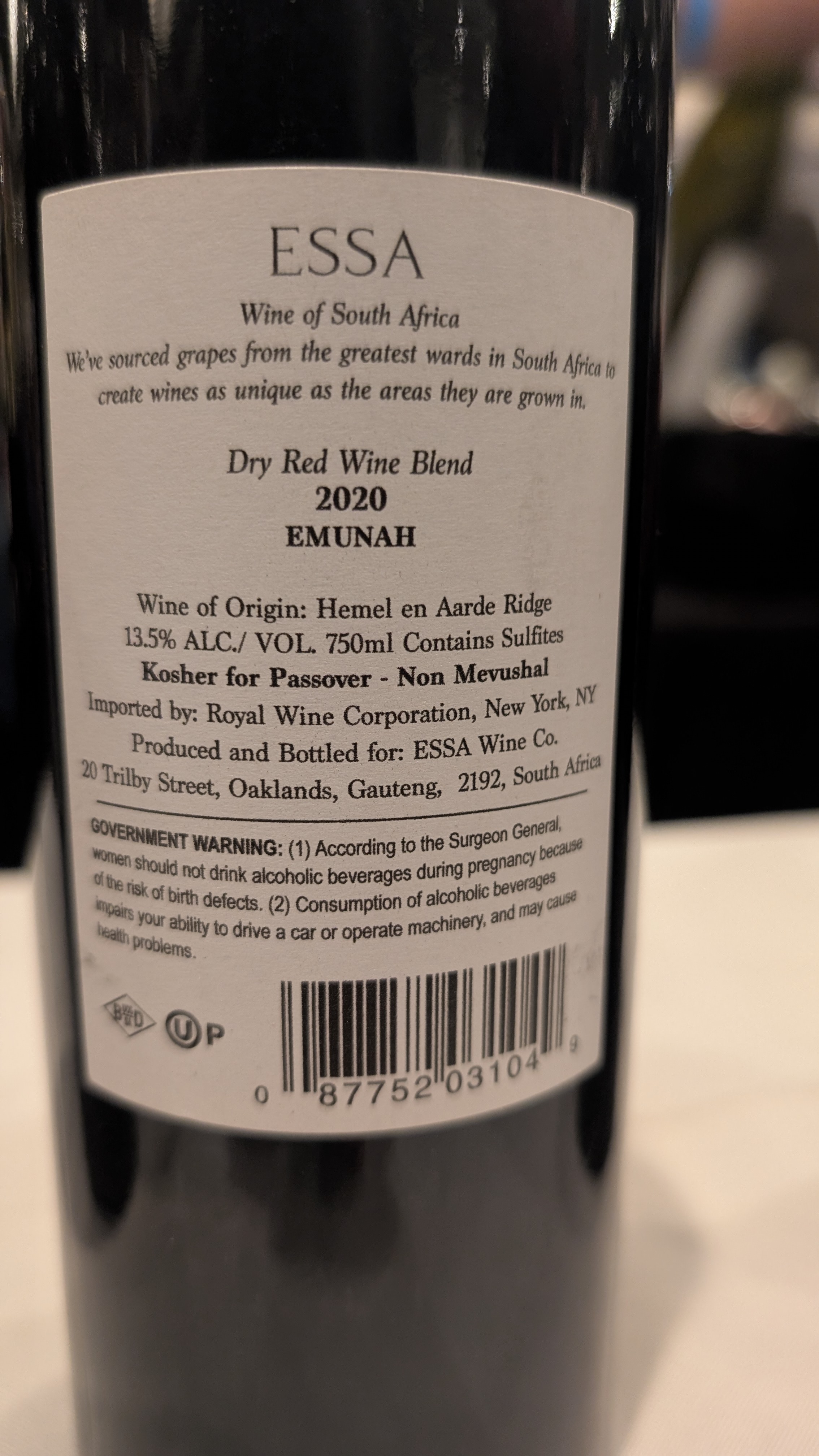
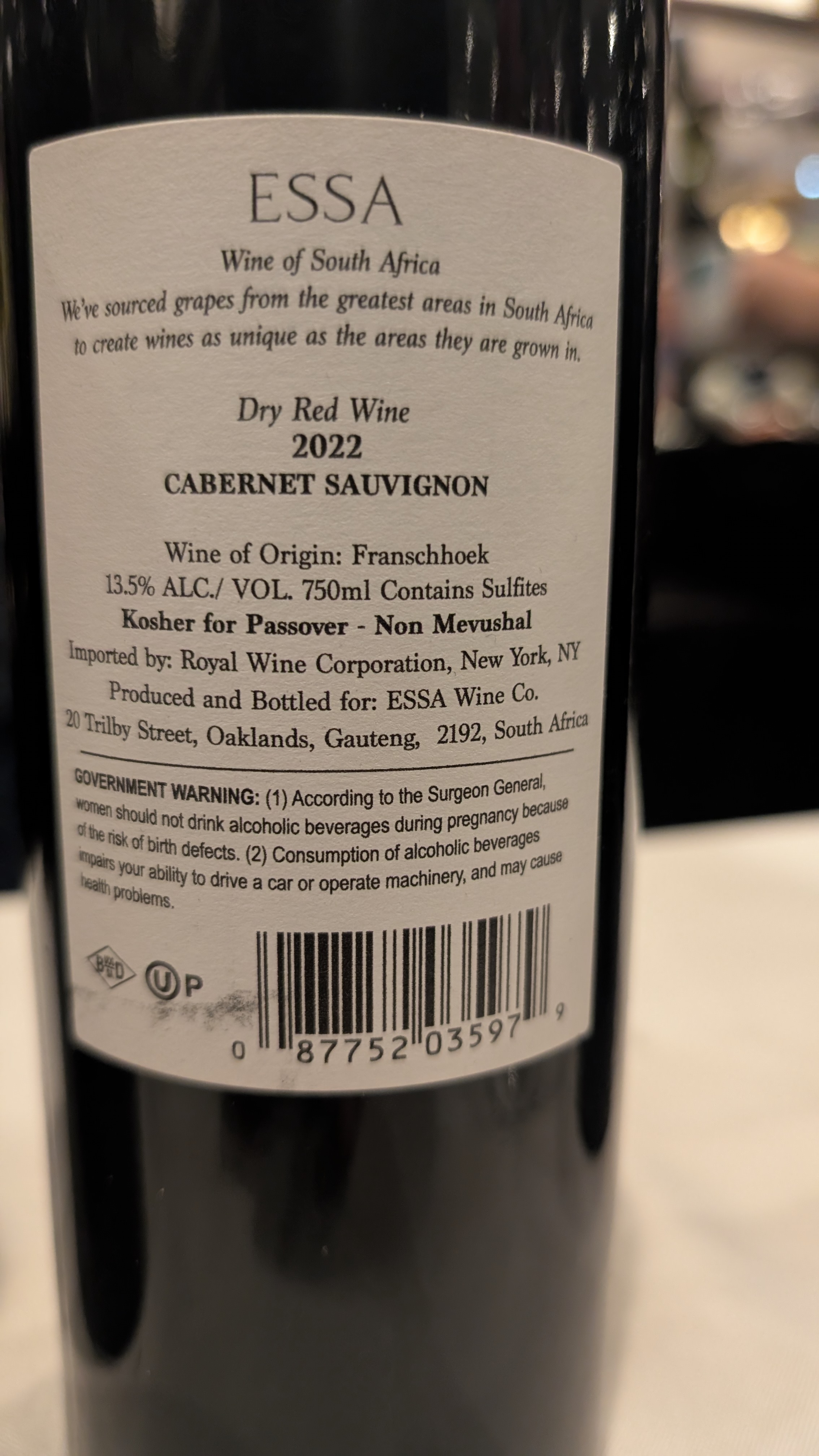
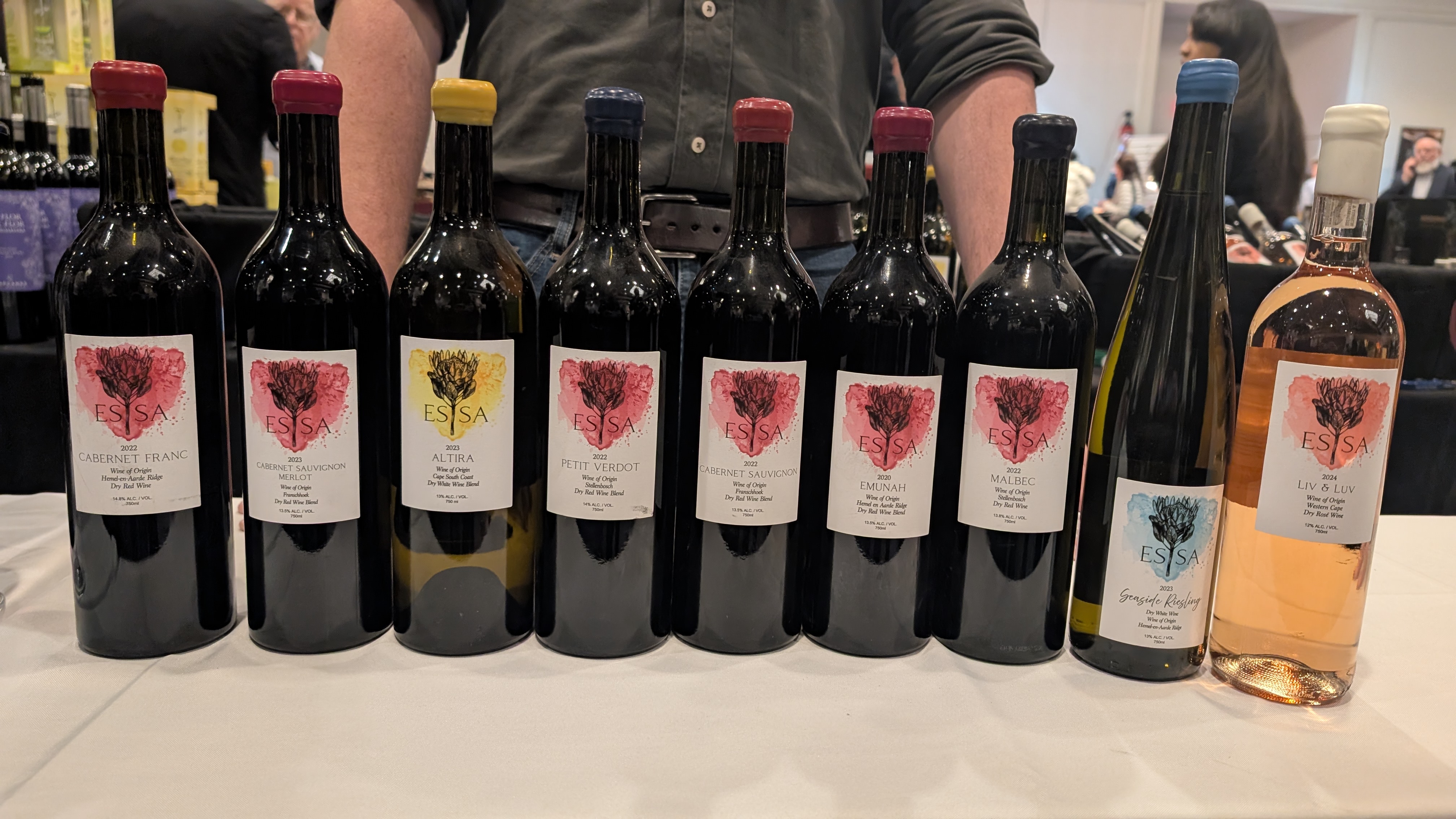
2020 ESSA Emunah, Hemel-en-Aarde Ridge – Score: 93 (QPR: WINNER)
The nose of this wine is lovely, with notes of dirt, earth, and smoke, followed by mushroom, loam, and dense smoke, all complemented by black and red fruit, which is lovely and elegant, evoking an old-world approach.
The mouth of this medium-bodied wine reveals great acidity, accompanied by a funky and earthy character and lovely mouth-draping tannin. It is elegant, not overly extracted, and features a nice focus on fruit, complemented by notes of raspberry, blackberry, and plum. Bravo! The finish is intense, with great acidity, funk, smoke, and toasty notes. The tannin lingers forever, accompanied by lovely minerality. Bravo. Drink by 2028. (tasted February 2025) (in KFWE, NJ) (ABV = 13.5%)

Paris tasting of Royal Wine’s 2022 and 2023 Bordeaux and other French wines – January 2025
Let us start with some facts; Avi Davidowitz, from the Kosher Wine Unfiltered blog, and I were in Paris together this past week. We were there to taste as many Kosher Bordeaux wines from the 2022 and 2023 vintages as humanly possible. We arrived on a Monday and by Noon, we were knee-deep into a plethora of Bordeaux wines. As is typical, the trip started with a massive tasting of Royal Wine’s latest releases, followed by two more organized tastings, and many tastings we did in our hotel room, as usual.
The first wine tasting that Avi Davidowitz and I organized during our trip to Paris was with Menahem Israelievitch, the Managing director and Winemaker of Royal Wine Europe, in his lovely home.
The 2022 Vintage in Bordeaux
So, the 2022 vintage is one that I will openly say surprised me. Until this trip, I had found the 2022 Bordeaux to be a ripe mess. Yes, there were a few exceptions, but the majority of wines, until that week, were a mess. However, even after the week of wonderful wines, I finally realized my issue, there is a difference between a good wine and a wine I want to drink. In this post and the rest of the 2022 Bordeaux wine posts (with more yet still untasted), the theme will be ripeness. Now, ripeness can be managed with good acidity, but at 15.5% ABV or 15% ABV, you may say that the wine is too ripe. However, that is not true. There are examples on this blog of wines we have tasted at that ABV that are actually refreshing!
Some of the wine notes you read below will state those words, the magic refreshing word. The wines, without that word, are still wonderful, and wines I may buy, but there is a sense of weight to those wines that I wonder about. How will they manage themselves in 15 years?
Let us talk about the age-ability of these 2022 Bordeaux wines. They are 100% UNDRINKABLE at this time. PERIOD. Sure, for tasting sake, we can taste them, but they are either horribly closed, horribly fat (meaning showing absurd fruit), or just so large and clumsy that they are not enjoyable at this time. So, when you look at the drinking windows, do not be shocked to see 30-year windows. The Leoville Poyferre, Pontet Canet, and even the Moulin Riche are wines that will cost you dearly now and in the future. These are wines that you will need to put away for 20+ years. In my opinion, these are not wines that will get to their tertiary dream state before a long time. These are wines that will require a very long and patient approach before you will get that payoff. For many of us on this earth, I wonder if I want to buy a wine that will not meet that plateau before I am pretty old. Ignoring mortality or the desire to enjoy wines like that at an advanced age – it is also the knowledge that the space in your cellar is locked away for these wines, and you really are not going to touch them for an extended period.
With all that said, sorry for the tangent; these are very special wines that should deserve some thought on how/where you will age and preserve them, given the long drinking windows. Now, I hear all of you. What about 2015, 2016, and the like? Are they not also akin to this? The answer is NO! Those vintages were balanced and, as such, will come around soon enough. Still, it has been 10 years now, and they are not ready, and they will not be ready for some time. I guess I am just projecting my thoughts here regarding what I can buy, store, and dream about enjoying in 20+ years.
Finally, unlike the 2021 vintage, these wines are not green. Maybe they have roasted herbs, but that is more oak, and they rarely show vegetal notes.
How do I see the 2022 vintage in comparison to other recent vintages? I say the quality and personal interest I have in buying these wines are behind the 2019, 2016, and 2014 but ahead of the 2015, 2018, and so on.
Looking through this list of wine notes below for the 2022 vintage and the ones coming for the other wines we tasted from this vintage, you will see a pattern, good scores, and many QPR WINNERS. Mr. Israelievitch and the team did an excellent job with the 2022 vintage. As you will see soon, there are many wines here. This is an outlier vintage BOTH regarding the number of labels made by Royal and others and the ripeness of the wines. I am not sure, but this feels like the largest number of French labels made by Royal in a single year. That does not even include the dual label (Mevushal and non-Mevushal issue/situation). Even if you look at Bordeaux alone, it has to be the largest, in my opinion. So, when you compare this vintage’s number of QPR WINNER scores, it is unfair. A more interesting thing is to look at the percentage of QPR WINNER to wines. Something I hope to explore.
The truly great vintage, for me, was the 2019 vintage, as I stated many times already, but even there, the 2019 vintage only had 13 QPR WINNER. It was the most balanced vintage so far, outside of 2014 and some of 2015. Of course, PLEASE be clear, I speak of kosher wines. I am sure many think 2020 was the perfect vintage in Bordeaux. However, IMHO, and I think I have tasted every kosher wine made from Bordeaux over the past 8 years; 2019, 2014, and some of 2015 were the winners. Still, the 2022 vintage takes the award for the most QPR WINNER wines produced by Royal Wines, 28! That is an incredible number! I state again that the 2022 vintage is incredible; it shocked me, and the ripeness is my issue. I crave balance, both in my life and in the and in the wines I drink. I think that most will find these wines enjoyable, and they will fly off the shelves, even given the more significant number of wines made.
To me, the 2014 vintage was crazy fun because it is less ripe than the 2015 or 2016 vintage. They were also FAR cheaper. Then you had the 2015 wines, which were more expensive and far riper than the 2014 vintage. This 2016 vintage is the best of both worlds but comes at a crazy high price. During the epic post of my visit to Bordeaux with Mr. Israelievitch, I warned you at that time that you better start saving your money; sadly, nothing has changed about that. The REAL shocker price-wise of the 2016 vintage was Chateau Malartic, which rose to almost 150 or more a bottle! That was close to double the 2014 vintage.
The 2022 vintage is more expensive than the 2021 vintage, which was more expensive than the 2020 vintage. The “deals” were from the 2019 vintage and the upcoming 2023 vintage. In between, the prices went up and up and up! The real Chutzpah was 2021. It was not a good vintage and yet Bordeaux raised their prices! The 2022 vintage is just one of those generational vintages, to those that crave massive fruit, and as such, garnered so many high scores during “En Primeur week” that they had to raise prices, yet again.
In a previous post about the most recent French wines (at that time in 2017) that were arriving on the market, I already discussed pricing and supply, so there is no need to discuss that again in this post.
Read the rest of this entry
Four Gates Winery’s January 2025 new releases
As you all know, I am a huge fan of Four Gates Winery, and yes, Benyamin Cantz is a dear friend. So, as is my custom, as many ask me what wines I like of the new releases, here are my notes on the latest wines.
I have often written about Four Gates Winery and its winemaker/Vigneron Benyamin Cantz. Read the post and all the subsequent posts about Four Gates wine releases, especially this post of Four Gates – that genuinely describes the lore of Four Gates Winery.
Other than maybe Yarden and Yatir (which are off my buying lists – other than SOME of their bubblies), very few, if any, release wines later than Four Gates. The slowest releaser may well be Domaine Roses Camille.
Four Gates grapes versus bought grapes
It has been stated that great wine starts in the vineyard, and when it comes to Four Gates wine, it is so true. I have enjoyed the 1996 and 1997 versions of Benyamin’s wines because of his care and control of his vineyard. The Cabernet Sauvignon grapes he receives from Monte Bello Ridge show the same care and love in the wines we have enjoyed since 2009. I recently tasted the 2014 Cabernet, and it is lovely while also being ripe, but the acidity there helps.
I have immense faith in Benyo’s wines, sourced from his and the Monte Bello Ridge vineyards. The other wines he creates from different sources are sometimes excellent, like the 2010 Four Gates Syrah I tasted recently. I would have sworn it was a Rhone wine, with crazy minerality, acid, and backbone, with fruit NOT taking center stage, though ever so evident, the way it is meant to be! While lovely on release, others may well not be the everlasting kind of Four Gates wines.
The wines in this release
This year, wines were missing, and you can blame the 2020 fires for that. Believe it or not, the 2020 fires affected Santa Cruz mountains as much as they did Napa Valley. In some ways, it was worse because the fires started earlier than in Napa.
This year, we have three Chardonnays, the PV, Malbec, and Pinot Noir, a Claret, and two Merlots. The Chardonnays are all very nice, some better than others, but I bought them all because I like aged Chardonnay with the kind of acidity that Four Gates has. As always, give these wines their time and due, and they will reward you for your patience.
The 2021 Petit Verdot and the Malbec are both from the Santa Cruz mountains but NOT from Benyo’s vineyards. These year’s wines almost tempted me to buy them, but I have too much wine and insufficient space. They are a step up from previous vintages, and most who buy them will appreciate them.
We have another vintage of the classic Four Gates fruit. The Chardonnays are from 2023. The Pinot Noir is from 2022. The Claret is from 2022, and it is okay, but give it some time to work itself out. The Pinot Noir is such a baby – good lord, give this time. The Merlot (the 2019 and 2021) are lovely wines, babies; leave them alone for a long time. The theme for Benyo wines made from his grapes (or the Cab, which is not for sale this year) is to leave them ALONE!
Prices and Quantities
I have heard it over and over again. That I and others caused Benyo to raise his prices. First of all that is a flat-out lie. I never asked for higher prices, but when asked about the value of his wines, the real answer I could give was more than 26 dollars.
Let us be clear, all of us who got used to 18/26 dollar prices and stocked up on his wines in those days should be happy. The fact that he raised prices, is a matter of basic price dynamics, and classic supply and demand. Four Gates has been seeing more demand for wines while the quantity of what is being made is slowing down.
The law of Supply and Demand tells you that the prices will go up, even if you beg for lower prices.
Four Gates Winery is one of the few cult wineries in the kosher wine world that releases wines yearly. Sure, there have been crazy cult wines, like the 2005 and 2006 DRC wines or some other rarities. His wines are in a class of their own, especially when it is his grapes, and there is less of it out there. This year, you can add more California wines like Tench, Addax, Yesod, and many others to the growing list of expensive California wines.
This year, the prices reached their highest Zenith again, and most of the wines sold out within minutes, with the highest-priced wines lasting a bit longer. Good wine has been working for Benyo in small quantities so far. No one knows how much longer this will go on. Until there is a clear successor, every year may well be the last one harvested. I am not trying to sound grim or load up on FOMO; this is just the apparent reality that all of us humans face throughout our lives.
The notes speak for themselves. Again, I did not buy the Malbec or Petit Verdot this year. The wine notes follow below, in the order they were tasted – the explanation of my “scores” can be found here, and the explanation for QPR scores can be found here:
2023 Four Gates Chardonnay, Ayala, Santa Cruz – Score: 92 (QPR: WINNER)
Ignoring labels, let’s talk wine! The nose of this wine is lovely, showing sweet pear, melon, sweet green apple, oak, lemongrass, and sweet garrigue. Lovely! The mouth of this plush, full-bodied wine is lovely, ripe, not candied, balanced with great acidity, sweet pear, melon, smoke, tart-ripe apple, lovely fruit attack with fruit focus, and so refreshing. With time, this will improve even more. The finish is long, ripe, and lovely, with sweet vanilla, sweet oak, and butterscotch on the long finish. It’s not an overly oaky wine at all; the acidity and balance are lovely! Drink from 2032 until 2036. (tasted November 2024) (in San Jose, CA) (ABV = 14.3%)

Another round of QPR (Quality to Price Ratio) Hits and Misses, Seven QPR WINNERS – Aug 2024
This may be one of the smallest QPR roundups I have done. The last one I did was in December of 2023, and that one had many more wines than this one. I will be having a follow-up QPR post to this one, but I wanted to get this one out now.
There are 26 total wines with 7 QPR WINNERS, so that is a good average to me. With this post, I will finally be caught up, though I have a bunch more wines to get through and more to come. That will lead us into the 9-Days, and I wish you all an easy, meaningful, and hopeful two weeks ahead.
QPR (Quality to Price Ratio) Wines
It has been seven or so months since my last QPR (Quality to Price Ratio) post and many people have been emailing me about some unique wines I have tasted and some lovely wines that are worth writing about.
Thankfully, no matter how much garbage and pain I subject myself to, we are still blessed with several wonderful QPR wines out there.
We have a SOLID list of QPR WINNERS:
- 2021 Shirah Pinot Meunier, Santa Maria, CA – LOVELY and unique wine that should improve!
- 2018 Golan Heights Winery Blanc de Blanc, Yarden, Galilee – the bubbles return!
- 2022 Chateau Hauteville, Saint-Estephe – solid 2022 Bordeaux
- 2020 Chateau La Tonnelle, Haut-Medoc – nice 2020
- 2022 Dampt Freres Bourgogne, Bourgogne – a SOLID Burg without Burg pricing
- 2020 Chateau Greysac, Medoc (M) – Nice Mevushal Bordeaux
- 2022 Lovatelli Nebbiolo, Monferrato (M) – Nice Mevushal Italian red
There were also a few wines that were a slight step behind with a GREAT or GOOD QPR score:
- 2021 Netofa Latour, Red, Galilee -Showing better than I had in Israel
- 2022 Capcanes Peraj Ha’abib Pinot Noir, Catalunya – Not a great vintage
- 2022 Chateau de Parsac, Montagne Saint-Emilion (M) – 2022 will be hit and miss for sure
- 2022 Rocca delle Macie Chianti Classico, Chianti Classico – Good enough just simple
- 2022 Chateau Le Petit Chaban, Bordeaux (M) – Again 2022, hit and miss
- 2022 Herzog Cabernet Sauvignon, Special Reserve, Alexander Valley – off year for the Alex
- 2020 Elvi Wines Herenza Crianza, Collection, Rioja (M) – The Mevushal version is nice enough
- 2021 Pacifica Malbec, Washington – Nice but a bit too rough for me
There are a few wines that got a QPR Score of EVEN – meaning expensive or average:
- 2021 Lovatelli Toscana Rosso, Tuscany – Solid wine just a bit overpriced for the quality
- 2021 Cantina Giuliano Super Tuscan, Tuscany – This entire line disappointed me
- 2022 Cantina Giuliano Cabernet Sauvignon, Tuscany – Same as above
- 2021 Chateau Mayne Guyon, Blaye Cotes de Bordeaux (M) – 2021 Bordeaux – tough year
The others are essentially either OK wines that are too expensive, duds, or total failures:
- 2023 Nana Grenache, Negev – Average wine for a crazy high price
- 2020 Cantina Giuliano A Mano Cabernet Sauvignon, Tuscany – Expensive and poor
- 2021 Cantina Giuliano Chianti, Tuscany – poor quality
- 2022 Capcanes Peraj Ha’abib, Montsant (M) – poor quality and expensive
- 2021 Cantina Giuliano Merlot, Tuscany (M) – poor quality
- 2021 Le Pletzl, Bordeaux (M) – poor quality
- 2022 Herzog Pinot Noir, Lineage, Clarksburg, CA (M) – poor quality
Some things that made me stand up and take notice (AKA QPR WINNERS):
The real stunner here is the 2021 Shirah Pinot Meunier, Santa Maria, CA! I have posted already about how the 2021 vintage SAVED California. Sadly, that may have been short-lived, with the recent raft of vineyards being ripped up and wineries closing. Still, the 2021 vintage has been a boon for Cali after the horrific 2020 fires.
The 2021 Shirah Pinot Meunier has to be one of the most unique and wonderful wines I have had in a very long time. It is not quite a Pinot Noir and yet it is also captivating. Sim ply said, read the notes, and buy!
The 2016 vintage of the Golan Heights Winery Blanc de Blanc, Yarden was a miss, but that is fine, they are normal in the wine business. The 2018 returns the bubbly to its crown position as the QPR sparkling wine.
The 2022 Chateau Hauteville, Saint-Estephe continues the streak for this wine. It is another WINNER after how well the 2021 vintage showed and the 2020 before that.
The 2020 Chateau La Tonnelle, Haut-Medoc, is a return to its status. This vintage is nice.
The 2022 Dampt Freres Bourgogne is the answer we need for non-Burgundy-priced wines from Burgundy. It is 2022, so it is ripe, but it is balanced and refreshing, and in the end, that is what Burgundy MUST BE!
The 2020 Chateau Greysac, Medoc, is a solid option for those who want a simple but fun and refreshing Mevushal Bordeaux.
Finally, this wine surprised me, the 2022 Lovatelli Nebbiolo, Monferrato (M) came in under a fair amount of internet chatter. However, I found it refreshing and for a Mevushal wine – a solid showing.
I was UNIMPRESSED by Royal’s new import – Cantina Giuliano, all of the wines were a hard miss. The Lovatelli wines are either a miss or a hit. The 2021 Lovatelli Barbera d’Asti and the 2022 Lovatelli Nebbiolo are WINNER to me. The other Lovatelli are either hard misses or just OK, so far. Still, two hits for a new brand is a good average!
Other wines worth noting (AKA QPR GREAT or GOOD):
I tasted this wine in Israel blind and I found it less than desirable. This time the 2021 Netofa Latour, Red showed better.
I had hoped for the 2022 Capcanes Peraj Ha’abib Pinot Noir, Catalunya, but it did not have the refreshing approach that I needed.
The rest of this group is just good enough wines to get these QPR scores. The miss here is the 2022 Herzog Cabernet Sauvignon, Special Reserve, Alexander Valley. It used to be that even vintages were the WINNER, but with 2021 things switched, 2021 was the WINNER vintage, and 2022 was a miss. Still a nice wine, but it lacks the refreshing aspect I expect.
Wines that are either good but too expensive or average (AKA EVEN):
As stated above, this post includes almost all the wines from Cantina Giuliano and in the end, for me, they lack balance, plain and simple. Two of the Lovatelli have that balance.
Wines that are either OK but far too expensive or bad wines (AKA POOR/BAD):
Not much here mostly poor-scoring wines. There are also, many duds to losers and I will just leave you to peruse the names and scores down below.
The wine notes follow below – the explanation of my “scores” can be found here and the explanation for QPR scores can be found here:
2021 Shirah Pinot Meunier, Santa Maria, CA – Score: 92.5 (QPR: WINNER)
This may well be the first time I have tasted the single varietal called Pinot Meunier. Of course, it is the grape used to make Champagne but I have never tasted a single varietal that I know of. How does Pinot Noir and Pinot Meunier differ? Pinot Noir is leaner and richer, earthier, dirtier, all of what you crave from Pinot, Meunier is fruitier, ripens faster, grows in very hard areas, and colder regions, and has citrus notes that a truly unique! Bravo Weiss Brothers!
The nose of this wine is unique, yes I would have said this was Pinot Noir, sorry, this is new, tasted blind I would have also said it was a riper Pinot, and the citrus would have made me think of a blend, but I am really not sure. The nose is ripe, not candied, blunted a bit by the oak, with rich floral notes, yellow and jasmine, very unique, with oolong tea, orange/Meyer Lemon, like what! Followed by sweet oak, roasted meat, and rich red fruit. Bravo! The mouth of this medium-bodied wine is on point, showing great acidity, lovely cranberry, dark cherry, Cherry Cola, and hints of blueberry, this is one strange cat, with nice mouth-draping tannin, and yes, sweet orange. The finish is long, plus, almost round, but with great acidity, and sweet notes that carry this wine. Bravo!! Drink by 2027. (tasted July 2024) (in San Jose, CA) (ABV = 14%)

Four Gates Winery’s January 2024 new releases
As you all know, I am a huge fan of Four Gates Winery, and yes Benyamin Cantz is a dear friend. So, as is my custom, as many ask me what wines I like of the new releases, here are my notes on the new wines.
I have written many times about Four Gates Winery and its winemaker/Vigneron Benyamin Cantz. Read the post and all the subsequent posts about Four Gates wine releases, especially this post of Four Gates – that truly describes the lore of Four Gates Winery.
Other than maybe Yarden and Yatir (which are off my buying lists – other than their whites and bubblies), very few if any release wines later than Four Gates. The slowest releaser may well be Domaine Roses Camille.
Four Gates grapes versus bought grapes
It has been stated that great wine starts in the vineyard, and when it comes to Four Gates wine, it is so true. I have enjoyed the 1996 and 1997 versions of Benyamin’s wines and it is because of the care and control that he has for his vineyard. That said, the Cabernet Sauvignon grapes he receives from Monte Bello Ridge show the same care and love in the wines we have enjoyed since 2009.
I have immense faith in Benyo’s wines which are sourced from his vineyard and the Monte Bello Ridge vineyard. The other wines, that he creates from other sources, are sometimes wonderful, like the 2010 Four Gates Syrah that I tasted recently. I would have sworn it was a Rhone wine, crazy minerality, acid, and backbone, with fruit NOT taking center stage, though ever so evident, the way it is meant to be! Others, while lovely on release may well not be the everlasting kind of Four Gates wines.
Two new wines
This year Benyo decided a Rose was a good idea, well, I mean last year! Yeah, he held the wine for a year! I have no idea why, it is just classic Benyo! The 2022 Rose is called Rosalinda and the fruit is Grenache from the Santa Clara Valley, CA.
OK, once we move on from the outlier, we come to a new wine in the Four Gates lineup, it is called Gidon. It is a blend of Merlot and Cabernet Franc. That blend has been consistent now for a couple of years, and Gidon is a wine that is here to stay.
The rest are returnees from previous vintages. The 2021 Petit Verdot from the Santa Clara Valley AVA, and a 2021 Malbec, also from Santa Clara Valley, CA. I will say that while I normally do not care for the Malbec or Petit Verdot, they are wines crafted for the “average man”. However, this year, they are controlled and ones I would have bought if I had more space to store them. They are good to go right now but for that price, I have other things I need space for.
We have another vintage of the classic Four Gates fruit. The Chardonnay is from 2022. The Pinot Noir is from 2021. The Cabernet Franc is from 2021. The rest are from 2019, the Gidon, Merlot, Cabernet Sauvignon, and Frere Robaire. The 2019 wines are stunning and are babies, please do not open these wines for a decade each. I am not sure about the Pinot Noir, it is such a lightweight but also so ethereal, so I am not 100% sure about that one. The Chardonnay is another wine to leave for 10 years.
Prices and Quantities
I have heard it over and over again. That I and others caused Benyo to raise his prices. First of all that is a flat-out lie. I never asked for higher prices, but when asked about the value of his wines, the real answer I could give was more than 26 dollars.
Let us be clear, all of us who got used to 18/26 dollar prices and stocked up on his wines in those days should be happy. The fact that he raised prices, is a matter of basic price dynamics, and classic supply and demand. Four Gates has been seeing more demand for wines while the quantity of what is being made is slowing down.
The law of Supply and Demand tells you that the prices will go up, even if you beg for lower prices.
Four Gates Winery is one of the few cult wineries in the kosher wine world that releases wines every year. Sure there have been crazy cult wines, like the 2005 and 2006 DRC wines, or some other such rarities. His wines are in a class of their own, especially when it is his grapes, and there is less of it out there.
This year, the prices reached their highest Zenith, again, and while the majority of the wines sold out within minutes the last two are still available as they were the wines that he had the most of and the highest-priced wines as well. Still, the crazy prices people paid for the Auction wines that he had last year show the high demand for the wines. These are wines for the long haul, other than the Rose, Malbec, and Petit Verdot.
My thanks to Michel and Sima Rynderman for hosting the tasting and for putting up with me and Benyo crashing their home. This year we did it earlier in the day so we did not keep them up! My apologies for not getting pictures, I got used to Avi taking the pictures!
The notes speak for themselves. Again, this year, I did not buy the Rosalinda, Malbec, or Petit Verdot. The wine notes follow below, in the order, they were tasted – the explanation of my “scores” can be found here and the explanation for QPR scores can be found here:
2022 Four Gates Rosalinda, Santa Clara Valley, CA – Score: 90 (QPR: EVEN)
The nose of this wine has changed a lot over the year, I had the wine in early 2023, but Benyo held out on releasing it.
The nose shows notes of peach, lemon, orange, orange blossom, and nice minerality.
The mouth of this medium-bodied wine is eh, what a lovely wine this was last year, sadly now, this is a nice and acidic wine with orange, peach, and lemon rind, but it is uni-dimensional. Drink now! (tasted December 2023) (in San Jose, CA) (ABV = 12.9%)

Final Tasting from my trip to Paris – November 2023
As stated in my previous post, I was in Paris in November, with Avi Davidowitz from Kosher Wine Unfiltered. The number of boxes in our room was not nearly as insane as last year. Last year, we had some 80 wines, this year we were at a measly 62. Of those 62, Avi did not get a chance to taste all of them, as he had to get back to Israel. It was a miracle he was even able to come in the first place and I really thank him and his family for him making it to Paris with all that was going on in Israel.
We were in Paris for a week and during that time Avi not only got to finally see some of Paris but we had three organized tastings and we had some Hotel time to taste other wines. Given the constraints, we sadly, did not have time to do these blind. I hope next year, we will make it a priority. Heck, at this point Avi has seen as much of Paris as I have, though he really does need to go to the Musée de l’Orangerie and some more of Musee d’Orsay. Heck, even a bit of the Centre Pompidou will not hurt him, but we have next time! B”H!!!
Like last time, I wanted to break up the normal approach, or taste wines from the distributor or wine producers and instead taste the wines in their respective groups. So the wines listed below are in the order we tasted them and in the groups, we tasted them.
Rhone & White Wines
Red Rhone wines were the first round of wines we tasted. I will take the blame here. I normally get rid of the white wines first, but I wanted to stick to regions and we did not have all the wines at the start, so yeah, the tasting order, at the start is a bit wonky.
Most of these wines were from Cedev, but a few also came from Yavine.fr. There were ten reds and three whites. The overall impression of the 13 wines was not impressive, though there were two nice wines from Yavine and Les Vins de Vienne and one from Domaine de Corps de Loup.
To start, the prices of some of these wines in France are outrageous and they are no better here in the USA (though some of these are only available in Europe). The others are barely OK wines and the price really is irrelevant. The best was the Yavine Les Vins de Vienne Crozes-Hermitage (white and red). The Domaine de Corps de Loup’s price was outrageous but it is a nice enough wine.
The Cedev wines rated OK to poor. The showing may be their best yet, but I have no need to buy any of them. They do have some interesting wines, like a Kosher red Vacqueyras, I just wish they tasted better.
In the end, the relationship between Yavine and Les Vins de Vienne continues to produce good wines.
Finally, if someone had asked me the day I came home, what was the best NEW wine I tasted on your trip – the answer would have been very simple – that is the 2021 Chateau Olivier Blanc. DONE. I would then have dropped the mic and walked away. It is an incredible wine! The 2020 vintage was nice enough, but the 2021 is shockingly incredible. It is clear that the 2021 vintage is really not good for Cabernet-based wines or even for some Merlot-based ones. It feels a bit like 2013 when the whites were incredible. We had no kosher white 2013 wines, but we had the 2013 Piada, yeah it is white, but it is sweet, and yeah, that was/is incredible!
2021 is a tough vintage for Bordeaux and 2022 is NOT what folks have hyped it – so far
This section is going to be tough. The 2021 vintage is a lost cause. Sadly, a large number of Bordeaux wines were made in 2021. There were no red wines made in 2021 from the wines we tasted in the hotel that were QPR WINNERs. There are four 2022 QPR WINNER wines but I continue to stress, that in the kosher world, for me, so far, 2022 is not the panacea or quality that the non-kosher world is hyping. Sure, we have not yet tasted the Chateau Pontet Canet. LOL! My real hope is that the 2020 Moulin Riche, Montviel, Royaumont, and so on, will NOT be like the 2018 vintage! NO! Please no! We want more of the 2014/016 vintage. Sadly, from what we have seen so far in the kosher wines, it is not what those on the outside are talking about. But, the final answer will be when we get to taste the big boys in November and Feb 2025. Yeah, 2025!!
Of this group, the standouts were the Taieb 20222 wines. No surprise here, Taieb continues to prove that great wine does not need to come from the Grand Cru names. Still, there were 2022 wines that were a ripe mess, but that happens with every vintage. My main issue here is that outside of these four wines we have found no other 2022 vintage that we liked enough to give it a QPR WINNER score. As stated, time will tell.
Other regions tasted with Avi
Literally, nothing here to talk about – next! So much pain!!
Elvi Wines
Elvi has another two QPR WINNER wines, while the 2020 Rioja Crizana (Mevushal and not) is not my cup of tea. The 2021 Clos Mesorah and the 2022 Herenza White are lovely wines. Sadly, because Royal can not sell the Herenza White (AKA Invita), the only place I get to taste the current vintage is in Paris or Europe. It is pathetic, that the USA cannot appreciate the joy and happiness of the Herenza white, but hey, that is OK! They sell out in Europe anyway, this is just the loss to those of us living in the USA!
The 2021 Clos Mesorah is another WINNER and yeah, lovely wine, ripe, bold, and concentrated, but with lots of soy sauce and umami. Great stuff and it shows the complexity that so many other wines we tasted lacked.
Other regions tasted without Avi
This is mostly a press release for the Terra di Seta wines I have yet to taste! JOKING, I do not do a press release wine posts, but yeah, the wines are nice. Look, something has changed at Terra di Seta since 2019, I do not know what it is. Sure, the 2019 Chainati Classico was not bad, it was a bit short, but ok. The 2020 vintage was OK as well, while the 2021 vintage was a real mess. The 2019 Riserva was a hard pass for me at the start. It took a couple of days and then I came around to like it enough but even there, the Riserva did not meet what I expected from TDS. Time will tell what is happening or if the Riserva or Assai are good in the later vintages. I have always felt that the Riserva wines were the real age-worthy wine. I have had my issues with the Assai. Still, something is amiss in the last three years. I am hoping that things will change back soon!
I tasted a bunch of wines in June of 2023. They were at a wine event and they were imported by BAM Imports. I wrote about them here. Well, it turns out I had them again, without Avi in Paris and they showed far better. This can always be an import issue, bottle variation, or who knows what. Still, the concern is clear and the wines were not evil in Paris, so who knows!
Finally, I had a couple of wines in the hotel after Avi left and the WINNER of those was a lovely Ribeauville Pinot Noir! I know the joke, Kosher Alsace Pinot Noir is too cheap to clean the car with. Still, this vintage was a SOLID QPR WINNER. Of course, import it to the USA, and goodbye QPR! Still, for those in Europe, ENJOY! This is a daily quaffer HOMERUN!
Where can you buy these wines?
So, the Cedev wines are in the USA, I have no idea what stores are selling their wines sorry. The Olivier and others from Mercier are imported by M&M (AKA Ralph) and sold by Kosher Wine Direct. The Taieb wines will make their way to the USA soon, and should be available by Liquid Kosher, and Elk (you can contact Elk, listed to the right on the desktop view of this page) has/should have them as well. Finally, the TDS and Elvi wines will get to the USA soon or are already here. The biggest issue I find, outside of Royal Wine produced wines, is distribution for the kosher wine buyer. It is almost impossible for the average Kosher wine-buying Joe, to know where to buy each and every SKU/wine, it is crazy!
Thoughts on this tasting
OK, so overall, this tasting was a disaster, much like most of our hotel wine tastings. Look, Kosher plonk exists in spades in all regions of the world! The USA may have the largest availability to them, but Paris is not far behind! That is the MAIN takeaway! Followed by that is the horrible 2021 vintage (other than white wines). Finally, 2022 is not all it has been cracked up to be. OK, that is a wrap for Paris 2023! Looking forward to my next trip over the pond!
Before I forget – Avi took all the pictures from this trip so if you dislike them, blame him. If you love them disregard the previous sentence! Thanks, buddy!! Finally, while most of these deliveries were to the hotel this time, my man Ari Cohen, AKA El-Presidente of Bakus Wines, still put up with our many deliveries. Thanks as always! These hotel tastings could never happen with you, my man!!!
The wine notes follow below – the explanation of my “scores” can be found here and the explanation for QPR scores can be found here:


—————————— Rhone & White Wines ———————————————-
2022 Domaine La Martinelle Cotes du Rhone Villages Visan, Cotes du Rhone – Score: 78 (QPR: POOR)
This wine is painful, it smells hot, it tastes hot, and it feels painful, literally. It also tastes like the wine came out of the wine vat early, AKA, hard pass! The wine has no acidity, loads of astringent, and uncontrolled tannin. Next! (tasted November 2023) (in Paris, France) (ABV = 14.5%)
2022 Vignobles Vuillemin de Valois Bonne Etoile, Cotes du Rhone Villages – Score: 87 (QPR: EVEN)
This wine is a blend of 70% Syrah, 15% Grenache, and 15% Carignan. This is a solid wine for a good price the wine has nice acidity, showing blue, red, and green notes, and earthy, smoky, dirty, and loads of graphite. The mouth of this medium-bodied wine is solid is nice, with good acidity, nice tannin, good fruit, herbs, nice blueberry, raspberry, roasted herbs, soft tannin, and graphite. The finish is nice, tannic, fruity, simple, and not asking for much. Drink now. (tasted November 2023) (in Paris, France) (ABV = 14%)

Paris tasting of Royal’s 2021 and other French wines – November 2023
With my last KFWE post, I have now caught up to my trip to Paris in November, which I think is awesome, because I was really behind! This was a multi-day tasting trip with Avi Davidowitz, from the Kosher Wine Unfiltered blog. It started with a massive tasting of Royal Wine’s latest releases, followed by two more organized tastings, and many tastings we did in our hotel room, as usual.
The first organized wine tasting that Avi Davidowitz, from the Kosher Wine Unfiltered blog, and I went to, during our last trip to Paris, in November 2023 was with with Menahem Israelievitch in his lovely home.
In May I made my way to Paris and I posted the Royal wines I tasted, they were mostly white, rose, and a fair number of red wines as well. For the past many years, I have been tasting the new releases from Royal wines with Menahem Israelievitch. Two years ago, because of COVID-19, I tasted the 2018 vintage in my house. Thankfully, those days are over and things have mostly returned to normal.
The 2021 Vintage in Bordeaux
Vintage-wise, I think 2021 is a mess. I say that because that is the overall feeling I get from tasting the wines from Royal and countless other producers. The 2021 wines, on average, the poor wines, show in one of these three styles:
- Thin-tasting wine that is overly green and has notes of Jalapeno and bell pepper
- Medium-bodied wines that are horribly hollow and overpowering with their Jalapeno or sometimes cooked/candied Jalapeno notes
- Over-ripe and candied cherry wine with green notes
Looking through this list of wine notes below, for the 2021 vintage, and the ones coming for the other wines we tasted from this vintage, you will see a pattern, low scores, and very few QPR WINNERS. Mr. Israelievitch and the team did a wonderful job with these wines given the product (aka the grapes) they had to work with. There are 6 QPR WINNERS here and some good wines.
In comparison, the 2020 vintage was OK, there were some clear WINNER wines, with the 2020 Pavillon de Leoville Poyferre and the 2020 Chateau Montviel. Though 2020 had 11 QPR WINNER wines. The truly great vintage was the 2019 vintage as I stated many times already, but even there the 2019 vintage only had 13 QPR WINNER. It was the most balanced vintage so far, outside of 2014, and some of 2015. Of course, PLEASE be clear, I speak of kosher wines. I am sure many think 2020 was the perfect vintage in Bordeaux. However, IMHO, and I think I have tasted every kosher wine made from Bordeaux, over the past 8 years, 2019, 2014, and some of 2015 were the winners.
The 2014 vintage to me, was crazy fun because it is less ripe than the 2015 or 2016 vintages. They were also FAR cheaper. Then you had the 2015 wines which were more expensive and far riper than the 2014 vintage. This 2016 vintage is the best of both worlds, but it comes at a crazy high price. I warned you at that time, during the epic post of my visit to Bordeaux with Mr. Israelievitch, that you better start saving your money, sadly nothing has changed about that. The REAL shocker price-wise of the 2016 vintage was Chateau Malartic, which rose to almost 150 or more a bottle! That was close to double the 2014 vintage.
In a previous post about the most recent French wines (at that time in 2017) that were arriving on the market – I already spoke about pricing and supply, so there is no need to talk that over again in this post.
NOTE: Mr. Israelievitch only had the Mevushal 2021 Chateau Gazin Rocquencourt Grand Vin, Blanc. I will have to wait until I return to Paris to taste the non-Mevushal as the USA imports only the Mevushal version.
Mevushal Wine Push
The Mevushal push, from Royal wines, is continuing for the USA labels. More wines are being made in a Mevushal manner and while I wonder if this is good overall for myself, it makes sense for Royal wines, which in the end, I guess is what matters to them. Will this be an issue? In the past, I have found that the mevushal work of Mr. Israelievitch is top-notch, and just ages the wine rather than ruining it. Sadly, that trend has been failing in recent years, especially when it involves white and rose wines. More and more the mevushal white and rose wines have shown a difference between the two variations, mostly in regards to acidity. I have no idea why the flash affects the acidity but it has been clear to me and the best example was the 2019 Gazin Rocquencourt, Blanc. The non-mevushal version is solid while the mevushal version was not.
So, once again, as I have been doing for YEARS, I will again ask Royal to treat their own, personally made French wines, with the same courtesy that they show Binyamina, Psagot, Capcanes, Shiloh, and others. Why are you OK with importing BOTH the mevushal and non-mevushal versions of wines that are not worthy of the glass they are in but are more than happy to throw a blind eye to wines you personally produce? The French wines deserve better and again, I AM ASKING for you to import BOTH the mevushal and non-mevushal versions as you do for so many other brands.
The Mevushal wines from France for the 2019/2020/2021 vintages will be the
- 2022 Les Marrionniers Chablis, Petit Chablis
- 2022 Les Marrionniers Chablis, Chablis
- 2022 Domaine J. de Villebois Pouilly-Fume
- 2022 Domaine de Panquelaine
- 2022 Domaine J. de Villebois Sancerre
- 2022 Chateau Les Riganes, Bordeaux
- 2022 Chateau Genlaire, Bordeaux Superieur
- 2021 Des Barons Edmond & Benjamin de Rothschild Les Lauriers, Montagne Saint-Emilion
- 2020/2021 Barons Edmond & Benjamin de Rothschild, Haut-Medoc
- 2019 Chateau Greysac, Medoc
- 2021 Chateau Le Crock, Saint-Estephe, Bordeaux
- 2020/2021 Chateau de Parsac
- 2021/2022 Chateau Les Riganes, Blanc
- 2019/2020 Chateau Mayne Guyon
- 2021 Chateau Tour Seran
- 2021 Pavillon de Leoville Poyferre
- 2021 Chateau Gazin Rocquencourt (Blanc and Red)
- 2021 Chevalier de Lascombes, Pessac-Leognan
- 2022 Clos Triguedina Malbec du Clos
- 2021 Chateau Lamothe-Bergeron
- 2021 Chateau Roubine Lion & Dragon, Red
Now does mevushal impede the long-term viability of aging in regards to the wine? Well, that too is not something that we have scientific proof of. I have tasted a mevushal 1999 Herzog Special Edition and it was aging beautifully! Same with the Chateau Le Crock, over the past few years. So, would I buy the mevushal versions of the wines I tasted below? The answer is yes! Would I age them? Yes, I would hold them for slightly fewer years. To me personally, it is very clear, that if Royal had their way they would make the Pontet Canet Mevushal! Nothing to Royal is sacred and this will not stop with the list above, it will grow, proof is Chevalier and Gazin were made mevushal in 2019. Now Pavillon and others in 2021. I personally guess the next wines to be Mevushal will be Chateau Moulin Riche and Chateau Tertre, IMHO.
Other than the mevushal aspect, there are no differences between the European version of the wines and the USA version of the wines. While that sounds obvious, I am just stating it here. The wines will be shipped now and the temperature issues that affected Israel’s wines of old, have not been a factor here.
Read the rest of this entry
Another round of QPR (Quality to Price Ratio) Hits and Misses, Twelve QPR WINNERS – Dec 2023
First off, this is not the largest roundup I have written – there is a larger one from October 2021. Sadly, that one only had 6 QPR WINNERs. My last QPR post had a lot of wines as well, and it had 19 QPR WINNERs!
Also, we have a shockingly high number/percentage of EVEN QPR score wines, 26 to be exact. Either the price or the quality pushed them to this level. So, without further ado, the 50 wines I tasted over the past few months.
QPR (Quality to Price Ratio) Wines
It has been seven months since my last QPR (Quality to Price Ratio) post and many people have been emailing me about some unique wines I have tasted and some lovely wines that are worth writing about.
Thankfully, no matter how much garbage and pain I subject myself to, we are still blessed with several wonderful QPR wines out there. This post differs though, as we are back to having a large number of POOR/BAD/N.A. QPR wines. We have 12 QPR WINNER scores and 14 GOOD/GREAT scores. The rest, 24 out of the 50 wines tasted here fall into the EVEN/POOR/BAD/N.A. categories, which is unfortunate.
We have a SOLID list of QPR WINNERS:
- 2019 Chateau Teyssier, Saint-Emilion Grand Cru – Stunning wine especially for the price some of us paid, not yet available
- 2019 Tenuta Monchiero Barolo, Barolo _ lovely wine!
- 2021 Castellare di Castellina Chianti Classico
- 2021 Chateau Montviel, Pomerol – One of the two best mid-range Bordeaux
- 2022 ESSA Cabernet Franc, Hemel-en-Aarde Ridge
- 2023 Baron Edmond de Rothschild Rimapere, Marlborough
- 2022 ESSA Altira, Cape South Coast
- 2021 Chateau Royaumont (M) – One of the two best mid-range Bordeaux
- 2021 Capcanes La Flor Del Flor De Primavera, Montsant (M)
- 2001 Chateau Bel Air Gallier, Graves
- 2021 Lovatelli Barbera d’Asti
- 2021 Hans Wirsching Silvaner, Iphofer
There were also a few wines that were a slight step behind with a GREAT or GOOD QPR score:
- 2021 Chateau Moulin Riche, Saint-Julien
- 2022 Chateau Les Riganes Cabernet Franc, Bordeaux (M)
- 2022 Chateau Les Riganes Cabernet Sauvignon, Bordeaux (M)
- 2020 Binah Chambourcin, Reserve, Pennsylvania
- 2021 Chateau de Parsac, Montagne Saint-Emilion (M)
- 2021 Le Nardian, Bordeaux – lovely wine, but at 110 it is a GOOD
- 2020 Capcanes La Flor Del Flor De Primavera, Montsant
- 2021 Pavillon de Leoville Poyferre, Saint-Julien (M)
- 2020 Ramon Cardova Garnacha, Rioja (M)
- 2022 ESSA Malbec, Stellenbosch
- 2022 ESSA Cabernet Sauvignon, Franschhoek
- 2021 Pescaja Barbara D’asti (M)
- 2022 Chateau Les Riganes Merlot, Bordeaux (M)
- 2021 Binah Gruner Veltliner, Lehigh Valley, Pennsylvania

An uninspiring list of new wines from France, Israel, and the U.S.A
The past 10 days have been sheer hell in California and I should have posted these wines already as mountains are not an option to climb in these temps. These 11 wines are not QPR WINNER wines, they all fell short for many differing reasons, but the ultimate issue continues to revolve around a lack of balance and a lack of acidity. Even the vaulted Pacifica Riesling, a wine I have liked over many iterations fell short with the 2021 release, which was unfortunate.
As usual, my QPR posts are a hodgepodge of wines and normally we have some nice QPR (Quality to Price Ratio) wines. This post sadly highlights no new QPR WINNER.
If there was a wine to kvell about I would happily do it but sadly there is none among these 11. Please look forward to my next post – that one will have a wonderful list of QPR WINNER and all 91+ wines, coming from a winery we all know well here in California.
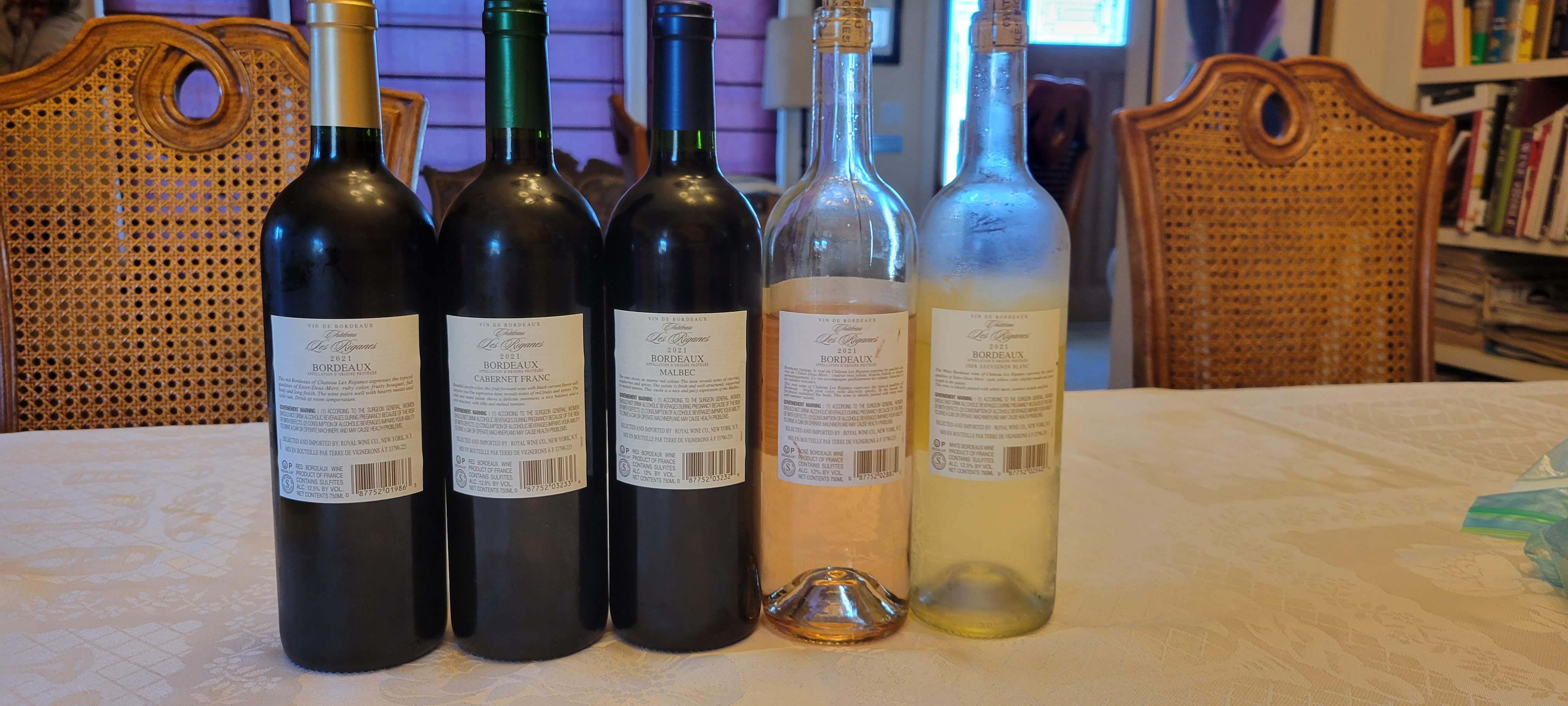
Sadly, this was the new full release of the 2021 Chateau Riganes, with the usual white, rose, and blend. This year they added single varietal bottles, of Malbec and Cabernet Franc. IMHO, this was the least interesting release of these wines in some years.
The wine notes follow below – the explanation of my “scores” can be found here and the explanation for QPR scores can be found here:

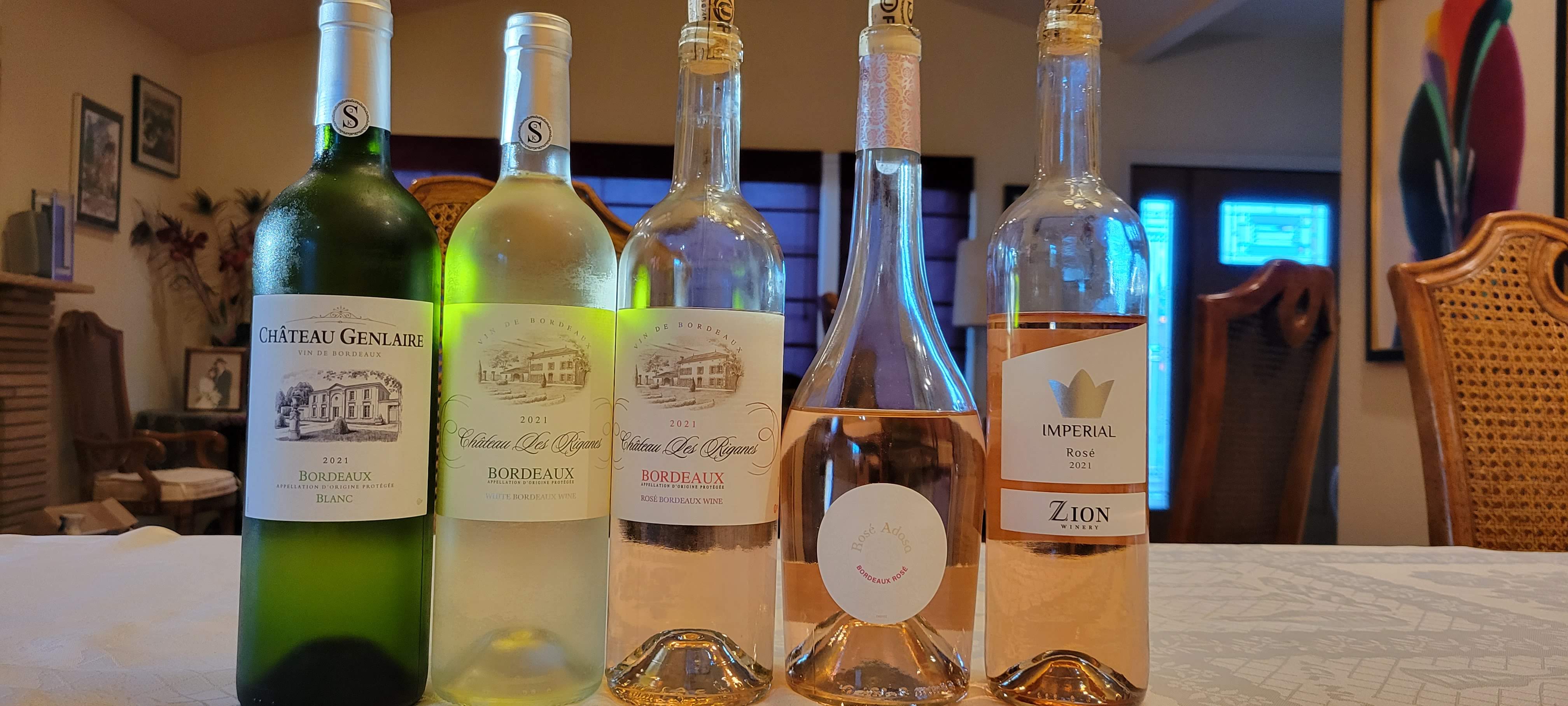
2021 Zion Rose, Imperial, Israel (M) – Score: 86 (QPR: GREAT)
This wine is made of Grenache and is off-dry. The nose of this wine is nice, it shows sweet notes, and clear RS, with raspberry, jasmine, peach, guava, cherry, and sweet fruit. The mouth of this medium-bodied rose is sweet, with balancing acidity, ripe fruit, sweet cherry, raspberry, guava, peach, and nice honey. The finish is long, sweet, but balanced with fruit, and not much else. (tasted August 2022) (in San Jose, CA) (ABV = 12%)

Herzog Wine Cellars’ latest releases – August 2022
Like much of my posts I am a bit behind, I received these wines in June 2022 and sadly, it took until this week to post them. The truth is that the notes are written quickly, but the delay is caused by the amount of time spent writing the post, with all the metadata in and around the post and the images.
In case you missed the last Herzog Wine Cellars post – please check that out here, the story and background around Herzog Wine Cellars is truly imperative to better appreciate what they have accomplished these many years! One large change since the last post would be the hiring of David Galzignato as Director of Winemaking and Operations. Joe Hurliman is now Winemaker Emeritus. As always I have incredible respect and appreciation for what both Joseph Herzog and Joe Hurliman have done for Herzog Wine Cellars. Their vision, drive, and continued passion for improving the wines and the winery are truly incredible and one that we should all aspire to learn from.
In shortened story form Herzog Wine Cellars is a fascinating story. It started with Eugene Herzog immigrating to the US from Czechoslovakia in 1948 after the war and after communism took over his winery. He worked for a small winery in NY, and by 1958 he became the majority owner of it. In deference to his grandfather, they called it Royal Wines, as he was given the title Baron in Czechoslovakia. By 1985, the family decided that they needed a California presence, and so they hired the famous Wine Maker Peter Stern, to build their initial footprint in the world of high-end wines. After that, they moved to Santa Maria, hired Joe Hurliman, and leased space from Coast Wine Services (CWS), all the while knowing that they needed a place that they could call home. In the end, Joe went looking for a plot of land, that was as close to a Jewish Community as possible (for the Kosher Wine managers) and landed on Oxnard. Not a classic place to house a winery, but one that is close to the highways to truck in the grapes and one close enough to a Jewish Community to allow for full-time Jewish supervision. The winery opened in 2005, and three years later it started hosting the International Food and Wine Festival. In my last post about this year’s KFWE I threw down a gauntlet, I wonder if anyone read/saw it, I think it is time for Herzog Wine Cellars to bring back IFWF, in the summer for a throwback! Time is ticking – the ball is in your court guys!
Now to the wines. The 2017 vintage was tough, it was tough for all of Cali, it was a bad vintage. The 2018 vintage was far better, but still not as good as the 2016 or 2014 vintages. We were all interested in the full 2019 vintage to see if Herzog could break the odd-year curse that has hung over them since the nice 2013 vintage. I guess I will have to say, the answer is maybe. There are clear QPR WINNER wines, but they do not shine as bright as in the even years of 2014, 2016, or 2018. They are riper and less focused, and while they show minerality, it feels/seems secondary to the larger picture.
Generally, when we look at Herzog, and their success for a year, we use the big three, the Cabernet Sauvignon, Special Reserve, Alexander Valley, the Cabernet Sauvignon, Special Edition, Warnecke Vineyard, and the Cabernet Sauvignon, Special Edition, Clone Six. However, there is also the burgeoning Lake County Cabernet Sauvignon, and of course the lovely Edna Valley and Santa Rita Hills Pinot Noirs, from both Eagle’s Landing and the Reserve line. There are the second-level wines from the Variations collection, which also weigh in a bit on a successful year for Herzog, IMHO, but the main wines drive the success ratio the most.
Still, Herzog is never resting on their laurels, in the past they were driving hard with a yearly Single Vineyard Cabernet Sauvignon, to add to the Cabernet Sauvignon rotation. However, in 2016, they paused the Single Vineyard Program. The good news is that starting in 2021 the Single Vineyard program is back online! After that, they started sourcing Stag’s Leap fruit in 2018 and then expanded the Special Edition line with Oakville and Rutherford.
One final statement around two wines in the lineup. One is Choreograph, it is a wine that has been around for a long time, started in 2016, the earlier name Camouflage started in 2014. It is a serious sleeper in the Mevushal Lineage line. In the first few years, the wine tasted like the makeup of the wine a hodgepodge of grapes, one of the classic issues with large field blends. The larger the number of fruit the harder it is for them to all get together and make the wine work. However, in 2020 and 2021, whatever Herzog is doing, they have been hitting a home run for the price. This is the absolute PERFECT BBQ wine, IMHO. Mevushal, served cool, with meat, chicken, or even fish, all will work if grilled or smoked, just a perfect wine with great acidity and balance.
The other sleeper is the Lake County Cabernet Sauvignon. Napa is either at max or close to the max price, at least for now, though everything was high, price-wise in 2021 and the Napa fruit prices may max out in 2022. They are not pretty! Many a winery has dropped serious money into Lake County, look at Andy Beckstoffer, AKA, Mr. Tokalon. He bought into Lake County in 1997 and continues to invest. This line has been showing great promise from the start and every year the wine improves or keeps the previous vintage’s quality. Bravo! It is not at the quality yet of Alexander Valley Cabernet, but it quickly making its way into that quality level.
Finally, this is more of a PSA, please cool your red wines in the fridge, for say thirty minutes before enjoying them, if they are at, what we call room temperature. If the room is at 75 degrees Farenheight, 20 to 30 minutes in the refrigerator will help to bring the red wine temperature down to what it should be enjoyed at, which is 60 degrees, or so.
There will be no 2019 Cabernet Sauvignon from Stag’s Leap, but interestingly, there will be a 2020 vintage, as it was picked just before the fires. There will also be a bit of 2020 Alexander Valley and Rutherford. Overall, 2019 turned out to be the best odd-numbered year in a long time, and while it does not rise to the quality of 2014/2016/2018 it is a solid showing for a not-so-good vintage.
The wine notes listed below shows seven wines that garnered the QPR (Quality to Price) WINNER score. That is a lovely list of wines the majority of them are 2020 or 2021 wines. There are two 2019 QPR WINNER wines, and they are the ususal suspects, the Alexander Valley and the Warnecke Vineyard.
I will keep this short, so my many thanks to Joseph Herzog, David Whittemore, Joe Hurliman, and Alicia Wilbur for answering my many emails and calls. Be well all of you! The wine notes follow below – the explanation of my “scores” can be found here and the explanation for QPR scores can be found here:


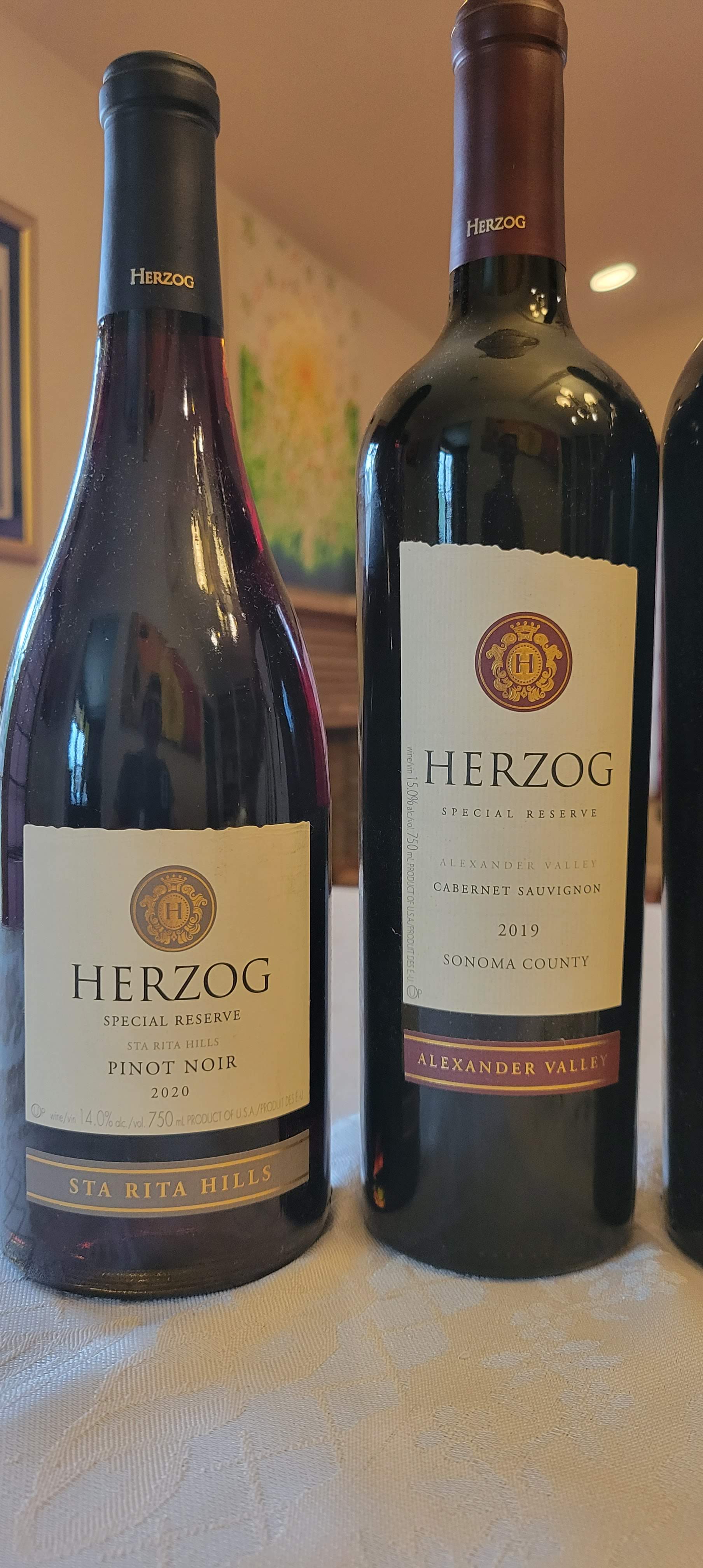


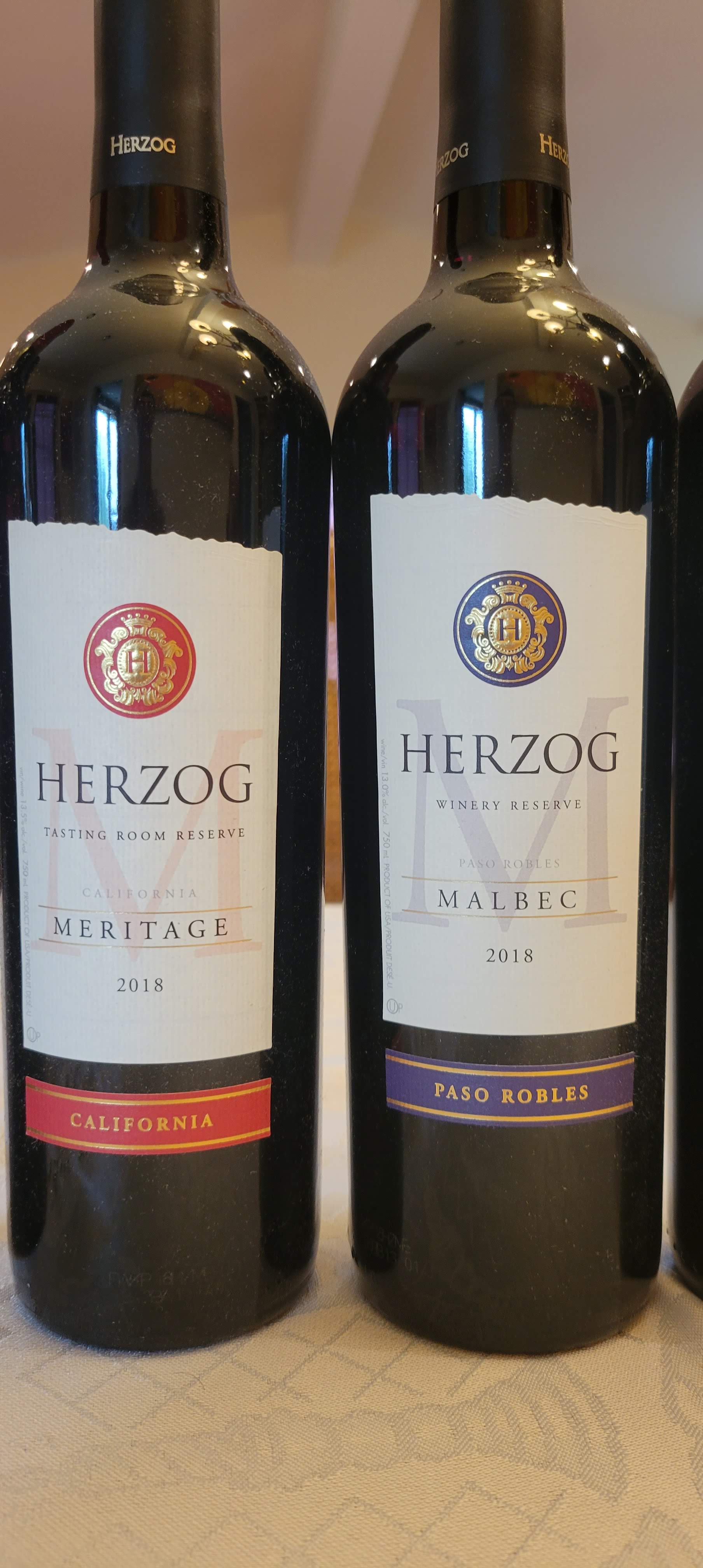
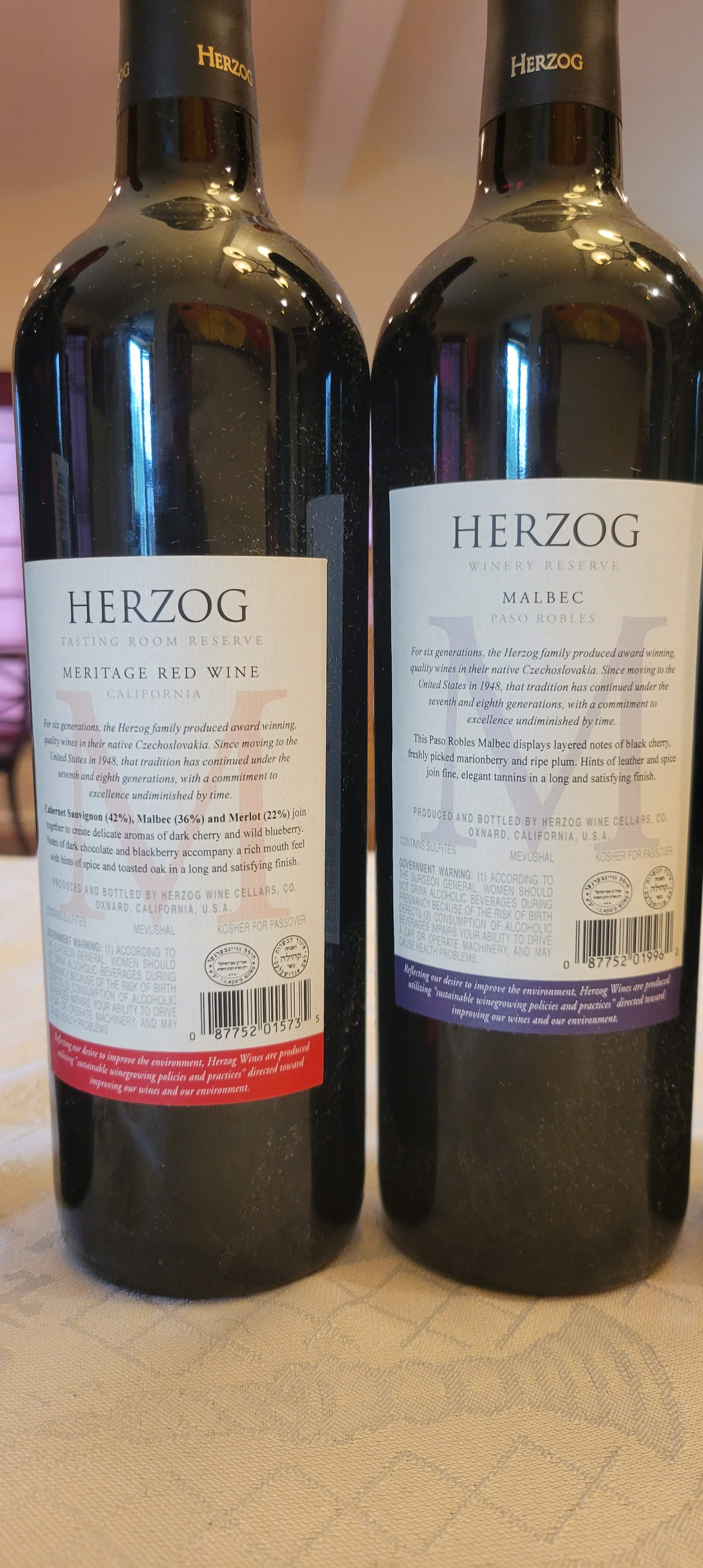
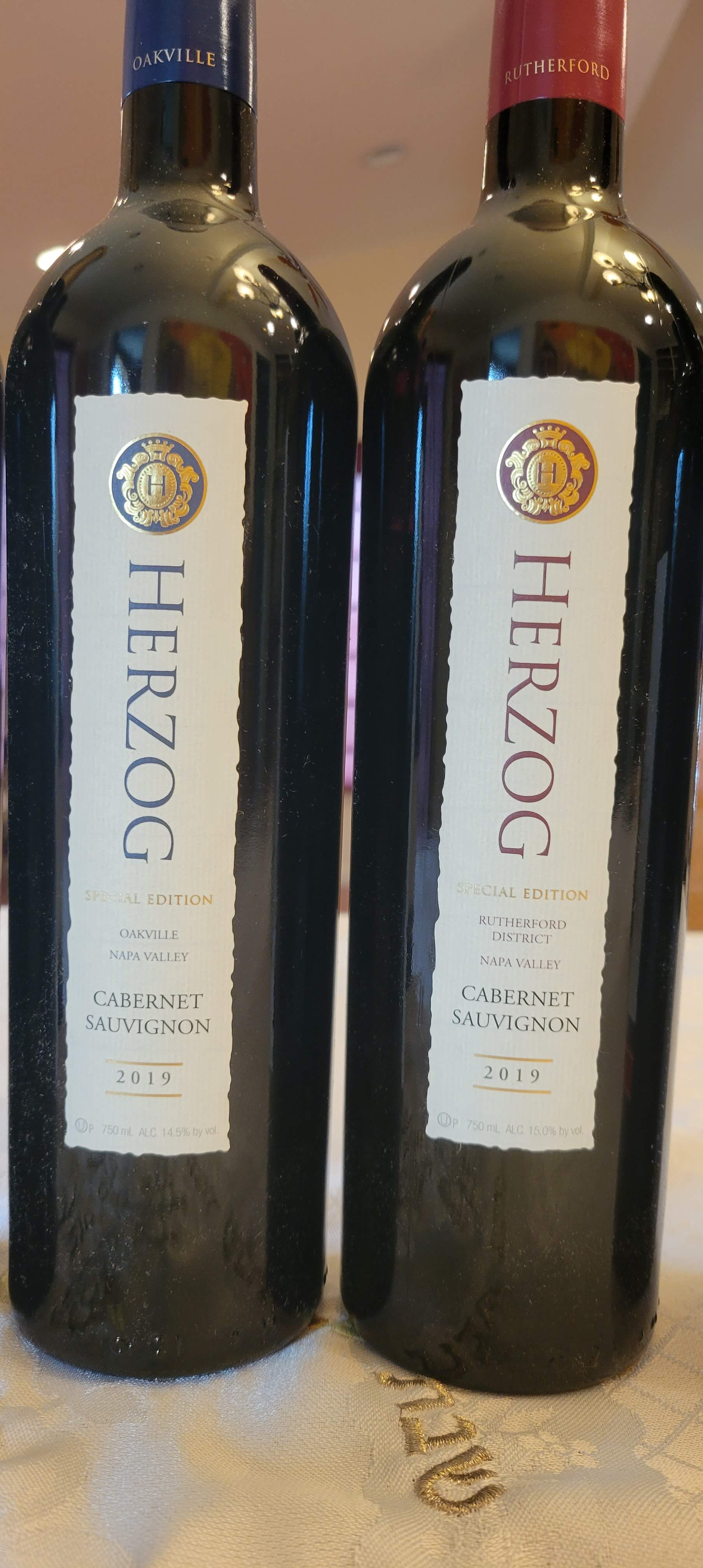
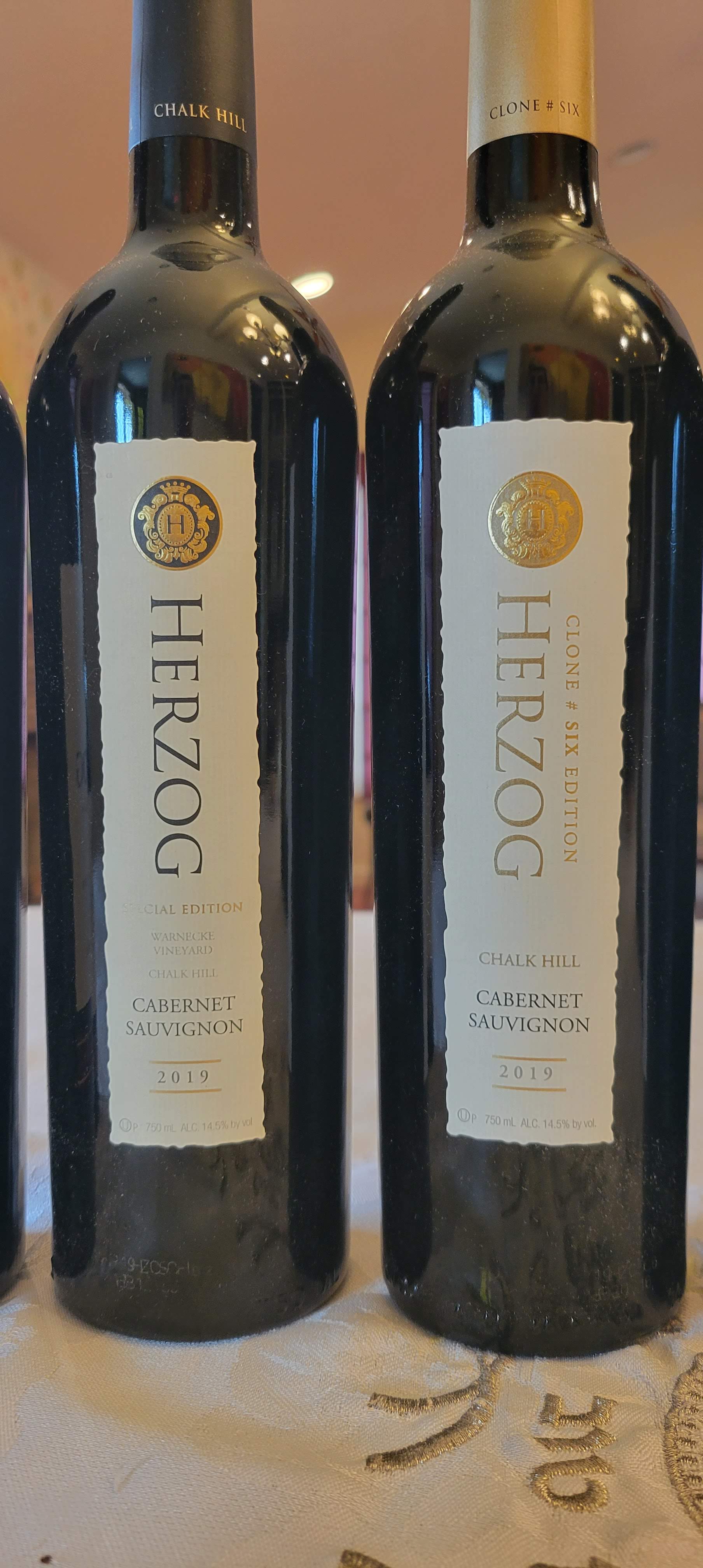


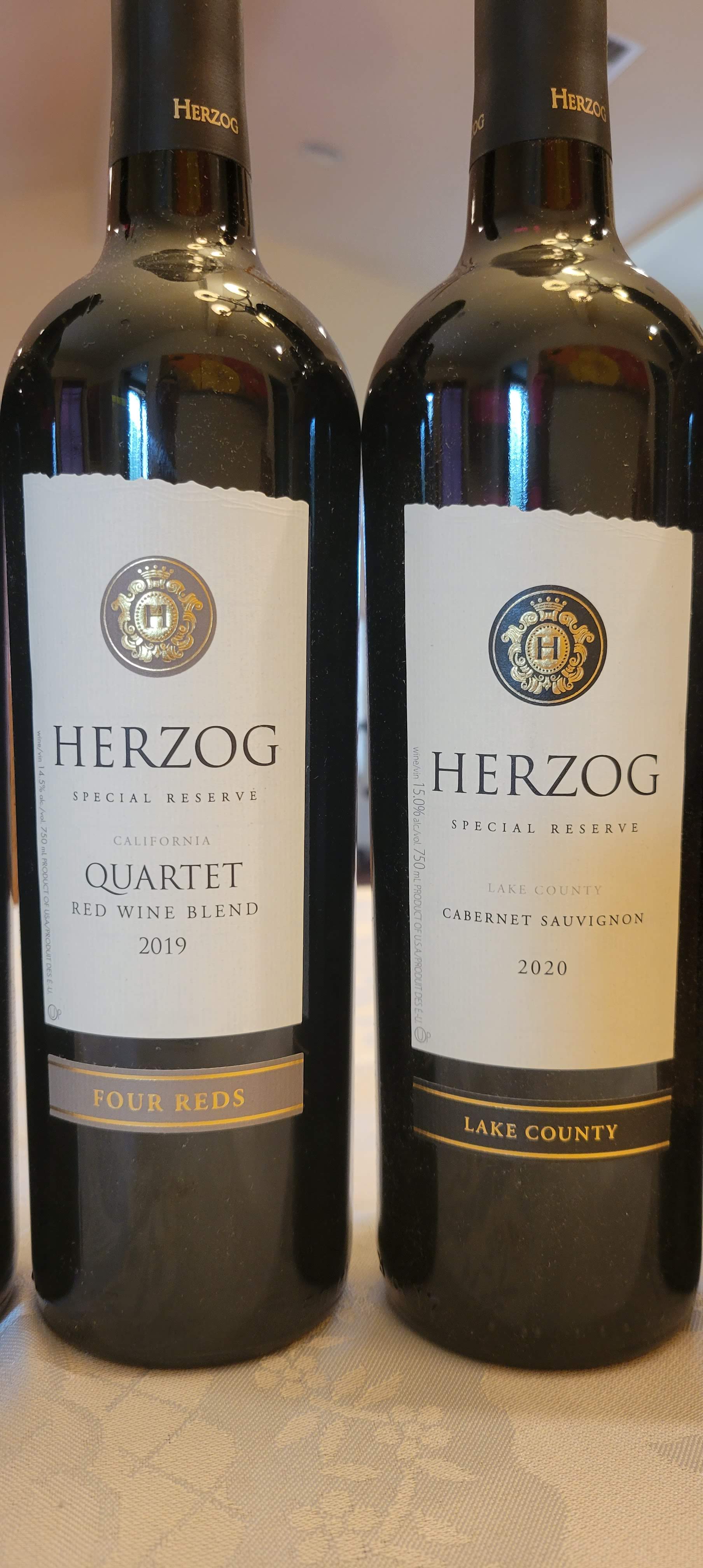
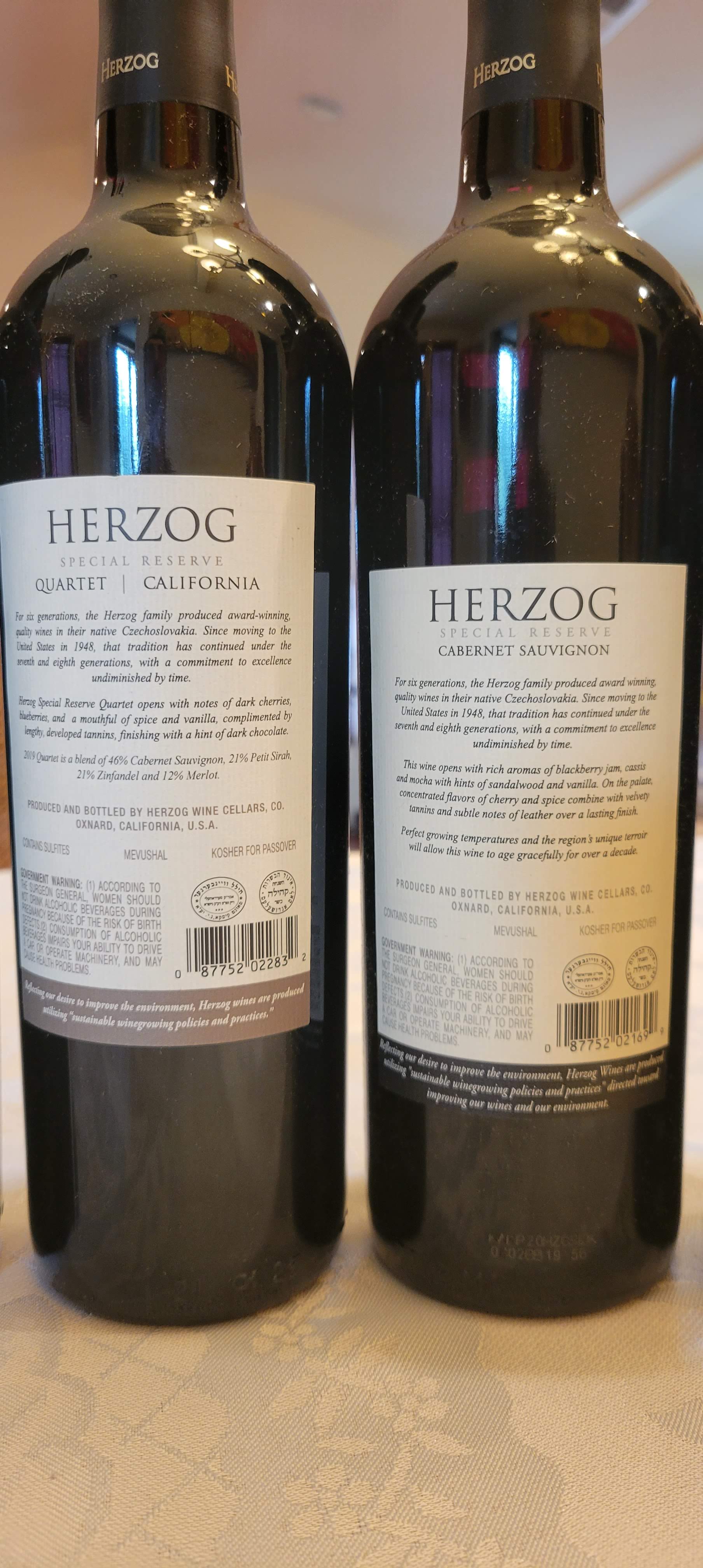
2021 Herzog Sauvignon Blanc, Lineage, Lake County, CA (M) – Score: 91 (QPR: WINNER)
The nose of this wine is more restrained than other Sauvignon Blanc out there, it is less ripe, it is dirtier, with mineral, floral notes, violet, rose, lemon, lime, yellow plum, and dryer sheet notes. The mouth of this medium-bodied wine is fun, refreshing, tart, acidic, and enjoyable, with green notes, lemon, lime, wet grass, mint, lemongrass, saline, hints of passion fruit, and otherwise, green notes, herbs, spices, flint, and rich mineral. The finish is long, green, spicy, and flinty, with saline, smoke, roasted herb, grass, and hay. BRAVO! Drink now. (tasted May 2022) (in San Jose, CA) (ABV = 14.5%)


 Wine Musings Blog