Blog Archives

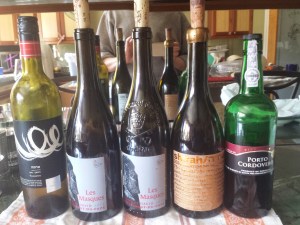
A tasting in Paris with a few WINNERS – June 2021
As stated in my previous post, I was in Paris in June, and while it took forever to post these notes, I am happy to finally be getting to them at this point. I will note, that almost none of these wines are or will be available here in the USA. The Vins de Vienne and Famille Mayard are available here, and the Tassi Brunello di Montalcino is here as well. The rest, are either in Israel or Europe.
So, returning to the trip, other than hanging out with my family and doing a few tastings in-person with Menahem Israelievitch of Royal Wines Europe, Clarisse and Lionel Bokobsa of Sieva/Bokobsa Wines, and Shlomo Corcos of Guter Wein, I kept to my hotel and tasted wines I bought throughout Paris. This is the tasting I had with Ari Cohen, David Naccache, Cedric Perez, Benjamin Sebbah, and Mickael Marciano. A really fun group of guys. I must thank Ari Cohen and his lovely family for hosting us during the tasting.
In the end, these were mostly painful wines but there were some real WINNERS as well. We did the tastings in parings of the same regions or style and some were quite nice.
Roses
There were three roses and none of them interested me at all. I was surprised as they had been hyped and they were expensive, but ultimately, they came up short.
Chablis
There were a few Chablis and overall they were boring. The best one 2019 Domaine des Malandes Chablis, Cuvee Amandine, Chablis, but it is not worth the money.
Two White Wines
Next, we had two white wines, one from Pays d’Oc and the other from Savoie, sadly they were both boring.
Sancerre
Next, we had some Sancerre! Yes, finally a real list of Kosher Sancerre! They were nice, some were crazy expensive and none really blew us away like the 2012 Chavignol Sancerre, but still nice. The WINNER from Bokobsa was the one wine that was both enjoyable and reasonable in price.
I do not normally care about price in regards to wine. However, I do care about the overall value of wine in regards to other options in its category, AKA QPR. There are so many great white wine options out there at this time that a 75 dollar Sancerre, nice as it is, really is not as interesting to me when I can have a better wine for half the price.
Another Chateau Magrez Fombrauge disaster
We then had 4 wines – they were all horrible. The 2017 Chateau Magrez Fombrauge Blanc, Bordeaux was an oxidized mess. The others were equally poor, I did not even write notes for them.
Rhone Wines
First we had four Rhone wines, two from Cotie-Rotie, one from Cotes du Rhone, and another from Chateauneuf-du-Pape. The two Cotie-Rotie were produced for Mes Vins Cacher and they were quite lovely, though expensive. The Cristia Collection are nice wines made for Israel that Ari was able to also get a few bottles of. This is yet another example of the growing list of French Kosher wines being made solely for Israel’s export. This has been the case for some USA purpose-made French wines as well, but in this case, Israel has taken the lead, at this point.
Next, we had another four Rhone wines, this time these were all made by Nathan Grandjean for sale on his website: yavine.fr. These wines and others from his collection were quite impressive and are WINNERS. Nathan had the largest number of QPR WINNERS in the tasting. Bravo!
Next, we had four Rhone white wines, all were again made by Les Vin de Vienne and Famille Mayard for Nathan Grandjean. Two Condrieu, one Crozes-Hermitage, and one Chateauneuf-du-Pape. Very nice. Two more WINNERS here!
Brunello
Finally, we had the 2016 Tassi Brunello di Montalcino, Bettina Cuvee, Brunello di Montalcino. It is a lovely wine but for the price and the quality, I would stick with Terra di Seta. I will try and taste this again, but for now, it is a lovely wine that is just too expensive.
Overall Feeling
Overall, there were some WINNERS and there were some nice wines that are not worth the money. Magrez continues to make wines I would never buy and the rest of the simpler whites and roses were a total waste of money.
The higher-end wines were nice but many were far too expensive to make it reasonable. Still, there is a growing selection of wines from regions that we could have only dreamed about in the past!
I must state that I could NEVER have tasted these wines without the incredible help of Ari Cohen, Nathan Grandjean of yavine.fr online wine shop, and MesVinCacher. Ari tracked down all the wines for this tasting and hosted us for the afternoon that turned into the evening. I was sure he was ready to throw us out an hour earlier! Thanks so much, Ari, and thanks to your wife and family for putting up with me, and the gang that invaded your home!
The wine notes follow below – the explanation of my “scores” can be found here and the explanation for QPR scores can be found here:


2019 Roussawine Rose, Greece – Score: 88 (QPR: EVEN)
The wine is surprisingly good for 2019 rose. The nose on this wine is nice enough, with good fruit, nice acidity, and minerality. The mouth on this medium-bodied wine is painful, it is too sweet, not balanced enough, but nice still, with melon, sweet strawberry, guava, and tart grapefruit. Nice enough. Drink now. (tasted June 2021)
2020 Chateau Gairoird Rose, Cotes de Provence – Score: 87 (QPR: EVEN)
The nose on this wine is simple, a bit of grapefruit, strawberry, peach, raspberry, and mineral, simple. The mouth on this medium-bodied wine is nice enough, it lacks the acidity to balance this wine, it is good enough, but sadly move on. (tasted June 2021)
2020 Chateau de Saint-Martin Grand Reserve, Cotes de Provence – Score: 85 (QPR: BAD)
The nose on this wine is pure citrus, tart grapefruit, hints of apricot, really the nose is filled with deep minerality, smoke, and bright fruit. The mouth on this wine is balanced, but it has slight bubbles, when you shake it the acidity falls off, this is crazy, the wine was supposed to be so great, but honestly, all I get is saline, smoke, and grapefruit. The finish is short, but the minerality and saline are nice, very sad. Drink now (tasted June 2021)

A wonderful day spent with Gabriel and Yael Geller
On another recent business trip, I spent a day with Gabriel and Yael Geller. My many thanks to my friends for hosting me for the day. The food was awesome, smoked ribs, and roasted chuck, and a game of blind tastings that was really wonderful. The wines we tasted blind were mostly 100% HORRIBLE but the last one we enjoyed was why I just stated that it was wonderful, because GG was so kind to pour a bottle of the 2002 Smith Haute Lafitte a wine I had not tasted till that moment. It was beyond wonderful – thanks so much, buddy!!!
We also took a tour around Teaneck, NJ’s Kosher takeout establishments and they were all horrible. Sorry. There was nothing good to report here. However, the wine shop where we bought a vast number of horrible wines was very nice. The wine shop is called Filler’up. The owner is called Mendy Mark and he was very kind and helpful in finding all the new wines that I have not yet tasted. Sadly, 95% of those wines were horrible but that is not Mendy’s fault there is far too much horrible plonk in the Kosher wine world.
So, if you are in the Teaneck area definitely swing by Filler’up they have a great selection and the staff is very nice. However, do not buy takeout food from around there that stuff is really bad.
Ok, thankfully, the takeout food was just a test of the quick food in the area, not really food we had that evening. If I had an image of the smoked ribs it would have been the post’s featured image, the animal was black bark heaven, with loads of spice and smoke. Do not forget breakfast and lunch before that which was also beautifully served and with such panache, my many thanks again!
I bought a bunch of wines and they were all duds other than one very nice French Mevushal wine that came in a 375ml format, but it also comes in 750ml format, but it is not available at any of the common shops that I can buy from. If someone finds it at a place that ships and does not charge an arm and leg, please tell me, more on the best of the tasting below, other than, of course, the EPIC 2002 Chateau Smith Haute Lafitte.
GG did a blind tasting and they were all bad to horrible, again, other than the 2002 SHL. To be fair, I did not take long notes for wines that were undrinkable. I have listed the blind and non-blind tasted wines below in different sections. Many thanks to Gabriel and Yael Geller for hosting me and for sharing his time, wonderful culinary feats, home, and wines with me. The wine notes follow below – the explanation of my “scores” can be found here:


2018 Route Victor Cabernet Sauvignon, California – Score: NA
The nose on this wine is bulk in nature, candied fruit, cherry, and cheap. The mouth on this wine is cheap, far too acidic, and a lack of body, cherry, acid, and vegetables. Move on
2016 Padre Bendicho, Yecla – Score: NA
This wine is a blend of 70% Cabernet Sauvignon and 30% Mourvedre. This wine is 100% PURE date juice, in all the glorious ways it can be! Read the rest of this entry
My top 25 kosher wines of 2014
Well, 2014 has come and gone and my top wines of the past year were too many to limit to 10. Now these wines comprise a list of wines I enjoyed over the year. Some were released in 2014 and many were released a long time ago. Either way these are wines that made an impression upon me and that is the only characteristic that I used to define this list.
Some of these wines may not score a solid A, but they deserve to be here because of their trail blazing characteristics Take for instance – the 2012 Recanati Marselan. It is the only kosher Marselan and it is very good. The 2013 Yarden Sauvignon Blanc, one of the best whites to come out of Israel along with the 2012 Tzora Shoresh White, a wine that I believe is better than the 2013 Shoresh white, were both on my list last year, so they are not on it this year. The 2013 Tzora Shoresh is on this year’s list and if you have not gotten any – you are making a huge mistake. I had both in 2014, and even though I liked the 2012 a bit more, the 2013 is an epic white wine, in its own right. The best rose, hands down, was the 2013 Hajdu Pinot Gris rose. It is tied for best ever kosher rose with the 2012 Shirah rose, but that was already enjoyed in 2013. The next white wine was the epic 2013 Dalton Viognier, a wine that is worthy, once again, of the Dalton reserve label. It beats the 2012 hands down, and reclaims the title as the best kosher Viognier that is available in the US or Israel. There may be a French Viognier that is available there, but I do not know of them. The final non red wine was the 1996 Four Gates Chardonnay, which while never released officially, it was an awesome wine indeed! I tasted while tasting an entire vertical of all of Benyamin’s Chardonnay wines and this was the best of the bunch. Many others were solid A- and maybe a bit more wines, but the 1996 was a A- to A wine that was truly epic.
The rest of the wines are red, and there are many special wines there including the fantastic 2012 Recanati wild Carignan and Syrah/Viognier wines. BRAVO! There were many more French wines, but they will have to fall till next year, when I get a chance to sit down and enjoy them over a long meal. The 2012 Chateau Giscours, the 2012 Pavillon de Leoville Poyferré, and the 2012 Roches de Yon Figeac are lovely wines and may well get on the list next year. In the end, California, France, and Spain continue to be my sweet spot. There are a few exceptional wines from Israel, like the epic and insane 2000 Yarden Katzrin and others. Along with current releases from Tzora Winery, Recanati Winery, and Yatir Winery. In the end, Israel will improve by having 2009, 2010, and 2011 in their rear view mirror, all the while enjoying the new 2012, 2013, and from what I hear 2014 vintages.
The wine notes follow below:
Wines of Spain
2012 Capcanes Peraj Habib (Crazy QPR) – Score: A- to A
Before I talk about this epic wine, I must sadly say that one of the wines that was on my list last year – the 2012 Capcanes Carignan – never made it into its own bottle. Sadly, it was not deemed worthy of a leading role. Thankfully, it found its place here, in this fantastic 2012 Peraj Habib! The wine blend for 2012 is not far off from 2011, consisting of 40% Grenache, 30% Carignan, and 30% Cabernet Sauvignon, sourced from very old vines.
The nose on this dark and impenetrable purple colored wine is redolent with roasted animal, intense black fruit, and mounds of dirt and mineral. The mouth on this full bodied wine hits you with an intensely inky structure, filled with layers of of rich concentrated fruit, ripe freshly squeezed black berries, cassis, plum, along with tart fruit, spice, and mouth coating tannins that may well make some people think that this is the best Capcanes Peraj Habib ever made. The finish is long and purely mineral based to start, like sucking on a salt and graphite stick, as it recedes, you sense the incredible balancing acid, which is then immediately replaced with richly roasted coffee, sweet and herbal spices, more black fruit, a sense of animal fats, leather, hints of tobacco, and finally followed by bitter notes on the long finish. BRAVO!!!! Read the rest of this entry

Lovely kosher Rhone wines from the Chateauneuf du Pape, Israel, and California
 It has been quite sometime since I last posted, it is a mix of many things that has limited my access to time to type up all my notes and thoughts. Over Passover we enjoyed a few wines and many of them were in the theme of Rhone wines, including two that were actually from the highly vaunted Chateauneuf du Pape wine region (a sub region of the Rhone wine region).
I have written extensively about Rhone wines from the best kosher purveyors of these lovely wine varietals; Syrah, Mourvedre, Grenache, Carignan (accepted by the Rhone Ranger community), Petite Sirah (same with this varietal), Grenache Blanc, and Roussanne. These varietals are gaining traction in the kosher wine world, with great help from Netofa Wines, Vignobles David Winery, Reacanati Winery, Hajdu/Brob Wines, and Shirah Winery.
There are many wineries making a wine or two from the Rhone varietals, but few have taken to the varietals like the list above. Recanati may well be making Cabernet and the such, the Mediterranean labels are almost all Rhone in style and varietal and it has been a boon for both buyers and the winery. The Carignan Wild has been a huge winner for the winery, the Petite Sirah is magnificent, and the white RSR is now a unique blend of Roussanne and Marsanne. But the best wine from the Med series may well be the 2012 Marselan – an absolutely insane wine.
Of course, when you think Rhone Ranger and Israel, the real ranger MUST be Pierre who released his first wine under the Netofa Winery label in 2009. It was an entire line of red and white wines based solely on the Rhone and Loire Valley varietals. Since then he has branched out to Portugal grapes, but the red and rose Netofa and Netofa Latour wines are all Rhone varietals. The white varieties are Chenin Blanc from the Loire Valley.
Even before that, Jonathan Hajdu and the Weiss Brothers have been releasing wines based on the Rhone Ranger methodology, under the Brobdingnagian and Shirah labels respectively, going as far back as 2005. Read the rest of this entry

 Wine Musings Blog