Blog Archives

A few new and old wines this past Shabbat. 2017 Petit Guiraud, Sauternes, 2010 Terra di Seta Chianti Classico, Reserva, and 2007 Tzora Vineyards Misty Hills were the winners
This past Shabbat we had some friends over and I opened many a wine, 13 to be exact. There were a few new wines, including the new 2017 Petit Giuraud, the 2nd of three wines that will be released from Chateau Giuraud. The first one was the G of Guiraud, which is a lovely dry wine. The second was the Petit Guigaurd, a Sauternes which has recently been released, and IMHO is better than the 2016 Chateau Piada. The third will be the 2016 Chateau Guiraud, which will be the first release since the 2001 vintage was released many years ago.
Besides, the Petit Guiraud, there was a 2nd tasting of the 2016 Matar Cabernet Sauvignon. We last tasted it in Israel, and it did not show well. Here it did not show well, but it showed better. It was less fruit-forward and absurdly ripe than at the tasting in Jerusalem.
The real winner of the evening, IMHO, was the 2010 Terra di Seta along with the 2007 Tzora Vineyards Misty Hills. It was a lovely wine and shows what Israel can produce when it wants to build wines for the future and not wines for the present alone.
My many thanks to all the folks who shared the dinner with me, and may we all be blessed to enjoy more meals together!
The wine notes follow below – the explanation of my “scores” can be found here:


2014 Roc des Moulins – Score: 88
Classic nose of the cheap Bordeaux Superieur wines, mushroom, dark cherry, rose, earth, and simple notes. At open this wine is very simple, not much complexity, but has solid acid, and nice fruit. With time, it opens nicely, to show a more complex mouth, still clunky and simple, with more cherry fruit, dark currant, and herb galore, along with saline, and mounds of bitter herbs, with tobacco, and forest floor. Nice. Drink by 2021.
2014 Chateau Roquettes, Saint-Emilion Grand Cru – Score: NA
We opened this wine before Shabbat, and it tasted like the notes below. We then tasted it at the Shabbat table, and it was oxidized. The cork is fine. I am not sure if this is an issue of bottle variation or just a bad bottle.
The nose on this wine is super closed and tight to start, with mounds of tobacco, smoke, herb, red fruit, and nice mushroom, showing lovely dark and red ripe fruit. The mouth on this full bodied wine is lovely, with lovely and rich extraction, with still ripping tannin, that is rich and layered, with concentrated fruit, dark plum, forest berry, with dark raspberry, and rich earth, mushroom, and lovely terroir, and nice sweet oak. The finish is long and rich, and layered, with rich minerality, lovely saline, forest floor, foliage, with graphite, tobacco, and saline. Bravo!!
2010 Terra di Seta Chianti Classico, Reserva – Score: 92
Wow, the nose on this wine is coffee, toffee, and heavy smoke, with crazy oak, and red fruit galore, hidden in the background, is dark red fruit, and lovely brightness. The mouth on this medium bodied wine is rich and layered, and really alive, with tart fruit, showing raspberry, cherry, and lovely herb, showing rich tobacco, herb, with mint, oregano, with lovely mouth draping tannin and rich mushroom, with wet forest floor, and great chocolate. The finish is long, and green, and herbaceous, with lovely dirt, and green notes. Drink by 2022. Read the rest of this entry

Top Grenache wines available now
Well, I just posted by Pinot Noir post, and as I have stated before, Grenache is the Pinot Noir of the Rhone Valley.
So, there we are – I hope we understand the dearth of options that exist in the kosher Pinot Noir landscape. With that in mind, I thought it was high time to have a Pinot Noir tasting, along with the fact that a guest who came to our house said he liked Pinot Noir and Grenache! In a way, it was the perfect wine combo! Grenache is called the “Pinot noir of the Rhone Valley” for its finicky growing style as well, so the combo was chosen.
Now if good kosher Pinot Noir is a pain to find – forget about Grenache!! Here is the list – the TOTAL list that I know of (whether I would or would not drink them):
- Hajdu Winery (much epic Grenache including 2007, 2010, and 2012, 2014)
- Capcanes Winery
- Ramon Cardova (undrinkable)
- Galil Winery (last I had was OK)
- Shirah Winery
- Vitkin Winery
- Dalton Estate (Last I had was really sweet)
- Kos Yeshuous (only in 2016)
After those – the rest are blends, including the lovely Elvi, Netofa, and onwards:
- Vignobles David (The last Vignobles I had were not fun, I hope to taste them again soon) – he has many wines with Grenache in them, in varying degrees of percentages.
- Elvi Winery (Great wines indeed)
- Netofa Winery (they recently added Grenache to their famous SM wines).
- Capsouto Winery (they too only have 30% or so from Grenache)
- Capcanes Winery (yes again because they make the famous Peraj Ha’Abib with Grenache as part of the blend)
- Yaacov Oryah Wines (he makes a Blanc de Noir from Grenache and a few GSM as well). Sadly, I have not tasted his new wines. I hope to be doing that soon.
Sadly, in the world of white – there are only TWO full Granche Blanc wines:
- Hajdu Winery (much epic Grenache including 2007, 2010, and 2012, 2014)
- Vitkin Winery
Also, like the Noir, there is a winery that uses the Grenache Blanc in a blend:
- Capsouto Winery (they use 60% of it or so in the Eva)
- Vignobles David (The last Vignobles I had were not fun, I hope to taste them again soon and new ones as well) – he has a wine or two with Grenache Blanc in them, in varying degrees of percentages.
- Shirah Winery made a Vintage White in 2016 that was mostly Grenache Blanc, but this year, they went back to using Viognier as the major varietal in this white blend.

A Horizontal of 2013 Pinot Noirs and other top Pinot Noir to buy now
A few weeks ago, Benaymin Cantz from Four Gates Winery and friends came over for a Friday night dinner, and I thought it was a good time to open my 2013 Pinot Noirs that I have been saving. I must say, in hindsight, I should have done it earlier, as some of the wines were already past their time or DOA.
My love for all things Pinot is well known, and I had such high hopes. Overall, the night was fine, it was just not at the level I had hoped for. Thankfully, Benyo brought two extra wines, and they made the night super special! They were, a 1997 Four Gates Pinot Noir and a 2005 Four gates Merlot. M.S.C.
It is funny how the media can change people’s perspectives, and in some cases twist it in a way that we would not expect. Say Pinot Noir and most wine drinkers will think of the enigmatic anti-hero Miles Raymond, and his explanation on his love for Pinot Noir; “…It’s, uh, it’s thin-skinned, temperamental, ripens early. It’s, you know, it’s not a survivor like Cabernet, which can just grow anywhere and thrive even when it’s neglected. No, Pinot needs constant care and attention. You know?…“. Pinot is a complicated grape – but not to its own detriment. Listen to Miles throughout Sideways and you may come to think that Pinot is fleeting, flinty, thin, and complicated. In the end, as you watch that horrible movie, you quickly realize that Miles was simply projecting in a fire fueled rambling and using Pinot Noir as his conduit.
To the French, Pinot Noir is called Burgundy – following the tradition of French wineries to name their wines after the region where the grapes are grown. Americans have had success with Pinot – in California, Oregon, and Washington State. New Zealand, has really taken the lead in bringing the grape into the 21st century. The French Burgundy has its terroir (earthy dirt flavors, sometimes barnyard flavors as well). The New Zealand and American Pinots show characteristics that are more akin to Syrah then Burgundy – fruit forward, meaty wines with soft caressing tannins. The rest of the world is choosing sides. Though true terroir flavors are hard to replicate outside of Burgundy, many countries have been successful at bringing out the true fruit characteristics that the land is willing to share and are creating wonderful Pinot Noirs. Israel was starting to come into its own with Pinot Noir, now all I would buy from Israel, in regards to Pinot would be from Gvaot. Even if the 2013 Pinot was DOA, I have had good success with Gvaot Pinot Noir. Right now, the best bet is France and the USA, with a drop from Israel, and after that, we are on empty.
Sadly, Pinot Noir to me is one of those wines that is so badly mangled in the kosher wine world, that it is no shock that most kosher oenophiles, turn face when u say Pinot Noir. Not on account of the Pinot Noir grapes themselves, but rather on account of the pathetic state of kosher Pinot Noir wine on the market.
Say, Pinot Noir to me, and sadly I can only think of:
- Four Gates Winery
- Gvaot Winery
- Covenant Winey’s Landsman Pinot Noir (the 2016 vintage is really fun)
- 2013 Eagle’s Landing Pinot Noir (the 2015 and 2016 were too ripe for me)
- Hajdu Makom Pinot Noir (though no new ones recently)
- 2014 & 2015 Chantal Lescure Burgundy from Pommard
- 2010 Domaine Gachot-Monot Beaune 1er Cru Les Cent Vignes
- 2016 Maison Roy & Fils Shai Pinot Noir, Willamette Valley
- Hagafen and Vitkin have left me wanting more, and forget the rest of Israel’s Pinot Noirs. Same goes for Pacifica, which has also been lacking, other than one vintage.

Riesling – is finally getting its due in the kosher market
If you have read my blog before, you know I love all things Pinot, Cabernet Franc, and Riesling. Yeah, the less loved grapes. Pinot is too loved in too many ways in the Non-Kosher market, and that sideways buzz is not dying down.
So let me start with why Riesling and what is Riesling? First, this grape has many names, White Riesling, Riesling, Johannisberg Riesling, and others are real names of the Noble grape, while Emerald Riesling or Welsch Riesling – not so much!
Riesling Grape
Riesling is old, like ancient, it is documented to exist in Mosel dating back to the early 1400s! It is one of the Noble Six grapes that define wine history, but that is all marketing hooey IMHO. In terms of kosher wines, this variety did not really become special until recently, with Hagafen and Carmel doing wonderful jobs with the grape.
Riesling wines can be made in so many ways. The most common are sweet wines, like the impressive Hagafen Rieslings, that Ernie Weir makes every year, or the less impressive Giersberger Riesling, or the even less impressive Gilgal Riesling. These wines all have some amount of RS (Residual Sugar), whether they are called off-dry, semi-sweet, or sweet, they all need a very important component to make them work – ACID! They desperately need acid to balance the sweet notes. Hagafen is the only off-dry Riesling I have ever liked, that I remember anyway, though the German wines are off-dry, but, they are on a different level.
It is sad, but while Jews do not seem to enjoy white wines, they do drink sweeter wines, and if there was a bit more acid to balance it out, I think they would show better. That said, I brought this subject up to many a winemaker, and the response was all the same. People like it simpler to drink, so spiking the wine with acid would not sell as well, IE, customers like sweet alcoholic water. Acid tends to discourage gulping or whatever to these people do. Truly sad.
I am finding that Riesling is quickly becoming my favorite white wines. The dry wines from Hagafen, Nik, and Carmel bring a smile to my face. They are rich, layered, oily and balanced, with good acid that makes them enjoyable for almost any part of the meal. That is what makes acid work so well. Food dishes, wine, even dessert, all need some amount of acid to balance out the palate.
There are many other white wines out there for sure, look at my list of whites from last year. Sauvignon Blanc, Chardonnay, and Riesling are all noble grapes, and they are all lovely when done correctly. Still, Riesling has something going for it, that none of the other white varietals have, funk!
When the wine is done correctly, and then aged for even a year, the wine starts to display notes of petrol and oil. Some may find that offensive, but to me, it is yet another aspect of how I love mineral based wines. The great thing is that these wines come from all around the world! You can find kosher Riesling from California, France, Germany, and Israel!
Riesling wines in the Kosher market
France has been making kosher Riesling since the 1960s, with Koenig and later with others. They are made in the region of France called Alsace, which is a five-hour drive east of Paris, on the Eastern Border of France, where it abuts up to Germany. Alsace has been making Riesling for almost as long as Germany, with documented proof of Riesling wine starting in 1477, when it was spelled Rissling.
Sadly, until 2008 or so, we only had sweet Rieslings here in the USA and Israel. Starting in 2008, Willm Riesling was brought to the USA, and it was an instant hit. It lasted a good many years, but then it died. It showed bracing acidity, awesome mineral, and good fruit. Still, that never reached the level of the 2014 Nik Weis wine or even the 2014 Hagafen Riesling, both of which we tasted this past week again, and both are as close to a 95 score without getting it.
In 2010 Carmel’s Kayoumi Riesling was pretty close to bone dry, and that really started the dry Riesling train going. We hit the next plateau with the 2012 Hagafen Riesling dry, it was their first dry Riesling and it was sensational. Then we hit the next plateau with the release of the 2014 Nik Weis Riesling. There was the 2015 Riesling, which is not bone dry like the 2014 vintage, more like the 2% Hagafen Rieslings with well-integrated acid, it was OK, but it needs lots of time to better integrate. Finally, there was the epic Von Hovel Rieslings, which are on the top of the mountain, in regards to the best kosher Rieslings made so far, even if they are slightly off-dry! Read the rest of this entry

The 2018 Kosher rose season is open – part 3
Well, after the first post I stated that I would be doing this rose wine post a few times. The subsequent posts would have the original content, and the newly revised or added rose wines as well. Well, this is part 3, and I hope this is the last one! My schedule was insane, but it is now slowing down, thankfully, so I hope to be adding more posts as well!
It is still officially Summer, which means it is Rose time! Rose wine in the non-kosher market is exploding – especially Rose wine from Provence; a wine region of France. Sadly, in the kosher wine market – that is not quite the case. I did not stress my previous statement with a suffix of AT ALL, even though I am not allowed to open a bottle of rose on my Shabbos table with guests – why? Well, that is simple – no one will drink it!!
Even worse, is that wine manufacturers may well have jumped the shark! There will be some 50 dry-ish kosher roses available in the USA this year! That may not sound like a lot, but when all you had was Herzog White Zinfandel 10 years ago – it is insane. The first high-end rose was Castel’s 2009 rose and that was only 9 years ago. Back then, there were few to no real Rose wine options, other than a handful of Israeli wines and almost no French Rose made it here. Now we will have tons of Rose, and I really think the real question here is will people drink it all?
Wine Color
What is a rose wine? Well, simply said, a rose is a wine that can best be defined as the wine world’s chameleon. Where white wine is a pretty simple concept – take white grapes, squeeze them, and you get clear to green colored juice. Yes, the white grape juice is clear – well so is red grape juice, but more on that in a bit.
White wine is not about color – almost all color in a white wine comes from some oak influence of some sort. So, an unoaked Sauvignon Blanc or Pinot Gris can sometimes look almost clear, depending on the region and how the wine was handled. Now oaked Chardonnay, of course, is what most people use as an example of a dark white wine. As the Wine Folly linked above states, different wine regions oak their Chardonnay differently and as such, they are sold with different hues from the start. With age, the wine changes color and the light gold moves to darker gold shades.
The only real exception to the stated rule above – that white grape juice without the influence of oak is somewhere in the clear to green color spectrum, is – orange wines. We have spoken about orange wines – mostly thanks to Yaacov Oryah. Outside of Yaacov’s work there really is no orange wine in the kosher world to speak about. Orange wine is made exactly like red wine, which means that the clear grape juice is left to sit on the yellowish to dark yellow grape skins (depending upon what varietal is used to make the orange wine).
Red wine juice – straight from the grape comes out the same color as white grapes. You see the juice from grapes is mostly clear to greenish in color. The red wine color comes from macerating the juice on the grape skins. The longer the juice sits on the grape skins (wine must) the redder in color the wine becomes until it reaches its maximum red color potential.
The only real exception to the rule of a grape’s juice color is the Teinturier varieties. The grapes are called Teinturier, a French language term meaning to dye or stain. The list of grapes whose juice is actually red colored is long – but the list of kosher wine options that is a wine made from these grapes – is the Herzog Alicante Bouschet. The Gamay de Bouze is not a normal Gamay grape, it is one of those grape mutations that are very red in nature. Read the rest of this entry
Top kosher 2017 white wines from around the world
Ok, let’s start with the obvious, I have been so busy this year that I have had zero time to work on these posts. So, ahead of the High Holiday Crescendo, I wanted to post a quick note about the 2017 vintage and my hopes for a great new year, filled with joy, success, health, and lots of great wine to all.
2017 Vintage
So far the 2017 vintage has been much akin to the 2016 vintage – last year. The 2017 roses have been a letdown overall, much akin to the 2016 vintage of roses that were a letdown after the epic 2015 vintage. Sure, we have a few rose winners, like the lovely 2017 Les Lauriers de Rothschild Rose, and the nice 2017 Covenant Blue C Rose, and 2017 Netofa Latour Rosado.
Still, the whites have been a real letdown, much akin to what happened in the 2016 vintages. We have not had a GREAT vintage out of Israel since the INSANELY good 2014 vintage.
So, Israel has been a letdown white wine-wise and rose overall these past few years. But there are some winners as usual. I have yet to taste the 2017 Tzora wines. The Netofa whites are lovely, along with the fun and very enjoyable 2017 Covenant Israel Viognier. There is also some nice Dalton Sauvignon Blanc wines.
The true savior is once again, the old-world region. France has a few great whites! Yes, I said whites! Throw in California, and we have enough whites, just not a bounty.
I hope you enjoy these great white wines in your Succah and with your family. Wishing you all a healthy year signed and delivered!
The wine notes follow below – the explanation of my “scores” can be found here:


2017 Chateau Lacaussade Saint-Martin, Vieilles Vignes – Score: 90
The wine is a blend of Semillon and Sauvignon Blanc. This wine is very slow to open, it may need a quick decanting, for an hour or so. The nose is slightly tropical in nature with lovely with melon, guava, and hints of passion fruit to start, over time it recedes to show lemongrass, straw, mineral, grapefruit, citrus, and honeysuckle notes. Just like the nose the mouth also starts off with crazy tropical notes that also recede with time, to show a very different wine. After some time, the mouth on this wine is not complex, but very nice, with rich acidity, showing a good balance of fruit, green apple, heather, tart pear, and mineral. The finish is long, super long, with southern tea, and rich acidity, and lovely pith. Drink by 2021.
2017 Chateau Guiraud ‘G’, Sec – Score: 92
Finally, a French white I can really appreciate! This is really fun, the wine is a blend of Semillon and Sauvignon Blanc, showing notes of pure funk, wax, green notes, with cucumber, mineral, old-world notes, showing honeysuckle, and floral notes, with green apple, quince, lovely straw, and rich minerality. The mouth on this medium bodied wine is fun, with more funk, nice complexity, with rich salinity, followed by rich dry and tart Asian pear, with nice gooseberry, and graphite. The finish is long and green, with lemongrass, stone, rock, with more wax and flint. Bravo! Drink by 2021.
2017 Jean-Pierre Bailly Pouilly-Fume, Sauvignon Blanc – Score: 92
WOW! This wine has quite the nose, screaming with fresh orange blossom, ripe yellow grapefruit, with hints of nectarines, cat pee, and lovely citrus. The mouth on this unoaked Sauvignon Blanc is dry, bone dry, not quite a Sancerre, but impressive, with lovely weight, and great fruit focus with a crazy core of acid that keeps going long after the wine is gone, followed by rich mineral, slate, saline galore, and a lovely core of lie and lemon that mingle well and play with each other. The finish is long, crazy long, with more mineral, floral notes, lovely bitter notes of citrus pith, and just fun, tart citrus that lingers forever. BRAVO!!! Drink till 2021 Read the rest of this entry
The 2018 Kosher rose season is open – part 2
Well, after the first post I stated that I would be doing this rose wine post a few times. The subsequent posts would have the original content, and the newly revised or added rose wines as well. Well, this is part 2, and there will be at least a part 3 or maybe a part 4, such is life. My schedule is insane right now (not complaining in any way), so when I can grab a few moments to update the roses I have had, I take it with both hands!
It is still officially Spring, which means it is Rose time! Rose wine in the non-kosher market is exploding – especially Rose wine from Provence; a wine region of France. Sadly, in the kosher wine market – that is not quite the case. I did not stress my previous statement with a suffix of AT ALL, even though I am not allowed to open a bottle of rose on my Shabbos table with guests – why? Well, that is simple – no one will drink it!!
Even worse, is that wine manufacturers may well have jumped the shark! There will be some 50 dry-ish kosher roses available in the USA this year! That may not sound like a lot, but when all you had was Herzog White Zinfandel 10 years ago – it is insane. The first high-end rose was Castel’s 2009 rose and that was only 9 years ago. Back then, there were few to no real Rose wine options, other than a handful of Israeli wines and almost no French Rose made it here. Now we will have tons of Rose, and I really think the real question here is will people drink it all?
Wine Color
What is a rose wine? Well, simply said, a rose is a wine that can best be defined as the wine world’s chameleon. Where white wine is a pretty simple concept – take white grapes, squeeze them, and you get clear to green colored juice. Yes, the white grape juice is clear – well so is red grape juice, but more on that in a bit.
White wine is not about color – almost all color in a white wine comes from some oak influence of some sort. So, an unoaked Sauvignon Blanc or Pinot Gris can sometimes look almost clear, depending on the region and how the wine was handled. Now oaked Chardonnay, of course, is what most people use as an example of a dark white wine. As the Wine Folly linked above states, different wine regions oak their Chardonnay differently and as such, they are sold with different hues from the start. With age, the wine changes color and the light gold moves to darker gold shades.
The only real exception to the stated rule above – that white grape juice without the influence of oak is somewhere in the clear to green color spectrum, is – orange wines. We have spoken about orange wines – mostly thanks to Yaacov Oryah. Outside of Yaacov’s work there really is no orange wine in the kosher world to speak about. Orange wine is made exactly like red wine, which means that the clear grape juice is left to sit on the yellowish to dark yellow grape skins (depending upon what varietal is used to make the orange wine).
Red wine juice – straight from the grape comes out the same color as white grapes. You see the juice from grapes is mostly clear to greenish in color. The red wine color comes from macerating the juice on the grape skins. The longer the juice sits on the grape skins (wine must) the redder in color the wine becomes until it reaches its maximum red color potential.
The only real exception to the rule of a grape’s juice color is the Teinturier varieties. The grapes are called Teinturier, a French language term meaning to dye or stain. The list of grapes whose juice is actually red colored is long – but the list of kosher wine options that is a wine made from these grapes – is the Herzog Alicante Bouschet. The Gamay de Bouze is not a normal Gamay grape, it is one of those grape mutations that are very red in nature. Read the rest of this entry

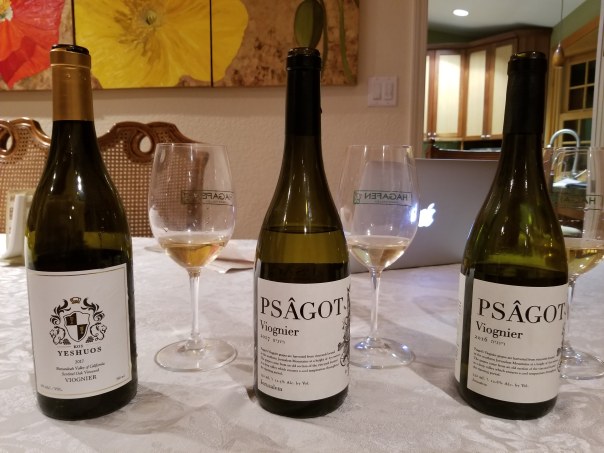
Seven Kosher Viognier Wines
Viognier (pronounced Vee-Ohn-Yay) is a very special grape and one that must be handled with great care. The Viognier grape/wine is a special treat. It is a wine that has distinct characteristics: perfume, floral notes, and acidity, but it is also a very picky grape. It is very easy to lose to mold and because of this wineries will plant roses next to the grape vines to act as a canary for detecting mildew early on. The grape needs to be picked late otherwise; it does not generate the classic perfume that we are used to seeing in Muscat and Riesling wines. The winemaker has many choices with how he/she wants to manage the grapes. The winemaker can allow the wine to go through malolactic fermentation (to give it a bit more weight) or let the wine lie in the must (to give it more perfume) or to let it have a bit of wood to give it roundness. With all the choices and difficulties that Viognier wines have, they rarely meet expectations and are, therefore, not one of the current popular white wines. Finally, Viognier is not meant for long storage – hence the VERY early release dates on these wines, also the wine should have the acidity, fruit, and perfume to make it a real winner. By default, the Viognier grape is lower in acidity than other white varietals, which makes for a wine that is not meant for cellaring, at least not yet in the kosher market.
The most famous of Viognier wines come from Condrieu AOC and though they are highly desired, even there they are not always winners. The climate in Condrieu is colder than much of the Rhone, and its soil is made up of a porous, drainable granite, chalk, mica, and deposits of gneiss. The area is known as the original mother of Viognier and in the AOC, the only legal grape is Viognier.
While I really liked the 2016 Psagot Viognier last year, now it is losing its steam and it acid is falling off, making for a fetter more round wine. Dalton, in the past, threw so much oak at the wine that it was built to last longer. Psagot and Kos Yehuos both do not throw that much oak at the wines and they release them early on. Psagot has a fascinating way to get acidity and perfume. Yaacov Oryah, picks around 80% of the Viognier early, for acid, minerality and low alcohol, and 20% later in the season, for perfume.
I really enjoyed the 2017 Covenant Israel Viognier, it was varietally true, and really lovely. The sad fact was that I could not find it in Israel, the week before Passover, and I tried almost every wine store in and around Tel Aviv and Jerusalem! I had to come to the USA to taste it, and it is a lovely wine indeed!
Still, of all of them, the Kos Yeshuos Viognier is showing a more old world and mineral style than the perfume madness of the Israeli options. It is sad that there are so few options in the world of Viognier. Galil has some, and they are OK but pretty average. Same with the 2016 Yatir Viognier, it was muted to me. The 2016 Dalton Viognier was nice, but it is an oak monster, and that is an acquired taste.
Now I stated that there were 7 Viognier wines here in the title, and while there are 5 varietal Viognier wines, the other two are blends. The first of the blends is the 2017 Shirah Vintage Whites which is a blend of 55% Viognier and 45% Chardonnay, from the Murmur Vineyard in Santa Maria Valley. The last of the blends is the 2017 Teperberg Fermitage White, Inspire.
The wine notes follow below – the explanation of my “scores” can be found here:
2017 Covenant Israel Viognier, Blue C – Score: 90
Classic viognier notes with crazy rich floral notes, with rich saline, lovely peach, and some oak. The mouth on this medium bodied wine is really fun and showing a lovely oily texture, with rich weight and more fun saline, followed by apricot rolled in the grass, with floral notes. The finish is sweet and ripe and fresh with tart notes of stone fruit, with lemongrass and flint. Bravo!
2017 Psagot Viognier: 89 to 90
This year’s vintage is leaner than last year’s vintage, but also more light in style and focus. The wine starts off very ripe and needs time to come around, give this wine time. The nose starts off with ripe fruit notes of pineapple juice, honeycomb, really ripe, with cloves, allspice, peach marmalade, and apricot, and stone fruit. With time the nose turns to nice mineral notes, backed by peach marmalade, wonderful peach jam, and lovely hay, quince jam. The mouth is more round and fat than I would have hoped, with orange and nectarines, still, it is well structured. With slate, saline, and pith galore. Nice.
2017 Kos Yeshuos Viognier – 92 (QPR)
Do not cool this wine too much, it likes 30 min in the fridge and no more.
This wine has evolved over the past 6 months. Gone is the fruity nose and now the nose is pure flint, yeast, smoke, and really fun straw and mineral, with peach and honey in the background. The mouth on this medium bodied wine is ripe for sure, but really well balanced and showing lemongrass, with a rich oily coat that covers the mouth, well focused with rich acidity, nice mineral, great fruit pith, apricots, peach, and lemon, with rock, and grass. The finish is long and acidic, with enough complexity to grab your attention and keep it throughout the finish with lovely white rose tea, sweet spices, notes of fresh lavender, crazy saline lingers super long, with cinnamon, and cloves. Bravo!
2016 Psagot Viognier – Score – 88
So last year this wine was very ripe, now the nose is showing nice funk, with hay, straw, and honeyed notes. last year this wine was an acid bomb, now the wine has lost that rich acidity and now it is well balanced, with good fruit pith, and green notes, and not much else. Sadly, this wine is losing its grip and should be drunken ASAP. DRINK UP!
2017 Teperberg Destitage White, Inspire – Score: 89
This wine is a blend of Viognier, Sauvignon Blanc, and French Colombard. The nose on this wine is very floral and classically inclined to Viognier with its intense peach bomb notes, with white cherry notes, and sweet Oak. The mouth on this medium bodied wine is oily and tactile, with a rich weight from the Viognier and Colombard fruit, with sweet Guava and nectarines, followed by with orange notes, The finish is sweet and tart and fun overall, with good acid and floral notes. Nice!
2017 Shirah Vintage Whites – Score: 91 (QPR)
Another winner from Shirah with a blend of 55% Viognier and 45% Chardonnay. The nose on this wine starts off really fun and funky, showing straw and rich mineral, with sweet peach, rich ripe guava, and apricot. The mouth on this wine is really fun, rich, layered, well balanced, oily and textured, and so professionally made, with lovely smoke, oak, with rich apple, dried quince and with fresh focus and lovely weight and viscosity. The finish is crazy and dry, with sweet notes of fig, sweet lemon tea, with intense mineral and lovely pith with a citrus background. Bravo!!
2016 Dalton Viognier, Reserve – Score: 89
The nose is classic Viognier, with peach, too much oak, showing good apricot, sweet rose hips, and a perfume of honeysuckle, and orange blossom. The mouth is medium bodied, with a nice almost oily mouthfeel, showing nice weight, with good notes of summer fruit, with just enough acid, wish there was more, with lovely pear and nectarines. The finish is long and balanced with less acid than before, still too much oak, lovely mineral, slate, and more floral notes. Drink up!

The 2018 Kosher rose season is open
It is officially Spring (though it snowed in Chicago for Passover – so I will hold judgment on that fact for a bit), which means it is Rose time! Rose wine in the non-kosher market is exploding – especially Rose wine from Provence; a wine region of France. Sadly, in the kosher wine market – that is not quite the case. I did not stress my previous statement with a suffix of AT ALL, even though I am not allowed to open a bottle of rose on my Shabbos table with guests – why? Well, that is simple – no one will drink it!!
Even worse, is that wine manufacturers may well have jumped the shark! There will be some 50 dry-ish kosher roses available in the USA this year! That may not sound like a lot, but when all you had was Herzog White Zinfandel 10 years ago – it is insane. The first high-end rose was Castel’s 2009 rose and that was only 9 years ago. Back then, there were few to no real Rose wine options, other than a handful of Israeli wines and almost no French Rose made it here. Now we will have tons of Rose, and I really think the real question here is will people drink it all?
Wine Color
What is a rose wine? Well, simply said, a rose is a wine that can best be defined as the wine world’s chameleon. Where white wine is a pretty simple concept – take white grapes squeeze them and you get clear to green colored juice. Yes, the white grape juice is clear – well so is red grape juice, but more on that in a bit.
White wine is not about color – almost all color in a white wine comes from some oak influence of some sort. So, an unoaked Sauvignon Blanc or Pinot Gris can sometimes look almost clear, depending on the region and how the wine was handled. Now oaked Chardonnay, of course, is what most people use as an example of a dark white wine. As the Wine Folly linked above states, different wine regions oak their Chardonnay differently and as such, they are sold with different hues from the start. With age, the wine changes color and the light gold moves to darker gold shades.
The only real exception to the stated rule above – that white grape juice without the influence of oak is somewhere in the clear to green color spectrum, is – orange wines. We have spoken about orange wines – mostly thanks to Yaacov Oryah. Outside of Yaacov’s work there really is no orange wine in the kosher world to speak about. Orange wine is made exactly like red wine, which means that the clear grape juice is left to sit on the yellowish to dark yellow grape skins (depending upon what varietal is used to make the orange wine).
Red wine juice – straight from the grape comes out the same color as white grapes. You see the juice from grapes is mostly clear to greenish in color. The red wine color comes from macerating the juice on the grape skins. The longer the juice sits on the grape skins (wine must) the redder in color the wine becomes until it reaches its maximum red color potential.
The only real exception to the rule of a grape’s juice color is the Teinturier varieties. The grapes are called Teinturier, a French language term meaning to dye or stain. The list of grapes whose juice is actually red colored is long – but the list of kosher wine options that is a wine made from these grapes – is the Herzog Alicante Bouschet. The Gamay de Bouze is not a normal Gamay grape, it is one of those grape mutations that are very red in nature. Read the rest of this entry

 Wine Musings Blog