Blog Archives

The 2020 Kosher rose season is open and once again I am underwhelmed – part 1
It is not yet summer but here in NorCal, it feels more like summer than spring, and the weather is making shipments really hard at this time of year. Normally, I would have been in Israel by now, one way or the other, and I would have at least had two tastings with the gang. Sadly, with the times we live in now, neither of those wonderful ideas is possible. Sad and strange days we live in. Also, this is round 1, there will be another 15 roses I will get through over the next week or so.
While rose wine in the non-kosher market is exploding – especially Rose wine from Provence; a wine region of France, the kosher market this year will be more subdued. In the past, distributors brought in as much as 60+ kosher rose wines, this year with the issues I brought up in my previous post – there is less of an appetite for all those wines.
QPR and Price
I have been having more discussions around my QPR score with a few people and their contention, which is fair, in that they see wine at a certain price, and they are not going to go above that. So, instead of having a true methodology behind their ideas, they go with what can only be described as a gut feeling. The approaches are either a wine punches above its weight class so it deserves a good QPR score. Or, this other wine has a good score and is less than 40 dollars so that makes it a good QPR wine.
While I appreciate those ideals, they do not work for everyone and they do NOT work for all wine categories. It does NOT work for roses. Look, rose prices are 100% ABSURD – PERIOD! The median rose price has gone up this year and it is around 22 bucks – that is NUTS! Worse, is that the prices are for online places like kosherwine.com or onlinekosherwine.com, with free or good shipping options and great pricing, definitely not retail pricing.
As you will see in the scores below, QPR is all over the place and there will be good QPR scores for wines I would not buy while there are POOR to BAD QPR scores for wines I would think about buying, based upon the scores, but in reality, I would never buy another bottle because the pricing is ABSURDLY high.
Also, remember that the QPR methodology is based upon the 4 quintiles! Meaning, that there is a Median, but there are also quintiles above and below that median. So a wine that is at the top price point is by definition in the upper quintile. The same goes for scores. Each step above and below the median is a point in the system. So a wine that is in the most expensive quintile but is also the best wine of the group gets an EVEN. Remember folks math wins!
Still, many of the wines have a QPR of great and I would not buy them, why? Well, again, QPR is based NOT on quality primarily, it is based upon price. The quality is secondary to the price. So, wines that are drinkable with an 88 or 89 score, though wines that I would not buy, have a low enough price to get a GOOD or GREAT score. Does that mean that I would buy them because they have a GREAT QPR? No, I would not! However, for those that really want roses, then those are solid options.
Please remember, a wine score and the notes are the primary reason why I would buy a wine – PERIOD. The QPR score is there to mediate, secondarily, which of those wines that I wish to buy, are a better value. ONLY, the qualitative score can live on its own, in regards to what I buy. The QPR score defines, within the wine category, which of its peers are better or worse than the wine in question.
Finally, I can, and I have, cut and paste the rest of this post from last year’s rose post and it plays 100% the same as it did last year. Why? Because rose again is horrible. There is almost no Israeli rose, that I have tasted so far, that I would buy – no way! Now, I have not tasted the wines that many think are good in Israel, the Netofa, Vitkin, and Recanati roses. Yes, there is ONE rose I would “buy” by my qualitative scoring approach, which is why I used the word almost above. That wine would be the 2019 Bat Shlomo Rose, but at some 28 or more dollars a bottle, it is highway robbery for that score. Read the rest of this entry

Guter Wein (Shlomo Corcos) Wine Tasting
The day after the Bokobsa tasting I sat down with Shlomo Corcos (Guter Wein) and Yoel Kassabi from YayinKosher to taste some of the recent wines from Corcos. Corcos has been the mashgiach behind many wines, including Falesco and some IDS wines, along with his own Guter Wein wines.
It was a short tasting, but there were some interesting and unique wines. Including a 7-year-old rose along with a newly bottled Champagne. The French wines were made at Michel Gonet, including the lovely Champagne and 4 Bordeaux wines. I was joined by a few of the French forum members, including Ari Cohen, Ben Sitruk, and Elie Dayan.
My many thanks to Mr. Corcos and to Yoel Kassabi for setting up the meeting, sharing his wines with us, and for taking time out of his incredibly busy schedule to meet with us. The wine notes follow below – the explanation of my “scores” can be found here:


2016 Champagne Michel Gonet, Les 2 Terroirs – Score: 91
Lovely nose of baked apple, yeast, with loads of mineral, pear, and pepper, and asparagus. The mouth on this medium-bodied wine is nice, well made, crazy acidity, with lovely yeast, baked and almost buttery ripe apple pie, with great minerality, lemon curd, with crazy grapefruit, rich salinity, and piercing focus, Bravo! The finish is super long, green, with crazy citrus, saline, lemongrass, and crazy tart clementine, lovely! Drink until 2022. Read the rest of this entry

The 2019 Kosher rose season is open but I am underwhelmed at best
It is not yet summer and here in NorCal, it feels more like winter with these strange May storms with thunder and hail. Sorry, but in NorCal, we do not get thunder, it is very strange indeed! Anyway, enough with my meteorologist fanboy moment, the weather was not conducive for my last tasting here in San Jose with a group of folks, but Rose was on the docket so rose it was.
Rose wine in the non-kosher market is exploding – especially Rose wine from Provence; a wine region of France. Sadly, in the kosher wine market – that is not quite the case. I did not stress my previous statement with a suffix of AT ALL, even though I am not allowed to open a bottle of rose on my Shabbos table with guests – why? Well, that is simple – no one will drink it!!
Even worse, is that wine manufacturers may well have jumped the shark! There will be some 60+ kosher roses available in the USA this year! That may not sound like a lot, but when all you had was Herzog White Zinfandel 10 years ago – it is insane. The first high-end rose was Castel’s 2009 rose and that was only 10 years ago. Back then, there were few to no real Rose wine options, other than a handful of Israeli wines and almost no French Rose made it here. Now we will have tons of Rose, and I really think the real question here is will people drink it all?
Also, I want to bring up a topic I rarely talk about – price! Yeah, I hear you, Avi Davidowitz, of KosherWineUnfiltered, please quiet down, gloating does not suit you – (smiley face inserted here). The prices of Rose wines have gotten out of control. QPR (Quality to Price Ratio) has become nonexistent, essentially here in the USA, for the kosher rose market. Finally, I am sorry, but I really feel that wineries were either horribly hampered in some way with the 2018 rose vintage, or honestly, they just threw in the towel, The 2018 vintage is the worst one in the last 10 years. We have hit Peak Rose, we really have. Peak X is when X becomes so default within the construct of our lives, and the quality and quantity of X peaks. Clearly, calling peak kosher rose is a subjective call, but look around. The roses of 2018 feel commodity at best, they feel rushed, no real care, rhyme, or reason. They feel like we have peaked. They are nowhere near 2017, and 2017 was nowhere near 2016, and so on. I am sure next year may be another peak rose, and to be honest, many have called for Peak Oil and Peak TV, so maybe I am just projecting what I see around me, but this year’s crop of roses feel half-hearted pure cash cows, and really without love behind them.
As always, I will be chastised for my opinions, my pronouncements, and I am fine with that. This is wakeup post, there may be ONE or two roses I would buy, but respectfully, given the prices, I would rather buy, the 2018 Covenant Sauvignon Blanc, 2017 O’dwyers Sauvignon Blanc, the 2018 Goose Bay Sauvignon Blanc, and so on. Throw in the 2018 Tabor Sauvignon Blanc and the 2018 Or Haganuz Amuka Blanc Blend, and really who cares about a rose?
I was thinking about going with the title: 2018 kosher roses, thanks, but who cares? Because that is how I feel. This vintage is a massive letdown, prices are too high, quality has hit rock bottom, and overall professionalism, IMHO, has gone along with the quality. Wineries have been getting away with less and less quality for years, raising prices, and this is the worst I have seen in the rose market overall. So, yeah, who cares?
Wine Color
What is rose wine? Well, simply said, a rose is a wine that can best be defined as the wine world’s chameleon. Where white wine is a pretty simple concept – take white grapes, squeeze them, and you get clear to green colored juice. Yes, the white grape juice is clear – well so is red grape juice, but more on that in a bit. Read the rest of this entry

Domaine Netofa Winery – March and November 2018
As always, I am super late on posting notes, and this post is no different. This past year, I have been really busy, and while I am thankful for that fact, it has put a crimp on my wine posts. Well, now I have been freed up a bit, and I am catching up on lost time.
In March 2018, I visited with Mr. Miodownick and on my latest trip in November, I had no time to get up north. So, I got all the current wines from Pyup and tasted them as part of the two blind tastings. Domaine Netofa is a winery I have posted about often and maybe the most posted about winery on my blog, besides Tzora Vineyards, that kind of tells you what I think about those two wineries. Pierre Miodownick is the head winemaker at this winery, as he has been since the winery’s inaugural 2009 vintage.
Thankfully, the winery is still one of the last bastions of normalcy, when it comes to white and red wines in Israel, along with a few others. Sadly, at the blind tasting, the 2017 Domaine Chenin Blanc was corked, but my notes for it from the March tasting can be found here. The 2016 red wines were a bit of a mixed bag, with some of them showing more ripeness, even for Netofa. The 2017 roses were fun, but they are all sold out already, and that is good, as 2017 roses should not be around anymore. The 2017 white Latour seemed to feel lacking in the blind tasting, though it was still elegant.
Sadly, the availability of these wines continues to be an issue here in the USA. I really wish Netofa could find an importer already and get us some fun Israeli red and white wines to enjoy here in the USA. Until then, you need to go to Israel to buy and enjoy them.
My many thanks to Mr. Miodownick and the winery for letting me come by and enjoy the wines with him, even if this post is many months late! The wine notes follow below – the explanation of my “scores” can be found here:


2017 Domaine Netofa Chenin Blanc – Score: 91
Really lovely wine, showing hints of oak which does not exist in this wine, along with lovely flint, peach, dry straw, and yellow pear, with mineral. The mouth is really lovely with nice bracing acid, followed by tart grapefruit, citrus, quince, and great mineral. The finish is crazy fun, with intense pith, spice galore, and lovely herb, slate, and pith. Lovely! Drink by 2020. (Sadly this is only available in Israel).
2017 Domaine Netofa Tel Qasser, White – Score: 91 to 92 (tasted blind in November)
Lovely wine, sadly I knew what it is, lovely Roussanne, showing earth, mineral, rich brightness, with loads of heather, lovely floral notes, with straw, yellow plum, and apple. The mouth on this full-bodied wine is layered, rich, and nicely extracted, showing rich oily structure, with layers of green apple, quince, lovely richness, with mineral, grass, straw, and lovely acidity showing long with flowers, and rich lemongrass. Lovely!! Drink until 2022. (Sadly this is only available in Israel). Read the rest of this entry

The 2018 Kosher rose season is open – part 3
Well, after the first post I stated that I would be doing this rose wine post a few times. The subsequent posts would have the original content, and the newly revised or added rose wines as well. Well, this is part 3, and I hope this is the last one! My schedule was insane, but it is now slowing down, thankfully, so I hope to be adding more posts as well!
It is still officially Summer, which means it is Rose time! Rose wine in the non-kosher market is exploding – especially Rose wine from Provence; a wine region of France. Sadly, in the kosher wine market – that is not quite the case. I did not stress my previous statement with a suffix of AT ALL, even though I am not allowed to open a bottle of rose on my Shabbos table with guests – why? Well, that is simple – no one will drink it!!
Even worse, is that wine manufacturers may well have jumped the shark! There will be some 50 dry-ish kosher roses available in the USA this year! That may not sound like a lot, but when all you had was Herzog White Zinfandel 10 years ago – it is insane. The first high-end rose was Castel’s 2009 rose and that was only 9 years ago. Back then, there were few to no real Rose wine options, other than a handful of Israeli wines and almost no French Rose made it here. Now we will have tons of Rose, and I really think the real question here is will people drink it all?
Wine Color
What is a rose wine? Well, simply said, a rose is a wine that can best be defined as the wine world’s chameleon. Where white wine is a pretty simple concept – take white grapes, squeeze them, and you get clear to green colored juice. Yes, the white grape juice is clear – well so is red grape juice, but more on that in a bit.
White wine is not about color – almost all color in a white wine comes from some oak influence of some sort. So, an unoaked Sauvignon Blanc or Pinot Gris can sometimes look almost clear, depending on the region and how the wine was handled. Now oaked Chardonnay, of course, is what most people use as an example of a dark white wine. As the Wine Folly linked above states, different wine regions oak their Chardonnay differently and as such, they are sold with different hues from the start. With age, the wine changes color and the light gold moves to darker gold shades.
The only real exception to the stated rule above – that white grape juice without the influence of oak is somewhere in the clear to green color spectrum, is – orange wines. We have spoken about orange wines – mostly thanks to Yaacov Oryah. Outside of Yaacov’s work there really is no orange wine in the kosher world to speak about. Orange wine is made exactly like red wine, which means that the clear grape juice is left to sit on the yellowish to dark yellow grape skins (depending upon what varietal is used to make the orange wine).
Red wine juice – straight from the grape comes out the same color as white grapes. You see the juice from grapes is mostly clear to greenish in color. The red wine color comes from macerating the juice on the grape skins. The longer the juice sits on the grape skins (wine must) the redder in color the wine becomes until it reaches its maximum red color potential.
The only real exception to the rule of a grape’s juice color is the Teinturier varieties. The grapes are called Teinturier, a French language term meaning to dye or stain. The list of grapes whose juice is actually red colored is long – but the list of kosher wine options that is a wine made from these grapes – is the Herzog Alicante Bouschet. The Gamay de Bouze is not a normal Gamay grape, it is one of those grape mutations that are very red in nature. Read the rest of this entry
The 2018 Kosher rose season is open – part 2
Well, after the first post I stated that I would be doing this rose wine post a few times. The subsequent posts would have the original content, and the newly revised or added rose wines as well. Well, this is part 2, and there will be at least a part 3 or maybe a part 4, such is life. My schedule is insane right now (not complaining in any way), so when I can grab a few moments to update the roses I have had, I take it with both hands!
It is still officially Spring, which means it is Rose time! Rose wine in the non-kosher market is exploding – especially Rose wine from Provence; a wine region of France. Sadly, in the kosher wine market – that is not quite the case. I did not stress my previous statement with a suffix of AT ALL, even though I am not allowed to open a bottle of rose on my Shabbos table with guests – why? Well, that is simple – no one will drink it!!
Even worse, is that wine manufacturers may well have jumped the shark! There will be some 50 dry-ish kosher roses available in the USA this year! That may not sound like a lot, but when all you had was Herzog White Zinfandel 10 years ago – it is insane. The first high-end rose was Castel’s 2009 rose and that was only 9 years ago. Back then, there were few to no real Rose wine options, other than a handful of Israeli wines and almost no French Rose made it here. Now we will have tons of Rose, and I really think the real question here is will people drink it all?
Wine Color
What is a rose wine? Well, simply said, a rose is a wine that can best be defined as the wine world’s chameleon. Where white wine is a pretty simple concept – take white grapes, squeeze them, and you get clear to green colored juice. Yes, the white grape juice is clear – well so is red grape juice, but more on that in a bit.
White wine is not about color – almost all color in a white wine comes from some oak influence of some sort. So, an unoaked Sauvignon Blanc or Pinot Gris can sometimes look almost clear, depending on the region and how the wine was handled. Now oaked Chardonnay, of course, is what most people use as an example of a dark white wine. As the Wine Folly linked above states, different wine regions oak their Chardonnay differently and as such, they are sold with different hues from the start. With age, the wine changes color and the light gold moves to darker gold shades.
The only real exception to the stated rule above – that white grape juice without the influence of oak is somewhere in the clear to green color spectrum, is – orange wines. We have spoken about orange wines – mostly thanks to Yaacov Oryah. Outside of Yaacov’s work there really is no orange wine in the kosher world to speak about. Orange wine is made exactly like red wine, which means that the clear grape juice is left to sit on the yellowish to dark yellow grape skins (depending upon what varietal is used to make the orange wine).
Red wine juice – straight from the grape comes out the same color as white grapes. You see the juice from grapes is mostly clear to greenish in color. The red wine color comes from macerating the juice on the grape skins. The longer the juice sits on the grape skins (wine must) the redder in color the wine becomes until it reaches its maximum red color potential.
The only real exception to the rule of a grape’s juice color is the Teinturier varieties. The grapes are called Teinturier, a French language term meaning to dye or stain. The list of grapes whose juice is actually red colored is long – but the list of kosher wine options that is a wine made from these grapes – is the Herzog Alicante Bouschet. The Gamay de Bouze is not a normal Gamay grape, it is one of those grape mutations that are very red in nature. Read the rest of this entry

The 2018 Kosher rose season is open
It is officially Spring (though it snowed in Chicago for Passover – so I will hold judgment on that fact for a bit), which means it is Rose time! Rose wine in the non-kosher market is exploding – especially Rose wine from Provence; a wine region of France. Sadly, in the kosher wine market – that is not quite the case. I did not stress my previous statement with a suffix of AT ALL, even though I am not allowed to open a bottle of rose on my Shabbos table with guests – why? Well, that is simple – no one will drink it!!
Even worse, is that wine manufacturers may well have jumped the shark! There will be some 50 dry-ish kosher roses available in the USA this year! That may not sound like a lot, but when all you had was Herzog White Zinfandel 10 years ago – it is insane. The first high-end rose was Castel’s 2009 rose and that was only 9 years ago. Back then, there were few to no real Rose wine options, other than a handful of Israeli wines and almost no French Rose made it here. Now we will have tons of Rose, and I really think the real question here is will people drink it all?
Wine Color
What is a rose wine? Well, simply said, a rose is a wine that can best be defined as the wine world’s chameleon. Where white wine is a pretty simple concept – take white grapes squeeze them and you get clear to green colored juice. Yes, the white grape juice is clear – well so is red grape juice, but more on that in a bit.
White wine is not about color – almost all color in a white wine comes from some oak influence of some sort. So, an unoaked Sauvignon Blanc or Pinot Gris can sometimes look almost clear, depending on the region and how the wine was handled. Now oaked Chardonnay, of course, is what most people use as an example of a dark white wine. As the Wine Folly linked above states, different wine regions oak their Chardonnay differently and as such, they are sold with different hues from the start. With age, the wine changes color and the light gold moves to darker gold shades.
The only real exception to the stated rule above – that white grape juice without the influence of oak is somewhere in the clear to green color spectrum, is – orange wines. We have spoken about orange wines – mostly thanks to Yaacov Oryah. Outside of Yaacov’s work there really is no orange wine in the kosher world to speak about. Orange wine is made exactly like red wine, which means that the clear grape juice is left to sit on the yellowish to dark yellow grape skins (depending upon what varietal is used to make the orange wine).
Red wine juice – straight from the grape comes out the same color as white grapes. You see the juice from grapes is mostly clear to greenish in color. The red wine color comes from macerating the juice on the grape skins. The longer the juice sits on the grape skins (wine must) the redder in color the wine becomes until it reaches its maximum red color potential.
The only real exception to the rule of a grape’s juice color is the Teinturier varieties. The grapes are called Teinturier, a French language term meaning to dye or stain. The list of grapes whose juice is actually red colored is long – but the list of kosher wine options that is a wine made from these grapes – is the Herzog Alicante Bouschet. The Gamay de Bouze is not a normal Gamay grape, it is one of those grape mutations that are very red in nature. Read the rest of this entry
Yitzchok Bernstein does it again – a 19 course culinary kosher tour de force
 A few months ago Heshy Fried, Yitzchok Bernstein’s sous chef and frum-satire blogger, was at the house for a shabbos dinner and he said that Yitzchok Bernstein, was back on the scene. Bernstein is the culinary mastermind behind the epic haute cuisine event that lasted some 27 courses, and which was one of the most often read posts on my blog, in the past year. Bernstein was lurking in NY for a few months – but he returned to Oakland after a short, yet successful, stint at Pomegranate.
 So, when I heard that Mr. Bernstein was back – we agreed that a dinner was in order. Fried was not sure what the actual cost of a multi-course dinner was, but after a few back and forth discussions with Bernstein we were set. Well, while the dinner was set, the next two hurdles were a bit complicated; finding and arranging with 10 other participants and then locking down a date. Throughout the process, Bernstein was as professional as they come, and responded almost immediately to our correspondences. Getting the final gang together had a few missteps along the way, but while the overall process was a bit long to arrange on my end, the final outcome was an absolute delight, but more on that in a bit.
 Once the gang was roughly worked out, we agreed that the date was not going to work until after Passover. So once that was decided the next step was agreeing on a final date – which took a few emails. After that we were set and then came the fun part, deciding the food and wine menu. The dinner does not include wines, which is fine with me as I am picky about my wines, but wow were the dishes impressive! Initially, there was some interest in lamb, but in the end that did not work out, as I am not that in love with lamb. In the end the set of dishes were truly innovative and fascinating and unique – so I am happy we passed on the lamb for the dishes we got instead.
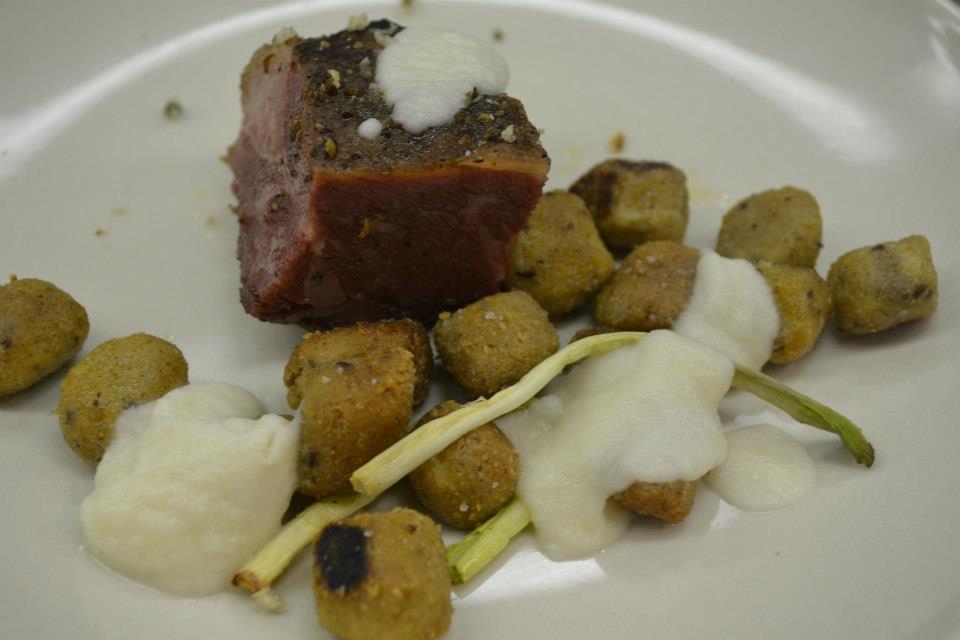 I laughed so hard throughout the process because initially, the number of courses was set at 12 or so, which was 100% fine. However, throughout the process of setting the menu Mr. Bernstein kept adding courses – it was HILARIOUS, I could not help from laughing whenever I would read the revised menu. It turns out that we were very lucky, Bernstein was trying out some new recipes and we were the beneficiaries of some wicked cool imaginative dishes. To be fair, some worked really well, some were awesome, and some were just 100% off the charts. Read the rest of this entry
2013 Kosher Food and Wine Experience (KFWE) lived up to all its billing
For years I have always sported a purple colored beaming grin when I finish my tasting at the IFWF (International Food and Wine Festival) in LA, which hid my grumbling stomach’s discontent. Like I have documented for years, I never get to eat at the events, even as the entire food court mocks me, attempting to pull me into their warm, delicious, and very present embrace, with their wafting and intoxicating aromas. Still, I stand strong and I taste through the night until my teeth are purple and my stomach is close to rioting on the lack of food. Truth be told, I am not that good at taking notes when eating – the flavors of the food cover up and belie the flavors and aromas of the glass that beckons me closer with its “come hither” look and aromas. So every year, after the event I go to dinner at Jeff’s Sausage (down the street from the new location of the IFWF). Which is sheer madness of course, here I have half the Pavilion at the Hyatt Regency Century Plaza, filled with food from one of the best kosher restaurants in the world – Tierra Sur Restaurant, and I pass on that for the spicy and homely fare of Jeff’s Sausage. In no way is this a slight to the joy of Jeff Rohatiner’s cookery and food. Rather, it has been my conscious tradeoff, throughout my many year experience at IFWF to drink through as much of the world-class wine I can before my taste-buds shutdown, rather than give them to the food court, no matter how wonderful it is.


This year was a massive shift for me, gone was the purple grin and my mutinous stomach, as I visited and added the New York KFWE to my travel dates. To say the KFWE was different than the IFWF would be an extreme understatement, the IFWF has close to 1000 people at the show, while the KFWE has closer to 2000 people. Further the event hall at Pier 60 is some 2 to 3 times larger than the Pavilion tent at the Hyatt Regency. Also, there were many options for lunch and dinner from the myriad of NY restaurants that all share half the hall, all clamoring to share their wonderful fare with great fanfare. The Pier 60 overlooks the Marina and Harbor and many folks were outside braving the cold to grab a smoke, but at least they had some comfort of looking at the marina and its waterfront.
To really appreciate the event you had to come to it with a game plan, and there were many guests who had a few of their own. The event started at Noon for those in the trade, a new thing that the KFWE started last year and something that the IFWF has been doing from the start (though initially with a smaller trade time). The trade event was crowded but there could not have been more than a thousand folks there, so access to wine was not a problem in any way. The event hall can easily handle 1000 people, it is a bit more complicated when the number swells to two thousand people, but still there was no pushing or shoving going on even at the end of the public tasting, when the number of guests was at its maximum. But I digress; the trade tasting allowed me to focus solely on wine and the winemakers, which was great. Read the rest of this entry

 Wine Musings Blog