Blog Archives

Final take on 2020’s crop of Kosher roses – 2 QPR Winners, but overall not great
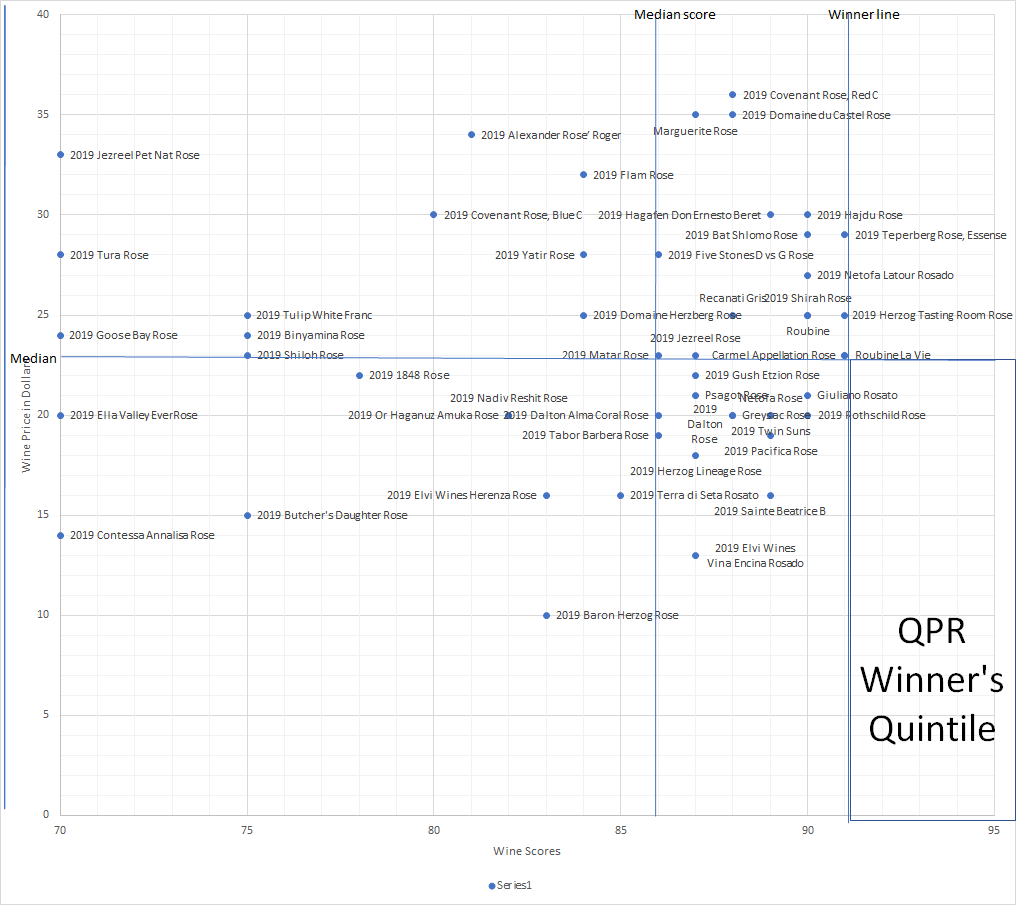
Kosher 2019 Roses charted by price and wine score (QPR)
So, as the image above shows roses are very expensive and the majority of the 28 of the 55 are at or above the median price of 23. This is not new, IMHO, roses overall have not been good or even very interesting this season.
Please read this post for my writeup on rose wines this year. I had a few follow-ups after that, including the one post with the QPR Rose for 2020, but this post will list all the rose wines I have had this year. Also, as I tasted more wines the price of the median went up and that allowed the Roubine La Vie to also become a QPR Winner. Again, the MARKET decides the QPR winners, not me! All I decide is the wine’s subjective quality score, and yes, that is subjective! The rest, the P part of QPR (Quality to Price Ratio) is decided upon by the market. Please read my revised QPR scoring here.
The image does not show the 2 QPR Winners as obvious winners, as the dot that represents the Carmel Rose and the Roubine La Vie Rose is on the top left of the winner box. These wines barely made their way into the Winner’s square, but with such a horrible vintage, rose-wise, 2 is better than NONE.
In regards to rose, look a lot of my friends and I do not agree. Look at the Cantina Giuliano Rosato, it is a VERy nice and classically made Gris style rose, but it has a bit of RS (Residual Sugar) in it, at least to my palate, and I have issues with that. Other wines that have more RS drive me nuts. My friends do not care about RS or ripe notes in rose as long as it is balanced. To me, rose, red, or white, I DO NOT want RS. The funny thing is that Kedel Jackson probably got away with1% RS in his Chardonnays for decades, and made it the classic style for Cali Chard, which brought on the famous ABC movement (Anything But Chardonnay). Which spawned Sauvignon Blanc, Riesling, and so many other great white wines here in California.
So, yes, there are two winners now, and there are a few 91 scored roses, but please look at the chart!! LOL! It is visually clear that the vast majority of the wines are not something I would look to buy. They are either too expensive or not interesting and that is what has gone wrong with the kosher rose market. Again, I have said it a few times, IMHO, the wineries have thrown in the towel and they make rose thinking it will sell, no matter what they release. This will eventually end badly. Only time will tell. Read the rest of this entry

Easy drinking white wines for 2020 – better than I expected
Well, the roses from the 2019 vintage, so far, are not inspiring, and initially, I thought the same for the white wines, thankfully, as I tasted through the last 15 bottles of wines things shifted. There is a reason why I have been pushing Price in relation to its quality, AKA QPR (Quality to Price Relationship).
For this tasting, I tasted more than 70 wines, however, I posted only some 49 wine notes here. Rest assured, the others were either not worthy or I did not have detailed enough notes to make it here on this post.
Interestingly, initially, I had zero hope for the white wines, much as I felt about the roses. However, all of this is data-driven and other than my wines notes, the rest is all prices defined by the USA market. The more, I tasted, the more I felt that there are options in the simple white wine category. I was really ready to give up hope, but thankfully, folks like Shirah, Kos Yeshuos, and other Europen wines really pulled their weight. Sadly, of the top 27 wines, there were a total of 11 from 2019. Of them, only two were from Israel. The rest hailed from California, France, and New Zealand. In the end, so far, the vast majority of the Israeli white wines I have tasted from 2019 are also highly uninspiring.
With that said, the median price for the wine category of non-aging white wines is going up! There lies in my over-arching issue, prices keep going up!! The median price for non-aging white wines, here in the USA, is now 24 dollars! Seriously!! COME ON!! This is crazy! As the kids say, total Cray Cray! Turned around, the total number of wines below the median price of 24 dollars that received a 90 or higher was 12, and many of those are our QPR WINNERS. Overall, 2019 is still a dud in Israel, of those that have made their way to the USA, and Califonia is saving the day, so far.
All the wines here are scored both quantitatively, AKA using my classic wine score described here, and using the newly revised QPR score described here. So, yes, there will be more of the QPR discussion that will arise from this post. Thankfully, we have a good number of wines, 7 from my count, that received the QPR score of WINNER, sadly, they are mostly from 2018. Therefore, I repeat again, I am highly unimpressed with how many 2019 white wines I had and how many are subpar. Please be careful with the ones you buy.
Finally, in order of price, the first of the 7 QPR WINNER wines come in at wine #38, sorted by price! That means there are loads of other wines far less interesting than the 2018 Ramon Cardova Albarino, the most expensive of the 7 WINNER QPR wines. This is the kind of data that makes me scream. This is what needs to change! Wineries are willing to produce wines that are more expensive and less interesting, than more than HALF of the wine I tasted! This is what needs to change, kosher wine has gotten out of control, price-wise.
Do yourself a favor, check the price, you do it for everything else you buy! Check the wine, check the price, and then decide!
The wine note follows below – the explanation of my “scores” can be found here and the explanation for QPR scores can be found here:


2018 Ramon Cardova Albarino, Rias Baixas – Score: 92 (QPR: WINNER)
This wine is in the 2nd quintile of quality scoring and it is just below the median price line, so this wine SHOULD get a score of GREAT for QPR. However, it is ALSO one of the few white wines that score at least a 91, and that has a price that is below the median price line, so this wine gets the coveted score of WINNER for QPR. Bravo!!!
The 2018 vintage of this Albarino, in its second vintage, shows less tropical and ripe than the first vintage, 2017. This bottle also had the thermal active label, and it shows up when the bottle is at the proper drinking temperature. My only REAL and serious complaint is the cork, why would Royal waste the money and my money of a real cork? Use a Diam or any other amalgamated cork, like almost everyone else is. I really hope I do not hit a bad cork for the wines I have.
The nose on this wine is better than the 2017 vintage, Lovely nose of rich mineral, with loads of straw, with which salinity, and lovely peach and dry pear, with honeysuckle, gooseberry, along with green notes galore. Lovely! The mouth on this lovely green and acid-driven wine has a more oily mouthfeel than the 2017 vintage, showing rich salinity, green olives, with lovely dry quince, green apples, more peach, green apple, but also with lovely lime and grapefruit, no sense of guava or melon-like on the 2017 vintage, with a tinge of orange notes. The overall mouth is lovely and it comes at you in layers. The finish is long, green, with gooseberry, tart fruit, with an incredible freshness, and orange pith, slate, rock, and incredible acidity lingering long. Incredible!! Bravo!! Drink until 2022.
2018 Hagafen Dry Riesling – Score: 91 (Mevushal) (QPR: WINNER)
This wine is in the 2nd quintile of quality scoring and it is below the Median price line, so this wine gets a GREAT score for QPR. However, it is ALSO one of the few white wines that score at least a 91, and that has a price that is below the median price line, so this wine gets the coveted score of WINNER for QPR. Bravo!!!
The nose on this wine is tropical and sweet fruit-focused, with pineapple, guava, melon, peach, but now THANKFULLY the petrol is in full gear, and it commands your attention, with the tropical fruit still very present, along with some nice mineral. The mouth on this medium-bodied wine is fun, tart, nice acidity, with more petrol funk, showing nice balance, with good acidity, still, the mouth is sweet and ripe, the petrol and tart notes help, with green apple, tart grapefruit, tart stone fruit, and slate galore, with waxy notes, and tart pineapple. The finish is long, green, with intense mineral, slate, flint, and lovely petrol that gives way to nice acidity, and hints of tannin. The wine has indeed come around and now petrol is more present and the hole in the middle is gone. Drink until 2024. Read the rest of this entry

The 2020 Kosher rose season is open and once again I am underwhelmed – part 1
It is not yet summer but here in NorCal, it feels more like summer than spring, and the weather is making shipments really hard at this time of year. Normally, I would have been in Israel by now, one way or the other, and I would have at least had two tastings with the gang. Sadly, with the times we live in now, neither of those wonderful ideas is possible. Sad and strange days we live in. Also, this is round 1, there will be another 15 roses I will get through over the next week or so.
While rose wine in the non-kosher market is exploding – especially Rose wine from Provence; a wine region of France, the kosher market this year will be more subdued. In the past, distributors brought in as much as 60+ kosher rose wines, this year with the issues I brought up in my previous post – there is less of an appetite for all those wines.
QPR and Price
I have been having more discussions around my QPR score with a few people and their contention, which is fair, in that they see wine at a certain price, and they are not going to go above that. So, instead of having a true methodology behind their ideas, they go with what can only be described as a gut feeling. The approaches are either a wine punches above its weight class so it deserves a good QPR score. Or, this other wine has a good score and is less than 40 dollars so that makes it a good QPR wine.
While I appreciate those ideals, they do not work for everyone and they do NOT work for all wine categories. It does NOT work for roses. Look, rose prices are 100% ABSURD – PERIOD! The median rose price has gone up this year and it is around 22 bucks – that is NUTS! Worse, is that the prices are for online places like kosherwine.com or onlinekosherwine.com, with free or good shipping options and great pricing, definitely not retail pricing.
As you will see in the scores below, QPR is all over the place and there will be good QPR scores for wines I would not buy while there are POOR to BAD QPR scores for wines I would think about buying, based upon the scores, but in reality, I would never buy another bottle because the pricing is ABSURDLY high.
Also, remember that the QPR methodology is based upon the 4 quintiles! Meaning, that there is a Median, but there are also quintiles above and below that median. So a wine that is at the top price point is by definition in the upper quintile. The same goes for scores. Each step above and below the median is a point in the system. So a wine that is in the most expensive quintile but is also the best wine of the group gets an EVEN. Remember folks math wins!
Still, many of the wines have a QPR of great and I would not buy them, why? Well, again, QPR is based NOT on quality primarily, it is based upon price. The quality is secondary to the price. So, wines that are drinkable with an 88 or 89 score, though wines that I would not buy, have a low enough price to get a GOOD or GREAT score. Does that mean that I would buy them because they have a GREAT QPR? No, I would not! However, for those that really want roses, then those are solid options.
Please remember, a wine score and the notes are the primary reason why I would buy a wine – PERIOD. The QPR score is there to mediate, secondarily, which of those wines that I wish to buy, are a better value. ONLY, the qualitative score can live on its own, in regards to what I buy. The QPR score defines, within the wine category, which of its peers are better or worse than the wine in question.
Finally, I can, and I have, cut and paste the rest of this post from last year’s rose post and it plays 100% the same as it did last year. Why? Because rose again is horrible. There is almost no Israeli rose, that I have tasted so far, that I would buy – no way! Now, I have not tasted the wines that many think are good in Israel, the Netofa, Vitkin, and Recanati roses. Yes, there is ONE rose I would “buy” by my qualitative scoring approach, which is why I used the word almost above. That wine would be the 2019 Bat Shlomo Rose, but at some 28 or more dollars a bottle, it is highway robbery for that score. Read the rest of this entry

KFWE London takes a giant step forward with things still to fix
As always, I start my posts by thanking God and my wife for allowing me to go and taste wines around the world. With the Coronavirus (COVID-19) going strong around the world, I was sure the planes would be emptier, but they were not. Thankfully, I flew and returned home, safely, Shomer Petayim Hashem. Now, on to show.
This year, I flew to London, and was in London for less than 24 hours, before, going on a train to Paris, where I stayed until after Shabbat, then I flew to NYC for KFWE there, then to LA, for KFWE there and then on home. Our plane to London came after the storms that terrorized Europe. First came Ciara on Feb 9th, a week before KFWE, but then came Dennis, the Sunday before KFWE, which was on Monday. What a beast that was, look at these videos, intense flooding! Ciara was so crazy that it blew a British Airways 747 825 MPH! The flight from NYC to LHR took under 5 hours, the fastest on record! I have a few snapshots on my flight going 700 MPH but come on, we were getting the leftovers of Denni’s fury or help, depending on how you see it and understanding the context of where you were at that moment.
Sadly, Dennis was so destructive, it did not stop at London or Paris, it continues throughout Europe. Sadly, that meant that wineries from Italy and Spain were not able to attend the KFWE. So Elvi Wines’s Moises Cohen and David Cohen were not able to make it, and nor was Eli Gauthier from Cantina Giuliano.
Overall thoughts of the new wines
Throughout the travels, I really did not find any new wine that I would kvell about. I STRESS NEW wine. Sure, there are many great wines, but they were wines I had already tasted. I did taste a few very special wines in Paris, that is another three posts from now. Other than that, all the roses I tasted from 2019 carried forth the flaws of 2018, flat, boring, and maybe showing a bit more acid, but who really cares. If there was ONE takeaway, from all the KFWE and other tastings like Bokobsa, and tastings I did in private, it would be that 2019 roses are a HARD pass from Israel and USA so far. The thankful note goes to Royal Europe for bringing back the rose love with the 2019 Chateau Roubine, La Vie! Also, Bravo to the unbottled Costa Rosato from Cantina Giuliano, sadly Eli was not there, because of the storms, but the rose showed very well, more of a Gris than a rose, and lovely. The other takeaway I had from all of the KFWE was that 2017 was a VERY hard year for California. It shows in every 2017 red and white wine, that I have tasted so far, except for the 2017 Herzog Chardonnay, Lineage, which is lovely, and which was on my QPR of the year list. The 2017 vintage, throughout the world, actually sucked. Spain had hail and other issues, Israel was a mess, California had two HUGE heat waves hit it and many lost their fruit, along with the smoke taint from the fires, and France had the freeze that culled many vineyards, while also just being an average vintage for Bordeaux and Burgundy. Yes, there were a few very nice wines from Bordeaux and Burgundy from 2017, but the vintage was no 2015 or 2016. On average 2017 in Bordeaux was no homerun. The 2017 California wines either taste overly ripe and fruity or they taste green and under-ripe. Either way, 2017, IMHO, is a vintage I will pass on from California, sadly.


Getting back on topic, the reason for coming to KFWE London was simply that I like London, it is a great city, and even if I am there for less than 24 hours, it is still fun to see the environment of what is becoming quite a kosher food and wine enclave. The issues I brought up on my post last year, being the distribution of kosher wines is still hanging over London. I spoke with many of the buyers that I know of in London, and they all agree, none of the enophiles buy their wines from a store. This issue is one I highlighted in my year in review, and it is one that needs to be answered long term.
KFWE London 2020
So, in my review last year of KFWE London 2019, I summed it up in one sentence:
So, in a single sentence to wrap up KFWE London 2019, an elegant hall and presentation, solid wines served, ok crowd control, poor implementation of the venue, glasses were OK and could be improved, and the food needs help.
This year things changed, well most of them anyway. Let us start with the good, the hall continues to be a huge highlight of the event, both the general hall and the VIP hall/rooms are quite beautiful. They are elegant and regal, all the ways you expect a London event to be held. The wines were solid again if you wanted to taste the new 2017 Royal wines, this was the ONLY KFWE event that had them all, ONLY! Sure, Menahem Israelievitch was nice to bring the 2017 Leoville Poyferre, by hand, from Paris, but if you wanted to taste the 2017 Chateau Giscours or the 2017 Les Roches de Yon Figeac, you were out of luck. Throw in the fact that ALL of the 2017 Herzog Wine Cellars Winery also had all of their 2017 wines there, along with the yet unlabeled 2016 Herzog Cabernet Sauvignon, Calistoga, Single Vineyard. Once again, Herzog Wine Cellars came to play and came with all their wines. Though it was an absolute miracle for Jospeh Herzog to have even made it to London, he too was disrupted by the storms, but he was there, with maybe an hour of sleep, promoting hos wines, Bravo Joseph!!

The 2019 Kosher rose season is open but I am underwhelmed at best
It is not yet summer and here in NorCal, it feels more like winter with these strange May storms with thunder and hail. Sorry, but in NorCal, we do not get thunder, it is very strange indeed! Anyway, enough with my meteorologist fanboy moment, the weather was not conducive for my last tasting here in San Jose with a group of folks, but Rose was on the docket so rose it was.
Rose wine in the non-kosher market is exploding – especially Rose wine from Provence; a wine region of France. Sadly, in the kosher wine market – that is not quite the case. I did not stress my previous statement with a suffix of AT ALL, even though I am not allowed to open a bottle of rose on my Shabbos table with guests – why? Well, that is simple – no one will drink it!!
Even worse, is that wine manufacturers may well have jumped the shark! There will be some 60+ kosher roses available in the USA this year! That may not sound like a lot, but when all you had was Herzog White Zinfandel 10 years ago – it is insane. The first high-end rose was Castel’s 2009 rose and that was only 10 years ago. Back then, there were few to no real Rose wine options, other than a handful of Israeli wines and almost no French Rose made it here. Now we will have tons of Rose, and I really think the real question here is will people drink it all?
Also, I want to bring up a topic I rarely talk about – price! Yeah, I hear you, Avi Davidowitz, of KosherWineUnfiltered, please quiet down, gloating does not suit you – (smiley face inserted here). The prices of Rose wines have gotten out of control. QPR (Quality to Price Ratio) has become nonexistent, essentially here in the USA, for the kosher rose market. Finally, I am sorry, but I really feel that wineries were either horribly hampered in some way with the 2018 rose vintage, or honestly, they just threw in the towel, The 2018 vintage is the worst one in the last 10 years. We have hit Peak Rose, we really have. Peak X is when X becomes so default within the construct of our lives, and the quality and quantity of X peaks. Clearly, calling peak kosher rose is a subjective call, but look around. The roses of 2018 feel commodity at best, they feel rushed, no real care, rhyme, or reason. They feel like we have peaked. They are nowhere near 2017, and 2017 was nowhere near 2016, and so on. I am sure next year may be another peak rose, and to be honest, many have called for Peak Oil and Peak TV, so maybe I am just projecting what I see around me, but this year’s crop of roses feel half-hearted pure cash cows, and really without love behind them.
As always, I will be chastised for my opinions, my pronouncements, and I am fine with that. This is wakeup post, there may be ONE or two roses I would buy, but respectfully, given the prices, I would rather buy, the 2018 Covenant Sauvignon Blanc, 2017 O’dwyers Sauvignon Blanc, the 2018 Goose Bay Sauvignon Blanc, and so on. Throw in the 2018 Tabor Sauvignon Blanc and the 2018 Or Haganuz Amuka Blanc Blend, and really who cares about a rose?
I was thinking about going with the title: 2018 kosher roses, thanks, but who cares? Because that is how I feel. This vintage is a massive letdown, prices are too high, quality has hit rock bottom, and overall professionalism, IMHO, has gone along with the quality. Wineries have been getting away with less and less quality for years, raising prices, and this is the worst I have seen in the rose market overall. So, yeah, who cares?
Wine Color
What is rose wine? Well, simply said, a rose is a wine that can best be defined as the wine world’s chameleon. Where white wine is a pretty simple concept – take white grapes, squeeze them, and you get clear to green colored juice. Yes, the white grape juice is clear – well so is red grape juice, but more on that in a bit. Read the rest of this entry

The 2018 Kosher rose season is open – part 3
Well, after the first post I stated that I would be doing this rose wine post a few times. The subsequent posts would have the original content, and the newly revised or added rose wines as well. Well, this is part 3, and I hope this is the last one! My schedule was insane, but it is now slowing down, thankfully, so I hope to be adding more posts as well!
It is still officially Summer, which means it is Rose time! Rose wine in the non-kosher market is exploding – especially Rose wine from Provence; a wine region of France. Sadly, in the kosher wine market – that is not quite the case. I did not stress my previous statement with a suffix of AT ALL, even though I am not allowed to open a bottle of rose on my Shabbos table with guests – why? Well, that is simple – no one will drink it!!
Even worse, is that wine manufacturers may well have jumped the shark! There will be some 50 dry-ish kosher roses available in the USA this year! That may not sound like a lot, but when all you had was Herzog White Zinfandel 10 years ago – it is insane. The first high-end rose was Castel’s 2009 rose and that was only 9 years ago. Back then, there were few to no real Rose wine options, other than a handful of Israeli wines and almost no French Rose made it here. Now we will have tons of Rose, and I really think the real question here is will people drink it all?
Wine Color
What is a rose wine? Well, simply said, a rose is a wine that can best be defined as the wine world’s chameleon. Where white wine is a pretty simple concept – take white grapes, squeeze them, and you get clear to green colored juice. Yes, the white grape juice is clear – well so is red grape juice, but more on that in a bit.
White wine is not about color – almost all color in a white wine comes from some oak influence of some sort. So, an unoaked Sauvignon Blanc or Pinot Gris can sometimes look almost clear, depending on the region and how the wine was handled. Now oaked Chardonnay, of course, is what most people use as an example of a dark white wine. As the Wine Folly linked above states, different wine regions oak their Chardonnay differently and as such, they are sold with different hues from the start. With age, the wine changes color and the light gold moves to darker gold shades.
The only real exception to the stated rule above – that white grape juice without the influence of oak is somewhere in the clear to green color spectrum, is – orange wines. We have spoken about orange wines – mostly thanks to Yaacov Oryah. Outside of Yaacov’s work there really is no orange wine in the kosher world to speak about. Orange wine is made exactly like red wine, which means that the clear grape juice is left to sit on the yellowish to dark yellow grape skins (depending upon what varietal is used to make the orange wine).
Red wine juice – straight from the grape comes out the same color as white grapes. You see the juice from grapes is mostly clear to greenish in color. The red wine color comes from macerating the juice on the grape skins. The longer the juice sits on the grape skins (wine must) the redder in color the wine becomes until it reaches its maximum red color potential.
The only real exception to the rule of a grape’s juice color is the Teinturier varieties. The grapes are called Teinturier, a French language term meaning to dye or stain. The list of grapes whose juice is actually red colored is long – but the list of kosher wine options that is a wine made from these grapes – is the Herzog Alicante Bouschet. The Gamay de Bouze is not a normal Gamay grape, it is one of those grape mutations that are very red in nature. Read the rest of this entry
The 2018 Kosher rose season is open – part 2
Well, after the first post I stated that I would be doing this rose wine post a few times. The subsequent posts would have the original content, and the newly revised or added rose wines as well. Well, this is part 2, and there will be at least a part 3 or maybe a part 4, such is life. My schedule is insane right now (not complaining in any way), so when I can grab a few moments to update the roses I have had, I take it with both hands!
It is still officially Spring, which means it is Rose time! Rose wine in the non-kosher market is exploding – especially Rose wine from Provence; a wine region of France. Sadly, in the kosher wine market – that is not quite the case. I did not stress my previous statement with a suffix of AT ALL, even though I am not allowed to open a bottle of rose on my Shabbos table with guests – why? Well, that is simple – no one will drink it!!
Even worse, is that wine manufacturers may well have jumped the shark! There will be some 50 dry-ish kosher roses available in the USA this year! That may not sound like a lot, but when all you had was Herzog White Zinfandel 10 years ago – it is insane. The first high-end rose was Castel’s 2009 rose and that was only 9 years ago. Back then, there were few to no real Rose wine options, other than a handful of Israeli wines and almost no French Rose made it here. Now we will have tons of Rose, and I really think the real question here is will people drink it all?
Wine Color
What is a rose wine? Well, simply said, a rose is a wine that can best be defined as the wine world’s chameleon. Where white wine is a pretty simple concept – take white grapes, squeeze them, and you get clear to green colored juice. Yes, the white grape juice is clear – well so is red grape juice, but more on that in a bit.
White wine is not about color – almost all color in a white wine comes from some oak influence of some sort. So, an unoaked Sauvignon Blanc or Pinot Gris can sometimes look almost clear, depending on the region and how the wine was handled. Now oaked Chardonnay, of course, is what most people use as an example of a dark white wine. As the Wine Folly linked above states, different wine regions oak their Chardonnay differently and as such, they are sold with different hues from the start. With age, the wine changes color and the light gold moves to darker gold shades.
The only real exception to the stated rule above – that white grape juice without the influence of oak is somewhere in the clear to green color spectrum, is – orange wines. We have spoken about orange wines – mostly thanks to Yaacov Oryah. Outside of Yaacov’s work there really is no orange wine in the kosher world to speak about. Orange wine is made exactly like red wine, which means that the clear grape juice is left to sit on the yellowish to dark yellow grape skins (depending upon what varietal is used to make the orange wine).
Red wine juice – straight from the grape comes out the same color as white grapes. You see the juice from grapes is mostly clear to greenish in color. The red wine color comes from macerating the juice on the grape skins. The longer the juice sits on the grape skins (wine must) the redder in color the wine becomes until it reaches its maximum red color potential.
The only real exception to the rule of a grape’s juice color is the Teinturier varieties. The grapes are called Teinturier, a French language term meaning to dye or stain. The list of grapes whose juice is actually red colored is long – but the list of kosher wine options that is a wine made from these grapes – is the Herzog Alicante Bouschet. The Gamay de Bouze is not a normal Gamay grape, it is one of those grape mutations that are very red in nature. Read the rest of this entry

The 2018 Kosher rose season is open
It is officially Spring (though it snowed in Chicago for Passover – so I will hold judgment on that fact for a bit), which means it is Rose time! Rose wine in the non-kosher market is exploding – especially Rose wine from Provence; a wine region of France. Sadly, in the kosher wine market – that is not quite the case. I did not stress my previous statement with a suffix of AT ALL, even though I am not allowed to open a bottle of rose on my Shabbos table with guests – why? Well, that is simple – no one will drink it!!
Even worse, is that wine manufacturers may well have jumped the shark! There will be some 50 dry-ish kosher roses available in the USA this year! That may not sound like a lot, but when all you had was Herzog White Zinfandel 10 years ago – it is insane. The first high-end rose was Castel’s 2009 rose and that was only 9 years ago. Back then, there were few to no real Rose wine options, other than a handful of Israeli wines and almost no French Rose made it here. Now we will have tons of Rose, and I really think the real question here is will people drink it all?
Wine Color
What is a rose wine? Well, simply said, a rose is a wine that can best be defined as the wine world’s chameleon. Where white wine is a pretty simple concept – take white grapes squeeze them and you get clear to green colored juice. Yes, the white grape juice is clear – well so is red grape juice, but more on that in a bit.
White wine is not about color – almost all color in a white wine comes from some oak influence of some sort. So, an unoaked Sauvignon Blanc or Pinot Gris can sometimes look almost clear, depending on the region and how the wine was handled. Now oaked Chardonnay, of course, is what most people use as an example of a dark white wine. As the Wine Folly linked above states, different wine regions oak their Chardonnay differently and as such, they are sold with different hues from the start. With age, the wine changes color and the light gold moves to darker gold shades.
The only real exception to the stated rule above – that white grape juice without the influence of oak is somewhere in the clear to green color spectrum, is – orange wines. We have spoken about orange wines – mostly thanks to Yaacov Oryah. Outside of Yaacov’s work there really is no orange wine in the kosher world to speak about. Orange wine is made exactly like red wine, which means that the clear grape juice is left to sit on the yellowish to dark yellow grape skins (depending upon what varietal is used to make the orange wine).
Red wine juice – straight from the grape comes out the same color as white grapes. You see the juice from grapes is mostly clear to greenish in color. The red wine color comes from macerating the juice on the grape skins. The longer the juice sits on the grape skins (wine must) the redder in color the wine becomes until it reaches its maximum red color potential.
The only real exception to the rule of a grape’s juice color is the Teinturier varieties. The grapes are called Teinturier, a French language term meaning to dye or stain. The list of grapes whose juice is actually red colored is long – but the list of kosher wine options that is a wine made from these grapes – is the Herzog Alicante Bouschet. The Gamay de Bouze is not a normal Gamay grape, it is one of those grape mutations that are very red in nature. Read the rest of this entry

Flam Winery latest releases
As I have been posting so far, I enjoyed my last trip to Israel and Europe, and this will be the last post about Israeli wineries for this trip anyway! Last we left off, I was talking about – Tzora Vineyards Winery. However, that was the third winery that we visited that day – the third of the four wineries that make up the Judean Hills quartet, three of which are kosher. We visited all three of the kosher wines from the Judean Hills Quartet on that Friday, and in this post, I will cover the first of those three that we visited that day – that one being Flam Winery. This will be my last post from my trip to Israel, the next ones will be about my epic tasting in France and Riesling wines from Mosel. Also, a side note, the winery that brings us the wonderful Rieslings and Sylvaner – Nik Weiss, is a sister winery to Flam Winery. Actually, Gilad brought out a bottle of the 2015 Nik Weiss Riesling and we told him that we had issues initially with the wine, but now understand that these wines take years to come around (flavor and fruit characteristic wise) and that he should save his next bottle for a few years from now.
Judean Hills Quartet
I have already posted here about my appreciation for the Judean Hills quartet, I think what they are doing is great and is the correct way to go after the gaping sinkhole in what some would call Israeli wine education. They happen to also be some of the best wineries in Israel, which is a blessing. Who would want Yarden pushing their date juice and declaring this is the future of Israel’s wine revolution?? Instead, you have wineries like Domaine du Castel Winery, Flam Winery, and Tzora Vineyards, along with a winery I wish I could enjoy, though sadly it is not kosher – Sphera Winery – run by Doron Rav Hon, who made some of the best Chardonnays and Pinot Noir in Israel when he was in Ella Valley – those were great days!!
If you look at the four wineries in the quartet, three of them have used Judean Hills grapes since the very beginning, Domaine du Castel Winery, Tzora Vineyards, and Sephora Winery. Both Castel and Tzora built their name and reputation and essence upon the terroir of the Judean Hills. Flam has always been using Judean Hills fruit in its wines, but the reserve wines have been sourced from the Upper Galilee (Ben Zimra and Dishon). That is changing now, the winery has planted 100 dunams on the beautiful slopes near Ein Kerem and the first wine from the Judean Hills is the 2015 Merlot Reserve.
Once they complete the move from the Galilee to the Judean Hills for their reserve wines as well, the majority of its red wines will be sourced from the Judean Hills. At this time, the Rose, Blanc, and Classico are all sourced from the Judean Hills, with the most of the reserve wines being sourced from the Upper Galilee.
Tasting
We were a large group that descended upon the winery, AO, JK, and his wife, OM, MB, and myself. We had the chance to taste through the current wines plus the not yet released but already bottled 2013 Flam Noble – the winery’s flagship wine. We were met by both Gilad and Golan Flam, and later for a bit by Israel as well. Golan, the winemaker, and Gilad who runs the winery were very kind to meet with us as was visible from the previous posts of this trip, it was harvest time, and Golan had to run to tend to the grapes. We did get a chance to watch some of the winemaking activities and then it was off to taste the currently released wines.
The wines once again show the professionalism and passion that is Flam Winery. As the first post I ever wrote about the winery shows, this is a family run winery and that focuses as much of its efforts in the vineyards as they do in the winery itself.
My thanks to Gilad, Golan, and Israel Flam, and the winery for a wonderful tasting. The wine notes follow below – the explanation of my “scores” can be found here:


2016 Flam Blanc – Score: B+
This wine tasted better than the last time we had it, with tart and crisp fruit, showing nice pith, lovely grapefruit, and green apple galore. The mouth is crisp and alive and tart with good balance and nice fruit and good spice, but lacks anything to grab you. The finish is long and rich and crisp, very refreshing.
2015 Flam Classico – Score: B+
The wine shows a bit too much oak now, nice enough, but a bit too much oak with crazy chocolate and elegance with more of the reserve fruit going into the Classico in 2015. The nose shows herb sweet dill, and good earth, and red fruit. The mouth is medium bodied and dark cherry, rich roasted herb, nice round and spicy with great sweet but controlled fruit and menthol and green notes abound. The extra syrah is showing with hints of blue notes but really nice with foliage and tobacco galore, but lacking complexity of previous vintages and a bit too much oak.
2015 Flam Merlot, Reserve – Score: A-
This is the first vintage being sourced from the Judean hills. The nose on this wine shows a very rich oaky nose with red fruit and green notes. The mouth on this medium bodied wine is rich and layered but lacking the acid, but really impressed by what the be vineyards will bring. The mouth shows mouth coating tannin with elegance, dark raspberry, with hints of dark currant, mineral, foliage, dirt, and loam galore, with great potential. The finish is long and elegant with chocolate, tobacco, and ripe fruit lingers long.
2015 Flam Cabernet Sauvignon, Reserve – Score: B+
Nice nose of bright mineral, rich earth and really ripe fruit. The mouth is ripe and plush with green notes and really accessible showing nice tannin and plush blackberry and foliage. The finish is long and green and soft with mineral and tobacco and loam.
2015 Flam Syrah, Reserve – Score: A-
The nose on this wine shows lovely blue and black fruit, with perfumed boysenberry, with less herb and more floral and blue fruit instead. The mouth is rich and full bodied and really accessible with a plush and a bit less pushed than the other two reserve wines, with nice extraction, good sweet fruit, controlled with green notes again and foliage that is wrapped in plush but firm tannin and great spice. The finish is long and sweet and really impressive with leather galore and tobacco that is backed by tar and roasted animal.
2013 Flam Noble – Score: A-
Really lovely old world nose with nice mineral, rich black and elegant fruit with great roasted herb. The mouth is full bodied, plush, not overly tannic with nice elegance and good complexity that is ripe and round and yet balanced with chocolate and nice graphite and mineral. The finish is long and green with tobacco, sweet dill, rich extraction that shows searing tannin that lingers and ripe black fruit with juicy tart raspberry, and fun blue notes in the background, with ripe fruit lingering long.
Kosher Rose wines of 2017 – final take
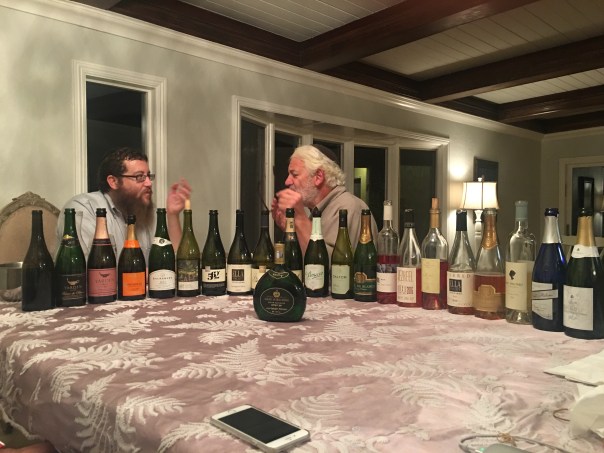
After all the tastings I have had for rose wines this year – I can say for now, that I am as far along as I can go without being in Israel, or asking people to schlep wines for me from Israel. I am still missing the new 2016 Elvi Wines Rose, the 2016 Terra de Seta Rose, the 2016 Matar Rose, and the 2016 Gvaot Rose. I guess that will have to be. When I get to Israel soon enough I will post again, but just on those wines.
In the end, my overall take on Israeli roses this year has been a huge and utter letdown. To me, there are few roses that I would waste my time drinking. In the end, the Netofa, Vitkin, Psagot, and Castel Roses are the only roses that I would buy this year, other than the untasted wines listed above (Matar and Gvaot), which may well be good.
The real saviors for us have indeed been Spain and USA. France has thrown in the La Vie Roubine, but it is not as good as the Ramon Cardova rose.
So, in closing, I will repeat what I listed the last posting. These wines are the best for each category, nothing I tasted in the last tasting has changed much around them, other than the sweet rose entry, which I would never buy, but is useful for those that like rose that way.
So, here are my recommendations based upon the wines I have tasted:
- 2016 Ramon Cardova Rose, is the best rose so far, but it is not a Provence style wine, it is more of a tweener.
- The 2016 Chateau Dubois is the best French rose I have tasted so far, but it is a clear non-Provence style rose.
- 2016 Chateau Roubine la Vie, is the best French classic Provence style rose.
- 2016 Ramon Cardova Rose is the best Spanish rose (that I have had the chance to taste so far, sadly I have yet to taste the new 2016 Elvi Rose)
- The 2016 Shirah Rose is the best USA rose. It is not a Provence style wine, it is a massive wine but a really fun one.
- The 2016 Netofa Rose is the best rose from Israel, it is as close to a Provence style wine I have found so far in Israel. Vitkin is right behind, along with Castel (but it is really expensive for the wine), and Psagot in the bigger/fuller rose category for Israel.
- The 2016 Psagot Rose (when it is on) is the best full bodied rose wine from Israel.
- The best sweet rose that is drinkable is the 2016 Contessa Annalisa Rose. Hopefully, a gateway rose to the drier and better options above.
Rose winemaking approaches
If you read the previous article, you would have read that there are classically three ways to make Rose; Maceration, Saignée, and blend.
The interesting thing we are seeing is a slight variation to the rose making – that is after they make the rose, using any of the aforementioned approaches, they are adding in some white wine! This is straight up genius! Why? Because as explained in the previous post, red grape juice has very few phenolics in it! The real phenolic powerhouse – for red wines, are the skins! White wine does not need skins to give it their phenolics, they have it innately from the juice alone. So, when you take red grapes and essentially crush them and bottle them, with minimal grape contact, what you get is a fun wine, that has very few phenolics in it. So, you have a few options, either let the liquid sit longer on the grape skins, thereby improving the phenolics, but that takes away from the classic rose look, as skin contact turns the juice darker. So, if you want more phenolics and less grape skin contact to keep the classic rose color, you can add in white wine!
The Ramon Cardova is a perfect example of this. As is the Elvi Rose (a wine I have not tasted), and the Jezreel Rose (see below). These three wines all added in different white wines, and it is a clear bump in the correct direction, but to the purists, it is not cool! I cannot speak to the purist’s issues, and yes, I can see that the Cardova is not a classic Provence wine, but it is a very enjoyable summer wine, and in the end, that is what rose to me, is all about!

 Wine Musings Blog