Blog Archives

The mad dash to Weingut von Hovel in Mosel to enjoy kosher German Rieslings – Gefen Hashalom
When I last left off on the story of my trip to Israel and Europe, I had just ended with the Flam Winery, my last post on the Israeli wineries that I visited that trip. Well, after that Friday, we had the shabbos post, and then another tasting (those tastings were not very successful), after that I made my way to the airport for a trip to France.
When I arrived in France I had the epic tasting of all of the Royal French wines, minus one 2015 Rothschild Haut Medoc. The next day, I get on a train and I head towards Alsace, to meet up with Nathan Grandjean and JK. JK was in Alsace for some wedding, and I was coming originally to have a tasting with Nathan on wines I had missed so far. However, the best part of those horrible tastings in Jerusalem, this one and this one, were the Rieslings. In the first one, the epic Riesling was brought by AS, and the second tasting’s Riesling I brought to the party.
I have already posted before about my love for Riesling when we did a horizontal of what we could find. However, up until that first tasting in Jerusalem, there were VERY few humans that had tasted the epic Von Hovel Rieslings.
Gefen Hashalom
The story behind this kosher German wine reimagination – is a group of four people and three wineries – called Gefen Hashalom (“Vine of Peace”). It started with Dr. Mark Indig and Benz Botmann who were interested in making kosher German wines. They approached Nik Weis – a sister winery to Flam Winery of Israel, as I explained here, during a twin city wine event, and the outcome was the 2014 Nik Weis Riesling, that all of us raved about and wrote about already last year. However, there was another partner – Max von Kunow, the owner of the Weingut von Hövel in Oberemmel in the Saar. that made kosher Rieslings as well in 2014 and 2015.
The shocking part of this kosher reimagination of wines in Germany was that the wines were made by top-notch wineries of Mosel. The wineries (Nik Weis and Von Hovel) are world-class wineries in Mosel and for the partnership to have been created with these extraordinary wineries is the true blessing of Gefen Hashalom, IMHO.
There is a third winery that is part of the partnership, Hans Wirsching, which made the very nice Silvaner.
Between these three wineries are hundreds of years and multiple generations upon generations of history in winemaking within their own families and that history is evident when you taste the Rieslings – they are expressive and truly unique.
The three German wineries have sister wineries in Israel. As explained previously, Flam is Nik Weis’s Sister winery, Bazelet Hagolan is Von Hovel’s sister winery, and Weingut Hans Wirsching’s sister/twin winery is Kishor Winery!
Also, another very fascinating aspect is that both Nik Weis and Von Hovel made kosher wines from the Saar region. Now, Von Hovel’s vineyards are indeed all in the Saar region, but Nik Weis has regions in Mosel as well, but so far the three vintages we have had (2014, 2015, and 2016) they have all been sourced from Saar, even the new 2016 vintage that used a more expensive vineyard, Ockfener Bockstein, was still from the Saar wine region.
The Saar region, which as I will explain below is freezing cold, and for the wines to attain their fruit and acidity requires nerves of steel, deep prayer, and sheer endless hope. The prayers are normally rewarded with wines that are extremely low in alcohol and high in acidity but are picked as late as November at times, if that is possible, or sometimes it never reaches peak ripeness.

Kosher wine tastings in Jerusalem
The next wines that I enjoyed on my last trip to Israel and Europe, came after I had finished tasting wonderful wines from the ever capable Yaacov Oryah (head winemaker at Psagot Winery) at one of the newest hip kosher wine bars in Jerusalem – the Red and White Wine bar – kitty-corner from the beautiful Mamilla hotel (8 Shlomo HaMelech Street at the corner of Yanai Street).
After going to see the Kotel (following the tasting at the Red and White bar), I made my way to where I was staying. It was not far from where we would be having the next two tastings, at our friend’s home DD. While, our host was fantastic, the wines were not so much. Much of that was a shocker to us all, because the wines we brought were not lightweights, they just did not show well at all.
There were some winners, a bottle of the epic Von Hovel kosher Riesling – that we will talk more about in a later post, but for now – the notes were very similar and the wine was insane. It was intoxicating (in its flavors) as much as it was intense, showing mineral, sweet notes, and acidity all at the same time.
The real winner of the night to me (other than the epic Von Hovel) was the 4 Vats red which was really nice and a solid QPR wine.
My many thanks to our friend DD for hosting us in his lovely home! To be honest after all the wine tastings I had up until this point, I was done for, so my notes were not very good this time. The wine notes follow below – the explanation of my “scores” can be found here:


2016 Yaacov Oryah Light from Darkness (Blanc de Noir) – Score: A-
This is a white wine made from Yaacov Oryah’s Rhone varietal vineyard, using Grenache, Cinsault, and Mourvedre. The juice of the grapes was pressed out of the grapes with no skin contact. The juice of red grapes is clear until it is left to macerate with its red skins.
Really a fun and unique wine never had such a wine showing red fruit notes in a white wine, showing grapefruit, sour cherry, rich mineral, yeasty notes with lovely minerality, green olives, and saline. The mouth is well integrated with lovely acid, rich peach, lemon and grapefruit with tart citrus, dried orange and more saline and slate galore, with nice pith on the long finish. Bravo! Drink by 2018.
2015 Matar Sauvignon Blanc / Semillon – Score: B+ to A-
The nose on this wine was lovely, showing ripe grapefruit, flint, spice, kiwi, and green notes. The mouth on this medium bodied wine has just enough acidity, showing nice focus with slate, saline, and nice peach, with pink grapefruit, yellow pear, and lovely acid. Drink UP!
2014 Von Hovel Hutte Oberemmel Riesling, Mosel, Gefen Hashalom – Score: A- to A
This was my initial notes for this wonderful wine, without knowing I would taste this very wine in the Von Hovel winery and bring a few home! Stay tuned for that post soon.
A nice Riesling wine, great funk, with rich petrol, honeysuckle monster, with great spice, with heather, lavender, with yellow apple, and yellow plum. The mouth is rich and layered and rich acidity that is insane, with layers of rich blossom honey, and layers of never ending oily texture that is dripping with acid and white peach, lovely funk that gives way to minerality and intense lovely saline, with the sweet notes showing instead of the ripping acid/slate that the 14 Nik showed. Bravo!

Tabor Winery’s latest releases
Well after my last couple of posts, this one returns to wines and wineries I enjoyed on my last trip to Israel and Europe. The next winery was Tabor winery and many thanks to Justin for meeting with us and sharing his knowledge and wines.
My last post on Tabor winery was earlier last year, though I have been posting about the white wines and rose wines throughout the summer.
The winery’s tasting room has undergone a radical renovation and I really like what they have done with it! The labels have also undergone a continuous facelift, over the past few years, and I think these are here to stay – as they are now. The special wines – which they called Adama II in the past has been renamed the Premium line. There are two new wines, the Tannat and Marselan, and they are under a new line, the Single Vineyard line.


We also have once again changed the flagship wine’s name! It started with Mescha, then it was changed to 1/10000 or whatever the bottle count was that year. Then it was renamed Limited Edition, and now it has been changed to Malkiya. I really hope this will be the last name change – we can only hope!
So at this point, the wine lines stand at:
- Har (Mount Tabor) – these are the baseline wines
- Adama – these are the wines we all love and the QPR superstars live here, like Sauvignon Blanc, Roussanne, Rose, and the Cab and Merlot
- Premium Wines – these used to be called Adama II and they hold all the wines, like Sufa, Ram, Zohar, and others
- Single Vineyard (like everyone is doing a single vineyard line now) – this is where the two new Tannat and Marselan wines live
- Malkiya – this is the new name for the 1/10000
Sadly, I missed out tasting the Tabor Roussanne, Adama, which was a shame as the wine I hear is very nice, and there are very few Roussanne available in the kosher market, other than Covenant Winery’s Mensch, Hagafen Winery’s Don Ernesto, and Netofa Winery’s new Roussanne wine (more on that soon).
My many thanks to Justin and the winery for putting up with us during a harvest week. The wine notes follow below – the explanation of my “scores” can be found here:


2015 Tabor Riesling, Shahar – Score: A- (Shmita) Sold only in Israel
This wine is more fun, in some ways than the 2014 vintage. It is more steely, leaner, with far drier and less tropical fruit. This is a lovely wine showing a very earthy side, with flint, rich fruit, petrol, crazy dry peach, with a soap/lavender aroma. The mouth is rich, layered, funky, richer than the 14, rich and yet really bright and showing great pith with great lovely acid, followed by bright summer fruits, no tropical fruit, with lovely Meyer lemon, orange and tangerine pith, and citrus galore. Really nice, floral and funky. Bravo!

Kosher Riesling Horizontal Tasting
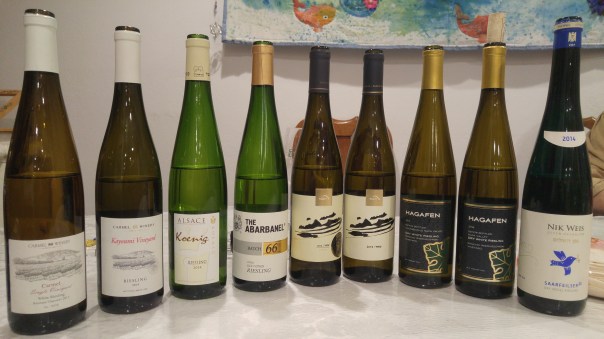
It was time to taste all the Rieslings that I had been gathering up for some time. The problem was that I had no time to do it, given all the events I was traveling to, along with some personal needs as well. So, I finally found a day that would work, a week ago Thursday night and we gathered to taste them all.
So let me start with why Riesling and what is Riesling? First, this grape has many names, White Riesling, Riesling, Johannisberg Riesling, and others are real names of the Noble grape, while Emerald Riesling or Welsch Riesling – not so much!
Riesling Grape
Riesling is old, like ancient, it is documented to exist in Mosel dating back to the early 1400s! It is one of the Noble Six grapes that define wine history, but that is all marketing hooey IMHO. In terms of kosher wines, this variety did not really become special until recently, with Hagafen and Carmel doing wonderful jobs with the grape.
Riesling wines can be made in so many ways. The most common are sweet wines, like the impressive Hagafen Rieslings, that Ernie Weir makes every year, or the less impressive Giersberger Riesling, or the even less impressive Gilgal Riesling. These wines all have some amount of RS (Residual Sugar), whether they are called off-dry, semi-sweet, or sweet, they all need a very important component to make them work – ACID! They desperately need acid to balance the sweet notes. Hagafen is the only off-dry Riesling I have ever liked, that I remember anyway.
It is sad, but while Jews do not seem to enjoy white wines, they do drink sweeter wines, and if there was a bit more acid to balance it out, I think they would show better. That said, I brought this subject up to many a winemaker, and the response was all the same. People like it simpler to drink, so spiking the wine with acid would not sell as well, IE, customers like sweet alcoholic water. Acid tends to discourage gulping or whatever to these people do. Truly sad.
I am finding that Riesling is quickly becoming my favorite white wines. The dry wines from Hagafen, Nik, and Carmel bring a smile to my face. They are rich, layered, oily and balanced, with good acid that makes them enjoyable during almost any part of the meal. That is what makes acid work so well. Food dishes, wine, even dessert, all need some amount of acid to balance out the palate.
There are many other white wines out there for sure, look at my list of whites from 2015. Sauvignon Blanc, Chardonnay, and Riesling are all noble grapes, and they are all lovely when done correctly. Still, Riesling has something going for it, that none of the other white varietals have, funk!
When the wine is done correctly, and then aged for even a year, the wine starts to display notes of petrol and oil. Some may find that offensive, but to me, it is yet another aspect of how I love mineral based wines. The great thing is that these wines come from all around the world! You can find kosher Riesling from California, France, Germany, and Israel!
My top kosher 25 wines of 2016
 Well, I have posted my year in review, and now I wanted to get to my top wines for 2016. Please beware that I know I missed many wines and that this list does not include wines that I have tasted that are not available on the open market.
I wanted to make this post short and sweet – so the criteria are simple I could care less about price, color, or where it was made. All that matters is that it is/was available this year sometime to the public at large and that I tasted it in a reliable environment, not just at a tasting, and that it was scored an A- to A or higher. Also, there are a few lower scoring wines here because of their uniqueness or really good QPR. I also included some of the ebst wines I tasted this year – they are at the bottom.
On an aside, there continues to be a whole mess of madness around wines notes and scores, even the Jewish Week weighed in on the matter. So, let me explain this really simply – go look at some of my recent blog posts – they talk about some nice enough wines, but wines I would not specifically buy. They have all the nice words and such, which were all true and to the point. But without the final value score, I can tell you a Cabernet is full bodied with good fruit and spice – and you may say cool I want that – but then I would say well, yeah but it was not complex or layered. You could try to reason that out of the words I wrote, because the words complex and layered are missing. However, the simple fact that it was scored a B+ or whatever, would have told you that it is not always a wine worth going after (unless it is the Terrenal or such where it gets a QPR moniker).
My point being that wine notes – without a proper context (AKA a real score) – is like looking at a wedding hall through a slit in the window. Sure you can “see” the hall, but are you really sure you want to get married there? I never scored wines to tell people to listen to my score. I score wines to set the context and to always read the notes to see if that sort of wine works for you!
I posted this about my scores – and what they mean, so I hope these are useful to you. OK, enough of the darn score rant for the day, back to the matters at hand, being wines of the year. The list is long – get over it. It is a list of wines that I would buy, have bought, and will buy again – simple enough I hope. I hope you enjoy!
2014 Elvi Wines EL 26 – Score: A- to A
This wine is a blend of 45% Carignan, 35% Grenache, and 20% Syrah. This wine is showing far more accessible than previous vintages. The 2014 vintage in Spain makes fro wines that are easily approachable now and yet has the power to last a long time. The nose on this wine is fruit forward with dark candied raspberry, blackberry, and spiced boysenberry, with root beer and earth, showing spice, anise, and cranberry. The mouth is beautiful and controlled, with great mouth coating tannin, sheer elegance, with great sweet and focused fruit, lovely extraction, showing ripe and tart strawberry, raspberry, and boysenberry all mixed together into a compote, with black fruit and earth. The finish is ridiculous, some of the best of the evening, with sweet fruit and ripe structure, yet balanced and focused, with coffee, leather, and sweet spices, nutmeg, and mineral galore, with scraping graphite, BRAVO!!
2014 Capcanes Peraj Habib – Score A- to A
This wine is a blend of 45% Grenache, 35% Cabernet Sauvignon, and 20% Carignan. This wine is showing far more accessible than previous vintages. The 2014 vintage in Spain makes fro wines that are easily approachable now and yet has the power to last a long time. The nose on this wine shows nicely, with chocolate and oak, along with crazy red fruit, roasted animal, toast, graphite, and lovely smoke, with floral notes galore. What a lovely wine, full bodied with great extraction, ripping acid and great crazy tannin that gives way to blueberry, blackberry, lovely cherry, and insane fruit focus that is backed by intense graphite, and mineral, scraping mineral, with mouth drying tannin all coming together into a far more accessible wine than any year before. The wine is really young but accessible, with insane fruit and mineral all coming together. The finish is long and epic, with leather, and rich extraction lingering with coffee and sweet spices coming together beautifully. Bravo!
2013 Covenant Cabernet Sauvignon, Solomon lot 70 – Score: A- to A
Really lovely but pushed nose, with ripe black fruit, tar galore, with garrigue, earth, and rich blackberry. The mouth on this full bodied wine is rich and extracted, showing an impressive attack with rich focus of blueberry, intense gripping tannin, spicy oak, sweet dill galore, with massive almost tactile mouth showing black fruit focus, with impressive inky structure that gives way to black and blue fruit. The finish is long and spicy, with green notes, foliage, good dirt, all wrapped with dark chocolate, leather, tobacco heaven, more green notes, and rich Asian spices.
2014 Elvi Clos Mesorah – Score: A- to A
This wines a blend of 50% Grenache, 35% Carignan from vines that are 105 years old, and 15% Syrah. Wow what a California Syrah nose, with intense root beer, watermelon, crazy how this smells like Shirah Syrah, with blueberry, and boysenberry, and spiced plum punch. The mouth on this full bodied wine wow, the mouth is full bodied, extracted, and crazy rich, with layers of extraction and concentrated fruit, showing searing tannin, ripping acid, that gives way to black and blue fruit, blackberry, plum, with crazy chocolate and coffee coming together to show mouth drying tannin, with earth, spice, cloves, black pepper, and spicy, with heady spice and blue fruit. The finish is long and spicy, with sweet spice and fruit that gives way to chocolate, roasted meat, and graphite. Really impressive wine bravo!
2010 ELvi Wines Rioja Reserva – Score: A- to A
Wow what a glass of umami, pure hedonism, bravo! The nose on this wine is pure joy, with root beer, blueberry, roasted meat, black pepper, mushroom, dirt, smoke, and toast. The mouth on this medium bodied wine is far more accessible than the 09, with sweet fruit, earth, dirt, sweet blue fruit, crazy candied and juicy blue fruit, that gives way to cherry, candied and spiced raspberry, with mouth coating and drying tannin, rich juicy and concentrated fruit, with insane focus and attack. The finish is long and juicy, with sweet fruit, nutmeg, sweet baking spices, milk chocolate, smoke, and crazy spices, anise and licorice. Bravo!

2014 Nik Weis Selection Gefen Hashalom – first exported kosher Mosel Riesling
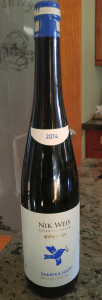 This wine is incredible, really in almost every way that I can describe it. It is a beautiful old world Riesling, its acid is intense, its mineral and saline come at you in waves, and forget about the impressive fruit structure. Yes, the wine is German, and yes I still enjoyed it. I would be the first to admit that I buy nothing German in my home, no German cars, or even shavers. The only German thing I have in my home, I am ashamed to admit was a sink, but that is a story for another day.
But here I am talking about wine, a food item that does not really make me think German as much as it does make me think how wonderful it is. Please do not get me wrong, German anything to a Jew is going to be a touchy subject, I get that, but I wanted to set the stage here first, that I am a Jew that is very much behind the no forgetting camp.
With all that said, yes I bought the wine, a case actually. The wine is incredible, and well worth buying more. That said, it is the first one to come to the USA, and if you try to search for it on Google, you will find NADA! Nothing at all. The closest thing you will find is GG’s wine notes on the wine. That is it!
Why? Well, because it is German, and Jews do not commonly buy German items, and also because the marketing behind it is really not very good! That said, of my friends that I told about this wine, none of them have told me they do not want to buy it. I did ask importers about the wine, and they told me, no thanks – we will stay away from Germany for now. The funny thing is that they are happy to import Alsace wines, a wine region that is separated from Germany by a river. Strasbourg, a major Jewish city, and the capital of Alsace, is a bus ride away from Germany. Still, Germany is Germany to importers, and with that, I will close this subject down.
Now, to the subject of where can I get this wine – well I bought my case from Gary at Taste Wine Company. His number is 212-461-1708. Please give him a call and get wine from him. He is a great guy and he is on the right side of my blog, “Favorite Wine Sites”, because he a friend and also a great person to buy wine from!
In the end, this wine is a true joy and if it is still available I would recommend buying it if it does not offend your Jewishness.
The wine note follows below:
2014 Nik Weis Selection Gefen Hashalom – Score: A- (QPR)
What a wine! This is the first kosher “dry” German Riesling from Mosel that I know about and it is a major hit. This is old world, with a great sweet body. The nose on this wine is insane, showing intense orange blossom, absolutely insane flint and smoke, followed by peach, honeysuckle, lovely green apple, and honeyed notes, with a bit of time the incredible petrol comes through beautifully. The mouth on this medium bodied wine is in your face from the get-go, with impressive floral notes, wrapped in an incredibly oily texture, followed by orange, nectarines, impressive mineral, saline galore, sweet notes, with guava, kumquat, mad ripe and racy grapefruit, and pineapple. The finish is long and really well balanced with ripping acid, great flint and sweet spices on the long and lingering finish. BRAVO!!! Drink now till 2023. I really want to watch this age.
Assorted wines I enjoyed over the past few weeks
Well, I hope I get into the flow of weekly posts, or even more often. For now, I am behind on wine posts from Yom Tov and other get-togethers. So, here is a list of wines I have recently tasted. Some I enjoyed and well, some not. There are a few shmita wines here, so be careful, as always I highlight them as shmita of course.


2007 Elvi Utiel-Requena Makor – Score: A- (Crazy QPR)
This wine is a blend of 85% Bobal and 15% Cabernet Sauvignon. The nose on this wine is rich with lovely umami, soy sauce, ripe plum, rich earth, loam, mushroom, raspberry, and black cherry. The mouth on this medium bodied wine is rich and impressively structured for such an old wine, showing really nice acidity, still integrated tannin, with an inky mouthfeel of velvet and texture with crazy mushroom, earth, barnyard, dark concentrated fruit, blackberry, ripe fruit, perfectly balanced with ripe currant, dark red forest berry, and green notes. The finish is long and tart with more dirt, and barnyard, showing still gripping tannin, and nice ripe and rich fruit. The oak does not show strongly in the mouth but it’s influence is felt nicely. BRAVO!!
2014 Louis Blanc Crozes Hermitage – Score: A- (Good QPR)
This is a lovely black fruit Syrah, with hints of blue fruit in the background. The nose on this wine is lovely, with roasted meat, rich licorice, with blueberry notes in the background, along with earth, loam, mineral, and spice galore! The mouth on this medium bodied wine is balanced and well-focused, with a mineral core, followed by sweet boysenberry that comes alive with time, followed by blackberry, spiced plum, and rich loam, that is wrapped in spicy oak, rich mouth coating tannin, and fig. The finish is long and spicy, with leather, chocolate, lovely charcoal, and bitter almond notes that give the wine its edge. The sweet fruit shows quickly and really is a nice wine, I hope it turns more French with time. It is ready now and will be at peak in two years. Drink till 2021.
2015 Psagot 7 Shmita Red – Score: B to B+ (shmita wine)
This is a blend of all the varietals that Psagot bought/used for the Shmita year of 2015. The white shmita blend was really nice, while this was good enough. It is very green.
The nose on this wine is cranberry, cherry, and asparagus salad. The mouth on this medium bodied wine is nice, but nothing spectacular, other than the very impressive mouth coating tannin. Other than that, it feels like a second label French wine, with lots of press juice, very harsh and not balanced, with black and red fruit. The finish is long and green, with good acid, and mounds of herb and foliage.
2015 Psagot 7 Shmita White – B+ to A-
This is one of the nicer Shmita white wines, it is a blend of all the white varietals that Psagot has under control. The nose is redolent with Mango, lychee, floral notes, honeysuckle, and lovely bright citrus notes. The mouth is medium bodied with good acid, nice balance, all wrapped in straw, cut grass, mint, green notes, with lovely grapefruit, peach, and pineapple. The finish is long with nice acid, mineral, and spice. Nice!! Read the rest of this entry

Vitkin, Tzora, and Flam Winery tastings along with 2015 rosé and whites from Israel
 Well, I am back, landing the day before the Shabbat preceding Shavuot. I was there for my Nephew’s wedding and we stopped off in Paris for two days – that post can be read/seen here. From there we jumped on an EasyJet plane and we were in Israel, but those kind of things do not just happen. In hindsight I would use EasyJet again – simply because there really were few other options. The direct flights were these (listed in cost order); Transavia (I wonder if the count sleeps in luggage), EasyJet, Arkia (Israel’s second largest airline), El Al, and Air France. I tried to use miles on AF – but they were crazy high. So, in the end, EasyJet it was.
EasyJet is one of those airlines that will nickel and dime you all the way to and in the plane. But the best plan (since I had no checked luggage), is to pay for seat assignment and then you get a roll on and backpack. I was stressing about my rollon, it was a bit heavy, and I was worried they would nickle me to death. In the end, the dude at the counter was very nice and they took the rollon – asking to check it, which was fine with me. The trip was fine, as there is a lounge in the CDG terminal, and what we really wanted was just a place to be normal in a land of madness.
Once we got to the gate they were boarding us only to leave us in the gateway for a good 25 minutes – no idea why. Once we boarded, I was asleep, which was a blessing. I had lots to watch – but sleep was what I craved. Once I awoke we pretty much landed, with maybe 20 minutes or so before landing anyway. Once we landed we disembarked quickly, and then well – no one was there at security check. There were loads of people backing into the anteroom. It would be another 20+ minutes before folks actually arrived and started to cut through the backlog.
Once we got through our bags were there already and we were off to get our car – or try! Look I like Budget in Israel, they normally treat me well, but this trip was horrible! They made us wait 1 hour or more and then they treated us in classic Israeli style and gave us a car that was smaller than what we ordered/paid for and then told us to leave them alone! Love people like that!
Anyway, we were off and really that is what I cared about – I wanted to be home! After that, I can say that the trip was really about tasting late 2014 released wines and 2015 wines. Before, I get into that – let’s recap the state of 2015. As stated here, this is what happened in 2015 and after tasting some 40+ wines from 2015 – nothing has changed my opinion.
Well after two world-class vintages in 2001 and 2008, 2015 was a huge letdown. The white and rose are for the most OK, and nice. The white and rose wines are not at the level of 2014 (more on that below), but they are very respectable. The 2015 reds on the other hand is an entirely different subject.
Shmita 2015
A few things going on here – first of all the weather was perfect through August – looking like yet another blockbuster Shmita vintage. Wet winter, tons of rain and no deep freezing, followed by very moderate spring (making for good bud formations). This was followed by temperate highs and nice cool evenings throughout the summer, except for a few spikes here and there, that was all until August! In August nature took a very dark view on Israel – starting with some of the worst highs in the history of Modern Israel, and power consumption that peaked for an entire week that broke record after record. August continued with crazy heat – but it was early September when all hell broke loose. September saw a return of the epic sandstorm – but this time it reached almost biblical proportions in September. Just look at these satellite images – they are crazy!

Overall, the season was not what it was meant to be. The sand storms brought even higher temps, it all unravelled at the end. The funny thing is that – the wineries that pull early, AKA do not produce date juice, were affected far less – like Recanati and Tabor. The ones who pull later or pull from the Galilee – even if they are great wineries – were affected. In some ways it will mean that lower level wines at wineries will have normally better fruit. It will also mean that many wineries will have less of their flagship wines. Of course this is all from what winemakers and wineries have told me so far. Only time will tell to see what really comes out, but agriculturally, it was not a great year. Read the rest of this entry

Tabor Winery – one of Israel’s top QPR wineries
 When I think of the wineries that have great quality wines for a reasonable price, I think of Tabor Winery today more and more. Of course Recanati continues to impress with their reserve Cab and Merlot and Petite Sirah, and their unheralded but dark horse Chardonnay. Then there is of course Netofa, which is crushing it more and more, if I could ever find a recent vintage in the USA – that is!
Tabor Winery is located in Kfar Tavor, and when you search for the older notes on the wines – the winery itself was not clear how to spell its name in English! Is it Tavor Winery or Tabor Winery. This is not a new issue in Israel, transliterating Hebrew words to English is a royal pain in the bottom, and sometime you get the Arabic twist – where Katzrin is spelled Qatzrin on Google Maps and on the road signs!
Either way, the winery did not just start in 1999, it really started 100 years before that in 1901 when Baron Rothschild – a massive supporter of Israel and a huge philanthropist, in his own right, wished to see Israel settled by Jews again. He came to Israel and spent millions of dollars – in those days – to build Carmel winery in Zichron Yakov. However, what is not so known, is that he also helped settle a small town then called Mes’ha (more on that in a bit) in 1901. The name Mes’ha came from a small neighboring Arab village that was down the road. In 1903, the Zionist leader – Menachem Ussishkin urged them to rename it to something Hebrew and so Kfar Tavor was what it was called, as the village lies beneath the shadow of Mount Tavor (Kfar means village in Hebrew – as at that time the town only harbored some 28 or so families). Read the rest of this entry

QPR Kosher wine options that I have been enjoying recently
In my state of kosher wine industry post – I lamented at the lack of QPR (Quality to Price Ratio) options in the kosher wine world. Now that is not to say that the options do not exist, as you can see by the number of QPR options on my top wines for Passover last year. Still, given the sheer number of wines in a kosher wine store (many hundreds) and the number of kosher wines on the open market (many thousands), we are left with a very small minority – sadly.
So, I thought I would list the most recent QPR wines I have enjoyed over the past 6 months. I wanted to catch up with wines I had not had till later last year and place them in a single easy to find place.
My hope is that people will enjoy the wines and demand more of them. For instance, the lack of many of the QPR wines from Elvi Wines on the open market. I can find them on Royal’s website and on Elvi’s website, but sadly I cannot find them at many wine stores. Thankfully, Kosherwine has gotten the Elvi Cava back along with the Gilgal Brut, but they have older vintages or no vintages of the Elvi options. Onlinekosherwine.com, also has many of the older Elvi wines. I have spoken with Moises and he says they exist here somewhere in the USA – only God knows where though!!! Sadly, the exact same can be said for Netofa wines – another QPR superstar! Where are the wines? I taste them at KFWE – but they are not at stores, online or at shops!
I hope to one day write a post about wine cellaring, but till I do, understand that certain wines are made to enjoy early, like Cava, most 2014 white wines, and lighter reds. The richer and tannic reds can use time in the cellar and that is normal. This list is not a list of wines that are meant for cellaring, though many can withstand a few years. The idea here is to enjoy these wines now while you let the long-term wines cellar and age. We all have that interest to drink interesting wines and while I agree with that, that is NO excuse to raid the cellar when u have a hunkering for a complex note or flavor. Many of these wines will scratch the itch while the beasts’ lie and settle.
Finally, some of these wines are hard to find and they may have different siblings – I will point out when an older one will be an issue or a newer vintage would not be on the list (like the 2011 Ella Valley Cabernet Franc versus the 2012). The 2012 Ella Valley Cabernet Franc would never be on this list. The 2011 is a fine wine for another year, after that I fear it will turn to date juice.
Also, many of the white/rose/bubbly wines will be repeats from the various posts I made, as most of the 2015 whites and rose are not coming to the USA as they are shmita in Israel. I tried to keep these wines under 30 dollars or so, some are more most are less and that is the point of this list. Of course, that means that for some wineries there will be one or no options, like Matar or Four Gates Winery. Though I could have thrown in the Four Gates Chard – which is a lovely wine, it is still far from my goal to add into this bucket. The same can be said for many more wineries. Also, 2015 Israeli wines are not on this list, actually no 2015 wines are on this list, though Hagafen Winery, has released their 2015, but I have yet to taste them and the 2014 Hagafen wines are the ones on the market anyway. Finally, wines that can only be found in Israel like the epic Tabor Rose of 2014 and the 2014 Reca Gris du Marselan and the yatir rose and the new 2014 Yatir Viognier – and so on. All of these wines are not on this list because they are hard to find, but they are on previous lists I have posted.
So, without further ado – here is my list of kosher QPR winners so far and if you have any more please tell me!! They are listed below without any real order.
2014 Domaine Netofa White – Score: A- (Crazy QPR)
I must say this is clearly the best Netofa white so far, and I hope they continue to impress! The wine is 100% Chenin Blanc sourced from the slopes of Mount Tabor. The nose is redolent with rich and bright quince, straw, mineral, lemongrass, and wet grass. The mouth on this medium bodied wine is lovely and rich mineral bomb, with more hay, spiced quince, now dry fresh cut grass, green apple, Asian pear, along with a crazy dry and insanely tart crab apple. The finish is long – spicy, dirty, and mineral based, with dry fruit, rich ripping acid, cloves, and nutmeg – BRAVO!!!
2013 Domaine Netofa Red – Score: A- (and more) (QPR!)
This wine is a clear step up from the 2012 Netofa Red, that is not putting the 2012 down in any way, it is just that this wine is even better! This wine is a blend of 65% Syrah and 35% Mourvedre. The nose on this wine is redolent and packed with mineral, lovely smoke, flint, ripe plum, lovely blueberry, with currants in the background. The mouth on this full bodied wine is attacks you first with lovely currants, followed by layers of blueberry, floral notes, richer and more extracted than the 2012, with great mineral, dried strawberry, all wrapped in ripping acid, and lovely tannin. The finish is long, extracted, and richly mineral in style, with blackcurrant, draping tannin, while being spiced with cloves, black pepper, sweet her, and hints of pith and lovely acid. BRAVO!!!
2012 Weinstock Cabernet Franc, Cellar Select – Score: A- (Mevushal) (QPR!)
This is not the same wine as the 2011 vintage, which was crazy and great this vintage started off closed and disjointed, but is now showing far better. The nose on this wine is mad green with red fruit notes, and herb. The mouth on this medium bodied wine is nice and round, with green notes, well balanced with good acid, raspberry, plum, earth, more bell pepper, crazy sweet dill, mouth coating tannin, and green foliage. The finish is long with nice enough acid, forest floor, nice butterscotch, good sweet tobacco, cedar, with tannin adding weight. Read the rest of this entry


 Wine Musings Blog