Blog Archives

QPR Kosher wine options that I have been enjoying recently
In my state of kosher wine industry post – I lamented at the lack of QPR (Quality to Price Ratio) options in the kosher wine world. Now that is not to say that the options do not exist, as you can see by the number of QPR options on my top wines for Passover last year. Still, given the sheer number of wines in a kosher wine store (many hundreds) and the number of kosher wines on the open market (many thousands), we are left with a very small minority – sadly.
So, I thought I would list the most recent QPR wines I have enjoyed over the past 6 months. I wanted to catch up with wines I had not had till later last year and place them in a single easy to find place.
My hope is that people will enjoy the wines and demand more of them. For instance, the lack of many of the QPR wines from Elvi Wines on the open market. I can find them on Royal’s website and on Elvi’s website, but sadly I cannot find them at many wine stores. Thankfully, Kosherwine has gotten the Elvi Cava back along with the Gilgal Brut, but they have older vintages or no vintages of the Elvi options. Onlinekosherwine.com, also has many of the older Elvi wines. I have spoken with Moises and he says they exist here somewhere in the USA – only God knows where though!!! Sadly, the exact same can be said for Netofa wines – another QPR superstar! Where are the wines? I taste them at KFWE – but they are not at stores, online or at shops!
I hope to one day write a post about wine cellaring, but till I do, understand that certain wines are made to enjoy early, like Cava, most 2014 white wines, and lighter reds. The richer and tannic reds can use time in the cellar and that is normal. This list is not a list of wines that are meant for cellaring, though many can withstand a few years. The idea here is to enjoy these wines now while you let the long-term wines cellar and age. We all have that interest to drink interesting wines and while I agree with that, that is NO excuse to raid the cellar when u have a hunkering for a complex note or flavor. Many of these wines will scratch the itch while the beasts’ lie and settle.
Finally, some of these wines are hard to find and they may have different siblings – I will point out when an older one will be an issue or a newer vintage would not be on the list (like the 2011 Ella Valley Cabernet Franc versus the 2012). The 2012 Ella Valley Cabernet Franc would never be on this list. The 2011 is a fine wine for another year, after that I fear it will turn to date juice.
Also, many of the white/rose/bubbly wines will be repeats from the various posts I made, as most of the 2015 whites and rose are not coming to the USA as they are shmita in Israel. I tried to keep these wines under 30 dollars or so, some are more most are less and that is the point of this list. Of course, that means that for some wineries there will be one or no options, like Matar or Four Gates Winery. Though I could have thrown in the Four Gates Chard – which is a lovely wine, it is still far from my goal to add into this bucket. The same can be said for many more wineries. Also, 2015 Israeli wines are not on this list, actually no 2015 wines are on this list, though Hagafen Winery, has released their 2015, but I have yet to taste them and the 2014 Hagafen wines are the ones on the market anyway. Finally, wines that can only be found in Israel like the epic Tabor Rose of 2014 and the 2014 Reca Gris du Marselan and the yatir rose and the new 2014 Yatir Viognier – and so on. All of these wines are not on this list because they are hard to find, but they are on previous lists I have posted.
So, without further ado – here is my list of kosher QPR winners so far and if you have any more please tell me!! They are listed below without any real order.
2014 Domaine Netofa White – Score: A- (Crazy QPR)
I must say this is clearly the best Netofa white so far, and I hope they continue to impress! The wine is 100% Chenin Blanc sourced from the slopes of Mount Tabor. The nose is redolent with rich and bright quince, straw, mineral, lemongrass, and wet grass. The mouth on this medium bodied wine is lovely and rich mineral bomb, with more hay, spiced quince, now dry fresh cut grass, green apple, Asian pear, along with a crazy dry and insanely tart crab apple. The finish is long – spicy, dirty, and mineral based, with dry fruit, rich ripping acid, cloves, and nutmeg – BRAVO!!!
2013 Domaine Netofa Red – Score: A- (and more) (QPR!)
This wine is a clear step up from the 2012 Netofa Red, that is not putting the 2012 down in any way, it is just that this wine is even better! This wine is a blend of 65% Syrah and 35% Mourvedre. The nose on this wine is redolent and packed with mineral, lovely smoke, flint, ripe plum, lovely blueberry, with currants in the background. The mouth on this full bodied wine is attacks you first with lovely currants, followed by layers of blueberry, floral notes, richer and more extracted than the 2012, with great mineral, dried strawberry, all wrapped in ripping acid, and lovely tannin. The finish is long, extracted, and richly mineral in style, with blackcurrant, draping tannin, while being spiced with cloves, black pepper, sweet her, and hints of pith and lovely acid. BRAVO!!!
2012 Weinstock Cabernet Franc, Cellar Select – Score: A- (Mevushal) (QPR!)
This is not the same wine as the 2011 vintage, which was crazy and great this vintage started off closed and disjointed, but is now showing far better. The nose on this wine is mad green with red fruit notes, and herb. The mouth on this medium bodied wine is nice and round, with green notes, well balanced with good acid, raspberry, plum, earth, more bell pepper, crazy sweet dill, mouth coating tannin, and green foliage. The finish is long with nice enough acid, forest floor, nice butterscotch, good sweet tobacco, cedar, with tannin adding weight. Read the rest of this entry

Tzora Winery continues to shine as one of the very best wineries in Israel
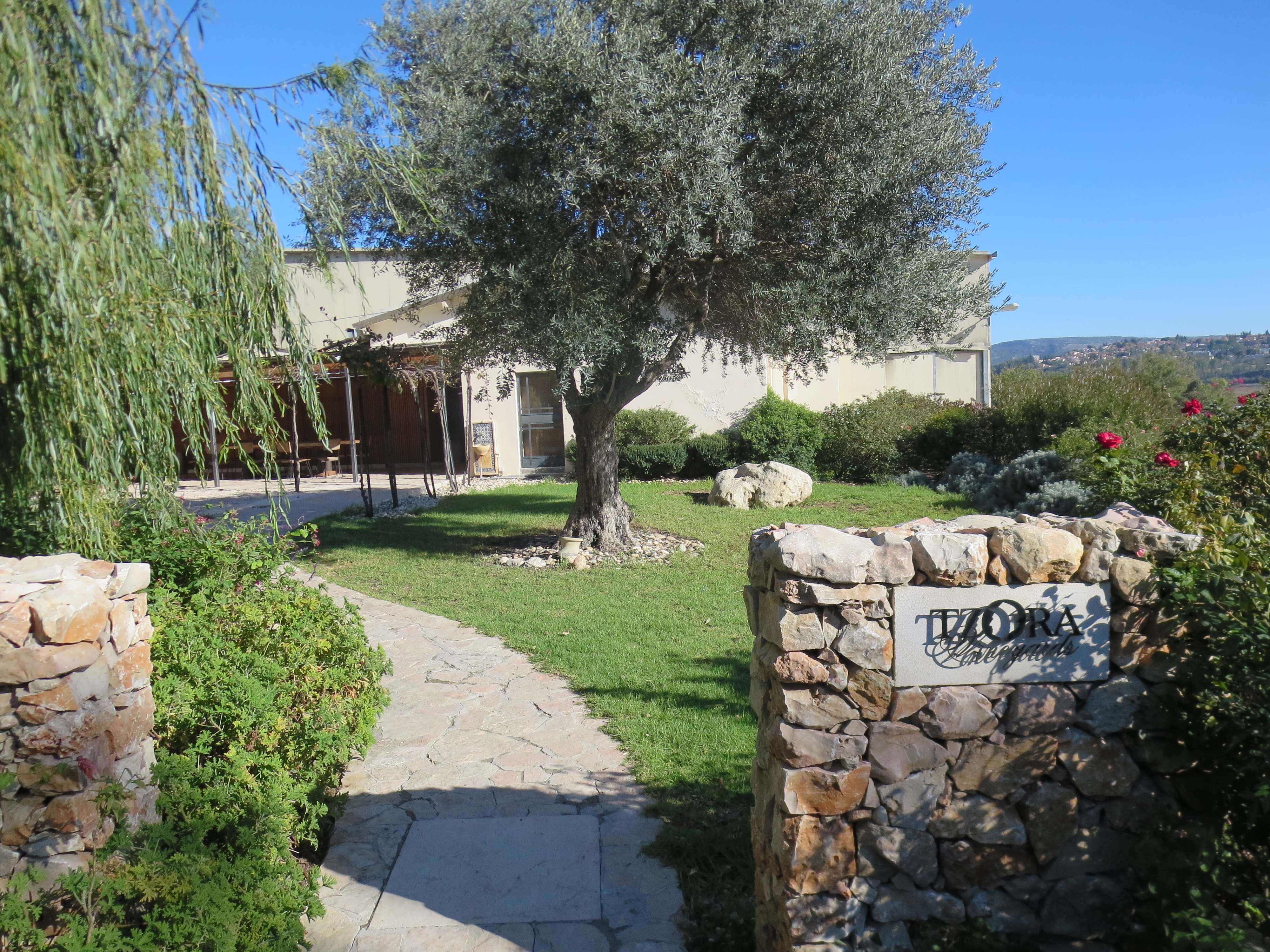 If one says terroir and Israel at the same time, many would snicker and laugh, but when it comes to Tzora Winery they continue to impress. I have written a few times about the Tzora Winery, it is a winery that proves that even in Israel, and even in 2010 and 2011 GREAT and controlled wines can be created.
This winery tasting was not a tasting like the previous ones on the trip, you see, we were not “officially” invited to this one. We arrived for the tail end of Nicolas Daniel Ranson and Christophe Bardeau (from Domaine Roses Camille Winery) wine tasting day. Previously to Tzora, they had gone to Flam Winery and Castel Winery, two wineries we had been to a few days earlier.
So, when we heard they were going to Tzora as well, we asked them both at the DRC tasting if we could piggy back on the tasting, and they agreed. Of course, in hindsight, in all of the enthusiasm and excitement of the DRC tasting, we forgot to ask Eran and the Tzora Winery if they were OK with it! You see, if you have been keeping up with the blog, we had braved the snow and all, and made our way to the Scala Restaurant, in the David Citadel hotel. We enjoyed the DRC wines with Messrs.’ Ranson and Bardeau. However, at the end of the tasting they were discussing where they were going the next day. We had Ella Valley on the books, but nothing else after that. Since Tzora Winery is a stone throw away Ella Valley Winery, we asked if we could piggyback and they said sure. Well, what we forgot to do was follow-up with Tzora Winery the next day. We deeply apologized for being so unprofessional, but Eran Pick, the head winemaker at Tzora Winery, and consummate professional, was so kind and was easy-going about the whole affair, and so we joined the tasting in mid run.
 If you want the true history and write-up on the Tzora Winery – please go here and read it all the way through – what a winery. To me the Tzora winery is one of the five best wineries in Israel, and Mr. Pick is one of Israel’s best winemakers.
We arrived and they were working their way through the white wines, and what wines they were. The wines showed richness, layers, and ripeness all in perfect control of both fruit and oak. Sure there is oak on the wines, but the oak does not dominate and nor does the fruit feel overripe. Instead, the wines show a harmony of fruit, oak, extraction, and expression – quite unique for Israel. The 2011 and 2010 vintages have been hit and miss in the Judean Hills, where most of the wines are sourced for all of Tzora’s wines. However, these wines were neither overly sweet, uncontrolled, or just unbalanced, like many of the 2010 and 2011 wines from the Judean Hills, with a few exceptions (Flam, Tzuba, Castel, Teperberg, and Yatir).
 This is not the first visit we have made to Tzora Winery, we have had a few, and most recently a few months before this visit. However, at that visit, the wines, or me, were having a bad day, and I did not think it would be correct to write about them. Even then, the wines were not out of kilter or uncontrolled, but rather they were showing lighter and with less expression.
This time, the wines, or I, or both were in the zone! The 2012 Tzora Neve Ilan was showing like a classic Burgundian Chardonnay and was killing it. Bardeau was raving about it but the one he loved the most of the two whites was the 2012 Tzora Shoresh White, a 100% Sauvignon Blanc wine which was aged in oak for 7 months and was tasting rich, layered, but tart and ripe all at the same time – wonderful. Read the rest of this entry

Gush Etzion Winery – One of the oldest and up and coming wineries of the Judean Hills
 This is the ninth article I am writing on wineries from the Judean Hills wine region of Israel. This particular winery is located just outside the city of Gush Etzion in the Judea region. The winery was a not even a figment of their imagination when Shraga and Tamar Rosenberg moved to Efrat, which is located in Gush Etzion, in the heart of Judea, just south of Jerusalem in 1986. However, the blackberry bush in their backyard looked interesting and their neighbors told them that it could be used to make fermented juice. So with the simple act of fermented blackberry juice (sorry I cannot bring myself to call that wine) was born the desire to, in time, create a world-class winery in the Judean Hills! He was not so different than another pioneer in the Israeli wine world, Eli ben Zaken of Castel Winery, who also left his job to create a world-class winery. Though Gush Etzion has not yet reached the level of Castel in terms of overall wine quality, it is steadily making its way up the hill.
 Most would not associate wine and blackberry juice, but for Rosenberg it was a great gateway beverage to acquire the yearning for something a bit more real. With time, Rosenberg realized that wine was his real future and he started tinkering with it in his basement – a classic garagiste! During that time his ultimate dream was growing, of building a winery that would prove the words of the Patriarch Jacob, who prophesied to his son Yehuda some 3000 years ago: “Binding unto the vine, his foal, and unto the choice vine, the colt of his ass; he will launder his garments in wine and his robe in the blood of grapes. His eyes shall sparkle with wine, and his teeth white with milk” (Bereishit 49:11-12). Commenting on these verses, Rashi states, “[Yaakov] prophesied regarding the land of Yehudah, that it would produce wine like a fountain.”
 As his tinkering continued friends told him how much they loved his wines and one thing led to another – with Rosenberg officially leaving his managerial position at senior citizen’s home to become a farmer and winemaker! In 1995, with the decision already made, he started to look around for enough grapes to make his dream a reality. To do this he reached out to growers in the area and he quickly found out that if he wanted to make this happen, he would need to plant his own vineyard and augment it in the time being with what he could find in the area. With total control on his vineyard, Rosenberg could manage the vines to make the kind of wine that he sees as world-class, rather than the yield and size that the growers wanted.
As the winery started to grow so did their output. In 1998 the Rosenbergs released their first vintage from their newly minted winery, in the basement of their house in Efrat. They initial vintage consisted of 7000 bottles, which is quite large if you are doing all the work in your basement! The varietals for the first year were all from the Noble grapes; Chardonnay, Cabernet, Merlot, and Sauvignon Blanc. Since then both the varietals and bottles have increased. By 2009 mass planted had expanded the winery’s vineyards to about 120 acres. Among the varieties planted include; Chardonnay, Organic Chardonnay, Sauvignon Blanc, White Riesling, Shiraz, Merlot, Organic Merlot, Cabernet Sauvignon, Cabernet Franc, Petit Verdot and Gewurztraminer and Viognier.

Tzora Judean Hills and Bone Licking Good Short Ribs
This past weekend saw us enjoying some really nice food and wine. We were in the mood for a nice cut of meat and so, we dipped into the freezer and pulled out some of my wife’s favorite cuts of meat – short ribs (or ribs in general). Now ribs and short ribs really have nothing in common, short of the name. Short ribs come in two styles as explained here, flanken which is cut against the bone, so a strip of flanken comes with many small pieces of bone, and the riblet is cut along the bone and is more akin to a rib. Short ribs are not particularly short; they are called as such because of where they come from – the short plate.
Short ribs are a hard and tough piece of meat and love being braised. We started the braise by browning the riblets, and then we removed them from the dutch oven, and sautéed a mirepoix in the rendered fat. After that I deglazed the pot with red wine and a thick and meaty sauce of liqueur, brown sugar, and onion base. I brought the pot to a boil and then transferred the pot to a 350 degree oven for two hours.
The meat was fantastic, but like all cuts of meat from the lower section of the cow that is riddled with connective tissue, intercostal muscles, and tons of collagen, the meat needs to be cooked low and slow and left overnight to cool. The next morning you want to skim the fat from the pot, strain the sauce, and thicken it. Reheat the meat inside the sauce and serve right away.
We served them over a bed of firm rice. This is not a classical match, but we were in the mood, and the sauce was a bit watery, so the pairing went along quite nicely.
We paired the meat with a nice red wine blend from the Tzora winery. I have blogged about this particular wine before and it has pretty much stayed the same, except that this time I noticed a nice roasted herb in the nose and finish. Also, the wine stood up to the meat and the rich sauce, which impressed me and once again, the price to value ratio of this wine sticks out from the prices of kosher wines now a days.
Tzora Judean Hills 2006 – Score: B++
The nose on this bright garnet colored wine is filled with earth, blackberry, cherry, raspberry, and roasted herbs. The mouth on this medium to full bodied wine starts with blackberry, raspberry, and herbs. The mid palate is highlighted with acidity, integrated tannins, and coffee. The finish is medium long with spice, coffee, and more tannin.
Spaghetti Bolognaise and Tzora Judean Hills
This past weekend found me returning from the frozen tundra of Chicago, in search of warmth and unfrozen sidewalks and roads. So with an evening to cook, I opted for making some soup. We had frozen our previous week’s san fromage Spaghetti Bolognaise to make the transition back home easy. So an appetizer of warm soup was on order. I opted for a simple soup of sautéed onions and winter vegetables fortified with white wine and vegetable stock.
When choosing a wine to pair with the acidity and sweetness of the Spaghetti Bolognaise and the freshness and body of the winter vegetable soup, I chose a bottle of Tzora Judean Hills. The wine is really nice, not an overly complex wine. However, for the price, this wine cannot be beat (at least in the US anyway).
The tasting notes follow below:
Tzora Judean Hills 2006 – Score: B++
I have to say that this wine improves with a ton of air. The ripeness of the nose and fruit become far more pronounced and exciting. The mouth opens more as well, and the balance and body are more accentuated.
The nose on this bright garnet colored wine is filled with earth, blackberry, cherry, raspberry, and mint. The mouth on this medium to full bodied wine starts with blackberry, raspberry, and dirt. The mid palate is highlighted with acidity, integrated tannins, and coffee. The finish is medium long with spice, coffee, and more tannin.
Tzora Winery
We made an unplanned stop at the Tzora Winery on a cold winters day and we are so happy we did. We arrived in the late afternoon and there was quite a party going on. A bunch of kids from America had arrived and they were making the most of the winery’s insanely kind hospitality. When we arrived the party was in full swing and we did not want to bother them or the winery staff. As we were getting ready to leave (please folks – always make reservations in advance – do not expect to be as lucky as we were), the staff was super kind and was able to squeeze us into the wine tasting that was in progress. The sad aspect is that though Tzora has increased the volume of wine – the best wines will continue to stay in Israel and not be imported abroad.
The thing that makes Tzora such a special winery are their vineyards. Ronnie James tends to the vines, and it is a labor of love. Unfortunately, as we write this article we are told that Ronnie has passed away. Ronnie and Tzora wines were built on the ideal that terroir makes the wine. The land that the vineyards sit on are the names given to the wines (Shoresh, Neve Ilan, Givat Hachalukim).
Ronnie was growing grapes since the 50s for himself and many other wineries. We will all miss him and his wine and vines will continue to pay tribute to him and his legacy.
We would like to thank the staff at the winery for allowing us to join in and enjoy the tastings. Following are the tasting notes which we sampled at the winery.
Tzora Judean Hills 2004 – Score: B+
The nose on this ruby red colored wine (60% Cabernet Sauvignon and 40% Merlot) is laden with raspberry, cherry, and oak notes. The mouth on this medium bodied wine fat with tannins and cherries. The finish is medium long and quite enjoyable.
Tzora Givat Hachalukim 2006 – Score: B+
The nose on this garnet colored wine (100% Cabernet Sauvignon) is laden with red berries and cherry. The mouth on this medium bodied wine is smooth and balanced with oak and soft tannins giving way to cherry and spice. The finish is not so long, but the wine lingers long on your palate after the wine is gone.
Tzora Shoresh 2004 – Score: A
The nose on this garnet colored wine (100% Merlot) is laden with red berries, mineral aromas, and cherry. The mouth on this medium bodied wine is balanced with integrated tannins giving way to red berries and oak. The finish is medium long with cherry and spice.
Tzora Or 2006 – Score: A+
This wine has quite a story around it as Robert Parker gave it one of the highest scores in a recent Israeli wine expose that he conducting along with Mark Squires. We were able to taste the end of the bottle and it was still quite impressive – none the less. Gewurztraminer grapes are harvested and then deep frozen for two months. Then they are extracted for 24 hours and only the first drips of the grape juice become Or. The nose of this golden wine is filled with honey and tropical fruit. The mouth of this full bodied and almost syrupy wine is fruity with citrus, pineapple and a touch of mint.
Tzuba Winery in Judean Hills
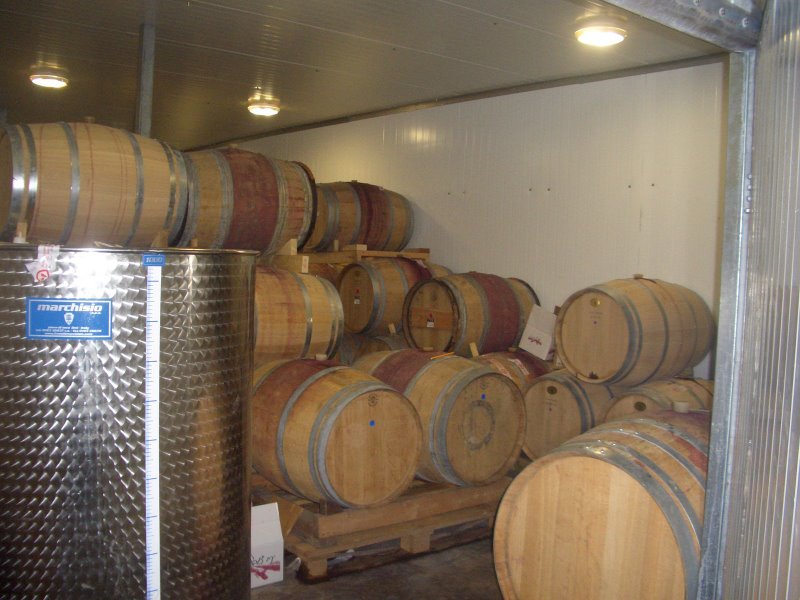
Barrels in Tzuba Winery
As we drive the 395 to get to Kibbutz Tzuba the winery’s vines grace our approach – they stretch from the bottom of the hill side along the valley below and all the way to the entrance of the Kibbutz. The Kibbutz is a tech Kibbutz, building bullet-proof glass and other protective shielding, a thriving business in these trying times.
As we drive up to the winery which is right on the left after you enter the Kibbutz gate – Paul Dubb is there to great us. Paul is the wine maker for the Tzuba Winery and has been growing grapes for the Castel Winery, since 1996. In 2000 Moti Zamir and Paul founded the winery and started planted vines for their label – while still tending to the vines for Castel. The 2005 vintage was the winery’s first vintage where they produced some 30,000 bottles. IN the following years they have ramped up to some 47,000 bottles. They hope to be ramping production up to 150,000 bottles in the next few years. They currently are releasing wines from the following varietal: Chardonnay, Viognier, Merlot, Cabernet Sauvignon, Cabernet Franc, Sangiovese, Shiraz, and Petit Verdot.
Paul has been around grapes since a youngster – where he grew grapes with his parents and grew a love for grapes and wine. Paul’s work is evident in the Castel wines – but is also visible in his own wines. The wines are fruit forward but in a balanced manner. This he says comes from the way he tends to his vines. He makes sure that the vines have sun, while keeping them shaded, to minimize over exposure of sun, which tends to show overripe flavors and too much acid in the wine. The wines are all aged in Hungarian oak and according to Paul – do not tend towards Bordeaux flavors. The winery is built to bring value wines in the Boutique winery market – something that Paul stressed is one of the selling points about Tzuba. Finally, the winery is owned in partnership with Kibbutz Tzuba – a partnership that should help the winery to compete in the ever competitive Kosher Israeli wine market.
My thanks to Paul, Moti and the Tzuba Winery for hosting us and showing us around their winery. Following are the tasting notes which we sampled at the winery.
Tel Tzuba 2006 Chardonnay – Score: A (50% 12 months in oak, 50% Stainless Steel)
Fermented at 55 degrees Fahrenheit – Sur Lie, this wine has a lovely and shimmering straw color. The nose is filled with Lychees, grass, and citrus. This medium bodied wine has a long and exciting finish and is not over oaked. The nose follows in the mouth – with Lychees and citrus flavors covering the mouth and enough acidity to balance the wine out.
Hama’ayan 2005 Sangiovese – Score: B
This ruby red wine has a nose of red fruit. The medium bodied wine has all the signature flavors of a Sangiovese – cherry, plum and added flavors of oak with soft and integrated tannins.
Tel Tzuba 2005 Cabernet Sauvignon – Score: A-
The deep Bordeaux colored wine has a nose of red fruit and oak. The medium bodied wine is smooth with light tannins, red fruit, and a long finish that tends to linger in your mouth.
Tel Tzuba 2005 Merlot – Score: B+
This dark ruby colored wine has a nose of plum and cherry. The medium bodied wine has firm tannins, almost jammy red fruit, a balanced palate and a finish that is medium in length that is accentuated with oak flavors.
Tel Tzuba 2005 Shiraz – Score: A-
This purple colored wine has a nose of fig, pepper, and earth. This medium bodied wine has jammy flavors, soft tannins, and a long finish that is supported by pepper and oak notes.
Tzuba 2005 Merlot Reserve Metzuda – Score: A-
This deep Bordeaux colored wine opens slowly. Over time the wine shows hints of red fruit and oak. The full bodied wine has strong tannins that show off its acidic core and cherry flavors. The finish is long and satisfying. This wine is still quite young and needs time to show its true self off.
Katlav Winery in Judean Hills
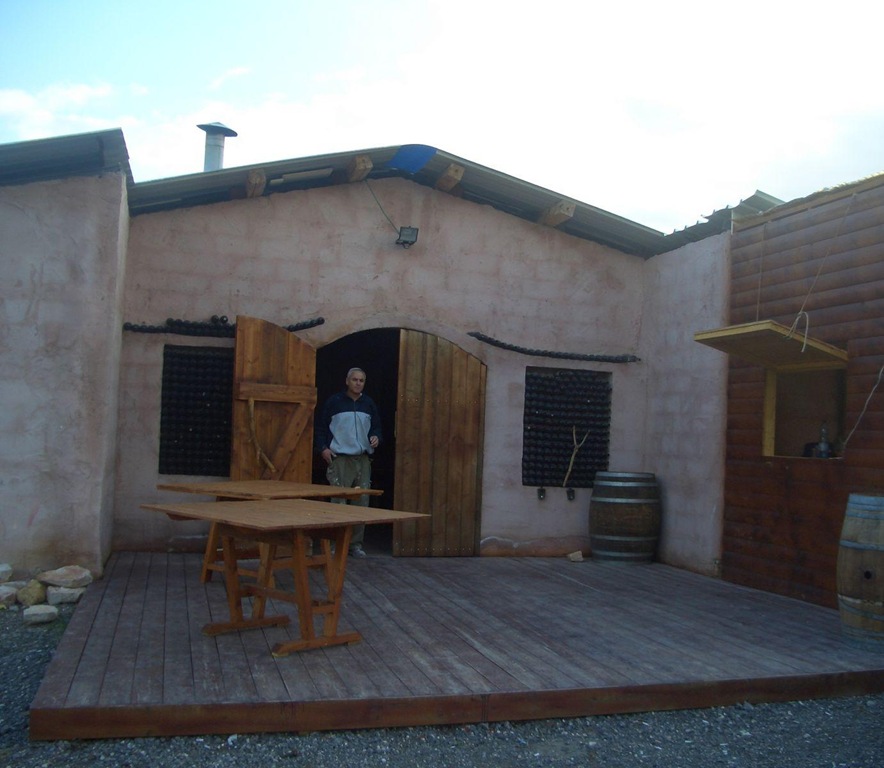
Katlav Winery and Yittach
Tucked away into the winding roads that meander through the misty Judean Hills – we find our selves driving through a small Moshav (town) called Nes Harim, in search of the Katlav Winery. Like so many of the small boutique wineries that are popping up all over these hills – this winery is equally challenging to find. However, what separates this winery from many of the other up and coming wineries is the owner and wine maker. We call Yittach Yossi on the cell and he answers us almost immediately and we explain to him – the best we can of course – where we are, and he goes on to explain that we had actually just driven by his house! We find a driveway and turn around. After tracking down the house – which in hindsight (as this story unfolds) should have been VERY easy to notice – being dwarfed by a hulking Olive Tree. He comes and greets us covered in paint and trailed by two adorable dogs – he asks us to drive the road behind his house and meet him at the winery. As we drive the small dirt road behind his house – the winery comes into view – but so does the beautiful overlook he has on the valley below. Nes Harim is no different than any of these Moshav(s) that line the Judean Hills – they are all compact in size and are built on hill sides that surrender to beautiful vistas and those pesky switch back roads – that we finished traversing a few moments ago.
To say Yittach is passionate about wine would be an understatement. He truly loves his craft. He started out as a highly successful architect and builder – building building all around Israel. It was chance meeting with an ailing Persian worker’s mother that changed his world and turned him into the wine maker he is today. One of his Persian workers had turned ill and he went to see him in the hospital. It was there that he met the worker’s mother and she told him I need two things from you – marry off my son and grapes! Yittach asked why do you need grapes? She went on to explain that she had been making wine for years, before immigrating to Israel – because of the lack of kosher wine in Iran, and she missed her home made wine. Yittach got right to work – he made the man his wife’s brother-in-law – by marrying him to his sister-in-law. Then he got to sourcing grapes, which 12 years ago was not as easy as it is today – unless you were looking for eating grapes. After a bit of work he found the grapes and went on to learn the Persian process of wine making. He took those techniques and improved on them (many times to detriment of the wine and Yittach) until 2000 when he released his first production of 1500 bottles. Today his bottle production fluctuates based upon the grape quality and vine production – but averages 10 thousand bottles. His vines are mostly dry farmed – which tend to produce fewer fruit from the vines, but ones with more tartness and more intense fruit flavors. They are planted in the hills that surround Moshav Nes Harim and on the very same terraces that the settlers planted vines (until they went into disrepair). The close proximity allows for better control of the vines, picking time, and sugar content – all the benefits of a Estate Bottled Winery.
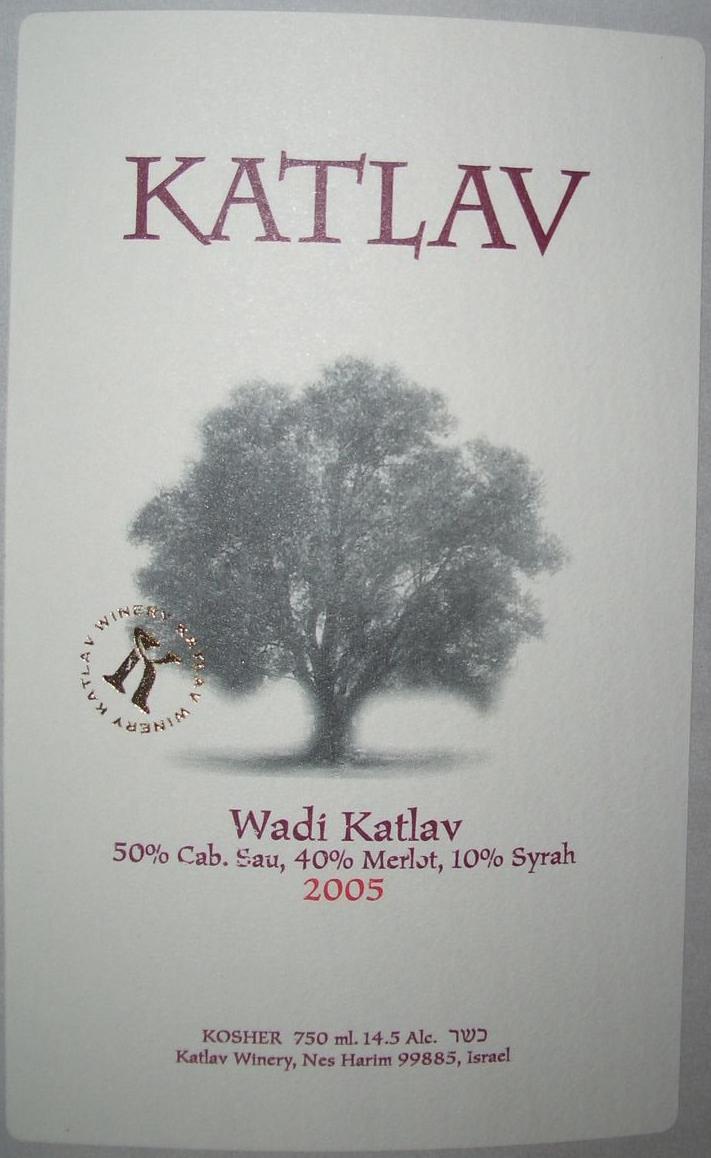
Label Wadi Katlav 2005
We were led into his winery (which he built by hand) and we sat down at the table and talked for quite a long time. Yittach is equally comfortable talking about wine as he is on a sundry of topics ranging from politics to spirituality. We tasted two bottles of wine (notes below). His warmth and comfort with his own skin seemed to draw us in to topics that we would not usually get into during a wine tasting. It was a real joy and one that showed us the other sides of the wine business here in Israel. Yittach then went on to show us the barrel rooms and his bottle cellar. The bottles are graced with a picture of the huge and ancient olive tree that graces Yittach’s front yard – the one we passed when driving by his house.
We would like to thank Yittach for his hospitality, passion and time when visiting his winery. Following are the tasting notes which we sampled at the winery.
2005 Wadi Katlav – Score: B+
This red to black colored wine seems to shimmer in the glass. The nose has strong aromas of blackberry, dark plums and some hints of green vegetation. The wine is accessible yet complex and smooth with carry over from the nose of blackberry, currants, and vegetation. The finish is long and satisfying with a mouth coating that lingers on the palate.
2005 Katlav Syrah – Score: A
This purple to black colored wine needs a fair amount of time to open. At the start the nose has anis, dates and hints of pepper. The wine opens in the mouth to reveal leather, tar and and almost inky flavor that lasts long on the mouth and ends with very nice spicy notes.
Ella Valley in Judean Hills

Ella Valley Winery in the Judean Hills
Ella Valley is a winery we heard of a few years ago when we saw their wine in a restaurant in Berkeley, CA. It was an amazing wine, so we called the distributor and convinced our local store to stock their wines. Since then the store has gone through the wine a few times and has a few of the new releases.
The winery is located in an industrial park of Kibbutz Nativ HaLamed-Heh. The winery was established in 1998 – when they planted their world renowned vineyard that lies a few feet from the beautiful winery building. It took a few years before the first vintage was harvested and bottled – 2002. The winery now produces 200 thousand bottles a year. When they started the process of preparing the land for planting their vineyard they found an ancient winepress – it is this very same symbol that graces almost every bottle of Ella Valley wine.
We met Udi – the winery manager at the visitor center. It was hard to hear him at times over the squall of the parrots that grace the front of the building. It turns out that the GM, Danny Valero, has a strong love for parrots and they have a commanded presence along the path that leads to the visitors center. Udi went on to explain that the winery has an exacting scientific approach to wine making – down to the numbering of each bottle that they produce. Being that the winery is so close to the perfectly tended and managed vines – they are estate bottled (a not so common feat in Israel), and they can control the fermentation process to their exacting standards. The vineyard is in a long and beautiful valley, which shelters the grapes from winter frost and the extreme heat during the long summer months.
We would like to thank Udi and the people at Ella Valley winery for allowing us to taste a wide range of wines – so that we could share the experience with our readers.
2005 Cabernet Franc – Score: B+
This is the follow-on to the smash hit of 2004 – but not quite up to its older brother’s standard. The has a nose of green grass and flowers – classic franc aromas. The balanced medium bodied wine has light tannins that give way to red fruit and more green grass. The finish is long and lingers on the palate long after the wine is gone.
2005 Cabernet Sauvignon/Syrah – Score: B+
The wine has a lively Bordeaux color that shimmers in the light. The nose is filled with earth and hints of green beans. The medium bodied wine is accessible with light tannins and a medium sized finish. The body has a sense of earth, a bit of tar, and complexity that helps to prop this wine up and give it more of a presence than it might have otherwise had.
2004 Merlot – Score: A-
This wine has a nice light Burgundy color. The nose is herbal and has hints of pepper and cherry. This medium bodied wine has a complexity to it that hints at what is brooding underneath the oak coat. It is a balanced wine with integrated tannins and a good amount of acid that allows the wine to stand tall in a crowd and culminates with a satisfying finish.
2003 Cabernet Sauvignon Vineyard Choice – Score: A
The color of the wine is an electric black – if that were possible. The nose is strong and attacking. First comes licorice, followed by oak, and then cassis and more black fruit. This exciting full bodied wine is complex and brooding. The balanced attack starts with cassis and dark plums and then is followed by a long and very satisfying finish.
2003 Muscat (reinforced) – Score: A
The straw color of this wine shimmers with excitement, and begs you to come closer and inspect. It is at that moment that the nose of the wine jumps up out of the glass and hits you with honey and lychees. This medium-full bodied wine is reinforced with alcohol that greet you with more honey and lychees, and finishes with a long flourish of acid and peaches.

 Wine Musings Blog