Blog Archives

Paris tasting of Royal Wine’s 2024 Roses and Whites – Late May 2025
Thankfully, Avi Davidowitz from Kosher Wine Unfiltered is now able to join me on my visits in May and November. This trip was once again very complicated, given that another late Passover occurred, and then Avi had business trip issues, but it all worked out. It never ceases to amaze me how many days the French take off in a year! Thankfully, the trip was successful; we arrived and returned home, so I would call that a success.
We did little to no wine searching, once again. Other than one store, there are very few, if any, new 2024 White or Rosé wines in Paris, anywhere. All the stores are still selling the 2022 or 2023 white and rose wines. This is the same issue that exists in the USA. Online and brick-and-mortar stores are loaded with old wines. So, yeah, not much going on right now! Furthermore, the kosher wine-buying public has all but given up on rosé. This is NOT the case in the non-Kosher market, but it is in the Kosher market. White wines are far out-selling rosés, and the difference is significant.
Additionally, I remain surprised by how little wine French people consume. It’s a declining Kosher wine demographic, for sure! Israel is drinking more kosher wine, as is the USA, but Europe, as a whole, is drinking less kosher wine. The UK is a demographic that seems to be holding its own, but this is mainly among wine enthusiasts. Visit a store in London, and you’ll typically find kosher wines that are a year or more out of date.
As on past trips, the hotel knows me by now; they are very gracious and put up with all the wine deliveries, always making sure to handle them with care. Kudos to the team! This time, we had multiple hotel shipments as Avi was there for Business the week before we hung out. It was challenging wrangling all the shipments, but we managed to get it done, and many thanks to all the wineries and producers for their assistance!
Avi was in France the week before we met for business reasons, and he stayed at a different hotel. Many of the boxes arrived there, and yet more boxes came to our shared hotel. The most amusing thing was that we had so many boxes that we lost track of them, and the hotel did too! B”H, all the wines arrived and we tasted them all. Some wines came after Avi left – but that will all be described in the Hotel Post.
The next morning, we made our way to the lovely home of Menahem Israelievitch, Managing Director and Winemaker at Royal Wine Europe. At the tasting, we enjoyed many lovely wines, and you can read the notes below. I would like to share a few thoughts on them.
- The 2024 Roses, which I have tasted, are showing better than the 2023 vintage. I found some of these wines enjoyable.
- Overall, I think Rose production is slowing down, and stores I visited in NYC and NJ said they are being very diligent about which/Roses they bring in. Further, Paris and much of Europe are still sitting on 2022 Roses. The USA has stores with 2023 Roses. As stated, we hit Peak-Rose in 2022, and we are living off the leftovers.
- We had eight WINNER White wines. Two of those wines are repeats. These are lovely wines, and they should all be available in the USA in the Mevushal status that I tasted in France
The tasting was great as always. We tasted about 31 wines, 10 of which were red. Once again, the wines have been very slow to get to the USA from France; as such, this was the first time I had a chance to taste almost any of these wines, other than the two repeated Chablis. There was a lovely new Chenin Blanc, the 2024 J. de Villebois Chenin Blanc from the Val de Loire, IGT. There was also a new port from Portugal, the N.V. Porto Cordovero Ruby Port, Porto. Other than those two wines, the rest were just new vintages of past releases.
With that said, the La Maison Bleue wine line continues to expand with yet another label and blend, the 2024 La Maison Bleue Grenache-Syrah-Mourvèdre. Nice!
Avi took all the pictures so if you have any issues blame him! Thanks, buddy!
My thanks to Menahem Israelievitch and Royal Wines for hosting us and letting us taste the wonderful wines. The wine notes follow below – the explanation of my “scores” can be found here and the explanation for QPR scores can be found here. The wine notes are in the order the wines were tasted:
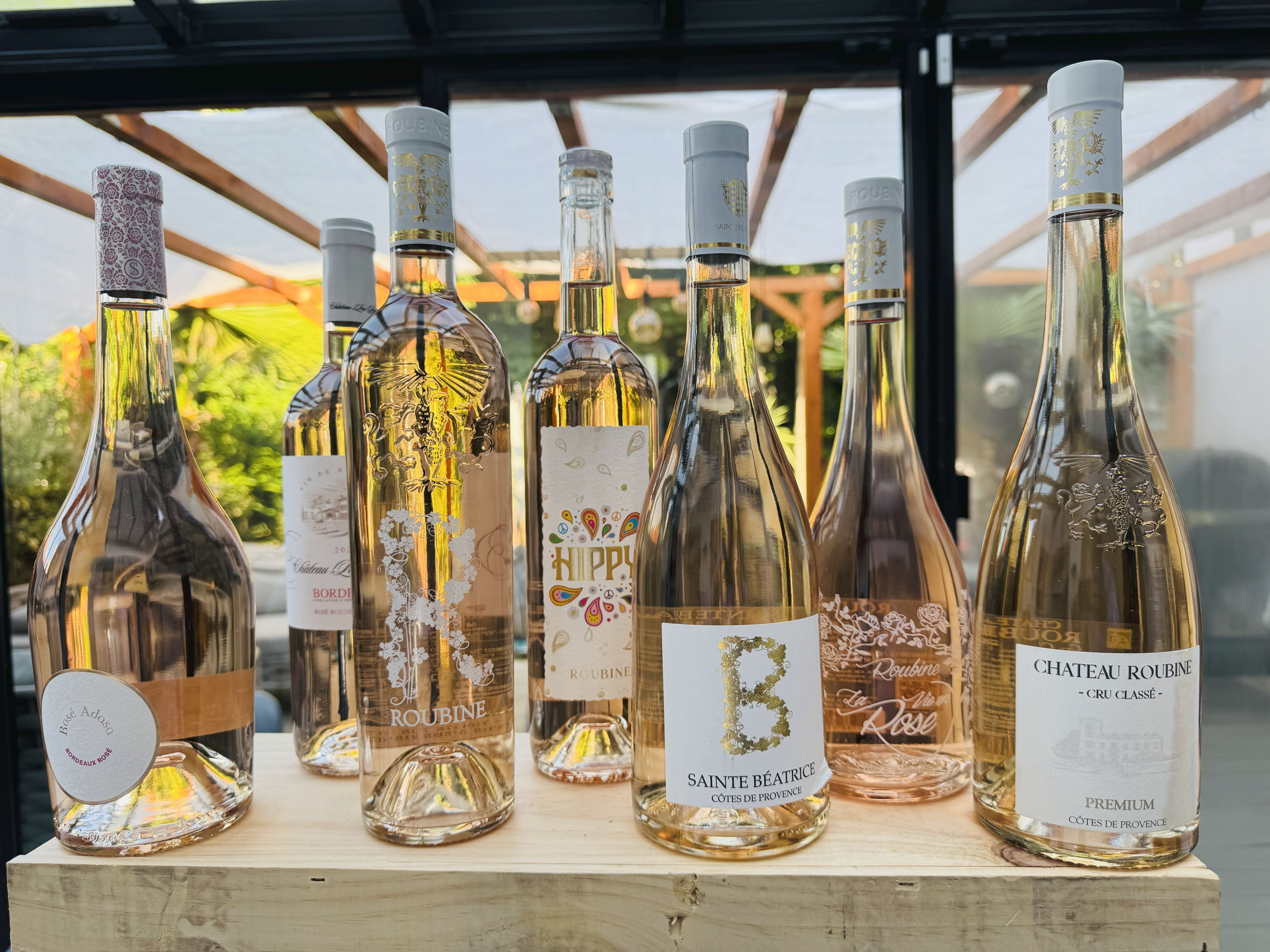
2024 Chateau Les Riganes Rose, Bordeaux (M) – Score: 90 (QPR: GREAT)
The nose of this wine features notes of peach, flint, orange, cherry, and ripe fruit. The mouth of this medium-bodied wine is nice; it has good acidity, nice fresh notes of orange, peach, lemon/lime, raspberry, and lovely tart fruit. The finish is long, tart, refreshing, with notes of flint and a nice finish. Drink now. (tasted May 2025) (in Royal Wines Tasting, France) (ABV = 12%)
2024 Rose Adasa Rose, Bordeaux (M) – Score: 90 (QPR: GREAT)
The nose of this wine shows more red fruit, fresh notes of strawberry, lemon/lime, orange, and slate. The mouth of this medium-bodied wine is nice, with good acidity, nice peach, raspberry, and strawberry, slate, nectarine, and orange notes. The finish is long and refreshing, with a nice slate note. Drink now. (tasted May 2025) (in Royal Wines Tasting, France) (ABV = 12%)
2024 Roubine R de Roubine, Mediterranee – Score: 89 (QPR: GREAT)
The nose of this wine is almost classic Provence, with notes of strawberry and crème, as well as nice raspberry, smoke, and floral aromas. The mouth of this medium-bodied wine is less interesting than the first two Rosés; it has a bit less acidity, with strawberry, but not enough acidity to pump up the wine. The finish is long, spicy, with notes of cloves, sweet spices, and herbal elements, finishing with a hint of slate. Drink now. (tasted May 2025) (in Royal Wines Tasting, France) (ABV = 13.5%)
2024 Roubine Hippy, Mediterranee – Score: 88 (QPR: GOOD)
The nose of this wine is ripe, with strawberry, rose hip, fleur de orange, rose water, and spices. The mouth of this medium-bodied wine lacks the acidity needed to make this work, with strawberry, raspberry, and spices. The finish is a bit short, featuring notes of spices, roasted herbs, cloves, and slate. Drink now. (tasted May 2025) (in Royal Wine Tasting, France) (ABV = 13%)
2024 Sainte Beatrice B Rose, Cotes de Provence – Score: 89 (QPR: GOOD)
The nose of this wine is classic Provence, with rich strawberry and crème, lovely slate, nice rose aromas, and citrus. The mouth of this medium-bodied wine is nice, with almost enough acidity, but it lacks the pop, with pith, strawberry, orange notes, and grapefruit. The finish is long, not tart enough, fruit, slate, and pith. Drink now. (tasted May 2025) (in Royal Wine Tasting, France) (ABV = 13%)
2024 Roubine La Vie en Rose, Cotes de Provence – Score: 90+ (QPR: GREAT)
The nose of this wine is classic with strawberry and creme, less pith than B, and with more acidity, showing nice lemon/lime, nectarines, and smoke. The mouth of this medium-bodied wine is nice, showing good acidity, nice mouthfeel, almost no pith, with strawberry and creme, nectarines, ripe orange, and nice slate. The finish is long, tart, and ripe at the same time, with good mouthfeel and nice attack. Drink now. (tasted May 2025) (in Royal Wine Tasting, France) (ABV = 13%)
2024 Chateau Roubine Rose, Premium, Cru Classe, Cotes de Provence – Score: 90+ (QPR: GREAT)
The nose of this wine is nice, with tart strawberry, no creme, rhubarb, rose hip, and lime. The mouth of this medium-bodied wine is leaner than the others, without the weight to match the desire, with strawberry and rhubarb, with just enough acidity, though I wanted more pop. The finish is long, tart, and nice, with notes of slate and more strawberry. Drink now. (tasted May 2025) (in Royal Wine Tasting, France) (ABV = 12%)

Sadly, simple kosher red wines are uninteresting and have poor QPR scores, for the most part
So, ask me what is the weakest wine category in the kosher wine market? The answer is simple, the simple red wine. Simple red wine is defined here in my QPR (Quality to Price Ratio) post as a red wine that would not last four years. In other words, a wine made to enjoy upon release and hold for a year or two max.
The sad fact is that there are hundreds of wines in this category and they are all poor quality wines. Remember, QPR scores are not controlled by me at all, but rather by the market forces and prices the market forces on the wines. So, a wine that I score a 91 (which is 100% subjective and up to me), like the 2019 Chateau Riganes or the 2018 Herzog Cabernet Sauvignon, Lineage cannot be given a QPR score by what I feel in my gut, or I think.
The QPR (Quality to Price Ratio) score of BAD/POOR/EVEN/GOOD/GREAT (WINNER) is defined by the wine’s category, in combination with the price of the wine compared against the price of its peers in that category. So, once you realize the Chateau Riganes is a simple red wine and that its price is 14 dollars, on average, and then you compare it against the other wines in this category, you quickly realize it has a GREAT QPR score and is a QPR WINNER. The median price for wines in the simple red wine category goes from 13 dollars to as high as 60 dollars and the wine scores go from 58 up to 91. Essentially an abysmal wine category with 100+ wines I have tasted recently and all but 22 of them score below a 90, with just six WINNERS (though some of those are just in France/Europe). So, the Riganes, with a score of 91 for 14 dollars, again on average, shows this wine is below the median price of its peers (20 dollars) and above the median score of its peers (87). So, for 14 dollars, you can get a simple red wine that is better than the vast majority of other red wines in the same category and for cheaper – the very definition of a GREAT/WINNER QPR wine.
If there was ONE take away from the work I have been doing into QPR, that I guess I did not see coming until I did all the work and wrote it all down into a spreadsheet, would be that wines that have a long drinking window also get higher scores and cost more, on average. All that sounds logical but it was not until I wrote it all up that it was glaringly obvious! The high-end kosher wine category’s median wine score is 92! Again, that makes sense as I would not give a wine like the 2017 Raziel a long drinking window. Mind you that wine may well be “alive” in ten years but it would not be a wine I would think about drinking at that time. The ripeness on it would be so overwhelming that it would turn me off more at that time than it does now. That can also be said for the 2016 Chateau Leydet-Valentin, Saint-Emilion, Grand Cru. It will be around for more than almost ANY simple red wine will live, but it will not be enjoyable, to me. So, the drinking window is very short, which places it into a simple red wine category.
It is an interesting byproduct of choosing the vector to compare wines against each other, outside of price, of course. I will keep an eye on it, but for now, the wine category vector that I think gets me the “best” sample size, per wine category option, is the drinking window. This means we will have strange outliers on both sides for sure.
Trying other categories, like wine region or varietal or style will not work – they are not apple to apple. By using the wine’s drinking window we get far more evenly distributed sample sizes and variation in the actual wines.
Finally, many wines are NOT on this list, BECAUSE, this list is of wines that drink NOW to soon. For instance, the 2018 Terra di Seta Chianti Classico, is a GREAT wine and is a QPR WINNER, but it is not on this list. It is not on the next list I will publish either (mid-level red wines). It is on the long aging red wines. It is sub 20 dollars and is a wine everyone should stock up on. Same for the 2015 Terra di Seta Chianti Classico, Riserva, and the 2015 Assai. That is why the price is not the arbiter for what defines a good QPR wine, nor is it based upon a winery, country, region, varietal, and style.
Sadly, the takeaway here is that this wine category is not very interesting. Still, there are a couple of options and six WINNERS, overall, spread across countries, so I guess we should be thankful for that, at least. The wine notes follow below – the explanation of my “scores” can be found here:
2019 Chateau Les Riganes (M) – Score: 91 (QPR: WINNER)
YES!!! The curse is broken! The odd year 2019 vintage is good! Finally! The nose on this wine is fun dirt, earth, bramble, green notes, followed by fun red and black fruit, all coming together into an intoxicating aroma. This is not a top-flight wine, but it is, once again, a very good QPR wine and a sure WINNER.
The mouth on this medium-bodied wine is not layered, but it has enough complexity and elegance to make this work, with a good attack of dark red fruit, with dark currant, dark cherry, hints of blackberry, followed by loads of dirt, mineral, graphite, and a very nice mouth-draping tannin structure, with fun dirt, loam, and loads of foliage. The finish is long, green, and red, with lovely graphite, draping tannin, green olives, and green notes lingering long with tobacco, oregano, and Tarragon. Bravo! Drink until 2024.

Domaine Netofa Winery – 2019 winery visit
For the first time in a long time, my post on Netofa winery is not months after I visited! I went with Avi Davidowitz of Kosher Wine Unfiltered, and as always Pierre Miodownick, head winemaker of Domaine Netofa Winery was beyond gracious with his time and his wines.
I have already posted my feelings about the 2017 whites and the 2016 reds in my previous post on the Domaine Netofa Winery in December 2018. I have also already posted some of the 2018 whites and rose wines as part of a large blind tasting after the winery visit. Domaine Netofa is a winery I have posted about often, and it may well be a winery I post the most of on my blog, besides Tzora Vineyards. That kind of tells you what I think about those two wineries. Pierre Miodownick is the head winemaker at Netofa, and he has been there since the winery’s inaugural 2009 vintage.
Thankfully, the winery is still one of the last bastions of normalcy, when it comes to white and red wines in Israel, along with a few others. I have found Netofa’s white and rose wines from the 2018 vintage to be quite lovely and unique. The red wines are solid with only the red Tel Qasser from 2016 being a wine I still cannot bring myself to love.
Sadly, the availability of these wines continues to be an issue here in the USA. I really wish Netofa could find an importer already and get us some fun Israeli red and white wines to enjoy here in the USA. Until then, you need to go to Israel to buy and enjoy them.
Yes, I know the rumors, I know. However, until their wines are in the USA and in my house I will reserve my optimism. That is in no way a judgment on Netofa, but more of a hope and a way to not jinx the return of one of the best kosher wineries in Israel from returning to our shores.
Wines to come:
- There will be a 10-year Tawny port released soon from the 2010 vintage.
- There will be a 2018 wine based upon Mourvedre, with a bit of Syrah. Look for it in a year or so.
My many thanks to Mr. Miodownick and the winery for letting me come by and enjoy the wines with him! The wine notes follow below – the explanation of my “scores” can be found here:


2018 Domaine Netofa, White – 90 to 91
I have had this wine 4 times now. Some shows like pineapple juice and others show beautiful like this one here. What can I do, I think this wine has a deep-rooted tropical backbone, but the mineral up front is so good that it hides the backbone.
The nose on this wine shows a lovely nose of straight up hay, mineral, and fruit, with apple and quince galore, and lovely fruit and blossom. The mouth on this wine is crazy good, with a clear ripe backbone, yet steely tart and bright with crazy saline and herb, with mineral galore, with crazy apple, and rich quince, with an incredible tension between the ripeness and the tart/dry fruit and minerality. The finish is long and green, with slate, more hay, and lovely freshness and minerality! Bravo! Drink by 2021.
2017 Netofa Latour, White – Score: 91 to 92
Crazy Oak nose with yellow pear and apple, quince and rich saline with hay and dry herb. The mouth on this medium bodied wine is crazy good, layered, extracted and richly round, but tart, and saline bomb, with lovely tension and rich herb, and lovely sweet spices and sweet Oak. The finish off long, green, with vanilla, herb, and mint, and lemongrass, with tart lemon curd and spices. Read the rest of this entry

Yaacov Oryah Winery – latest wines
Having just posted my take on where Israel’s wines are at this point, especially in regards to red wines, there is still a silver lining, the white wines from top Israeli wine producers. Those include Vitkin, Domaine du Netofa, Capsouto, Covenant Winery Israel, Tzora Winery, and of course Yaacov Oryah’s not so well known masterpieces of white wines.
You can read my last post on Yaacov Oryah and his wines here. I visited Israel for a short trip, but I was sure to contact Yaacov and he was very kind to make time to meet once again at the lovely Red and White Wine Bar of Jerusalem. The bartender is the owner, sommelier, coffee bean roaster, and the cheesemonger – Mark Arnold Jam.
The wine bar is one of those few bars that is very particular about what wines are served on their menu. They have top flight wines from Castel, Flam, Gvaot, Adir, Psagot, Matar, and Yaacov Oryah. Of course, not everyone is on the same page as I am, so they have wines from other Israeli wineries, but the majority are wines I would drink! They also have great food, his menu consists of omelets, cheese, and butter (from Naomi Farm in the Golan), great bread, fresh pasta, and fish dishes. However, do not forget the great dessert options as well!
The overall feel of the bar is old school, but equally current, with a bartender that understands food, service, and wine are all intertwined into a single vision that is focused on people first, wine and food second. The bartender is the owner, sommelier, coffee bean roaster, the cheesemonger – Mark Arnold Jam. If you ever get the chance to sit down for an hour in this lovely place you will quickly find that his last name equates well to his musical tastes. Mark gets the vision and he is a one-man show that weaves poetry, music, an old school vibe, and great food and wine knowledge into the ideal renaissance man at your service!
When we arrived for the tasting, I was joined by OU, AD, JK, and NA, along with Arnold and of course Yaacov Oryah. We were there to taste the wines he released recently for 2018. Yaacov’s white wines are pure joy, he gets what works, for people like me, and for others as well. The wines are always enjoyable, well made, balanced, and really rich and layered. The only con to the wines may be the price, but hey greatness comes at a cost.
Yaacov is currently the head winemaker at Psagot Winery and he also makes wines under his own label and some special wines just for restaurants around Israel. His winery is proof that Israel can make great wines. It is further proof, that for now, Israel may well be better served to concentrate on white wines than red ones. The 2017 Yaacov Oryah Silent Hunter, to me, is the best white wine I have tasted this entire year. Better than the 2017 Jean-Pierre Bailly Pouilly-Fume, Sauvignon Blanc, or the other top white wines from 2017. There is no denying it, Semillion in the hands of Yaacov, is like lead in the hands of an Alchemist. The other white and orange wines he made this past year are also quite impressive. Truly a tour de force – Bravo!!!
My many thanks to Yaacov Oryah for allowing me to taste all the current wines and to Mark for letting us spend some time in his lovely wine bar! The wine notes follow below – the explanation of my “scores” can be found here:


2017 Yaacov Oryah Light from Darkness (אור מאופל in Hebrew) – Score: 91 to 92
This wine is a blend of Grenache, Cinsault, Mourvedre, Tempranillo. This is a classic Blanc du Noir using beautiful Rhone Valley grapes.
The nose on this wine shows beautiful and crazy aromatics, with great notes of tart lemon, yellow Apple, with straw, mineral, and lemongrass. The mouth on this medium bodied wine is joy, showing great acid and a tactile mouthful with screaming tart peach, fun and tart lime, with screaming grapefruit, tart, and juicy nectarines, and mineral galore. The finish is long, green, and joyous with more citrus, rich salinity, slate, and rock. Bravo! Drink until 2020.
2017 Yaacov Oryah Silent Hunter (הצייד השקט in Hebrew) – Score: 92 to 93
From what I have tasted so far, this may well be the best white wine of 2017 from Israel, and maybe around the world, though I have others still to taste from Cali and France. This wine is a blend of 60% Semillon and 40% Chenin Blanc. This wine’s name is a nod to Hunter Valley in Australia, and its ability to create Semillion based wines that last forever.
The nose on this wine is a crazy flint bomb, with dry quince, sweet and spicy ginger, rich saline, and paraffin, with rich yellow plum, apple, lemongrass, honeydew, honeysuckle, followed by rich floral notes, and rich mineral. The mouth on this medium-bodied wine is an oily texture with rich fruit, showing lovely mineral, with a mouthfeel of rich earth, straw, and crazy grapefruit with lemongrass and rich pear, all balanced by an acidity that is off the charts. The finish is long, mineral-driven, with more floral and green notes, with incredible acid, dry quince, and floral notes lingering long. Bravo!! Drink by 2030.
2017 Yaacov Oryah Chenin Blanc, Alpha Omega – Score: 91
Another vintage and another Orange wine from Yaacov. In 2017 he made one orange wine. In 2018, he will be making 10 of them!!!
The nose on this wine is almost pure funk! Really funky, nutty and really floral with straw, mad honeysuckle, and rich sweet nectarines, with crazy yellow plum. The mouth on this medium bodied wine is lovely and intense with an oily and crazy mouthfeel, that comes at you in layers and hits you with balanced tannins that give this wine an incredible structure, the tannins, and the acid combine to pucker the mouth with funk madness. The middle of the wine shows that lovely nutty characteristic of orange wines, showing with almond and halva, followed by with honeyed fruit and hints of oxidation. The finish is long acidic, and earthy, with green notes, spice, ginger, and lovely almond pith and orange peel that lasts forever. Bravo!!! Drink until 2024.
2016 Yaacov Oryah Alpha Omega – Score: 90
This wine is a blend of Roussanne, Semillon, and Viognier, that sat and fermented for three weeks on the white grape skins.
The nose on this wine is really fun and crazy, with intense richness and lovely fruit, white chocolate, raspberry, with floral notes galore, and rich orange blossom with orange and rich mineral and spice. The mouth on this medium to full-bodied wine is crazy rich, mouth coating, with lovely nectarines, more yellow plum, with intense acidity, showing rich oak and butterscotch, balanced well with mouth-drying tannin, quince, and more floral notes. The finish is long, sweet, and tart with crazy graphite, saline, and tannin that give way to orange fruit, and cloves and sweet spices. Fun! Drink until 2024.
2016 Yaacov Oryah Eye of the Storm (עין הסערה in Hebrew) – Score: 89
This wine is a blend of Grenache, Syrah, and Mourvedre. The nose on this wine shows lovely blue and black fruit, with a smoke bomb redolence, followed by tar and rich roasted animal fat, with a huge pile of blackcurrants. The mouth on this medium bodied wine is tar driven, with chocolate and tobacco, with a long and balanced wine finish showing a bit of green, with loads of ripe and juicy blueberry, slightly pushed blackberry, and lovely tobacco that lingers long. Nice! A bit too ripe for me, but very well made. Drink until 2023.

Top Grenache wines available now
Well, I just posted by Pinot Noir post, and as I have stated before, Grenache is the Pinot Noir of the Rhone Valley.
So, there we are – I hope we understand the dearth of options that exist in the kosher Pinot Noir landscape. With that in mind, I thought it was high time to have a Pinot Noir tasting, along with the fact that a guest who came to our house said he liked Pinot Noir and Grenache! In a way, it was the perfect wine combo! Grenache is called the “Pinot noir of the Rhone Valley” for its finicky growing style as well, so the combo was chosen.
Now if good kosher Pinot Noir is a pain to find – forget about Grenache!! Here is the list – the TOTAL list that I know of (whether I would or would not drink them):
- Hajdu Winery (much epic Grenache including 2007, 2010, and 2012, 2014)
- Capcanes Winery
- Ramon Cardova (undrinkable)
- Galil Winery (last I had was OK)
- Shirah Winery
- Vitkin Winery
- Dalton Estate (Last I had was really sweet)
- Kos Yeshuous (only in 2016)
After those – the rest are blends, including the lovely Elvi, Netofa, and onwards:
- Vignobles David (The last Vignobles I had were not fun, I hope to taste them again soon) – he has many wines with Grenache in them, in varying degrees of percentages.
- Elvi Winery (Great wines indeed)
- Netofa Winery (they recently added Grenache to their famous SM wines).
- Capsouto Winery (they too only have 30% or so from Grenache)
- Capcanes Winery (yes again because they make the famous Peraj Ha’Abib with Grenache as part of the blend)
- Yaacov Oryah Wines (he makes a Blanc de Noir from Grenache and a few GSM as well). Sadly, I have not tasted his new wines. I hope to be doing that soon.
Sadly, in the world of white – there are only TWO full Granche Blanc wines:
- Hajdu Winery (much epic Grenache including 2007, 2010, and 2012, 2014)
- Vitkin Winery
Also, like the Noir, there is a winery that uses the Grenache Blanc in a blend:
- Capsouto Winery (they use 60% of it or so in the Eva)
- Vignobles David (The last Vignobles I had were not fun, I hope to taste them again soon and new ones as well) – he has a wine or two with Grenache Blanc in them, in varying degrees of percentages.
- Shirah Winery made a Vintage White in 2016 that was mostly Grenache Blanc, but this year, they went back to using Viognier as the major varietal in this white blend.

Kishor Vineyards Winery – the latest 2015 and 2016 wines

I wrote about Kishor Winery a couple of times, when I saw them at Sommelier the last few years. I also wrote a more in-depth article about the winery here, last year. Well, since they did not come to this year’s Sommelier, it meant I had to go and see the winery again this year.
Last year I loved the 2014 Kishor Savant Red, but when we tasted this again late last year, it had turned hard. I asked to taste it again at the winery, and it had indeed become another wine, not the crazy old-world wine I adored last year.
Well this year, there are new releases, and many are quite nice, even if they were 2015 wines. As I have stated before, in my post on the Sommelier event, 2015 whites were and are a disaster. There were a few here and there, but the vast majority were horrible.
That said, I am finding that the 2015 reds are actually drinkable, at least some anyway. Sadly, the curse of Rose in Israel has continues into 2016, the crop of roses so far are B+ wines at best. However, the clear white grape of 2016 is Viognier – it is doing very well in all the wine regions of Israel.
I arrived early, really early, like 9AM early, and my many thanks to the team for meeting me at this early hour. As I stated on my Bokobsa post, I had just landed at 5AM, dropped my bags at my host, then I essentially drove directly to Kishor! So, it was early when I arrived, and it was great to taste some nice coffee and get down to tasting wine!
Yair Una, the winery’s marketing agent was there when I arrived, and he was VERY kind to call the winemaker, Richard Davies, to come from the fields to taste the wines with me. Richard Davies is one of those Vignobles of Israel. He makes the wines and he prunes the vineyards himself! He is one of those Renaissance guys you read about in the wine books!

The winery has three labels. The Kerem Kishor wines (rose, white and red) are the first label. Next is the Kishor Winery label, which seems to only have Viognier, and finally the Savant label, which has the red blend. Read the rest of this entry


 Wine Musings Blog