Blog Archives

The Top and Best 34 QPR Kosher Wine WINNERS of 2024
In May 2020 I wanted to drive home the need for QPR (Quality to Price Ratio) wines. So I set out to create what I thought a QPR metric should be! Gone were arbitrary price ranges and such. Instead, I let the market define what the QPR price range should be. I did this by grouping the wines by their type (white, red, rose, sparkling, and dessert) and then further refined the grouping by age-ability within the white and red wines. This gave me the following groups:
- Drink “soon” White Wine (Simple whites)
- Rose Wine (always drink soon)
- Drink “soon” Red Wine (Simple reds)
- Mid-range aging Reds (4 to 11 years)
- High-end Red wines (11 and more years)
- High-end White wines (7 and more years)
- Sparkling Wine (No need here for extra differentiation)
- Dessert Wine
I then made the mistake of trying to create an Orange wine range/group – that was a HUGE mistake. Again, the wines themselves were not the issue, the issue revolved around trying to group such a small sample set into its group. They will go into their respective white wine category, next year.
Throughout the year, I posted many QPR posts, for almost all of the main categories. I will continue down this road until I find a better way to categorize and track wines that are QPR WINNERS. Talk about WINNERS, that secondary QPR score was a 2.1 revision to my QPR scoring, and that is explained in this post. All the wines listed here are QPR WINNERS from my tastings in 2023.
Let us discuss the approach
I have heard from a few of you. I do not understand your QPR (Quality to Price Ratio) scoring. So, let us take another shot at this! Every time a customer comes into a shop or goes online to buy kosher wine, they have a choice of a few thousand wines, online, or many hundreds in a store. The question is how does a buyer differentiate one wine from the next?
If they like Terra di Seta wines, as I do, and it costs 30 dollars, then he/she will compare other wines to that wine, in regards to the wine and the price. That is the same for any wine they like and any wine they are looking at buying. Price matters! Now, the real question is how can you compare two wines to each other. Any two wines in the world of kosher wines? What characteristics can you use to compare them?
Let us say they like the 2022 Elvi Wines Clos Mesorah. It is a red wine from Montsant, Spain. OK, what other wine can you compare with it? You can compare other Montsant kosher wines, like the Cellar Capcanes wines. However, the Cellar Capcanes wines have an issue – they have been poor for many years! As the ratio states it is QUALITY to price! Quality is primary; once you have a good wine, you can compare it with similarly good wines.
OK, so we need equal or comparably equal quality and that is it??? So, let us say there exists a rose from Montsant that scores the same quality score as Clos Mesorah, are they comparable (by the way no such wine exists!)? What about a white wine – same? Can/should someone compare them? The answer is no, of course. People will compare similar items. OK, are we then forced to compare ONLY Montsant wines with Montsant wines? Of course not, that is NOT how people think. People will compare like-scored red wines with like-scored red wines. Further, there are literally SIX Monstant Kosher red wines on the market. How can one compare six wines to each other? It has no value.
So, the question remains how do we compare two wines? What criteria can we use to compare them? The first step is for us to agree that people will compare wines that are similar in style, but not in locale, region, or price. So what is that characteristic that they will use to compare two arbitrary kosher wines? Price IS NOT the answer.
So, let us recap – we have two similarly scored wines (AKA quality) but they are very different in many ways. Let us look at three of the wines below, two of which are from the greater Medoc region:
- 2022 Chateau d’Agassac Cru Bourgeois, Haut-Medoc – Score: 93+ (QPR: WINNER)
Drink until 2038 - 2022 Chateau Fourcas Dupre, Listrac-Medoc – Score: 93 (QPR: WINNER)
Drink from 2034 until 2040 - 2022 Chateau Royaumont, Lalande de Pomerol – Score: 93 (QPR: WINNER)
Drink from 2030 until 2038
These wines sell for between 38 dollars and 60 dollars. So, are these wines comparable? I would state they are, and further state that wine buyers compare them every time they read my lists and other lists that like these wines. Again, the primary requirement is quality – these all scored roughly the same quality score.
So, next, would you at least compare two Medoc wines to each other? The Chateau Fourcas Dupre and the Chateau d’Agassac? I would say yes for sure. Well, why is the Royaumont any different? Of course, they are very distinct wines, but in the end, what do oenophiles buy such wines for?? To store them and share them at a later date, meaning that wine buyers classify wines by regions, but ultimately they classify them by their ability to age gracefully or not! This means some wines age beautifully, and many will be good to enjoy in the coming years.
So, now you see the logic to the categories I use to compare wines – this is the list once again:
- Drink “soon” White Wine (Simple whites)
- Rose Wine (always drink soon)
- Drink “soon” Red Wine (Simple reds)
- Mid-range aging Reds (4 to 11 years)
- High-end Red wines (11 and more years)
- High-end White wines (7 and more years)
- Sparkling Wine (No need here for extra differentiation)
- Dessert Wine
Essentially, ignoring sparkling, rose, and dessert wines, there is white wine and red wine. Each of those two major categories is broken into their age-ability. Red wines have three age ranges while white wine has two. Then there are the other three aforementioned groups, rose, sparkling, and dessert wines.
Once you have scored a wine – IRRELEVANT to the price – this is KEY, you must place that wine into one of the 8 categories listed above. Once you have done that, any wine in that category is available for comparison. Using the median approach, wines are stacked and ranked by their price, within that category, and some rise above others, by having an equal or better quality for a lower or equal price. Please read more about this here and here.
The Summary
Before we get to the list of the best QPR wines for this past year, I wanted to give you some raw stats. I tasted more than 1200 wines this past year. In actuality, it is probably far more, I just did NOT care to write notes on hundreds more because all it would have said was NO. I made sure to taste all the Israeli wines at three KFWE, and while some were worthy of notes, none garnered these scores. The pain was all I remember. In the end, 188 wines were scored with a QPR score of WINNER, for the blog year 2024.
I have stated it over and over again now, there is no way we can buy all the good wines out there unless you have a local warehouse to store them and you drink two or more bottles a day. That is the excellent news about Kosher Wine today! I hope we have not yet hit peak QPR WINNER Wine.
This year, the list came to a total of 34 names, and none had to dip below 93 in the scores, which is a large number and better scores overall than last year, but again, the pool from where they are culled continues to grow, and the diamonds in the rough are getting harder and harder to find. This year, there are 34 or so QPR WINNERS who scored 93 this year but not in a single area.
The 4 regions that encompass the 34 WINNERS are in order of size, France (27), Spain (4), USA (2), and Hungary (1). Within France, it is not all Bordeaux! There are wines from Bordeaux, Burgundy, and Chateauneuf du Pape.
Of the 34 WINNER, 4 of them are white, 28 are red, and 2 are sweet. However, at the lower price and quality QPR WINNERS (think 20 dollars 91 scoring wines), you will find that white wines are the majority!
This year we have 9 wines that are a WINNER in Europe and the rest of the world and NOT in the USA.
- The 2020 Chateau Haut Brisson) is because of pricing here in the USA.
- The 2023 Domaine Raymond Usseglio & Fils Chateauneuf du Pape, Blanc is not the same here in the USA as it is in Europe. I have no idea what happened to it but the quality is vastly different.
- The 2021 Tokaj-Hetszolo Tokaji Aszu 6 Puttonyos is because of pricing here in the USA.
- The 2020 Chateau Haut Brisson is because of pricing here in the USA.
- The 2022 Chateau Royaumont is because the wine is Mevushal here and not as good, though still a WINNER, but not at the same quality.
- The 2022 Les Roches De Yon-Figeac is because the wine is Mevushal here and not as good.
- The 2022 Chateau Gazin Rocquencourt is because the wine is Mevushal here and not as good.
- The 2022 Chevalier de Lascombes is because the wine is Mevushal here and not as good.
- The 2022 Château Olivier Grand Cru Classe is because of pricing here in the USA.
- The 2022 Chateau Haut-Marbuzet is not available at all here in the USA.
Sadly, there were no new Sparkling or Rose wines to make it to the score of 93 and to meet its counterpart pricing. To me this is a HUGE issue in the kosher wine market! The kosher wine market has lifted up one of the previous sad wine categories, white wine! Which is HUGE! Sadly, we have not moved from there. We have a dominating red and white kosher wine scene. What is lacking sorely, is quality, sparkling wines! The rose wines will never reach the upper echelons, at least in the Kosher wine markets! However, there is actual demand for sparkling wines, and sadly, the products being sold are nice, but the prices are too high, or the quality is too low.
Maybe, Avi Davidowitz, from Kosher Wine Unfiltered, can create a list like that for Israel, this year, a bunch of wines became available there, and a proper QPR list would be worthwhile!
The wines on the list this year are all available here in the USA, and in Europe, and a few can be found in Israel, as well. The wine notes follow below – the explanation of my “scores” can be found here and the explanation for QPR scores can be found here:
2022 Elvi Wines Clos Mesorah Garnatxa, Montsant – Score: 95 (QPR: WINNER)
The nose of this wine is lovely. It pops with intense brightness, followed by a massive attack of ripe but controlled fruit, dense minerality, rich salinity, intense graphite, lovely cloves, cinnamon, warm spices, loam, dirt, earth, lovely raspberry, strawberry, and ripe/bright red berries. WOW! With time, the wine becomes even more complex, showing floral notes, ripe fruit, and lovely sweet spices. Bravo!
The mouth of this medium-bodied wine is so elegant, complex, and singular in grape, and there is nowhere to hide in this bottle; it is complex, lithe, rich, and layered but intensely refreshing. This wine is the Pinot Noir of the Rhone and Spain; there is nowhere to hide, and yet the wine is so impressive. This wine is pure black magic; it is ripe, lithe, tart, acidic, elegant, and dirty, all in the same glass, and yet this is a wine that does not exist in Kosher. Sure, there are lovely blends, but a wine this ripe that is also elegant, lithe, and smoky, you want to drink it all!
The mouth is lovely, ripe, layered, elegant, and toasty, with sweet spices, lovely raspberry, and strawberry, nice umami, really fun, expressive, and captivating; it is so unique and special, with umami, and mouth-drawing elegance, WOW! Bravo! The finish is long, dirty, earthy, smoky, and umami-dense, with great graphite and ripe, mouth-draining tannin. Dirt, minerality, graphite, ripe and tart red fruit, and intense acidity linger long. Drink from 2030 until 2036. (tasted December 2024) (in Clos Mesorah, Spain) (ABV = 15%)

The Best and Top 25 Kosher Wines of 2024, including the Wine of the Year, Winery of the Year, the Best Wine of the Year, the Best Mevushal Wines of the Year, and Best QPR Wine of the Year Awards
First, I must start this by saying I am sorry for this being two months late. The late tasting of the 2022 wines in Paris pushed all the dates forward. Such is life! It was worth tasting those wines in their correct place. As stated below, I love at KFWE, but it is not a place to taste wines for a blog or a post. It is a place to taste wine and know if I should taste it in the correct setting. It is an excellent filter to help fine-tune the wines to sit down with.
Like last year, I wanted to make this post short and sweet – so the criteria are simple. I could care less about price, color, or where it was made. All that matters is that it is/was available this year sometime to the public at large, that I tasted it in a reliable environment, not just at a tasting, and that it scored a 94 or higher. PLEASE NOTE the improved quality of the top wines this year! This is the best year – that I have posted about – in regards to scoring. All 25 wines are 94 or above. The closest we had before was the 2021 blog year, which had a fair number of 93+ scored wines.
We are returning with the “Wine of the Year,” “Best Wine of the Year,” “Winery of the Year,” “Best White Wine of the Year,” “Best QPR Wine of the Year”, along with the – “Best Mevushal Wine of the Year.” Wine of the Year goes to a wine that distinguished itself in ways that are beyond the normal. It needs to be a wine that is readily available, incredible in style and flavor, and it needs to be reasonable in price. It may be the QPR wine of the year, or sometimes it will be a wine that has distinguished itself for other reasons. The wines of the year are a type of wine that is severely unappreciated, though ones that have had a crazy renaissance over the past two years. The Best Wine of the Year goes to a wine well worthy of the title.
The Mevushal wine of the year is something I dread. I understand the need for a wine that can be enjoyed at restaurants and events. Still, when we start seeing Château Gazin Rocquencourt and Chevalier de Lascombes go Mevushal – we know we have a problem. As I have stated in the past, if this is what needs to happen, then please sell both options as many do with Peraj Petita/Capcanes, Psagot wines, and many others. Still, it is a wine; as such, it needs a best-of-the-year moniker, so we do it again!
This past year, I tasted more wines than I have ever, in the past. Now, to be clear, I tasted thousands of Israeli (and other) wines but did not write notes on them. At this point, I refuse to post notes that demean the Israeli wine situation. I understand that goes against my long-term stance, but the situation there also goes against any logical or even human stance. As such, if the wine is good, I post. Otherwise, I am not adding value. I still think, long-term, Israel needs to change its winemaking style. However, as long as folks buy the wines, they will stay as they are. Enough said.
I spent a fair amount of time tasting all the US, French, Southern Hemisphere, and European wines I could get my hands on, and I feel that is where I added the most value, IMHO. For those who like the Israeli wine style – other writers/bloggers can point you in some direction. Thankfully, the 2022 vintage did pull up the overall quality from Europe, so we have some good options.
There are wines from the 2018 and 2020 Bordeaux vintages that snuck in, along with many from the 2022 vintage. Also, there are wines from around the United States and Europe. There are even a couple from the 2021 Bordeaux vintage. This proves wrong the idea that all of the 2021 vintage was a waste of time.
Now, separately, I love red wines, but white wines – done correctly, are a whole other story! Sadly, in regards to whites, we still had no new wines from Germany, still. Thankfully, we have some fantastic entries from ESSA, Domaine de Chevalier, Marciano Estates, Chateau de Rayne Vigneau, Domaine Raymond Usseglio & Fils, Chateau Gazin Rocquencourt, and Le Nardian. Some of these wines that scored well were ONLY the French versions. The USA versions of Chateau Gazin Rocquencourt are Mevushal and the Domaine Raymond Usseglio & Fils – it is a very different animal than what I tasted/enjoyed in Paris. However, they all scored a 93 or lower, and I do not see the point in putting a white wine in – just to cover that base. Therefore, this year, I am going with the “white” 2021 Tokaj-Hetszolo Tokaji Aszu 6 Puttonyos, Tokaj. I hope to post a roundup soon of the top white wines out there like I did last year.
The wines on the list this year are all available here in the USA, and in Europe, and a few can be found in Israel, as well. The wine notes follow below – the explanation of my “scores” can be found here and the explanation for QPR scores can be found here:
The 2024 Kosher Winery of the Year
This award continues to get harder and harder each year. The sad, cold, hard truth is that there are too few great kosher wineries. When I started this award some five years ago, I thought it would only get easier. Sadly, there are a few truths that limit my ability to give out this award.
First, as much as we have been blessed with great Kosher European wines in the past 6 years, most of those blessings come under the auspices of single-run kosher wines. Chateau Leoville Poyferre, Château Smith Haut Lafitte, you name it, are all based upon kosher runs. What we have in Europe, kosher-winery-wise, is Terra di Seta, Cantina Giuliano, and Elvi Wines (including Clos Mesorah), Domaine Roses Camille, which only became 100% kosher in 2020. Still, for all intent and purpose, Domaine Roses Camille has been producing the vast majority of their wines in kosher since 2011.
The requirements to receive this award are simple, the winery must be kosher, not a kosher-run, the quality must be consistent, and the wines must be readily available. The last requirement is the main reason why Four Gates Winery has yet to win the award, but at this point, it is only a matter of time, as kosher wine availability is becoming less of an issue overall, given the sheer number of cult-like kosher wineries that exist today. Also, I may be forced to start playing with percentages instead of wholly kosher wineries if the people understand what I mean.
This year’s winner starts to break down one of my unspoken laws. Never give awards to one of your best friends, but Josh and Chana Rynderman have forced my hands. No, they have not done so physically or even by voice; it is all in their work. This award is worthy on so many levels. I have written about ESSA Wine before, as well as Kos Yeshuos Winery. Both are worthy of this award, and one could not exist without the other.
It is crazy to think that Kos Yeshuos started “unofficially” in 2015! I was not even scoring wines with numbers back then! Ten years ago, Kos Yeshuos made a lovely Vin Gris from Cabernet Sauvignon, and the game was afoot! From there, he made wine for sale in 2016, the first “official” vintage of Kos Yeshuos, with two reds, a Syrah and a Grenache (I had just turned over to numerical scores and started to dabble with QPR). The 2016 Syrah was excellent last year!
Read the rest of this entry
IDS tasting of current releases in Paris – Late May 2024
As stated I was in Paris in May, and the second tasting I had on the trip was at the offices of Les Vin IDS. I was hoping for a blind tasting like we had in May 2022, sadly, it was not in the cards for me. Hopefully, the next trip will include an IDS blind tasting! I am looking at you Ben my man!!! This post, like so many of the other Parisian posts, that are NOT yet posted, is horribly behind. My sincere apologies to Ben and the IDS team. So, without further ado – the tasting!
Oh, and yes, Avi Davidowitz, from Kosher Wine Unfiltered finally made a trip to Paris in May! Congrats my man!
Le Vin IDS Wines
Thankfully, many of the supply and wine bottling issues of 2022/2023 are gone and all the wines were available and ready to taste in May of 2024! As stated there were many wines and they would have been perfect for a blind tasting but extenuating circumstances did not allow for that on this trip.
As is customary, I ask Ben to open the windows to air out the room, as soon as I enter, as the smell of tobacco ash is always insufferable. I understand France is one of the last few advanced nations in the world where smoking is still a thing. I have never tolerated it, the smell makes me retch, so Ben is always so kind to air out the room before we begin tasting his wonderful wines.
Once that was done I took in the room and I realized this was going to be an awesome tasting. There were tons of new wines and wines I had never seen yet. Though, at this time, none of these wines are in the USA, yet!
Two new Champagne and a white wine
Sadly, none of the new 2023 wines are out yet, so I will have to wait for those to come here before tasting them.
What we tasted were two new Champagne from Maison Jeeper and a lovely 2021 Domaine de Chevalier L’Esprit de Chevalier. The 2022 Paul Aegerter (yes they changed the name again) white wine had not yet been bottled, so we did not get the chance to taste that.
If you are wondering where the name Maison Jeeper comes from:
The house was founded by Armand Gourtobe, a winemaker whose legs were injured while rescuing American soldiers. To thank him and reward him for his courage, the U.S. army gave Gourtobe a Jeep which he then used to tour his vineyard, thus gaining the nickname ‘Jeeper’ which he naturally used for his Champagne bottles. (From Sommeliers International).
I thought they were both exceptional and Champagne that most people will love, though they are expensive!
Finally, the 2021 Domaine de Chevalier L’Esprit de Chevalier is a stunning white wine. The 2021 vintage has blessed us with many a great white wine and thankfully this one will not break the bank! Bravo!
Red Wines
The next 13 red wines, mostly from the 2021 vintage, outside of the 6 2022 Paul Aegerter Burgundies (yeah as stated before, yet another new name).
We started with a run of the 2022 Burgundy wines. They were all nice to lovely! The last one was the closest Burgundy that Aegerter has made which reminded me of the 2019s. We started with a Domaine Aegerter Bourgogne Hautes-Cotes de Nuits. That was followed by a 2022 Domaine Aegerter Volnay. Then came the bigger/riper Burgundies and the Premier Cru. The 2022 Domaine Aegerter Beaune Premier Cru, the 2022 Domaine Aegerter Nuits-Saint-Georges, followed by the 2022 Domaine Aegerter Nuits-Saint-Georges Premier Cru, and finally the 2022 Domaine Aegerter Gevrey-Chambertin Premier Cru. That is two QPR WInner and four QPR WINNER, quite a good run.
Then came the 2021 Bordeaux wines. These are all new wines – with some new wineries and the return of Chateau La Gaffeliere, with its second wine as well, the Clos La Gaffeliere. There are new wineries like the Chateau Lespault-Martillac, Chateau Puyblanquet, and Chateau Edmus. Quite a bunch of new wineries that IDS has made kosher in 2021. The last time a Chateau La Gaffeliere was made in Kosher was 1993! Some 28 years ago!
The shockers here are the 2021 Chateau Puyblanquet, Saint-Emilion, 2021 Chateau Marquis d’Alesme Becker, Margaux, and the 2021 Chateau La Gaffeliere. The Gaffeliere and the Puyblanquet are made from a majority of Merlot, which helps in the 2021 vintage. However, the Marquis d’Alesme Becker is a majority Cabernet Sauvignon and it shined bright in the 2021 vintage. Impressive!
Between the Marquis, Puyblanquet, and the Chateau Gaffeliere – it proves that there exist Kosher 2021 Bordeaux wines worthy of being bought. Bravo!
Sweet Wine
Finally, we cannot end this post without discussing the 6 Puttonyos Tokaji! Look this is a sweet wine, it is ripe, it is candied, and yet it is seductive, enveloping, and bracing in its acidity. It lacks the funk of Sauternes, but it surpasses it with its approachability, seduction, and rich mouthfeel. In ways, the funk of Sauternes can get in the way of the sheer enjoyment of botrytized wines, and this wine is proof. We have had a few 5 Puttonyos Tokaji made Kosher but this is the first and only 6 Puttonyos Tokaji! The next level is Aszú Eszencia, which is really close to the 6 Puttonyos (150 (grams per liter vs 180 grams per liter), and then there is the granddaddy of them all the Eszencia (at 450 gpL).
This wine is a baby. Look around and the market is selling the 1999, 2000, 2001, and 2013 vintages. It is crazy to even think this wine is accessible and showing its best at this point. Still, it is a wine that is fun now, but one that will evolve richly over the next 30 years.
The wine, like almost all Six Puttonyos Tokaj, is 500 ml and it is not cheap but it is a lovely wine that deserves your attention!
Closing
My many thanks to Ben Uzan for setting up the meeting, sharing his wines with us, and taking time out of his busy schedule to meet with us. The wine notes follow below in the order they were tasted – the explanation of my “scores” can be found here and the explanation for QPR scores can be found here:
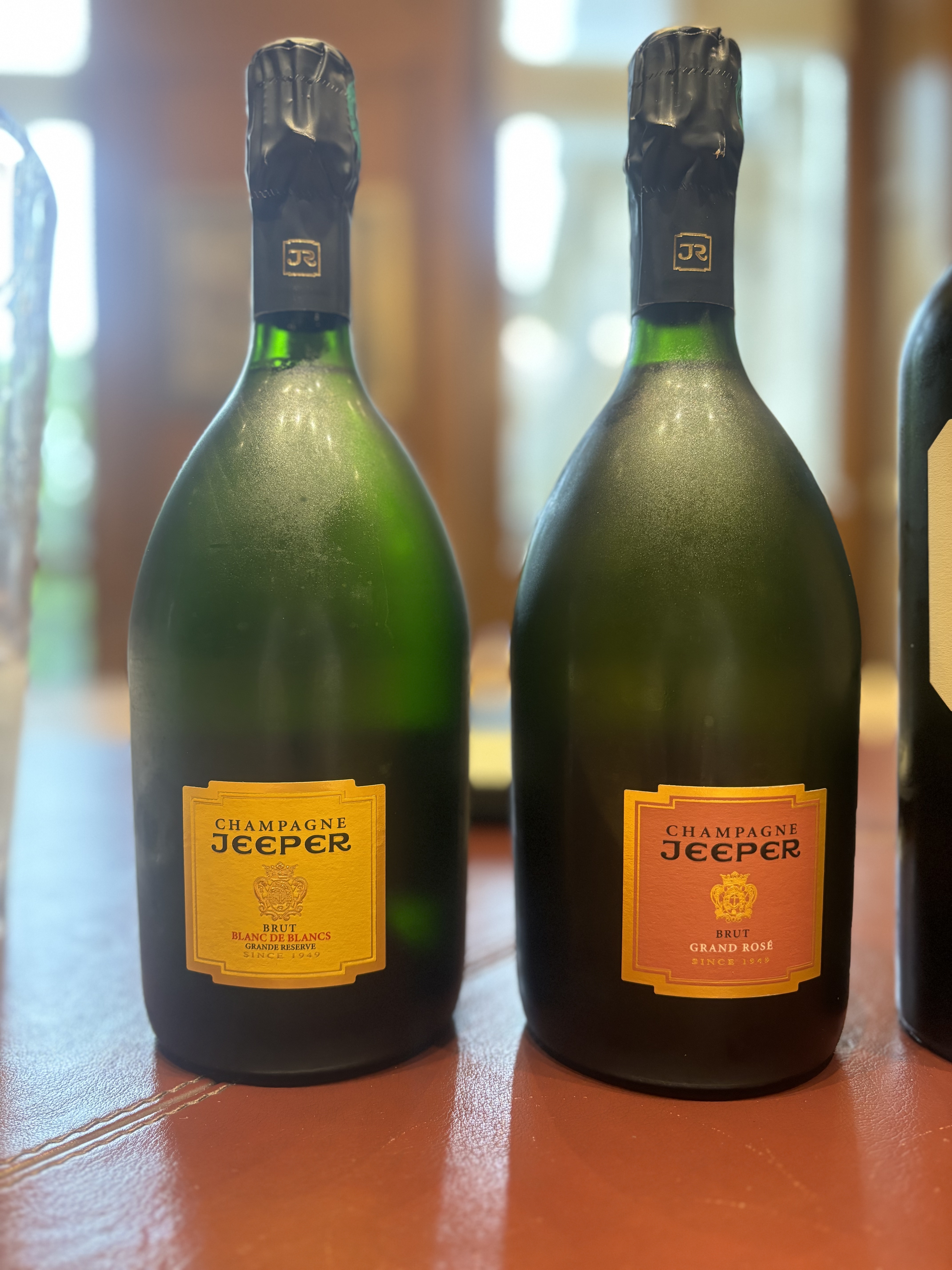
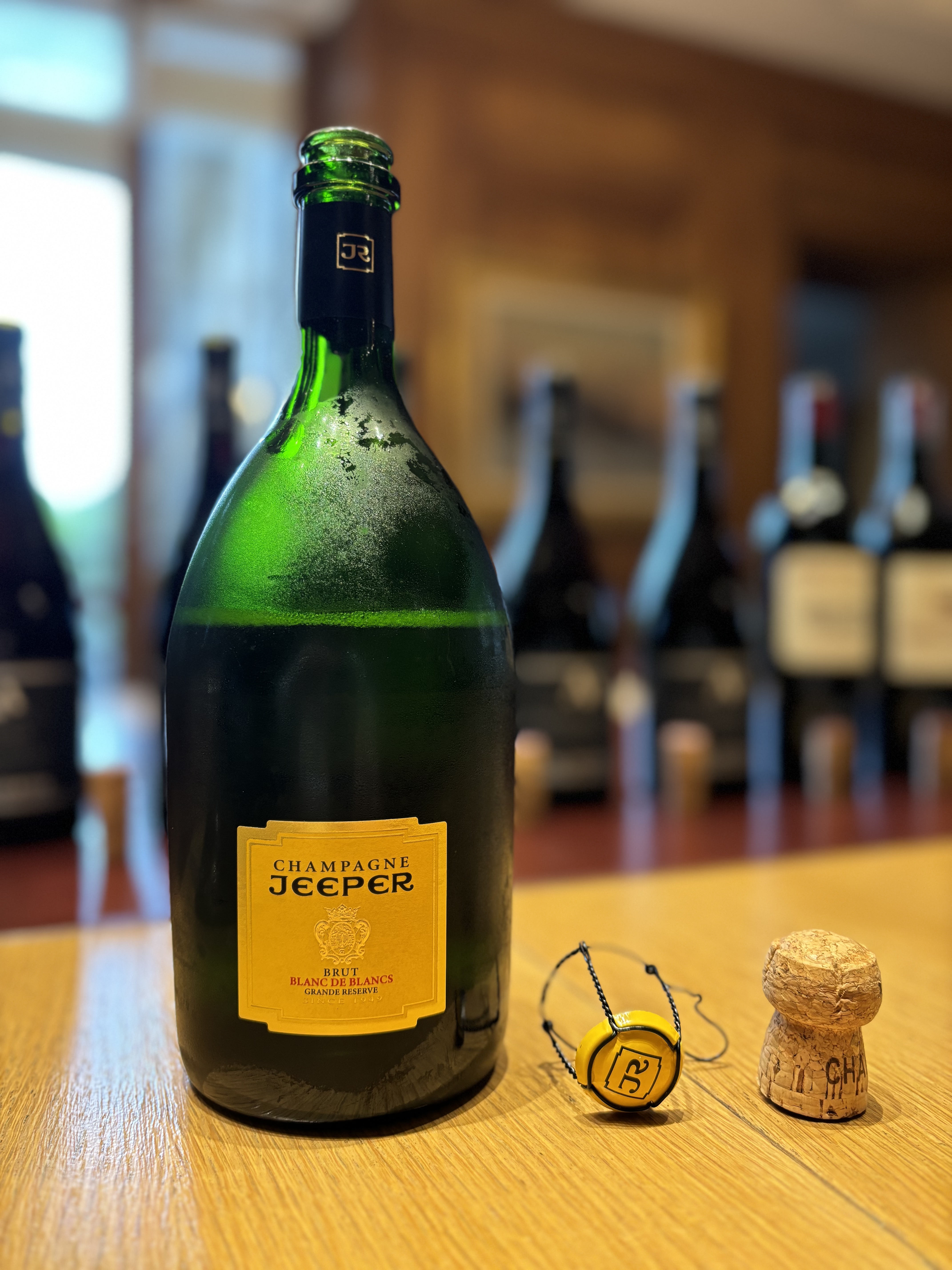
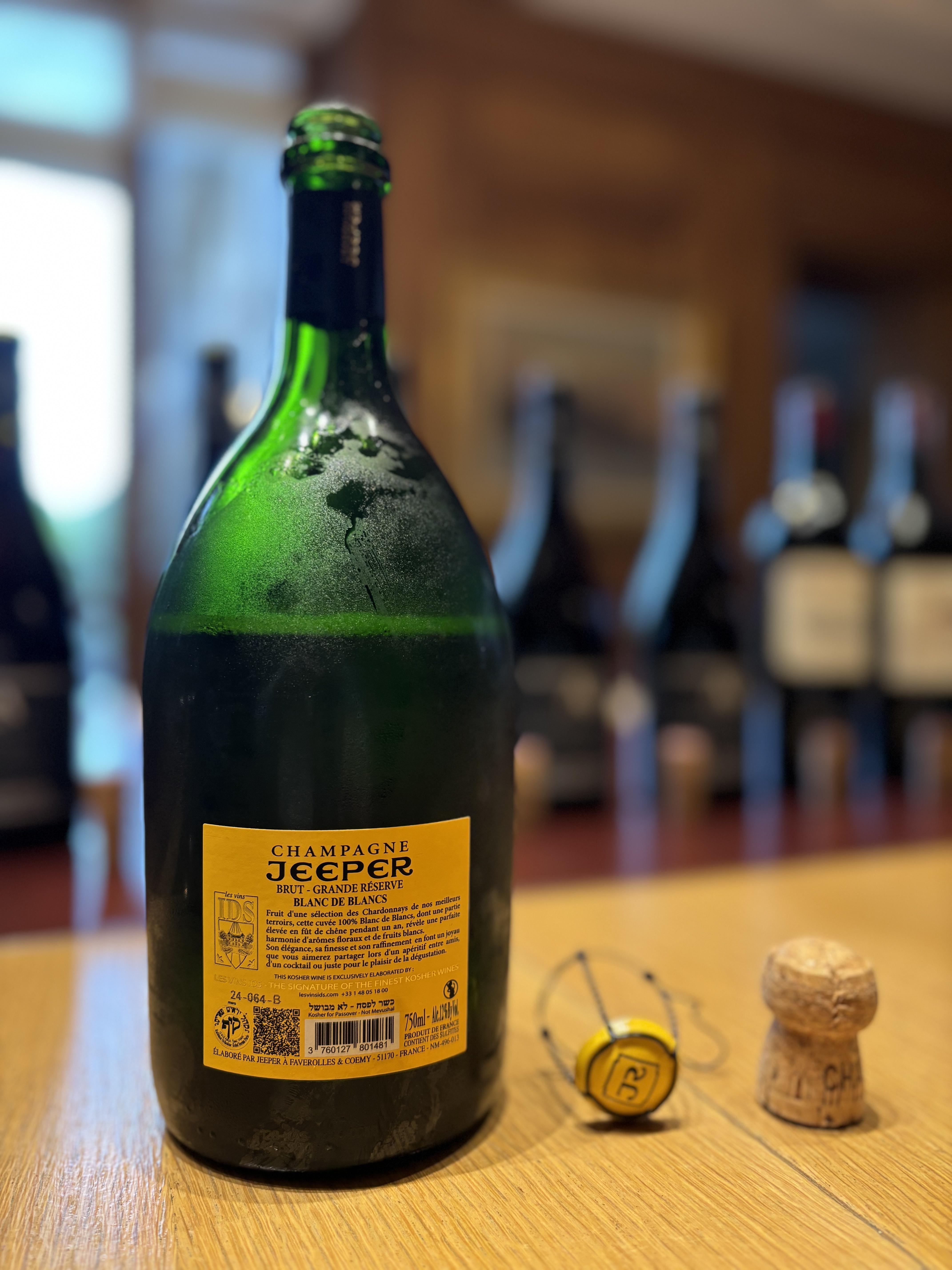
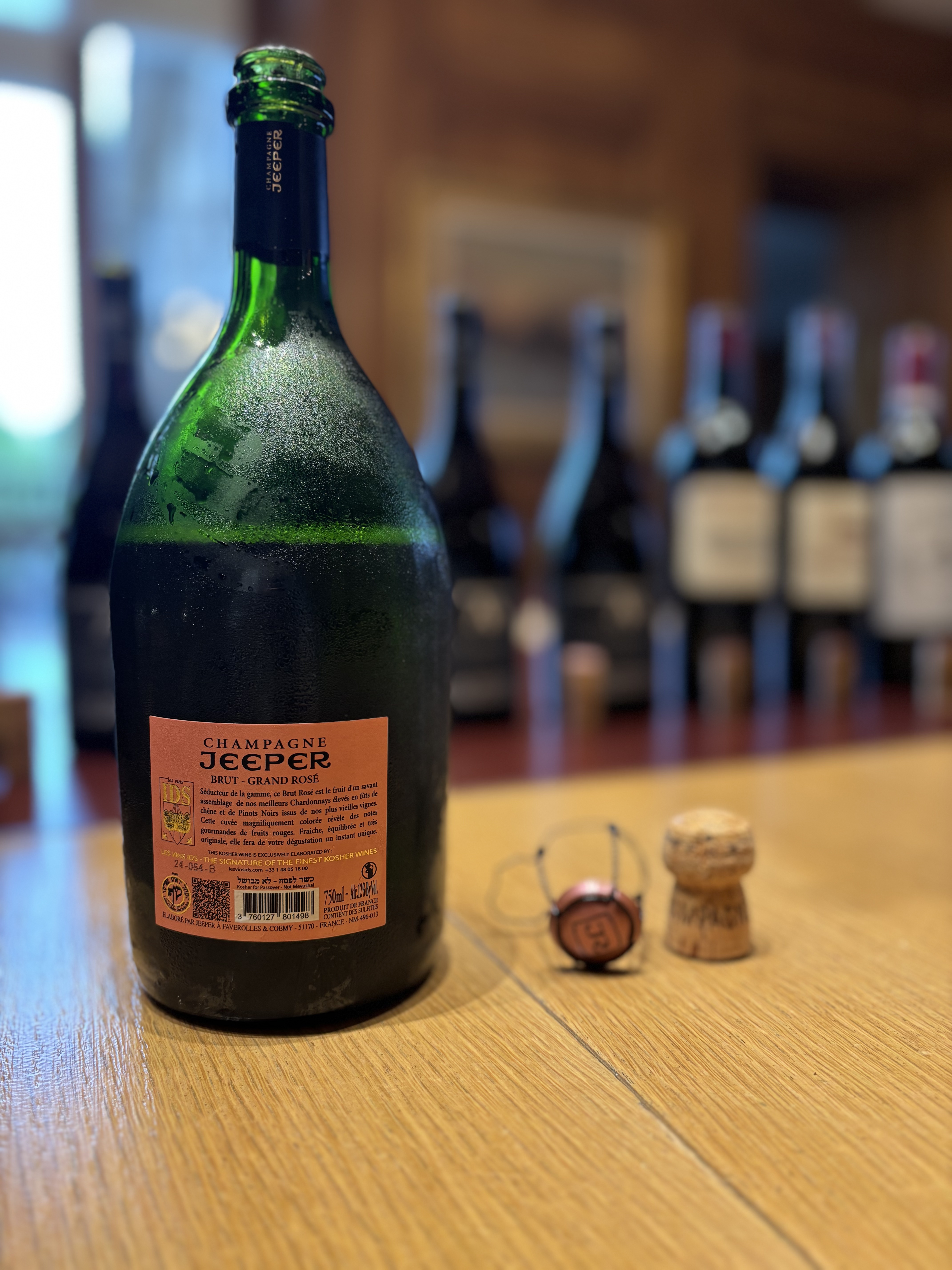
N.V. Maison Jeeper Brut, Champagne – Score: 92.5 (QPR: GREAT)
This Champagne is a blend of the 2020 and 2022 vintages.
The nose of this wine is lovely! with rich yeasty notes, lovely peach, quince, red apple, creamy notes, brioche, citrus curd, and rich salinity.
The mouth of this medium-bodied sparkling Chardonnay wine is rich, with a creamy texture, and notes of ripe Asian pear, apple, lemon, and grapefruit, with small mousse bubbles.
The attack is creamy, rich, and persistent, with the fruit and mousse playing well together.
The finish is long, and yeasty, with brioche, citrus, and brioche lingering long. Nice! Drink until 2028. (tasted May 2024) (in Paris, France) (ABV = 12%)
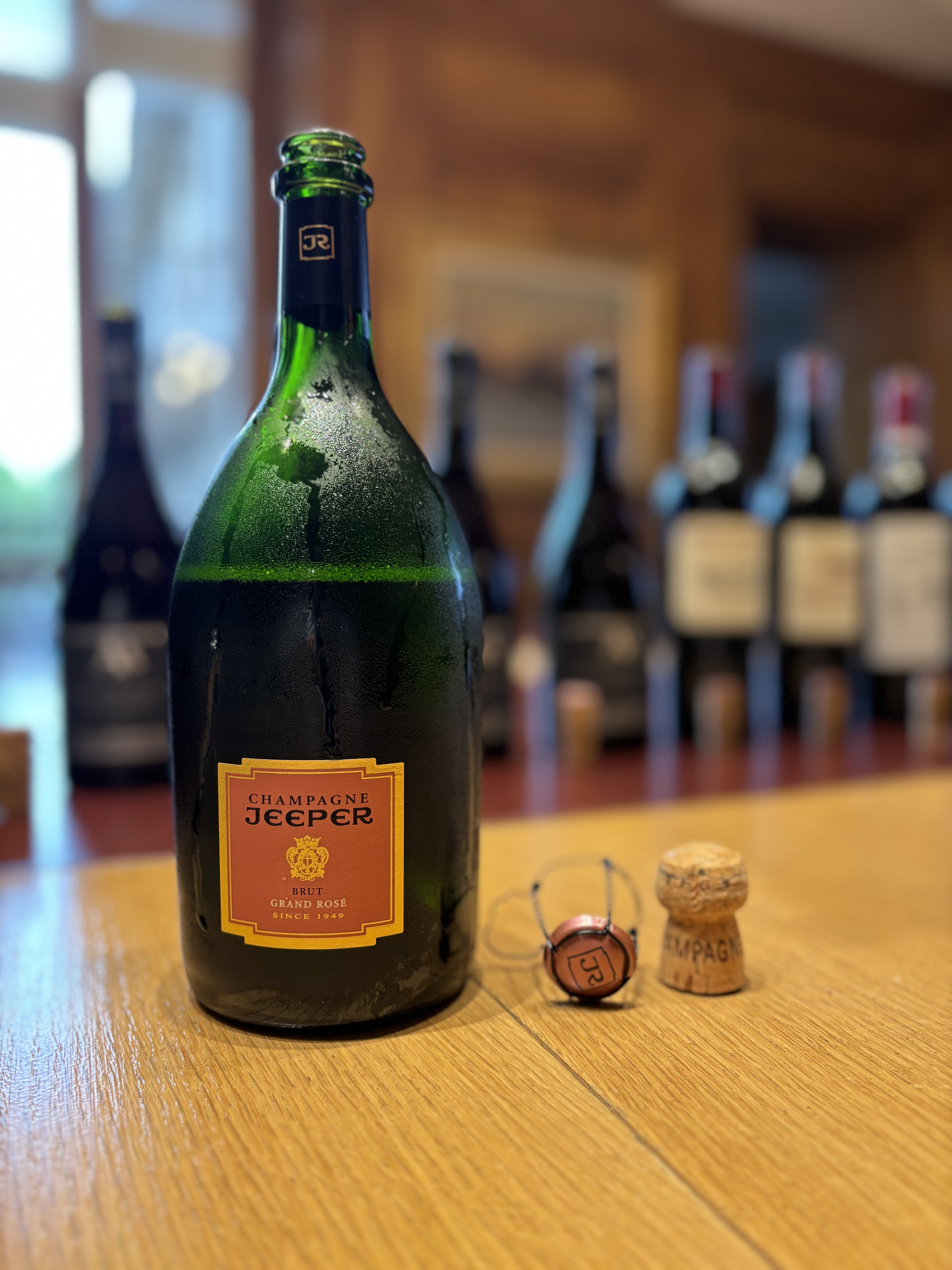
N.V. Maison Jeeper Brut, Grand Rose, Champagne – Score: 92.5 (QPR: GREAT)
Like the Brut, this wine is a blend of 2020 and 2022 vintages.
The nose of this wine is ripe with strawberry and creme, rich salinity, but also ripe with raspberry, brioche, and lovely minerality. Fresh, ripe, and refreshing!
The mouth of this medium-plus bodied wine is richer than the Brut, riper, and more layered, with ripe strawberry, raspberry, and rich peach, highlighted by its peak note of strawberries and creme, the mousse bubbles are persistent, and the acidity is intense and the mouthfeel is plush and creamy with some orange peel, orange notes, and the orange blossom notes that interplay with the strawberries and small bubble mousse. Bravo!
The finish is a bit muted but the attack and mouthfeel make up for that and it may come with time. Drink until 2028. (tasted May 2024) (in Paris, France) (ABV = 12%)
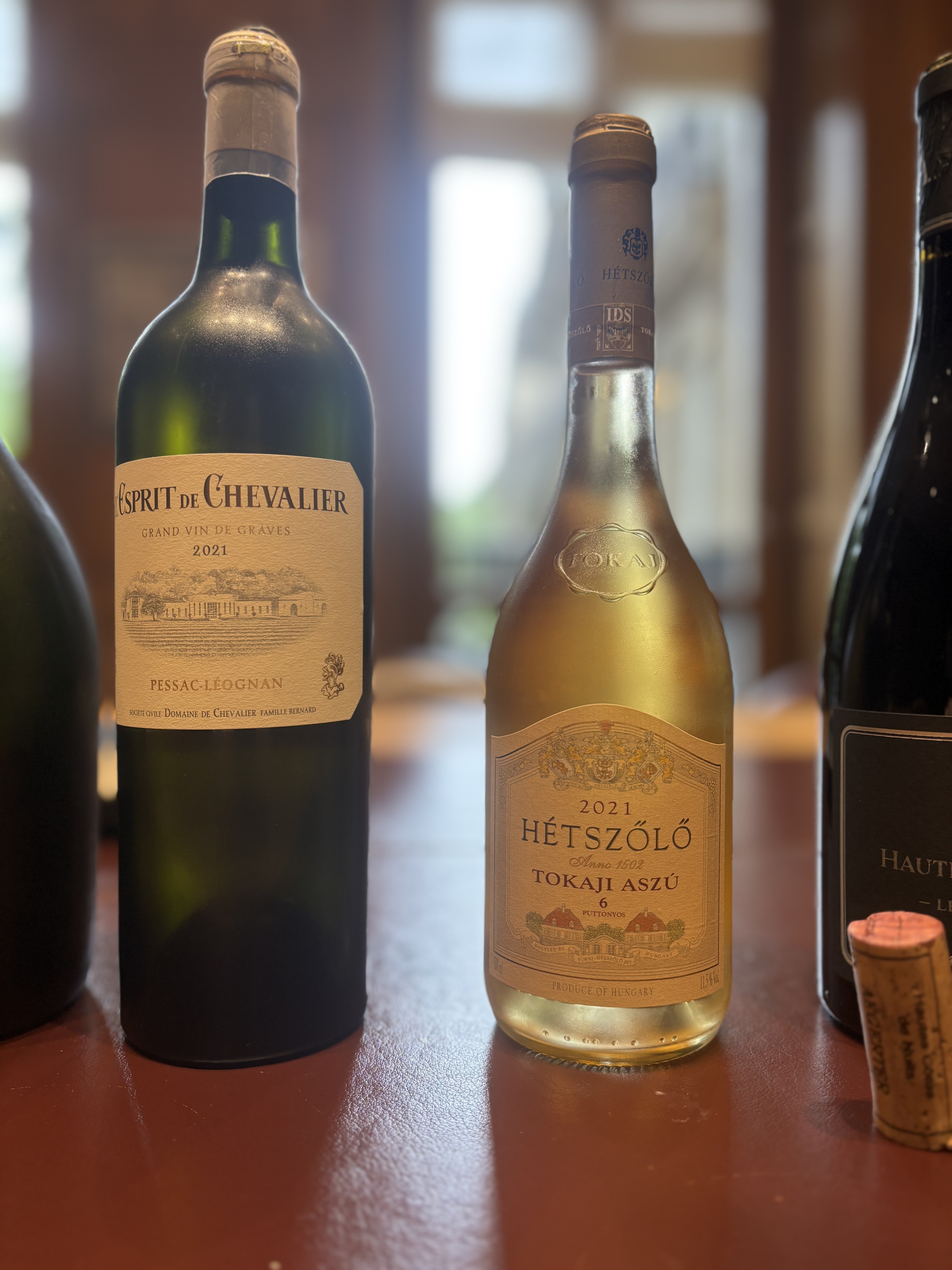
2021 Domaine de Chevalier L’Esprit de Chevalier Blanc, Pessac-Leognan – Score: 93 (QPR: WINNER)
This wine is a blend of 80% Sauvignon Blanc & 20% Semillon.
The nose of this wine is lovely, ripe, extracted, and funky with intense funk, straw, hay, smoke, rich toast, sweet oak, Asian pear, smoked duck, citrus, gooseberry, wet grass, green notes, and sweet herbs. Bravo! The mouth of this medium-plus-bodied wine has richness, precision, and an impressive verve, the funky minerality follows through from the nose with ripe Asian pear, lovely gooseberry, lemon curd, and lemon Fraiche, followed by ribbons of minerality, saline, graphite, all wrapped in a toasty, funky mouthfeel, lovely! The finish is long, tart, ripe, balanced, and refreshing with great acidity, smoked duck, smoked pear, gooseberry, and tart lemon, lovely! Drink by 2030. (tasted May 2024) (in Paris, France) (ABV = 13%)

A tasting of M&M Importers’ current wines – February 2024
I did it again, too much time has passed from my previous post on M&M imports, and this follow-up post is some 9 months apart! This post is meant to not only catch up with the wines that I missed in my last post but also to show ALL the current wines available from M & M Importers.
It is always a pleasure to taste the wines from Ralph Madeb, president and CEO of M&M Importers. The BIG news is that now some of his wines are available on kosherwine.com! I really hope this helps to spread the good word about the work that Ralph and his team do! More info on M & M Importers can be found here.
Where can you find the wines?
Let us get the obvious out of the way first, it is very hard to track what M&M imports and where they are for sale. As stated above kosherwine.com is selling some of them and IDrinkKosher.com also sells them. Neither is the best option because KW has a limited number of the total portfolio, more of that in a moment and IDK is solid, both in pricing and in what they buy. However, knowing what is ACTUALLY available is almost impossible unless you show up at the store. I have been at the store a few times and they have great prices and good storage – again the issue lies in knowing what is actually for sale, as the website is never updated. Calling in does not help much either, but this post is here to shed more light on the matter. I know Ralph is working very hard on this matter and I hope we get more news on this soon.
UPDATE: You can now buy many of the SKUs from elkwine.com! Elchonon Hellinger is a dear friend and as always, I make NOTHING from your purchases, but if you live or are visiting the Miami area, please look him up! If you do not find what you need on the site, text him on Whatsapp: 17867501019, he is adding more SKUs as fast as he can!
Portfolio
If anyone wants to get a bird’s eye view of Ralph Madeb they should listen to the great podcast series from Simon Jacobs – The Kosher Terroir. The episode that focuses on Dr. Ralph Madeb and M&M Importers is this one.
From a Fifty Thousand Mile view, Ralph started his adventure as a mixture of importing IDS wines while also creating his own. Even when he was bringing in some IDS wines, it was not all of them, and access to them was almost impossible.
Since then, things have grown, by leaps and bounds and now they produce or import more than 70 wines.
Again, aside from the accessibility to/of these wines, for the average guy, not living in/near/around NYC, let us talk about what they are and where they come from.
IDS makes wines from all around France and you can find all my wine notes from November 2023, here. Between, Pinot Noirs from Burgundy, famous estates from Bordeaux, and now famous estates from Alsace, Provence, and Sancerre, IDS has expanded its portfolio over these past 10 years.
Names like Chateau Smith Haut Lafitte, Domaine de Chevalier, Chateau Lafon-Rochet, Chateau Marquis d’Alesme Becker, Virginie de Valandraud. Chateau Labegorce, Chateau la Tour de By, Chateau de Valois, Chateau Leydet-Valentin, Chateau Trianon, Chateau Sainte Marguerite, Domaine Aegerter Gevrey-Chambertin, Domaine Aegerter Nuits-Saint-Georges Premier Cru, Domaine Aegerter Nuits-Saint-Georges, Domaine Aegerter Beaune Premier Cru, Gustave Lorentz, Tokaj-Hetszolo, Domaine Vacheron Sancerre, Jean Luc et Paul Aegerter Pouilly Fuisse, Jean Luc et Paul Aegerter Meursault, Clos des Lunes Lune D’Argent.
These are wines made by and for IDS and M&M imports them and sells them locally here in the USA.
Mercier Wines
When you see names Chateau Cantenac Brown, Château Saint Martin Rouge and Rose, Domaine Lebrun Pouilly Fumé, Château Rayne Vigneau, Chateau Fayat, Chateau Olivier Red and White, Chateau Clement Pichon, Alphonse Mellot Sancerre, La Moussiere, Chateau Haut-Marbuzet, and Carillon d’Angelus, these are all made under the auspices of Maison Mercier.
Some of these wines are imported and sold by Royal Wines and some are imported and sold by M&M Imports.
They make many other wines and they import a large portfolio of Israeli wines into France as well. Most of the French wines are made under the watchful eye of Pierre Miodonick, whom I have written up on a few times.
These are really big names for Kosher, much like Royal makes with Pontet Canet, and IDS makes with Smith Haut Lafitte. Any time we can get kosher wines from Angelus and Pichon things are moving in the correct direction. Still, the prices are sky-high because of the added partners in the process.
Honest Grapes
Tom Harrow and Nathan Hill (a man I met for a few hours recently, more on that in a few posts) built an impressive wine club system. They are happy to sell you wine here and there, but their business is built on wine clubs and events. They have been in business since 2014 and they started a kosher line in 2017. Like much of their business and clubs, they run using a mix of crowd-sourcing and partnerships.
The 2017 and 2018 vintages were all sold out long ago as they were both crowd-sourced and sold to those who signed in to the En Primeur. The 2019 vintage was a change, they expanded and with that expansion came a bit more space for non-club access. They expanded a bit because of demand and also because of the appearance of M&M. That was a bit ahead of schedule, and there was no real extra access, at that time, mostly leaving the wines to be sold En Primeur.
The 2020 vintage was when the partnership helped Honest Grapes to expand and make more of the small winery plots kosher. Remember, it is not like they can go from 1000 bottles to 1100 or 1200 bottles. Everything is still barrel based. Either the barrel (25 cases of 12 bottles) is kosher or it is not! These plots are so small, for the most part, that it was not long before the plots were vinified 100% kosher.
The impressive wines in this portfolio are a mix of Bordeaux and Burgundy:
- Chateau Teyssier (QPR Homerun)
- Vieux Château Mazerat
- Le Dôme Kosher
- Pontet Labrie
- Domaine de Montille Pommard Premier Cru ‘Les Grands Epenots’
- Domaine de Montille Puligny-Montrachet Premier Cru, Les Chalumeaux
- Domaine de Montille Volnay Premier Cru ‘Les Brouillards’
- Domaine de Montille Nuits-Saint-Georges Premier Cru ‘Aux Thorey’
- Domaine de Montille Beaune Premier Cru ‘Les Perrières’
- Domaine de Montille Monthelie Premier Cru ‘Les Duresses’
- Domaine de Montille Bourgogne Blanc
- Domaine de Montille Bourgogne Rouge
Right now, M&M only has two wines for sale from Honest Grapes, the 2019 Chateau Teyssier (QPR Homerun), and the 2020 Domaine de Montille Volnay Premier Cru ‘Les Brouillards’.
The rest of the 2020 Bordeaux and the 2021 Burgundies are still in route and will be here soon enough.
Read the rest of this entry
IDS tasting of current releases in Paris – a second time – in Nov 2023
As stated in my previous post Avi Davidowitz, from the Kosher Wine Unfiltered blog, and I went to Paris and had three organized tastings. This was the second organized tasting of the trip and it was with IDS. IDS is officially called Les Vins IDS and IDS stands for International Distribution Service. On a lovely Wednesday afternoon, Avi and I jumped in an Uber and went to see Ben Uzan at IDS’s offices.
Le Vin IDS Wines
Many of the wines I tasted that day were wines I had tasted 6 months earlier in May 2023. There were two wines that I had not tasted earlier, the 2022 Chateau Sainte Marguerite Cuvee Fantastique Blanc. In May it was the 2021 vintage. The other new wine was the 2020 Chateau Trianon, Saint-Emilion Grand Cru. We got the chance to taste the 2018, 2019, and 2020 vintages side-by-side, which was very cool!
Ben was so kind to have aired out the office room before we came in, as the smell of tobacco ash is always insufferable. I understand France is one of the few advanced nations in the world where smoking is still a thing. I have never tolerated it, the smell makes me retch, so Ben is always so kind to air out the room before we begin tasting his wonderful wines.
Once that was done I took in the room and I realized this was going to be an awesome tasting. I was not expecting a full replay of the May tasting, it was a true treat, and my many thanks. The full outlay was not for me, this was a very kind gesture by Ben for Avi and Ben’s other guests/friends, I was just a lucky recipient. It also gave me the time to take in this tasting in a far less rushed approach, as the wines were mostly tasting the same as they were 6 months ago. However, and this is important, it did give me a chance to better appreciate some of the wines. So, you will see some scores and note changes from the previous tasting. I will note those by RESCORED at the start of the notes.
This tasting was beyond comprehensive, this tasting was essentially the entire current wine portfolio of IDS. If IDS sold the wine it was at the tasting. There will be new 2021 wines released soon, if not already, in France, but the wines in this tasting are all available in France unless they are sold out. For example, maybe the 2019 Chateau Smith Haut-Lafite, but again, I have no idea of IDS inventory stocks!
In regards to whether these wines are here in the USA, the vast majority of them are indeed imported by M&M Importers and should be available in the NYC area.
White and Roses
The first 8 wines we tasted were the current whites and roses from Les Vin IDS. One of them is a favorite of mine, the 2018 Clos des Lunes Lune D’Argent – a lovely white Bordeaux that started a bit slow for me in 2019 but it has blossomed recently and I love it!
We started with the lovely 2022 Chateau Sainte Marguerite Cuvee Fantastique Rose, Cotes de Provence, followed by the 2022 Chateau Sainte Marguerite Cuvee Fantastique Blanc, Cru Classe, Cotes de Provence. There is only one rose and white this year, the Cuvee Fantastique.
Then came the lovely 2018 Clos des Lunes Lune D’Argent, it continues to impress, improve, and show its age-ability. I have been so badly burned with poor aging white wines, even from France/Europe, that I pull back hard on my DW. I would rather enjoy than curse at my wines! This is one of the RESCORED notes.
Then came a wine, the lovely 2021 Gustave Lorentz Riesling, Grand Cru, Alsace, a baby of a wine from Alsace made in the way I love, dry, and screaming with acidity and minerality. The Petrol joy will come later!
Ben did not pour the Gewurtztraminer, as Avi had it earlier, it is a nice wine but the off-dry approach is one I have a hard time with. Still professionally made and a real wine that may come around for me in a few years.
Then came the 2021 Jean Luc et Paul Aegerter Pouilly Fuisse, Premier Cru, Vers Cras, Pouilly Fuisse. It is a wine we have not had in Kosher for a long time now. A lovely mineral bomb! I am not sure of the exact vintage of the last one, but it has been a while!
Then came a lovely Sancerre, the 2021 Domaine Vacheron Sancerre, Grand Champs. Lots of fun! This is one of the wines that I did do a RESCORED on. It has truly moved along since May.
Followed by the 2021 Tokaj-Hetszolo Sarga Muskotaly, Tokaji, a unique and fun wine.
Finally, there was the beautiful 2020 Domaine de Chevalier, Blanc, Pessac-Leognan. This is a famous white wine and it was a joy to taste. In the non-kosher market, the white Chevalier is more expensive than the red, as in this kosher production as well! This too, is one of the wines that I did do a RESCORED on.
Red Wines
The next 23 wines – yes TWENTY-THREE wines were all red. I had tasted them all before in May and other times before that, other than one, the 2020 Chateau Trianon.
We started with a run of Burgundy wines. I can hear it now, 2021 red Burgundies, they must have all been horrible! As I stated in May, I was not expecting much, even now after only 6 months, but they were exactly the same as they were 6 months earlier. They are all well-made, balanced, and enjoyable. In the end, nice wines indeed! There are three 1er Cru wines and 2 Village wines.
That was followed by the red Cotes de Provence, a blend of Grenache and Syrah, the 2021 Chateau Sainte Marguerite Cuvee Fantastique, Rouge, Cru Classe. A nice, tart, refreshing red wine.
Read the rest of this entry
IDS tasting of current releases in Paris – May 2023
As stated I was in Paris in May, and the second tasting I had on the trip was at the offices of Les Vin IDS. I was hoping for a blind tasting like we had in May 2022, sadly, it was not in the cards for me. Hopefully, the next trip will include an IDS blind tasting! I am looking at you Ben my man!!! This post, like so many of the other Parisian posts, that are NOT yet posted, is horribly behind. My sincere apologies to Ben and the IDS team. So, without further ado – the tasting!
Le Vin IDS Wines
Thankfully, many of the supply and wine bottling issues of 2022 are gone and all the wines were available and ready to taste in May of 2023! As stated there were many wines and they would have been perfect for a blind tasting but extenuating circumstances did not allow for that on this trip.
As is customary, I ask Ben to open the windows to air out the room, as soon as I enter, as the smell of tobacco ash is always insufferable. I understand France is one of the few advanced nations in the world where smoking is still a thing. I have never tolerated it, the smell makes me retch, so Ben is always so kind to air out the room before we begin tasting his wonderful wines.
Once that was done I took in the room and I realized this was going to be an awesome tasting. There were tons of new wines and wines I had never seen yet. Since then, many of those wines have made their way to the USA.
White and Roses
The first 9 wines we tasted were the current whites and roses from Les Vin IDS. One of them is a favorite of mine, the 2018 Clos des Lunes Lune D’Argent – a lovely white Bordeaux which started a bit slow for me in 2019 but it has blossomed recently and I love it!
We started with the lovely 2022 Chateau Sainte Marguerite Cuvee Fantastique Rose, Cotes de Provence, followed by the 2021 Chateau Sainte Marguerite Cuvee Symphonie Blanc, Cru Classe, Cotes de Provence. There is only one rose this year, the Cuvee Fantastique.
Then came a wine I have not seen in many a year! The wine was the 2021 Jean Luc et Paul Aegerter Pouilly Fuisse, Premier Cru, Vers Cras, Pouilly Fuisse. A lovely mineral bomb! I am not sure of the exact vintage of the last one, but it has been a while!
Then came a lovely Sancerre, the 2021 Domaine Vacheron Sancerre, Grand Champs. Lots of fun! Followed by the 2021 Tokaj-Hetszolo Sarga Muskotaly, Tokaji, a unique and fun wine.
Then came a wine, the lovely 2021 Gustave Lorentz Riesling, Grand Cru, Alsace, a baby of a wine from Alsace made in the way I love, dry, and screaming with acidity and minerality. The Petrol joy will come later! Finally, there was a Gewurtztraminer, that was nice but the off-dry approach is one I have a hard time with. Still professionally made and a real wine that may come around for me in a few years.
Finally, there was the beautiful 2020 Domaine de Chevalier, Blanc, Pessac-Leognan. This is a famous white wine and it was a joy to taste. In the non-kosher market, the white Chevalier is more expensive than the red, as in this kosher production as well!
Red Wines
The next 18 wines – yes EIGHTEEN wines were all red. There were five of them that I had before, but the vast majority of them were new to me and everyone else at the table.
We started with a run of Burgundy wines. I can hear it now, 2021 red Burgundies, they must have all been horrible! I had ZERO expectations that I would like these wines. Still, with each of them that I tasted, I found no issues that I disliked. They were all well-made, balanced, and enjoyable. In the end, nice wines indeed! There are three 1er Cru wines and 2 Village wines.
That was followed by a nice red Cotes de Provence, a blend of Grenache and Syrah, the 2021 Chateau Sainte Marguerite Cuvee Fantastique, Rouge, Cru Classe. A nice, tart, refreshing red wine.
After that, we moved to Bordeaux country! Starting with a simple 2020 Chateau Larrivaux. The wine was balanced and approachable. Next came one of my eternal QPR WINNER wines from IDS, the 2020 Chateau La Tour de By. There were two other Chateau Tour de By wines, one was the Heritage and the other was the Cuvee Cabernet Sauvignon. All three are QPR WINNER.
The 2020 Chateau Leydet-Valentin, Saint-Emilion, Grand Cru, is a wine that I sadly cannot come to love, it is always a bit too ripe for me, maybe it would be great to taste further evolved, but such is life! The 2020 Chateau de Valois, Pomerol, is another wine I normally find too ripe, for me, even evolved ones that I have had the chance to taste. However, this vintage was more controlled and more balanced, IMHO, WINNER!
Then came a few wines we have had before, the 2020 Chateau Labegorce, a lovely QPR WINNER. Next, was the 2018 Virginie de Valendraud, another of those wines that I have a hard time with. Next came the 2019 Chateau Marquis d’Alesme Becker, a lovely, QPR WINNER, in France for sure, and a GREAT QPR in the USA.
Then came three epic wines, all back-to-back, the 2020 Chateau Lafon-Rochet, 2020 Domaine de Chevalier, Pessac-Leognan, and then the 2019 Chateau Smith Haut Lafitte.
All three of those wines are incredible. The Lafon Rochet pricing in France is really good and it is a clear WINNER in France. The last two wines, while not QPR WINNER, given the comparative pricing and quality landscape, are still GREAT QPR wines and should be in your cellar if pricing and life permits!
Read the rest of this entry
My top 25 kosher wines of 2022, including the Wine of the Year, Winery of the Year, the Best Wine of the Year, and the Best Mevushal wines of the year awards
Like last year, I wanted to make this post short and sweet – so the criteria are simple. I could care less about price, color, or where it was made. All that matters is that it is/was available this year sometime to the public at large and that I tasted it in a reliable environment, not just at a tasting, and that it scored a 93 or higher.
We are returning with the “wine of the year”, “best wine of the year” “Winery of the Year”, and “Best White wine of the year”, along with a last year’s new addition the – “Best Mevushal wine of the year”. Wine of the year goes to a wine that distinguished itself in ways that are beyond the normal. It needs to be a wine that is easily available, incredible in style and flavor, and it needs to be reasonable in price. It may be the QPR wine of the year or sometimes it will be a wine that so distinguished itself for other reasons. The wines of the year are a type of wine that is severely unappreciated, though ones that have had a crazy renaissance, over the past two years. The Best Wine of the year goes to a wine well worthy of the title.
The Mevushal wine of the year is something I dread. I understand the need for a wine that can be enjoyed at restaurants and events, but when we start seeing Château Gazin Rocquencourt and Chevalier de Lascombes go Mevushal – we know we have a problem. As I have stated in the past, if this is what needs to happen, then please sell both options as many do with Peraj Petita/Capcanes, Psagot wines, and many others. Still, it is a wine and as such, it needs a best-of-the-year moniker, so we do it once again!
This past year, I tasted more wines than I have ever, in the past. Now to be clear here, I did not taste many Israeli wines as they have proven to me over and over again, even with the much-ballyhooed 2018 vintage that they are not worth my spending my money on. Still, I did taste a large number of Israeli wines both in my home and at KFWE events. I spent a fair amount of time tasting all the French and European wines I could get my hands on and I feel that is where I added the most value, IMHO. For those that like the Israeli wine style – other writers/bloggers can point you in some direction. This past year, was a return to an above-average year but not as good as last year’s list because last year’s 2019 wines were incredible and precise.
Last year’s list was star-studded and was driven by the incredible 2019 vintage. This year’s list is solid and will highlight a few top 2020 wines, but the clear winner will highlight a 2019 wine that missed making last year’s list because it was released later.
There are also interesting wines below the wines of the year, think of them as runner-up wines of the year. There will be no rose wines on the list this year. If last year, I thought the roses were pure junk, this year, you can add another nail in the coffin of rose wines, IMHO. Last year’s list was stronger with some 123 WINNER wines, this year we had 95. Still, another overall solid year.
Royal Wines continues to impress with the wines they make or import. However, slowly, more lovely wines are being made from other sources though they are harder to find in the USA or outside of Europe.
Now, separately, I love red wines, but white wines – done correctly, are a whole other story! Sadly, in regards to whites, we had no new wines from Germany, still. Thankfully, we have some awesome entries, from the incredible 2020 Chateau Malartic Blanc to the lovely 2021 Covenant Solomon Blanc, to the beautiful 2021 Jean-Philippe Marchand Meursault.
Finally, this year is the year of the Clos! Between the awesome Wine of the Year – the 2018 Clos Mesorah and the Clos Lavaud from Domaine Roses Camille, the Winery of the year, long live the Clos!!!
The wines on the list this year are all available here in the USA, and in Europe, and a few can be found in Israel, as well. The wine notes follow below – the explanation of my “scores” can be found here and the explanation for QPR scores can be found here:
The 2022 Kosher Winery of the Year
This award continues to get harder and harder each year. The sad cold, hard truth is that there are too few great kosher wineries. When I started this award, some 4 years ago I thought it would only get easier. Sadly, there are a few truths that limit my ability to give out this award.
First, as much as we have been blessed with great Kosher European wines, in the past 6 years, most of those blessings come under the auspices of single-run kosher wines. Chateau Leoville Poyferre, Château Smith Haut Lafitte, you name it, are all based upon kosher runs. What we have in Europe, kosher-winery-wise, is Terra di Seta, Cantina Giuliano, and Elvi Wines (including Clos Mesorah). Along with this year’s winner, Domaine Roses Camille. Officially, Domaine Roses Camille only became 100% kosher in 2020, but for all intent and purpose, they have been producing the vast majority of their wines in kosher, since 2011.
The requirements to receive this award are simple, the winery must be kosher, not a kosher-run, the quality must be consistent, and the wines must be readily available. The last requirement is the main reason why Four Gates Winery has yet to win the award, but at this point, it is only a matter of time, as kosher wine availability is becoming less of an issue overall, given the sheer number of cult-like kosher wineries that exist today.
Domaine Roses Camille was one of those cult-like wineries at the start when they produced a stunning 2005 Pomerol. It hit that cult status when the late Daniel Rogov called it the best kosher wine he had ever had, at that point, anyway.
As always, my disclaimers. The U.S. importer of Domaine Roses Camille is Andrew Breskin, of Liquid Kosher, and a person I call a friend. This past week I spent two days with him tasting many a wine, that post will follow my year-in-review posts, along with the Four Gates Winery new releases post.
Domaine Roses Camille’s winemaker is Christophe Bardeau. I have had the honor of meeting him a few times and he always comes across as a kind and professional person. While the main two wines, Domaine Roses Camille and the Echo Roses Camille come from Pomerol, he also makes wines from other regions in Bordeaux, like the Clos Lavaud (Lalande de Pomerol), Chateau Moulin de la Clide (a wine that took on its cult-like status as it was sadly a one and done run), Chateau Marquisat de Binet, and others.
Now, to be clear, the Domaine Roses Camille, Echo Roses Camille, and Clos Lavaud – which are all in Pomerol are made in Domaine Roses Camille winery, the 2022 Winery of the year. The one-off Moulin de la Clide and the lovely Chateau Marquisat de Binet were/are made in those Chateaus. Christophe Bardeau made/makes all the other wines but I named them here for completeness.
Pomerol is a lovely location and the wines of Domaine Roses Camille continue to impress. The Clos Lavaud is a year-in-year-out QPR WINNER along with the Echo Roses Camille. They are both perennially great wines and wines we all are very lucky to have in the kosher wine market! The flagship wine, Domaine Roses Camille has never had a bad year, it is the model of consistency, and the only years it was not made kosher was during the lean years of the kosher wine market in France, 2007 – 2010 (inclusively). It does come in at a higher cost than other kosher Pomerol wines but the high-end quality of Domaine Roses Camille matches the prices and longevity potential of other high-end quality kosher wines that cost much more than the DRC does. Yeah, there, I slipped, we all call the Domaine Roses Camille, our kosher DRC, but yeah, we all know what the real DRC is and that is a different wine region and price, all together!
So, with mad props and great happiness, and hope for even more success, I say Bravo to Christophe Bardeau and Andrew Breskin for all the hard work and lovely wines. The quality of the wines that are here and will be coming, in the future (I tasted many of them over this past week), are impressive and I wish them only continued success!
Read the rest of this entry
IDS tasting of current releases in Paris – May 2022
As stated I was in Paris in May, and the first tasting I had on the trip was at the offices of Les Vin IDS. I know I said I was done with asides but this one is about wine. Remember that my QPR standard means Quality to Price Ratio! Well, the price fluctuates with currency. Most of us do not think about it but it does! We are all feeling it now with inflation but a very nice aside, at least if you are using US Dollars in Europe is that the US Dollar has almost reached parity with the Euro, and that made for a wonderful trip!
All my purchases were discounted by the Euro and that made the QPR scores a bit better but overall I stayed with either the Euro or the US dollar prices (AKA US prices). More on that below.
So, with that aside, let us get to the IDS tasting.
Tasting
The tasting was a two-part wine event. The first part featured IDS wines while the second part featured wines that Ben Sitruk of Wine Symphony. This included wines from Ari Cohen’s new wine business Bakus, wines from Domaine Roses Camille, and some wines from Cantina Giuliano and the Toscana from Terra di Seta. This post will focus on the Le Vins IDS and the next post will follow up with the other wines.
Le Vin IDS Wines
As I stated in my Paris trip preamble post, the timing for the trip was not great. This year because of so many supply chain issues June or late June would have been better, but there was no way I was going to go to France at that time for so many reasons.
Even last year, in November 2021, the timing was nice but I missed tasting many of the IDS wines that had to wait until this trip, by maybe 1 month at most. Still, I enjoyed the tasting for many reasons as will become apparent quickly.
It turned out that Alexandre Kassel was going to be in Paris at the same time I was there so we had some shared tastings. This was one of them and it was great to hang with him. It had been far too long since I had hung out with Alexandre, mostly because of COVID and my not being in Israel for such a long time.
As soon as we entered the office we were graced with blind tasting bags on the bottles. I thought this is great! I love tasting wine blind, Alexander and I used to do that all the time when we tasted wines in Israel. So, it felt so correct to be doing it again. In the end, as you will see, there were two wines on the list that we were not expecting as we had them a few times so it helped to add some amount of doubt to what we “knew” when entering the room.
Tasting
As is customary, I ask Ben to open the windows to air out the room, as soon as I enter, as the smell of tobacco ash is always insufferable. I understand France is one of the few advanced nations in the world where smoking is still a thing. I have never tolerated it, the smell makes me retch, so Ben is always so kind to air out the room before we begin tasting his wonderful wines.
Once that was done I took in the room and I realized the tasting was going to be blind, as the bottles were in bags and this brought a broad smile to my face. I love blind tastings. The two roses and two white wines were not tasted blind, I guess because there was not enough variation, but the reds were all going to be blind.
White and Roses
The first 4 wines we tasted were the current whites and roses from Les Vin IDS. These wines were not tasted blind. One of them is a favorite of mine, the 2018 Clos des Lunes Lune D’Argent – a lovely white Bordeaux which started a bit slow for me in 2019 but it has blossomed recently and I love it!
That was followed by the latest vintage of the 2021 Chateau Sainte Marguerite Cuvee Symphonie Blanc, Cru Classe. This is a wine made from Vermentino and I like it. Some find the oak a bit too much but it did not bother me as much. Next was the 2021 Chateau Sainte Marguerite Cuvee Symphonie Rose, Cru Classe, a lovely Rose, but like last year, a slight step behind the bigger brother, the 2021 Chateau Sainte Marguerite Cuvee Fantastique Rose, Cru Classe. The 2021 Chateau Sainte Marguerite Cuvee Fantastique Rose, Cru Classe is the best rose I have tasted so far and it is lovely. Still, for the price, it is all a matter of QPR.
Red Wines
The next 5 wines were tasted blind and were tasted in the order they are found below. The entire list below is in the order the wines were tasted. As I will start to reveal slowly, I have changed how I take notes. Many have seen it but to keep it simple I use Google forms, which also has a spreadsheet behind it, which means my notes will be searchable, but more on that at a different time.
The point of me telling you all this is that I normally know the wines when I post them. This time, I named the wines based on the color of the bag. Later, at reveal time (thankfully no explosions), I updated the forms with the real names and the ABV and such. It also meant that the pictures were not great, my apologies, but they show what matters and in the end, that is all that matters.
Also, by the time the tasting was over it was very clear who had won the 2019 big red war, at least up until this point, more on that below. So, let us get to the tasting.
The first wine was the green bag and it was nice enough but nothing that blew me away. It did not show in a very special manner and I thought it was the Le Benjamin, but the 2019 Le Benjamin was not as good as this wine. I wrote the notes, but I never thought it was a Valendraud. It turned out this wine was the 2011 Virginie de Valendraud, which I did not remember ever tasting, but indeed I had it some five-plus years ago. The notes are not that far apart, I would drink this in the next few years.
The next wine was in the red bag and now things were looking up the wine was a clear step up, the fruitiness was calmer, and it was also clearly a younger wine, but beyond that, I had no idea what I was tasting. It turned out the wine was the 2019 L’Esprit de Chevalier. It is a blend 55% Cabernet Sauvignon, 40% Merlot, and 5% Petit Verdot. I do not remember anything else screaming out beyond what I wrote in the notes. It was a bit stunted in the nose and floral but otherwise, nice young wine with potential was my takeaway. This is yet another wine from the Pessac-Legonan region, we seem to be having a fair number of them in the kosher wine market. This is the 2nd wine from the famous Domaine de Chevalier.
The next wine was in the yellow/orange wine bottle and with one sniff things were looking up once again. Again, from the nose and taste, this was a step up but not a wine that rang any bell for me. It felt tart, bright, and elegant, but also dense and ripe, all at the same time. Quite a lovely experience, I hoped this was NOT the Smith Haut Lafitte while tasting this as it was a nice wine but not what I was expecting from the 2019 vintage of SHL. Sure enough, we were rewarded with the next wine to prove that it was not the Smith. Overall, the wine was lovely, and in France, this is very close to a WINNER (still a GREAT QPR score, but very close), while here in the USA, the pricing moves it too far out of the WINNER range. the wine is the 2019 Chateau Marquis d’Alesme Becker, Margaux.
Read the rest of this entry

 Wine Musings Blog