Category Archives: Israel

My short but meaningful trip to Israel
As stated in a previous post, I was in Israel, in early 2024. To state that things are different yet the same would be a simplification of reality. A quick, sad, yet real note, I had not been to Israel for almost 5 years, since Passover 2019. Crazy! Also, it marked a 10th anniversary, for me, and Israel, for my last meaningful trip, when again, Israel invaded Gaza, just crazy! Just read the last post (from 2014) and compare that to my takeaway post from my time in Israel for Passover in 2019.
I will not get into gloom or the such that I felt in 2014. That was indeed a very dark time for me, personally, in regards to my trip, at that time, for many reasons. This trip was sad, of course, but I thought it uplifting, given the state of the people I met. My hotels were filled with people who had to evacuate their homes, and the hallways felt like a building in Har Nof. I was perfectly fine with what was going on but I truly felt for those in these hotels. Breakfast felt more like a school cafeteria, with kids everywhere, packing lunches and the like. Just take a moment to think about what those people must feel like, what they must be going through! There was this lovely young girl whose birthday it was, one of the days I was in the hotel, she refused to have her party, in the hotel basement, because none of her friends or even family would be there. It really helps to open your eyes and realize how spoiled we all are.
The trip revolved around spending time with my family and my Rabbi and even that was limited, sadly. In the end, it was too short, it was too crazy, and I wish I had more time. Wineries and folks did reach out when they found out I was in town, and of course, I politely refused, given the already limited time I was going to be there and the people I wanted to spend time with. That said, I did carve two evenings to spend a few hours with my friends. One night I hung out with Avi Davidowitz and his family and one night I hung out with the French clan in Jerusalem. The evening with Avi and his family was lovely and the evening with the French guys was Tu B’Shvat.
We did do a large-ish blind tasting the second night, with the French guys, and I must say, the 2023 vintage for Israeli wine is horrible! There is no other way to say it, a total disaster. There are SOME okay wines, but they are the minority and the sad truth is that 2023 will be remembered as a horrible, sad, and depressing year for Israel, and the wine, at least so far, is not making up for it.
I was going to keep this short, so my many thanks to those who hosted me and the gang. I really need to thank Avi and his wife Michal and Joel and his wife Delphine for hosting me and the gang at Joel’s! Both evenings were lovely, and the food was awesome, sadly, I cannot say the same for the wine on the 2nd night. The evening with Avi and the wines were top-notch, minus a couple, listed here. The second evening was a blind tasting and man – was it painful! REALLY! All the 2023 wines were pretty much useless. There were a couple of Shmitta wines from 2022 and a couple of reds as well. Also, many thanks to Joel for taking the pictures!
The wine notes follow below, in order of tasting – the explanation of my “scores” can be found here and the explanation for QPR scores can be found here:
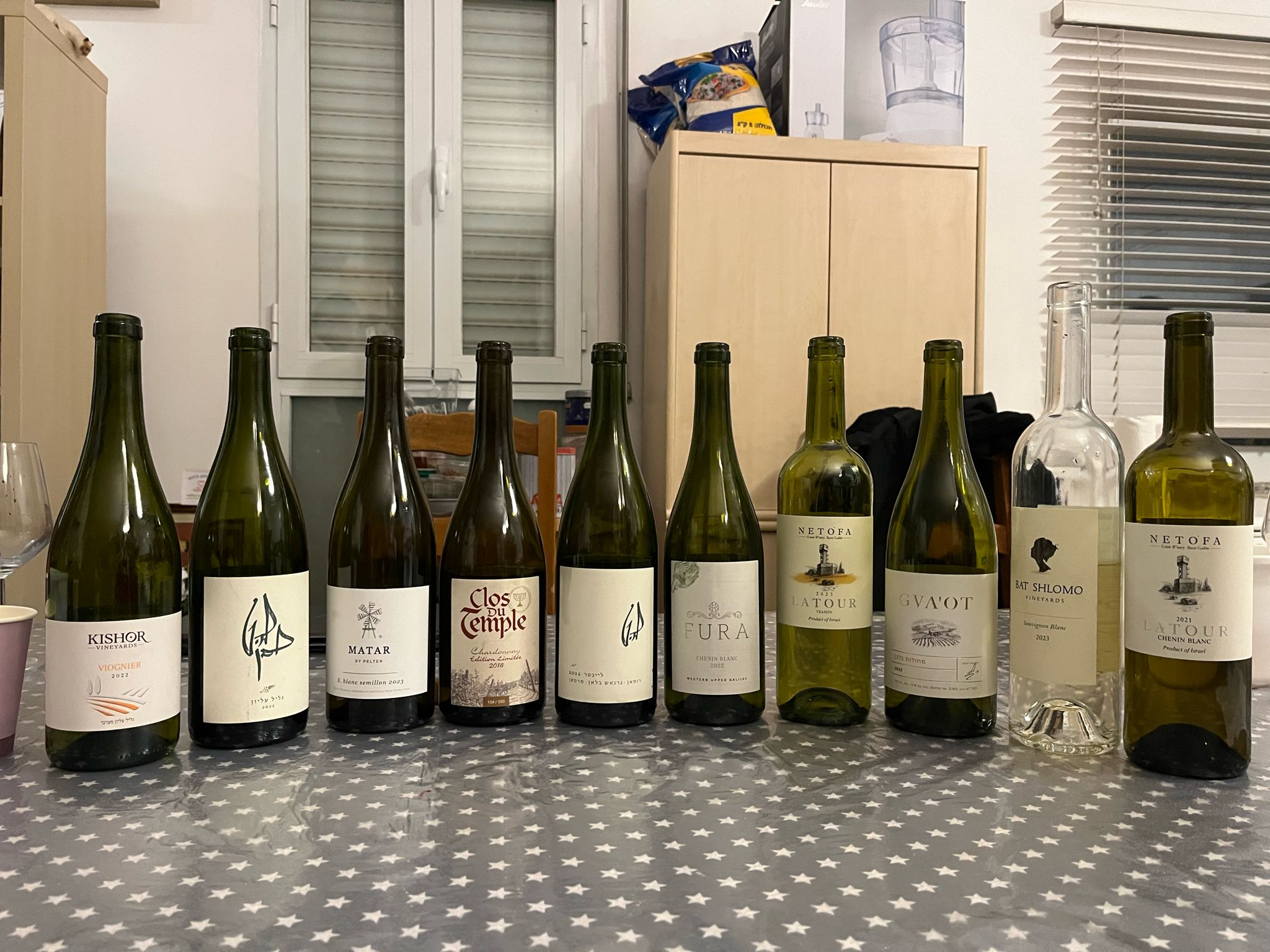
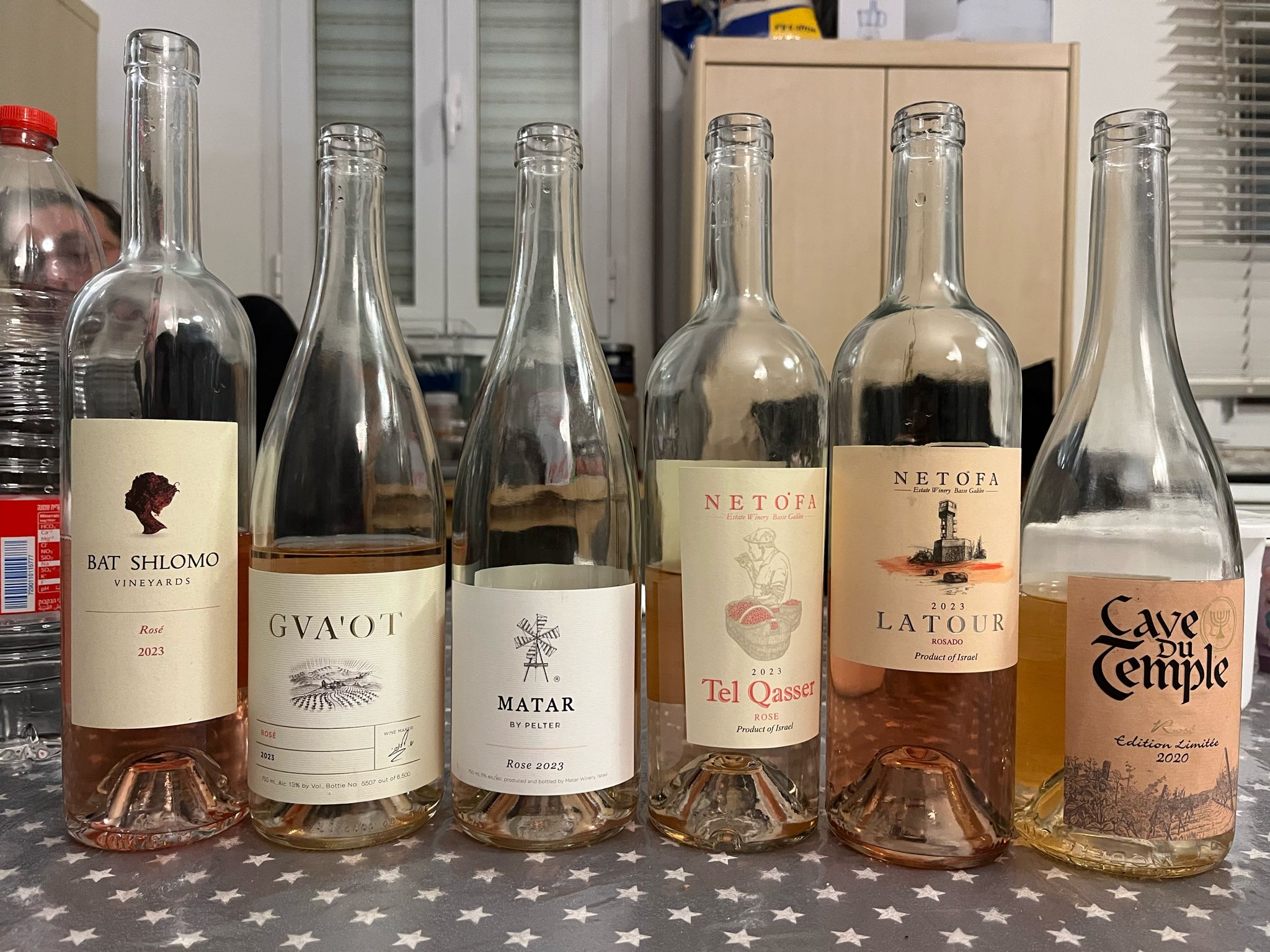
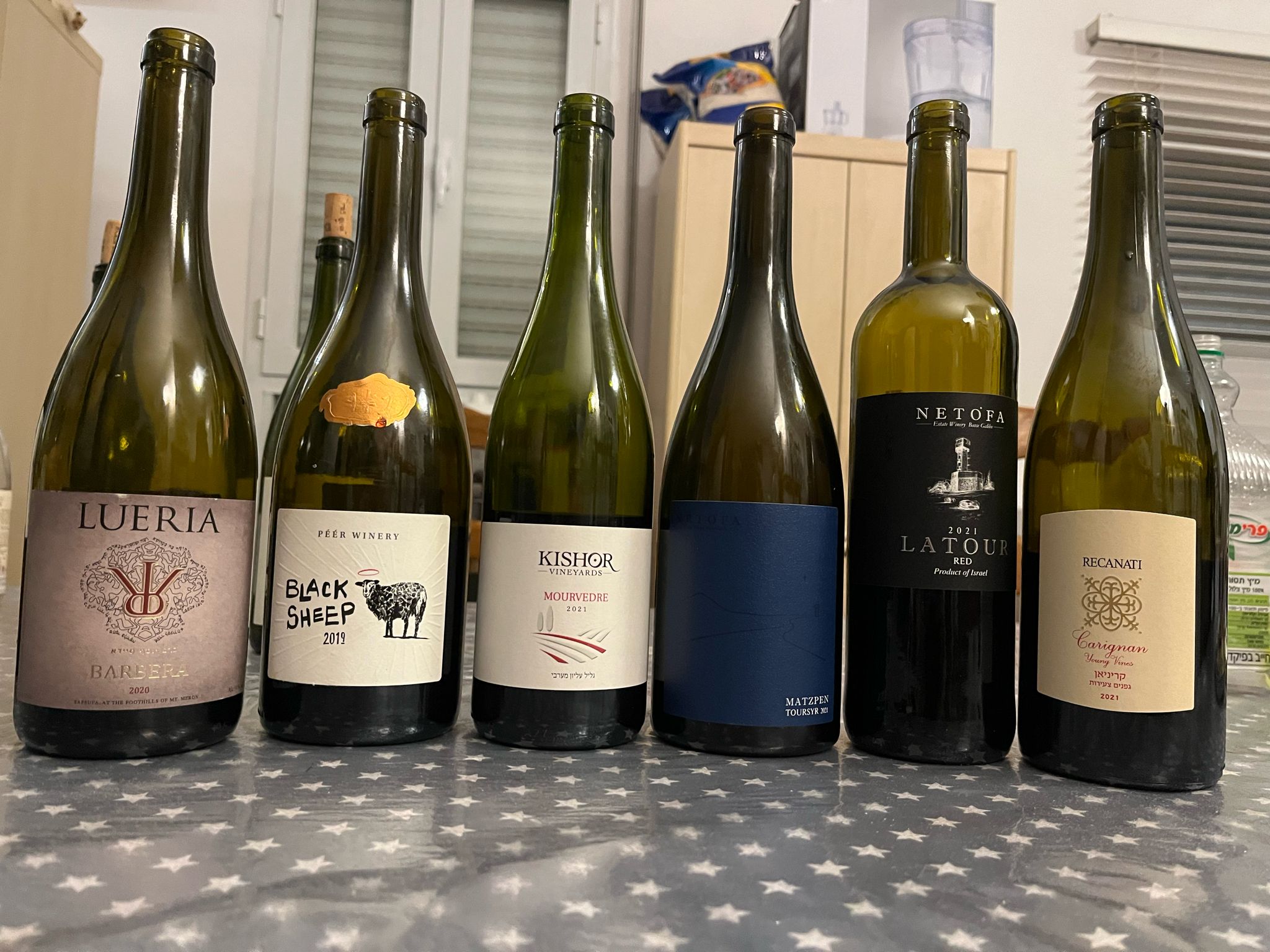
The first evening – none tasted blind
2021 Vitkin Riesling, Judean Hills – Score: 88 (QPR: EVEN)
The nose of this nice is nice with gooseberry, honeysuckle, flowers, and rich saline, flint, peach, and slate. The mouth of this light to medium-bodied wine is boring, lacking acidity, with some fruit, and essentially nothing to grab you. Next. (tasted January 2024) (in Jerusalem, Israel) (ABV = 11.5%)

Klal Yisroel is suffering – is wine really that important??
This post comes to me with great trepidation. Not on my behalf but rather I question if I have what to say of the horrors that have befallen a nation that lies so far from many of us. I was called out, by friends, for not posting here after the devastating attacks that were wrought upon the Jewish people in Israel. My reply, then, and maybe still now, is how does wine weigh in on this issue?
So many of my posts here on this blog are counter to the approach new-world wineries have taken to meet the growing needs of the kosher wine-drinking public. The decision was a financial one that was focused far more on what a winery could sell than what it wanted to sell. My words are out there and I do not hide from them. They are my opinions and I stand by them. Still, many take my sharp criticism towards the direction Israeli wineries took to move in an even more new-world direction starting in 2009 as a reflection of my feelings towards the country! That could not be farther from the truth. Israel is the land of our forefathers, it is the land where I first learned to fall in love with wine and it is the land where I traveled to more often than any other location until 2018 or so. In the end, my dearest friends, family, and Rabbis are all in a land that is under attack and I feel deep pain for what my brothers and sisters (literally and metaphorically) have had to endure. The physical and psychological trauma is beyond words. I had the honor to finish the Torah this year at my shul and in respect to that I did a Siyum on Masechet Horayot, a Gemara I finished in the week, along with my Daf and the start of Shtayim Mikrah with Ramban.
My point is that I broke down a few times doing the Siyum, imploring those to do more. More can be like my friends who have flown to Israel to carry food, clothes, and supplies to many on the front or worse. More can be protecting those who cannot protect themselves with funds and so much more. Every one of us cannot be silent we must do more we must stand and state that the atrocities that were wrought upon our nation are not OK. The people are suffering, it is not good enough to ask how people are, it is not enough to wonder if your friends and family are well, it is time for more! Talk to your community leaders and your friends, there are hundreds of opportunities to help those less fortunate than you. Now is not the time to stand on the side it is time to enter into the fray and do more. More is what is being asked of us until those opportunities, calluses, and pain are removed.
So, with all that what does a wine writer have to say to the madness that we watch from afar? Stated simply wine is a business, the very same business that made conscious decisions to meet the needs of the many. That need did not just stop when war was thrust upon a nation. One may think talking about wine is crass and beneath us at a time like this. To that, the simple fact is wineries are real, they need your help, and they need the help of every Jew. We all need to do more. If you enjoy wine, buy Israeli wine. I have a few options here down below. If you dislike wine buy chocolate, buy food, buy Israeli. This is not a question of IF or OR this is an AND. You need to buy AND you need to do more. You need to support Israel as we all must do, and we must buy Israel, and we must pray, and we must learn, and we must do more. This is not the time to shirk your responsibility with IF or OR it is more and it is AND!
I was asked for a list of wines I would buy and do buy and here they are, I have also sprinkled in a few wines that may accommodate other people’s palate. In the end, it is upon all of us to do more, stand by our brothers and sisters, and remember that the lack of action, whether within or external, is tantamount to supporting those who have terrorized our nation. Stand strong, stand well with Israel, and you will be supported as well.
What follows is a smattering of current wines I buy/bought and wines I have tasted recently that you may all enjoy and buy. Some are older than I thought but they are the vintages I bought or enjoyed.
2020 Vitkin Grenache Blanc, Samson – Score: 92.5 (QPR: GREAT)
This wine is a blend of 90% Grenache Blanc and 10% Macabeo. The nose of this wine is lovely, ripe, tart, and elegant, with intense floral notes, violet, yellow flower, orange blossom, orange, minerality, and peach, just lovely! The mouth of this medium-bodied wine is lovely, ripe, balanced, tart, and elegant, with hints of oak, and a lovely almost oily mouthfeel, backed by intense acidity, showing lovely peach, apricot, melon, green tea, and smoke. The finish is long, tart, ripe, and balanced, with great smoke, hay, straw, fruity, and bracingly acidic. Bravo!! Drink until 2025. (tasted August 2023) (in San Jose, CA) (ABV = 13%)
NV Matar Blanc de Noir Brut, Galilee – Score: 92 (QPR: WINNER)
I wanted to ding this wine for the bottle shape, NO this is not cool! It is IMPOSSIBLE to store, and painful to ship, it may look nice, but it is a disaster, and I am sorry, it is a horrible idea. Now, let us get to rating the liquid in this horrible bottle! This wine is slow to open with lovely notes of green apple, Asian pear, peach, pomelo, lovely minerality, yeasty notes, and sweet Meyer lemon. The mouth of this medium-plus-bodied wine is a pure pleasure, it is acidic to the core, it is yeasty, it is nutty, it is clean, with lovely small mousse bubbles refreshing your palate like light butterflies dancing on your tongue, along with slate, slight tannin, beautiful minerality, green apple, Asian pear, peach, tart orange, and sweet quince. Lovely! The finish is forever, with enough weight, just tantalizing, with mineral, slate, saline, and lovely mousse and tannin and acidity that lingers forever with the pomelo and tart orange! Bravo! This harkens back to the early days of Matar, really a joy! Drink until 2027. (tasted September 2023) (in San Jose, CA) (ABV = 12%)
2021 Netofa Matzpen, Galilee – Score: 92 (QPR: WINNER)
This wine is a blend of 33% Grenache, 34% Syrah, & 33% Mourvedre. The nose is ripe, a bit too much for me, candied cherry, candied plum, rosehip, white flowers, smoke, green notes, roasted herbs, and sweet smoking tobacco. The mouth of this medium-plus-bodied wine is nice, with great acidity, and balance, still candied, but that will calm, with cranberry, pomegranate, dark cherry, life-saver candies, raspberry, layers of sweet oak, and nice tannin. The finish is long, tannic, layered, and refreshing, tart enough to make it all work, let’s watch this evolve a bit over the next few days. Drink from 2026 until 2030. (tasted October 2023) (in San Jose, CA) (ABV = 14%)
2019 Netofa Latour, Red, Galilee – Score: 91+ (QPR: WINNER)
Oh WOW! This reminds me of the good old days of the early years of Latour, very nice! This wine is a blend of 70% Syrah and 30% Mourvedre. The nose of this wine is floral, ripe, fruity, bright, smoky, earthy, and dirty, with roasted meat, this is what a Rhone should smell like, wow! The mouth of this full-bodied wine is a crazy WINNER, ripe, balanced, tart, fruity, and dirty, with lovely strawberry, tart, and juicy raspberry, boysenberry, smoke, earth, loam, hints of watermelon, root beer, and lovely garrigue. The finish is long, fruity, tart, smoky, and just fun, with great fruit focus, a dynamite mouthfeel, a very accessible wine out of the bottle, but will last some time as well, lovely!!! Sadly, by the night after opening the wine dulled out, and while it is not bad, and still a WINNER, it is not at the same level as I had upon opening. Right now, I do not truly understand how the wine goes from being a juicy and vibrant wine to being a dull one but such is life. Drink by 2026. (tasted June 2022) (in San Jose, CA) (ABV = 13.5%)

Jacques Capsouto Vignobles Cotes de Galilee Village – latest 2018/2019 vintages
After two years, Jacques Capsouto Vignobles Cotes de Galilee Village is back, and just in time, as the 2016 vintage was getting over the hill.
I have written extensively on the incredible story of Jacques Capsouto, both here and here. I have been waiting for the new vintage to hit the store and as usual, it is difficult to find, but they are in many stores in the great NY/NJ area. I got mine directly from the distributor – Solstars.
As much as we have seen Israel continue to move away from the Cabernet and Merlot, few have such a plethora of grapes from the Rhone Valley, like Jacques Capsouto. The sheer plethora of varietals and their impact on the wine shows where Israel can find their future. Whenever I get the chance to smell and enjoy a wine with Clairette or Cinsault, it always brings a smile to my face. The wines did show nicely but I would not hold them for too long, they are nice now with a bit of decanting or bottle open time and enjoy!
My many thanks to Selvi Uludere and everyone else from SolStars, along with Pamela Wittmann, as well. The wine note follows below – the explanation of my “scores” can be found here:


2018 Jacques Capsouto Cuvee Albert, Grand Vin Blanc – Score: 91 (QPR: WINNER)
The Grand Vin Blanc has returned with the lovely 2018 vintage. The 2016 vintage was lovely and so is 2018. The blend is 44% Roussanne, 28% Marsanne, and 28% Clairette. The nose on this wine starts a bit closed, still, the aromas are dry, mineral, straw, with green apple, pear, lovely straw funk, white flowers, green notes, and white tea. The mouth on this medium-bodied wine is quite nice, old-world in style, with lovely funk, good balance, nice minerality, with Asian pear, with hints of French oak, followed by green apple, tart notes, and smoke. The finish is long, funky, balanced, with flint, richness, nice weight, and mouthfeel. Drink now. (tasted April 2021)
2019 Jacques Capsouto Cuvee Samuel, Rouge – Score: 91 (QPR: WINNER)
This wine is a blend of 55% Cinsault, 25% Mourvedre, 10% Grenache, 5% Counoise, and 5% Syrah. The nose on this wine starts Syrah-like, but with time it comes around to show better as a whole than as its parts. Very much like a Rhone-style Pinot Noir. The nose starts ripe but calms down to show lovely notes of rosehip, rhubarb, watermelon, dried rose petals, with soy sauce, berries, and minerals. The mouth on this medium-plus bodied wine is well controlled with lovely acidity, nice dirt, floral notes, sweet oak, rhubarb, dark cherry, plum, currants, and nice sweet spices, all wrapped in elegant tannin, mineral, and saline. The finish is long, ripe, but well balanced, with sweet cloves, cinnamon, sweet candied cherry, Asian spice, and sweet red fruit wrapping a dark chocolate bar, with great acidity that helps to balance the fruit. Bravo! Please drink this now, yes, it can make it until 2023, but why? It is good now, will not improve, drink now. (tasted April 2021)
2018 Jacques Capsouto Cuvee Marco, Grand Vin Rouge – Score: 90 (QPR: EVEN)
This wine is a blend of 40% Grenache, 40% Mourvedre, and 20% Syrah. The nose on this wine starts ripe, it is riper than its younger 2019 brother, the Cuvee Samuel. The blend is different as well, and there is much more oak on the Marco. The nose on this wine is ripe, it feels like a Cali Rhone wine more than how the 19 Samuel felt, with black and blue fruit, sweet oak, soy sauce, ripe plum, floral notes, dark and brooding, with roasted animal, and loam. The mouth on this full-bodied wine is ripe, balanced, with good acidity, blackcurrant, blackberry, boysenberry, nice draping tannin, sweet oak, loam, and black tea. The finish on this wine is ripe, with dense black fruit, loam, mushroom, graphite, milk chocolate, and nice smoke. Please drink this now, yes, it can make it until 2023, but why? It is good now, will not improve, drink now. (tasted April 2021)

2020 kosher wine year and decade in review – glass half empty
As I am want to do, it is another year on the Gregorian calendar and I have already posted the wines of the year and the QPR (Quality to Price Ratio) wines of the year. Now it is time for the year and decade in review. I had to wait until now, to talk about the decade in review, because there is a clear disagreement on when the new decade begins, so I went with the non-computer science approach (0-based systems), which is not what most people believe. To this point I quote Library of Congress’s estimable Ruth S. Freitag:
Dilemmas over marking time have been going on for years. In the late 1990s, the Library of Congress’s estimable Ruth S. Freitag famously compiled a 57-page research document titled The Battle of the Centuries, in which she called out people who celebrate any era before its time.
“When the encyclopedia of human folly comes to be written, a page must be reserved for the minor imbecility of the battle of the centuries — the clamorous dispute as to when a century ends,” Freitag wrote. Noting that there was no “year 0” in history, she said, “In fact, there has never been a system of recording reigns, dynasties, or eras that did not designate its first year as the year 1.”
To bolster her argument, Freitag, who was then a senior science specialist in the library’s Science and Technology Division, cited historical records that showed similar disputes had erupted when calendars were turned to 1900.
But even Freitag acknowledged that she was swimming against the tide of popular opinion.
It may seem obvious to many, but there was never a year 0, so let’s go with the obvious fact that the decade has finally passed us and we can discuss it in regards to all things kosher wine. IMHO, I will go with the glass half empty metaphor, as no matter how hard I try, there is no real way to look at this past decade in a glass-half-full approach – give the utter disregard from much of the world for anything approaching wine I would buy.
Where are we now??
Well, that is pretty simple, IMHO, we are WORSE than we were last year, and that was worse than we were in the years before. Essentially, we are continuing the slide down, maybe even at a faster rate, with a slight caveat to the positive on high-end white wines. That would be my summation – hence the glass-half-empty reference.
COVID and what it has done to the kosher wine industry
I could not talk about 2020 in a review, or the decade in a review, without at least mentioning Covid! The clear impact of the Virus on our lives is not wine, or food, or any other material impact. What truly has changed are the people we have lost, friends or family that have been sick or passed, and jobs and families crushed by this pandemic. Those things are REAL and those real things are truly very sad and are hard to move on from.
Yes, we have lost freedom of movement, we have been locked away from our friends and family, but it all pales in comparison to the true loss of life, income, and time. Many, if not all of them, have been lost forever, and that is the true loss and suffering.
Still, there is a need/desire to talk about how COVID changed the wine industry – over the past 12 months. As such, I wrote a post – some 7 months back, and I am shocked and saddened by how much it has not changed at all over these past many months. There were some missing points so let us hit them:
- There will be no in-person KFWE or any other tasting this year, sadly. To that point, Royal Wine has made a KFWV this year and I hope you can listen in at least and maybe join in with the tasting as well!
- As I stated in the post the online stores have come through. But even more so than that were the local stores that supported the communities and I can only repeat, support your local wine merchants if you have them! Sadly, our merchants, here in NorCal, while they exist, do not quite have what I am looking for, but they are trying – so kudos to them for that! However, those of you on the east coast – BUY LOCAL! Come on, folks! Your local store is there, you have the same taxes, buy local, and make sure they feel the love!
- Restaurants may finally be coming back, but wine sales are still very low to zero, and again, why do we need Mevushal?? I pray the biggest outcome of all of this madness is the production of dual labels M and not). I know it is a pipe dream, like a real Shmitta game plan – dream on. IMHO, Mevushal will take a hard hit soon, people will see it for what it is, a sham on the kosher wine market. If a wine needs to be Mevushal then go buy a beer and move on!
- The lack of travel and access to wineries is a real issue here. I would have already have been in France twice since my last year in review and Israel, at least once. The lack of access to wines impacts my ability to properly score and grade, but thankfully the UPS/FedEx of the worlds have been doing a yeoman’s job and they do truly deserve a cheer every time they drive by! Please show them the love (from a distance) that they deserve!
- Finally, to repeat – the lack of KFWE or any other tasting this year, or even marketing of wines in-person, will further complicate the lack of wine education in this industry and I fear it will sadly slow or hurt the sales of many wineries.
My yearly blog disclaimer about me and wine
I try to get this disclaimer into every year of my posts – but this year – for reasons I do not know, I have been receiving a lot of questions about my posts. So let me be 100% clear here:
- I NEVER HAVE AND NEVER WILL receive a penny for ANYTHING I write on this blog – PERIOD!
- I do not advertise and I do not receive money for advertisements. I PAY WordPress.com to NOT advertise on my blog. Again, there will never be ads or money on this blog.
- The next most prevalent question is: do I get a kickback for anything I recommend?? LOL! People do not know me well to be asking that question! NEVER! I write what I think – almost literally at times, so NO!
- Next question – do I receive an item of value for my posts? NEVER.
- The only thing I receive, having nothing to do with my posts is access to tastings or wine to taste. Also, I have received passes to KFWE, or this year, the KFWV. The coupon codes are not affiliated links or deals for me! Again, I get no money from this blog – I hope this starts to come across soon!
- Am I receiving money or any other item of value from Royal or an affiliate for the use of the ‘MUSINGS’ discount code? Again NO! NEVER!
- Do I spend money on my notes or wines? I promise you there are VERY few people in the kosher wine world who spend more money than I do on wines that I DESPISE! Very few! There are loads of people who spend more money than I do on wine – I am not a Macher! But I buy the majority of the wines I taste and post on. In the past year that has changed a bit, but no, I buy most of the wines and it sickens me to spend so much money on wines I would never drink or even cook with! Sadly, that is what I like to do. So, sure if the importer will help me and send me samples, great! I will still post my notes and scores based 100% on the way I see and taste the wine. NOTHING else goes into my scoring.
- Finally, I have people in the industry that I call friends. When I taste those wines I always disclaim those as well.
So, that wraps up my yearly post on how I, my blog, or my life is ever gaining anything from the world of wine! I hope that is clear. I do not do any business in wine, I do not sell any wine, I do not transfer wines, I am not a middleman for people who buy wines. I do not in any manner, way, or form, work in the world of wine – period!
Finally, I do help Elvi Wines, at times, to pour wine, at a KFWE or the such, and act as their US contact for the USDA. I have again, never received compensation for those pouring’s. My travel costs are sometimes reimbursed, but that is the totality of my relationship, financially speaking, with Elvi Wines or any other winery or wine business. I am a software architect by trade and that is where I make my money. Be well!

Sadly, simple kosher red wines are uninteresting and have poor QPR scores, for the most part
So, ask me what is the weakest wine category in the kosher wine market? The answer is simple, the simple red wine. Simple red wine is defined here in my QPR (Quality to Price Ratio) post as a red wine that would not last four years. In other words, a wine made to enjoy upon release and hold for a year or two max.
The sad fact is that there are hundreds of wines in this category and they are all poor quality wines. Remember, QPR scores are not controlled by me at all, but rather by the market forces and prices the market forces on the wines. So, a wine that I score a 91 (which is 100% subjective and up to me), like the 2019 Chateau Riganes or the 2018 Herzog Cabernet Sauvignon, Lineage cannot be given a QPR score by what I feel in my gut, or I think.
The QPR (Quality to Price Ratio) score of BAD/POOR/EVEN/GOOD/GREAT (WINNER) is defined by the wine’s category, in combination with the price of the wine compared against the price of its peers in that category. So, once you realize the Chateau Riganes is a simple red wine and that its price is 14 dollars, on average, and then you compare it against the other wines in this category, you quickly realize it has a GREAT QPR score and is a QPR WINNER. The median price for wines in the simple red wine category goes from 13 dollars to as high as 60 dollars and the wine scores go from 58 up to 91. Essentially an abysmal wine category with 100+ wines I have tasted recently and all but 22 of them score below a 90, with just six WINNERS (though some of those are just in France/Europe). So, the Riganes, with a score of 91 for 14 dollars, again on average, shows this wine is below the median price of its peers (20 dollars) and above the median score of its peers (87). So, for 14 dollars, you can get a simple red wine that is better than the vast majority of other red wines in the same category and for cheaper – the very definition of a GREAT/WINNER QPR wine.
If there was ONE take away from the work I have been doing into QPR, that I guess I did not see coming until I did all the work and wrote it all down into a spreadsheet, would be that wines that have a long drinking window also get higher scores and cost more, on average. All that sounds logical but it was not until I wrote it all up that it was glaringly obvious! The high-end kosher wine category’s median wine score is 92! Again, that makes sense as I would not give a wine like the 2017 Raziel a long drinking window. Mind you that wine may well be “alive” in ten years but it would not be a wine I would think about drinking at that time. The ripeness on it would be so overwhelming that it would turn me off more at that time than it does now. That can also be said for the 2016 Chateau Leydet-Valentin, Saint-Emilion, Grand Cru. It will be around for more than almost ANY simple red wine will live, but it will not be enjoyable, to me. So, the drinking window is very short, which places it into a simple red wine category.
It is an interesting byproduct of choosing the vector to compare wines against each other, outside of price, of course. I will keep an eye on it, but for now, the wine category vector that I think gets me the “best” sample size, per wine category option, is the drinking window. This means we will have strange outliers on both sides for sure.
Trying other categories, like wine region or varietal or style will not work – they are not apple to apple. By using the wine’s drinking window we get far more evenly distributed sample sizes and variation in the actual wines.
Finally, many wines are NOT on this list, BECAUSE, this list is of wines that drink NOW to soon. For instance, the 2018 Terra di Seta Chianti Classico, is a GREAT wine and is a QPR WINNER, but it is not on this list. It is not on the next list I will publish either (mid-level red wines). It is on the long aging red wines. It is sub 20 dollars and is a wine everyone should stock up on. Same for the 2015 Terra di Seta Chianti Classico, Riserva, and the 2015 Assai. That is why the price is not the arbiter for what defines a good QPR wine, nor is it based upon a winery, country, region, varietal, and style.
Sadly, the takeaway here is that this wine category is not very interesting. Still, there are a couple of options and six WINNERS, overall, spread across countries, so I guess we should be thankful for that, at least. The wine notes follow below – the explanation of my “scores” can be found here:
2019 Chateau Les Riganes (M) – Score: 91 (QPR: WINNER)
YES!!! The curse is broken! The odd year 2019 vintage is good! Finally! The nose on this wine is fun dirt, earth, bramble, green notes, followed by fun red and black fruit, all coming together into an intoxicating aroma. This is not a top-flight wine, but it is, once again, a very good QPR wine and a sure WINNER.
The mouth on this medium-bodied wine is not layered, but it has enough complexity and elegance to make this work, with a good attack of dark red fruit, with dark currant, dark cherry, hints of blackberry, followed by loads of dirt, mineral, graphite, and a very nice mouth-draping tannin structure, with fun dirt, loam, and loads of foliage. The finish is long, green, and red, with lovely graphite, draping tannin, green olives, and green notes lingering long with tobacco, oregano, and Tarragon. Bravo! Drink until 2024.
Israel’s lost decade for red wine
Well, it has been too long since I have posted and so I thought I would return with a thought that has been really eating away at me for far too long. Which is, it has been more than 10 years since I have tasted a wine from Israel that I would think would actually improve with age. The last ones that I thought could do it were the Flam 2010 and 2011 Noble, the first kosher vintages for the Flam Noble. Sure, you have Domaine Netofa as well, but that is where it ends.
I recently really enjoyed a 2007 Tzora Misty Hills, sadly I cannot say for any of the recent Misty Hills. Sure they are nice wines, but after a few years, they go really ripe and sweet. The 2013 Domaine du Castel Grand Vin is already tasting very sweet and is a drink-up now for my bottles. The 2016 Domaine du Castel was always super ripe to start and I do not have much hope it will last long either. The 2007 Domaine du Castel, that I had a couple of years ago was STUNNING. I will be honest, until maybe a year ago I thought the 2013 Domaine du Castel Grand Vin would live long, but after tasting it recently, that does not seem to be the case. It may well be the case that 2016 will live up to the original drinking window, but with how 2013 turned, and with where 2016 started, I am seriously worried.
This brings me to my point, in the last ten years Israel has produced hundreds of millions of bottles of red wine and I can honestly say I have bought maybe 20 of them, and of those, they are in drink-now mode. Domaine Netofa stands as the only real red wine that can age, but that is sad for a country with so much potential.
The crazy thing is that Israel has the ability to make great wines, it proved it during the aughts and yet they all decided that it is better to go for the least common denominator than for the world-class moniker. I get it, wine is a business and wineries need to hew to where the money is, and right now, that is riper wines. Wines that may well not hold out for a decade, and if they do, they will be riper and as long as the market holds up, all is good.
Israel produces white and sparkling wines that are world-class. Look at Yaakov Oryah’s work, his 2009 Semillon is getting tired but epic, his 2008/2015 Musketeer is INSANE. The 2005 Yarden Blanc de Blanc is crazy good, and the 2007 vintage is even better!
So, while Israel continues its need to push riper wines we have been blessed with many vintages of world-class wines from all around the world, which includes many Israeli white wines from Domaine Netofa and Yaakov Oryah Wines.
Of course, with time everything changes. Ten years ago, we had almost nothing from Europe, and we relied heavily on Israel, Herzog, and Capcanes/Elvi Wines. Now, that has flipped, and if the current batch of wines from Capcanes is a harbinger of what is to come, they too have sold out to the Parker-side of wines.
Sure, temperatures are rising all around the world, but Europe keeps pumping out great wines with higher temps, so nature is not the issue here, in regards to Israel’s desires, it is a market-driven decision and my response is to buy almost nothing of it.
I wish Israel only the best, it is OUR country, it is the land of the Jews, the land of flowing milk and honey, and it is where I feel at home most. I love the land with all my heart, I am just not a fan of the red wines. May we blessed with a year of success, health, family, great friends, and great kosher wines, no matter their origin.

The 2019 Kosher rose season is open but I am underwhelmed at best
It is not yet summer and here in NorCal, it feels more like winter with these strange May storms with thunder and hail. Sorry, but in NorCal, we do not get thunder, it is very strange indeed! Anyway, enough with my meteorologist fanboy moment, the weather was not conducive for my last tasting here in San Jose with a group of folks, but Rose was on the docket so rose it was.
Rose wine in the non-kosher market is exploding – especially Rose wine from Provence; a wine region of France. Sadly, in the kosher wine market – that is not quite the case. I did not stress my previous statement with a suffix of AT ALL, even though I am not allowed to open a bottle of rose on my Shabbos table with guests – why? Well, that is simple – no one will drink it!!
Even worse, is that wine manufacturers may well have jumped the shark! There will be some 60+ kosher roses available in the USA this year! That may not sound like a lot, but when all you had was Herzog White Zinfandel 10 years ago – it is insane. The first high-end rose was Castel’s 2009 rose and that was only 10 years ago. Back then, there were few to no real Rose wine options, other than a handful of Israeli wines and almost no French Rose made it here. Now we will have tons of Rose, and I really think the real question here is will people drink it all?
Also, I want to bring up a topic I rarely talk about – price! Yeah, I hear you, Avi Davidowitz, of KosherWineUnfiltered, please quiet down, gloating does not suit you – (smiley face inserted here). The prices of Rose wines have gotten out of control. QPR (Quality to Price Ratio) has become nonexistent, essentially here in the USA, for the kosher rose market. Finally, I am sorry, but I really feel that wineries were either horribly hampered in some way with the 2018 rose vintage, or honestly, they just threw in the towel, The 2018 vintage is the worst one in the last 10 years. We have hit Peak Rose, we really have. Peak X is when X becomes so default within the construct of our lives, and the quality and quantity of X peaks. Clearly, calling peak kosher rose is a subjective call, but look around. The roses of 2018 feel commodity at best, they feel rushed, no real care, rhyme, or reason. They feel like we have peaked. They are nowhere near 2017, and 2017 was nowhere near 2016, and so on. I am sure next year may be another peak rose, and to be honest, many have called for Peak Oil and Peak TV, so maybe I am just projecting what I see around me, but this year’s crop of roses feel half-hearted pure cash cows, and really without love behind them.
As always, I will be chastised for my opinions, my pronouncements, and I am fine with that. This is wakeup post, there may be ONE or two roses I would buy, but respectfully, given the prices, I would rather buy, the 2018 Covenant Sauvignon Blanc, 2017 O’dwyers Sauvignon Blanc, the 2018 Goose Bay Sauvignon Blanc, and so on. Throw in the 2018 Tabor Sauvignon Blanc and the 2018 Or Haganuz Amuka Blanc Blend, and really who cares about a rose?
I was thinking about going with the title: 2018 kosher roses, thanks, but who cares? Because that is how I feel. This vintage is a massive letdown, prices are too high, quality has hit rock bottom, and overall professionalism, IMHO, has gone along with the quality. Wineries have been getting away with less and less quality for years, raising prices, and this is the worst I have seen in the rose market overall. So, yeah, who cares?
Wine Color
What is rose wine? Well, simply said, a rose is a wine that can best be defined as the wine world’s chameleon. Where white wine is a pretty simple concept – take white grapes, squeeze them, and you get clear to green colored juice. Yes, the white grape juice is clear – well so is red grape juice, but more on that in a bit. Read the rest of this entry

Tzora Vineyards Winery latest release – April 2019
My posts on the wines and wineries I visited in Israel for Passover continue with my visit to Tzora Vineyards Winery. I have posted many times about Tzora Vineyards and as always I am impressed by the winery, it continues to push back against the tide of date juice. Even before I got to Israel I was texting with Eran Pick, the head winemaker, and General Manager of Tzora Vineyards Winery. Once again, Avi Davidowitz, of KosherWineUnfiltered, joined me on Monday, and I really have to thank Mr. Pick for allowing us to come while work was being done in the cellar.
Judean Hills Quartet
I have already posted here about my appreciation for the Judean Hills quartet, I think what they are doing is great and is the correct way to go after the gaping sinkhole in what some would call Israeli wine education. They happen to also be some of the best wineries in Israel, which is a blessing. Who would want Yarden pushing their date juice and declaring this is the future of Israel’s wine revolution?? Instead, you have wineries like Domaine du Castel Winery, Flam Winery, and Tzora Vineyards, along with a winery I wish I could enjoy, though sadly it is not kosher – Sphera Winery – run by Doron Rav Hon, who made some of the best Chardonnays and Pinot Noir in Israel when he was in Ella Valley – those were great days!!
Tzora Vineyards Winery
Of course, you all know my great affinity for all things Tzora Vineyards! It is clearly one of the top 3 wineries in Israel and one that continues to focus on well balanced new-world style wines, while Israeli wineries continue to create fruit-forward crazed wines that lack balance and something to call their own.
If there is a winery that gets terroir in Israel it would be Tzora. I wrote about the late founder, Ronnie James, who sadly passed away in 2008. He saw the power of terroir in Israel. He understood what vines to plant where and why! It was his passion and belief that great wines could be made in Israel, that continues to fuel Eran Pick MW (Master Of Wine), the head winemaker and General Manager of Tzora Vineyards and the rest of the winery, forward. I love that the winery is defined by its vineyards both in name, Tzora Vineyards and in reality! I have had the honor to meet with Mr. Pick many times at the winery now, and each time it is always a joy to see how the winery continues to grow leaps and bounds above the rest of Israel’s date juice producing masses. For the few that can understand the quality and beauty of Tzora’s wines, there is a treasure to be reaped for sure! Here is a winery that cares, and does not sell out to the million bottle siren and the date juice wines that it demands.
It had not been long since I was last at Tzora Winery, but there were new wines to taste, 2017 red and the 2018 whites, as well. Once again, the winery put out these incredibly fragile and lovely wine glasses, from Zalto – just to make sure we were on our toes during the tasting and very careful!
The wines continue to be imported by Skurnik Wines, who has been importing Tzora wines for many years now, and they have all of these wines in NYC, even the shmita wines! I continue to buy from NYC, either kosherwine.com or Gary at Taste Co – email him at info@tastewineco.com or call at (212) 461-1708, even though Skurnik has set up a west coast operation. Read the rest of this entry

Vitkin Winery visit – April 2019
I have written before about Vitkin last year, and this year (2018 production), makes it the third year of kosher production for the winery! Yes, as stated last during the 2015 vintage, Asaf believed that it was time to go kosher, so why not make it on a shmita year! They moved from 60K bottles in 2014 to 100K bottles in 2015 and on. The hope there is that expansion would be possible by moving kosher. Royal Wines is the USA importer for their wines from 2016 and on.
The winery has grown from its early days in 2001 to now making 100,000 or so bottles of wine, and though it has space for more, it will stay there for now. Avi Davidowitz, of KosherWineUnfiltered, and I arrived during the start of post-production work on the 2018 vintage for reds and some of the special whites, that we will talk more about later on.
The winery does not use pumps to move the wine must to the top tanks, but rather they use hydraulics to move the bins to the top of the tank and drop them into the tank. This makes sure that the fruit and it’s must is not crushed a second time, allowing for better wine. After the wine is finished fermenting, using gravity the grapes and the must are placed into the press and then the resulting wines are then dropped into the barrels. Tank to press to barrels all using gravity, with an assist from the hydraulics at the start. This is not a new scheme, it can be seen all over France, but it is nice to see it in Israel as well (Galil Mountain winery also does this along with others, but not many family-run boutique wineries show such care and concern).
Vitkin has three main lines of wines; Israeli Journey, Vitkin, and Shorashim (the elite wines), and some dessert wines as well. The kosher line started in 2015 and so initially the whites and rose were the only available options. Of the wines, we tasted this year, the rose is in the Israeli Journey line, along with the white Israeli Journey. The other three whites; Riesling, Gewurztraminer, and Grenache Blanc are all in the Vitkin line, with the Grenache Blanc and The Gewurtztraminer adding the Collector’s Edition moniker.
The current red wines that are kosher all fall into the Vitkin wine label, both the 2018 Vitkin Israeli Journey, Red, along with the 2017/2018 Vitkin Pinot Noir, the 2016 Vitkin Cabernet Franc, the 2016 Vitkin Petite Sirah, old vines, Collector’s Edition, and the 2016 Vitkin Carignan, old vines, Collector’s Edition.
There are two fascinating aspects of the wines produced the Vitkin Winery. One is that more than 55% of the bottles produced are either rose or white! Think about that for a second! Are you kidding me, that is really impressive if you ask me personally. Israel has changed so much in the last 10 years, in two core aspects. The Israeli public now drinks more wine, and they like white/roses and the second is that red wines are turned riper – a drum I constantly beat – and one that is not changing yet. Read the rest of this entry

My recent visit with Yaacov Oryah and the white and orange wine factory
Anyone who has enjoyed an old white wine from Yaacov Oryah’s mind and hands can understand my choice of title. As long as you were not born in this century, of course (OMG, do not bring up the abomination that was the remake).
Yaacov Oryah has had many wineries that he has worked for, made wines for others, and/or consulted with. The official list that I know of is Asif Winery, Midbar Winery, Yaakov Oryah, Ella Valley, and now Psagot, where he is the head winemaker.
For the longest time, as long as I have known the man when we first met at Midar Winery in 2013, I have been struck by his passion, drive, and single-mindedness in creating great white wines in Israel.
Yes, Mr. Oryah can make fine red wines, like the 2011 Yaacov Oryah Iberian Dream, Gran Reserva, and Reserva, the Claro wines he makes for a restaurant called Claro, and others. Still, what I really crave and admire are the white and orange wines.
I have already spoken at length about Mr. Oryah here so I will concentrate on the 2019 releases. Also, if you think that the names of Yaacov Oryah wines are a bit whimsical, then good for you! You are starting to get a glimpse into the operation that is Yaacov Oryah Winery, a blend of whimsical genius, alchemy, great winemaking, and downright unique color all wrapped into a unique lineup of wines that define Mr. Oryah himself.
Orange wine factory
Mr. Oryah keeps saying that the white wines on the market today are a stripped down version of what a white wine should be. Sure, Europe has superstar white wines that can last decades, but that requires unique soil, fruit, terroir, and of course, history. In Israel, where the only thing that really sells well is date juice, that kind of wine is a dream. Still, Mr. Oryah thinks that he can create wines that are still quite unique indeed.
I have had the 2009 Midbar Semillon, and though the tasting in 2016 did not show well, that wine continues to blow me away in tasting after tasting. A Semillon that is 10 years old, and may now finally be reaching its limits. It is not a white wine covered in oak makeup, it is a wine that is pure and truly professional. It is what Mr. Oryah thinks can be done in Israel with white varietals. Yet, each and every year he makes more and more crazy wines. Each one is a data point for a growing list of wines that he sees as potential suitors for the wines he dreams of building.
Until he creates the perfect wine, the wines and data points he is building along the way, are getting better and better. The map and path he is building are not pointing towards another mass produced winery. The data points point towards a more precise and surgically built winery. Where plots or even rows of vines may well define the data point for his dream wine.
Factory of the future
When I heard that Mr. Oryah was creating 10 Orange wines (only 9 are publically available, the other is for a restaurant), four white wines (the varietal Semillon is for a later date), and one rose wine, I thought – I need to taste these!
So, Avi Davidowitz of Kosher Wine Unfiltered, and I made our way to the only real place to taste wine in Jerusalem, the Red and White Wine Bar. Yes, I have spoken about Mark and the bar before. It is still kitty-corner from the beautiful Mamilla hotel (8 Shlomo HaMelech Street at the corner of Yanai Street). Mark is still the ever present and mindful host, and while we tasted through 20+ wines, Mark was there with us through every wine, with food, heady music, with an uncanny ability to feel the room and timing throughout it all. I really feel horrible that I never had the time to go back to the bar and hang with Mark for an evening and watch him ply his trade, teaching the world about the world of Kosher Wine while serving great food and playing really fun music. Hopefully, next time!
I have spoken about orange wines in the past. Orange wine is simply the process of leaving white grapes to ferment on their skins, like red wine. To Mr. Oryah it is the truest expression of a white varietal and one that Israel can use now to create great white wines, while it searches for more data points on the path for Israel’s white varietals of the future. He calls the wine line Alpha Omega (AO) because it is greek for A to Z, to represent that this wine has it all, skin, pulp, and seed, not juice white juice, like most white wines are made.
The skins add more than just a bit of color, they add a huge amount of natural phenolics, along with tannin (yes tannin in white wine), and then it adds a few extracurricular notes, that some could find challenging. Notes that are defined as nuts and other aspects of reduction or oxidation. The point though is that the Alpha Omega line is a showcase of control and experimentation. Many of the wines show the proper and incredible next step beyond white wines we all know. The rich and layered complexity that skins add without some of the extracurricular notes. Some of the wines show those notes and many will find them wonderful, like myself, but in all, it is a show of control, experimentation, and more dots on the plot to a richer future. Read the rest of this entry

 Wine Musings Blog