Blog Archives

The 2019 Kosher rose season is open but I am underwhelmed at best
It is not yet summer and here in NorCal, it feels more like winter with these strange May storms with thunder and hail. Sorry, but in NorCal, we do not get thunder, it is very strange indeed! Anyway, enough with my meteorologist fanboy moment, the weather was not conducive for my last tasting here in San Jose with a group of folks, but Rose was on the docket so rose it was.
Rose wine in the non-kosher market is exploding – especially Rose wine from Provence; a wine region of France. Sadly, in the kosher wine market – that is not quite the case. I did not stress my previous statement with a suffix of AT ALL, even though I am not allowed to open a bottle of rose on my Shabbos table with guests – why? Well, that is simple – no one will drink it!!
Even worse, is that wine manufacturers may well have jumped the shark! There will be some 60+ kosher roses available in the USA this year! That may not sound like a lot, but when all you had was Herzog White Zinfandel 10 years ago – it is insane. The first high-end rose was Castel’s 2009 rose and that was only 10 years ago. Back then, there were few to no real Rose wine options, other than a handful of Israeli wines and almost no French Rose made it here. Now we will have tons of Rose, and I really think the real question here is will people drink it all?
Also, I want to bring up a topic I rarely talk about – price! Yeah, I hear you, Avi Davidowitz, of KosherWineUnfiltered, please quiet down, gloating does not suit you – (smiley face inserted here). The prices of Rose wines have gotten out of control. QPR (Quality to Price Ratio) has become nonexistent, essentially here in the USA, for the kosher rose market. Finally, I am sorry, but I really feel that wineries were either horribly hampered in some way with the 2018 rose vintage, or honestly, they just threw in the towel, The 2018 vintage is the worst one in the last 10 years. We have hit Peak Rose, we really have. Peak X is when X becomes so default within the construct of our lives, and the quality and quantity of X peaks. Clearly, calling peak kosher rose is a subjective call, but look around. The roses of 2018 feel commodity at best, they feel rushed, no real care, rhyme, or reason. They feel like we have peaked. They are nowhere near 2017, and 2017 was nowhere near 2016, and so on. I am sure next year may be another peak rose, and to be honest, many have called for Peak Oil and Peak TV, so maybe I am just projecting what I see around me, but this year’s crop of roses feel half-hearted pure cash cows, and really without love behind them.
As always, I will be chastised for my opinions, my pronouncements, and I am fine with that. This is wakeup post, there may be ONE or two roses I would buy, but respectfully, given the prices, I would rather buy, the 2018 Covenant Sauvignon Blanc, 2017 O’dwyers Sauvignon Blanc, the 2018 Goose Bay Sauvignon Blanc, and so on. Throw in the 2018 Tabor Sauvignon Blanc and the 2018 Or Haganuz Amuka Blanc Blend, and really who cares about a rose?
I was thinking about going with the title: 2018 kosher roses, thanks, but who cares? Because that is how I feel. This vintage is a massive letdown, prices are too high, quality has hit rock bottom, and overall professionalism, IMHO, has gone along with the quality. Wineries have been getting away with less and less quality for years, raising prices, and this is the worst I have seen in the rose market overall. So, yeah, who cares?
Wine Color
What is rose wine? Well, simply said, a rose is a wine that can best be defined as the wine world’s chameleon. Where white wine is a pretty simple concept – take white grapes, squeeze them, and you get clear to green colored juice. Yes, the white grape juice is clear – well so is red grape juice, but more on that in a bit. Read the rest of this entry

My recent visit with Yaacov Oryah and the white and orange wine factory
Anyone who has enjoyed an old white wine from Yaacov Oryah’s mind and hands can understand my choice of title. As long as you were not born in this century, of course (OMG, do not bring up the abomination that was the remake).
Yaacov Oryah has had many wineries that he has worked for, made wines for others, and/or consulted with. The official list that I know of is Asif Winery, Midbar Winery, Yaakov Oryah, Ella Valley, and now Psagot, where he is the head winemaker.
For the longest time, as long as I have known the man when we first met at Midar Winery in 2013, I have been struck by his passion, drive, and single-mindedness in creating great white wines in Israel.
Yes, Mr. Oryah can make fine red wines, like the 2011 Yaacov Oryah Iberian Dream, Gran Reserva, and Reserva, the Claro wines he makes for a restaurant called Claro, and others. Still, what I really crave and admire are the white and orange wines.
I have already spoken at length about Mr. Oryah here so I will concentrate on the 2019 releases. Also, if you think that the names of Yaacov Oryah wines are a bit whimsical, then good for you! You are starting to get a glimpse into the operation that is Yaacov Oryah Winery, a blend of whimsical genius, alchemy, great winemaking, and downright unique color all wrapped into a unique lineup of wines that define Mr. Oryah himself.
Orange wine factory
Mr. Oryah keeps saying that the white wines on the market today are a stripped down version of what a white wine should be. Sure, Europe has superstar white wines that can last decades, but that requires unique soil, fruit, terroir, and of course, history. In Israel, where the only thing that really sells well is date juice, that kind of wine is a dream. Still, Mr. Oryah thinks that he can create wines that are still quite unique indeed.
I have had the 2009 Midbar Semillon, and though the tasting in 2016 did not show well, that wine continues to blow me away in tasting after tasting. A Semillon that is 10 years old, and may now finally be reaching its limits. It is not a white wine covered in oak makeup, it is a wine that is pure and truly professional. It is what Mr. Oryah thinks can be done in Israel with white varietals. Yet, each and every year he makes more and more crazy wines. Each one is a data point for a growing list of wines that he sees as potential suitors for the wines he dreams of building.
Until he creates the perfect wine, the wines and data points he is building along the way, are getting better and better. The map and path he is building are not pointing towards another mass produced winery. The data points point towards a more precise and surgically built winery. Where plots or even rows of vines may well define the data point for his dream wine.
Factory of the future
When I heard that Mr. Oryah was creating 10 Orange wines (only 9 are publically available, the other is for a restaurant), four white wines (the varietal Semillon is for a later date), and one rose wine, I thought – I need to taste these!
So, Avi Davidowitz of Kosher Wine Unfiltered, and I made our way to the only real place to taste wine in Jerusalem, the Red and White Wine Bar. Yes, I have spoken about Mark and the bar before. It is still kitty-corner from the beautiful Mamilla hotel (8 Shlomo HaMelech Street at the corner of Yanai Street). Mark is still the ever present and mindful host, and while we tasted through 20+ wines, Mark was there with us through every wine, with food, heady music, with an uncanny ability to feel the room and timing throughout it all. I really feel horrible that I never had the time to go back to the bar and hang with Mark for an evening and watch him ply his trade, teaching the world about the world of Kosher Wine while serving great food and playing really fun music. Hopefully, next time!
I have spoken about orange wines in the past. Orange wine is simply the process of leaving white grapes to ferment on their skins, like red wine. To Mr. Oryah it is the truest expression of a white varietal and one that Israel can use now to create great white wines, while it searches for more data points on the path for Israel’s white varietals of the future. He calls the wine line Alpha Omega (AO) because it is greek for A to Z, to represent that this wine has it all, skin, pulp, and seed, not juice white juice, like most white wines are made.
The skins add more than just a bit of color, they add a huge amount of natural phenolics, along with tannin (yes tannin in white wine), and then it adds a few extracurricular notes, that some could find challenging. Notes that are defined as nuts and other aspects of reduction or oxidation. The point though is that the Alpha Omega line is a showcase of control and experimentation. Many of the wines show the proper and incredible next step beyond white wines we all know. The rich and layered complexity that skins add without some of the extracurricular notes. Some of the wines show those notes and many will find them wonderful, like myself, but in all, it is a show of control, experimentation, and more dots on the plot to a richer future. Read the rest of this entry

Israeli White and Rose wines along with a few others thrown in
As the weather starts to warm up, it is time to start enjoying the white and rose wines that come from Israel. With that said, there is a lot of buzz recently that 2018 is the new year for white and rose Israeli wines, well I can personally attest that the noise is a red herring and a gross over exaggeration.
Are there a few more wines that work in 2018 than in 2017, 2016, or 2015? Yes, but the 2018 vintage is NOTHING like the epic 2014 vintage for Israeli white and rose wines. Still, I am happy to say that there are a few wines that I have enjoyed and I am posting them here.
I had a large tasting with the Israeli/French/American wine tasting group in Jerusalem, and there were a few winners. I am posting here wines that I tasted with them, along with a few that I have tasted before and after the event. Also, since we had many wines, we did not write long notes for wines I disliked and some wines I liked elsewhere are either missing notes or I cannot find them, but I do my best to describe those as well.
Thanks to Avi Davidowitz of Kosher Wine Unfiltered, and the rest of the French wine group on Facebook for helping with the tasting, and a big shout out to Joel and his company for letting us have the tasting at his office.
Finally, as always! PLEASE only drink 2018 roses and finish them by October 2018 or so. Also, if you wish to read how rose wine is made, please read this post from last year. Same can be said for many of these simple white wines, other than where I give an actual drinking window.
The wine notes follow below – the explanation of my “scores” can be found here:


2018 Tabor Sauvignon Blanc – Score: 90
The nose on this wine is pure gooseberry, slate, mineral, lemon, and cat pee. The mouth on this medium bodied wine is nice, dry, and very good, with floral notes, of orange blossom, and lovely control with good acidity, fruit focus, and lovely passion fruit. The finish is long, green, and slate, with good salinity, and blossom. Nice!
2018 Segal Chardonnay, Wild Fermentation – Score: 80
The nose on this wine is boring and closed, with bits of peach, orange blossom, and not much else. The front and middle of this wine are flat as a crepe, with hints of hay and slate, with a bit of acidity on the end.
2018 Shiran Semillon – Score: NA
The nose is 100% apple juice, and not much else. The mouth is offensive. Candied quince with lemon juice, all over the place and nasty.
2018 Yarden Sauvignon Blanc – Score: 90
This is a nice wine, yay, it is a nice SB, nice gooseberry, passion fruit, and citrus. The mouth on this medium bodied wine is nice, really acidic, well balanced, with good fruit structure, with nice weight and structure, showing peach, hints apricot, and nice hay, and orange blossom, and orange pith, with good structure and balance. Nice! Pith, acidity, salinity, and nice ripe but balanced fruit linger long.
2018 Flam Blanc – Score: 86
The nose on this wine is boring, flat, no life, with hints of orange, blossom, and not much else. The mouth on this wine is pure lemon/lime/orange juice, and not much else, very little complexity, but nice acidity. Nice enough.
2018 Ramat Negev Sauvignon Blanc – Score: 70
This is another bummer wine, big pass. The mouth on this medium bodied wine is acidic quince juice. Boring, move on.
2018 Vitkin Gewurztraminer – Score: 91 to 92
This wine is dry and lovely pineapple, with ripe melon, and green notes and lychee galore, with funk and hints of soap, incredible aromas, white pepper, smoke, flint, and redolence. The mouth on this wine is lovely, with grapefruit, citrus, lovely pith, with apple, pith galore, followed by complexity and bitter notes of melon, yellow Apple, lovely weight, slight tannin, with sweet notes honeysuckle, sweet pineapple, and balance. The finish is long and green and sweet and mineral balanced. Bravo! Drink by 2021. Read the rest of this entry

The 2018 Kosher rose season is open – part 3
Well, after the first post I stated that I would be doing this rose wine post a few times. The subsequent posts would have the original content, and the newly revised or added rose wines as well. Well, this is part 3, and I hope this is the last one! My schedule was insane, but it is now slowing down, thankfully, so I hope to be adding more posts as well!
It is still officially Summer, which means it is Rose time! Rose wine in the non-kosher market is exploding – especially Rose wine from Provence; a wine region of France. Sadly, in the kosher wine market – that is not quite the case. I did not stress my previous statement with a suffix of AT ALL, even though I am not allowed to open a bottle of rose on my Shabbos table with guests – why? Well, that is simple – no one will drink it!!
Even worse, is that wine manufacturers may well have jumped the shark! There will be some 50 dry-ish kosher roses available in the USA this year! That may not sound like a lot, but when all you had was Herzog White Zinfandel 10 years ago – it is insane. The first high-end rose was Castel’s 2009 rose and that was only 9 years ago. Back then, there were few to no real Rose wine options, other than a handful of Israeli wines and almost no French Rose made it here. Now we will have tons of Rose, and I really think the real question here is will people drink it all?
Wine Color
What is a rose wine? Well, simply said, a rose is a wine that can best be defined as the wine world’s chameleon. Where white wine is a pretty simple concept – take white grapes, squeeze them, and you get clear to green colored juice. Yes, the white grape juice is clear – well so is red grape juice, but more on that in a bit.
White wine is not about color – almost all color in a white wine comes from some oak influence of some sort. So, an unoaked Sauvignon Blanc or Pinot Gris can sometimes look almost clear, depending on the region and how the wine was handled. Now oaked Chardonnay, of course, is what most people use as an example of a dark white wine. As the Wine Folly linked above states, different wine regions oak their Chardonnay differently and as such, they are sold with different hues from the start. With age, the wine changes color and the light gold moves to darker gold shades.
The only real exception to the stated rule above – that white grape juice without the influence of oak is somewhere in the clear to green color spectrum, is – orange wines. We have spoken about orange wines – mostly thanks to Yaacov Oryah. Outside of Yaacov’s work there really is no orange wine in the kosher world to speak about. Orange wine is made exactly like red wine, which means that the clear grape juice is left to sit on the yellowish to dark yellow grape skins (depending upon what varietal is used to make the orange wine).
Red wine juice – straight from the grape comes out the same color as white grapes. You see the juice from grapes is mostly clear to greenish in color. The red wine color comes from macerating the juice on the grape skins. The longer the juice sits on the grape skins (wine must) the redder in color the wine becomes until it reaches its maximum red color potential.
The only real exception to the rule of a grape’s juice color is the Teinturier varieties. The grapes are called Teinturier, a French language term meaning to dye or stain. The list of grapes whose juice is actually red colored is long – but the list of kosher wine options that is a wine made from these grapes – is the Herzog Alicante Bouschet. The Gamay de Bouze is not a normal Gamay grape, it is one of those grape mutations that are very red in nature. Read the rest of this entry
The 2018 Kosher rose season is open – part 2
Well, after the first post I stated that I would be doing this rose wine post a few times. The subsequent posts would have the original content, and the newly revised or added rose wines as well. Well, this is part 2, and there will be at least a part 3 or maybe a part 4, such is life. My schedule is insane right now (not complaining in any way), so when I can grab a few moments to update the roses I have had, I take it with both hands!
It is still officially Spring, which means it is Rose time! Rose wine in the non-kosher market is exploding – especially Rose wine from Provence; a wine region of France. Sadly, in the kosher wine market – that is not quite the case. I did not stress my previous statement with a suffix of AT ALL, even though I am not allowed to open a bottle of rose on my Shabbos table with guests – why? Well, that is simple – no one will drink it!!
Even worse, is that wine manufacturers may well have jumped the shark! There will be some 50 dry-ish kosher roses available in the USA this year! That may not sound like a lot, but when all you had was Herzog White Zinfandel 10 years ago – it is insane. The first high-end rose was Castel’s 2009 rose and that was only 9 years ago. Back then, there were few to no real Rose wine options, other than a handful of Israeli wines and almost no French Rose made it here. Now we will have tons of Rose, and I really think the real question here is will people drink it all?
Wine Color
What is a rose wine? Well, simply said, a rose is a wine that can best be defined as the wine world’s chameleon. Where white wine is a pretty simple concept – take white grapes, squeeze them, and you get clear to green colored juice. Yes, the white grape juice is clear – well so is red grape juice, but more on that in a bit.
White wine is not about color – almost all color in a white wine comes from some oak influence of some sort. So, an unoaked Sauvignon Blanc or Pinot Gris can sometimes look almost clear, depending on the region and how the wine was handled. Now oaked Chardonnay, of course, is what most people use as an example of a dark white wine. As the Wine Folly linked above states, different wine regions oak their Chardonnay differently and as such, they are sold with different hues from the start. With age, the wine changes color and the light gold moves to darker gold shades.
The only real exception to the stated rule above – that white grape juice without the influence of oak is somewhere in the clear to green color spectrum, is – orange wines. We have spoken about orange wines – mostly thanks to Yaacov Oryah. Outside of Yaacov’s work there really is no orange wine in the kosher world to speak about. Orange wine is made exactly like red wine, which means that the clear grape juice is left to sit on the yellowish to dark yellow grape skins (depending upon what varietal is used to make the orange wine).
Red wine juice – straight from the grape comes out the same color as white grapes. You see the juice from grapes is mostly clear to greenish in color. The red wine color comes from macerating the juice on the grape skins. The longer the juice sits on the grape skins (wine must) the redder in color the wine becomes until it reaches its maximum red color potential.
The only real exception to the rule of a grape’s juice color is the Teinturier varieties. The grapes are called Teinturier, a French language term meaning to dye or stain. The list of grapes whose juice is actually red colored is long – but the list of kosher wine options that is a wine made from these grapes – is the Herzog Alicante Bouschet. The Gamay de Bouze is not a normal Gamay grape, it is one of those grape mutations that are very red in nature. Read the rest of this entry

Seven Kosher Viognier Wines
Viognier (pronounced Vee-Ohn-Yay) is a very special grape and one that must be handled with great care. The Viognier grape/wine is a special treat. It is a wine that has distinct characteristics: perfume, floral notes, and acidity, but it is also a very picky grape. It is very easy to lose to mold and because of this wineries will plant roses next to the grape vines to act as a canary for detecting mildew early on. The grape needs to be picked late otherwise; it does not generate the classic perfume that we are used to seeing in Muscat and Riesling wines. The winemaker has many choices with how he/she wants to manage the grapes. The winemaker can allow the wine to go through malolactic fermentation (to give it a bit more weight) or let the wine lie in the must (to give it more perfume) or to let it have a bit of wood to give it roundness. With all the choices and difficulties that Viognier wines have, they rarely meet expectations and are, therefore, not one of the current popular white wines. Finally, Viognier is not meant for long storage – hence the VERY early release dates on these wines, also the wine should have the acidity, fruit, and perfume to make it a real winner. By default, the Viognier grape is lower in acidity than other white varietals, which makes for a wine that is not meant for cellaring, at least not yet in the kosher market.
The most famous of Viognier wines come from Condrieu AOC and though they are highly desired, even there they are not always winners. The climate in Condrieu is colder than much of the Rhone, and its soil is made up of a porous, drainable granite, chalk, mica, and deposits of gneiss. The area is known as the original mother of Viognier and in the AOC, the only legal grape is Viognier.
While I really liked the 2016 Psagot Viognier last year, now it is losing its steam and it acid is falling off, making for a fetter more round wine. Dalton, in the past, threw so much oak at the wine that it was built to last longer. Psagot and Kos Yehuos both do not throw that much oak at the wines and they release them early on. Psagot has a fascinating way to get acidity and perfume. Yaacov Oryah, picks around 80% of the Viognier early, for acid, minerality and low alcohol, and 20% later in the season, for perfume.
I really enjoyed the 2017 Covenant Israel Viognier, it was varietally true, and really lovely. The sad fact was that I could not find it in Israel, the week before Passover, and I tried almost every wine store in and around Tel Aviv and Jerusalem! I had to come to the USA to taste it, and it is a lovely wine indeed!
Still, of all of them, the Kos Yeshuos Viognier is showing a more old world and mineral style than the perfume madness of the Israeli options. It is sad that there are so few options in the world of Viognier. Galil has some, and they are OK but pretty average. Same with the 2016 Yatir Viognier, it was muted to me. The 2016 Dalton Viognier was nice, but it is an oak monster, and that is an acquired taste.
Now I stated that there were 7 Viognier wines here in the title, and while there are 5 varietal Viognier wines, the other two are blends. The first of the blends is the 2017 Shirah Vintage Whites which is a blend of 55% Viognier and 45% Chardonnay, from the Murmur Vineyard in Santa Maria Valley. The last of the blends is the 2017 Teperberg Fermitage White, Inspire.
The wine notes follow below – the explanation of my “scores” can be found here:
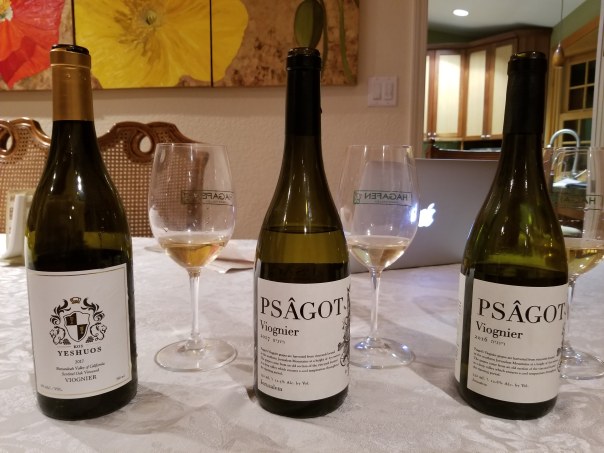
2017 Covenant Israel Viognier, Blue C – Score: 90
Classic viognier notes with crazy rich floral notes, with rich saline, lovely peach, and some oak. The mouth on this medium bodied wine is really fun and showing a lovely oily texture, with rich weight and more fun saline, followed by apricot rolled in the grass, with floral notes. The finish is sweet and ripe and fresh with tart notes of stone fruit, with lemongrass and flint. Bravo!
2017 Psagot Viognier: 89 to 90
This year’s vintage is leaner than last year’s vintage, but also more light in style and focus. The wine starts off very ripe and needs time to come around, give this wine time. The nose starts off with ripe fruit notes of pineapple juice, honeycomb, really ripe, with cloves, allspice, peach marmalade, and apricot, and stone fruit. With time the nose turns to nice mineral notes, backed by peach marmalade, wonderful peach jam, and lovely hay, quince jam. The mouth is more round and fat than I would have hoped, with orange and nectarines, still, it is well structured. With slate, saline, and pith galore. Nice.
2017 Kos Yeshuos Viognier – 92 (QPR)
Do not cool this wine too much, it likes 30 min in the fridge and no more.
This wine has evolved over the past 6 months. Gone is the fruity nose and now the nose is pure flint, yeast, smoke, and really fun straw and mineral, with peach and honey in the background. The mouth on this medium bodied wine is ripe for sure, but really well balanced and showing lemongrass, with a rich oily coat that covers the mouth, well focused with rich acidity, nice mineral, great fruit pith, apricots, peach, and lemon, with rock, and grass. The finish is long and acidic, with enough complexity to grab your attention and keep it throughout the finish with lovely white rose tea, sweet spices, notes of fresh lavender, crazy saline lingers super long, with cinnamon, and cloves. Bravo!
2016 Psagot Viognier – Score – 88
So last year this wine was very ripe, now the nose is showing nice funk, with hay, straw, and honeyed notes. last year this wine was an acid bomb, now the wine has lost that rich acidity and now it is well balanced, with good fruit pith, and green notes, and not much else. Sadly, this wine is losing its grip and should be drunken ASAP. DRINK UP!
2017 Teperberg Destitage White, Inspire – Score: 89
This wine is a blend of Viognier, Sauvignon Blanc, and French Colombard. The nose on this wine is very floral and classically inclined to Viognier with its intense peach bomb notes, with white cherry notes, and sweet Oak. The mouth on this medium bodied wine is oily and tactile, with a rich weight from the Viognier and Colombard fruit, with sweet Guava and nectarines, followed by with orange notes, The finish is sweet and tart and fun overall, with good acid and floral notes. Nice!
2017 Shirah Vintage Whites – Score: 91 (QPR)
Another winner from Shirah with a blend of 55% Viognier and 45% Chardonnay. The nose on this wine starts off really fun and funky, showing straw and rich mineral, with sweet peach, rich ripe guava, and apricot. The mouth on this wine is really fun, rich, layered, well balanced, oily and textured, and so professionally made, with lovely smoke, oak, with rich apple, dried quince and with fresh focus and lovely weight and viscosity. The finish is crazy and dry, with sweet notes of fig, sweet lemon tea, with intense mineral and lovely pith with a citrus background. Bravo!!
2016 Dalton Viognier, Reserve – Score: 89
The nose is classic Viognier, with peach, too much oak, showing good apricot, sweet rose hips, and a perfume of honeysuckle, and orange blossom. The mouth is medium bodied, with a nice almost oily mouthfeel, showing nice weight, with good notes of summer fruit, with just enough acid, wish there was more, with lovely pear and nectarines. The finish is long and balanced with less acid than before, still too much oak, lovely mineral, slate, and more floral notes. Drink up!

The 2018 Kosher rose season is open
It is officially Spring (though it snowed in Chicago for Passover – so I will hold judgment on that fact for a bit), which means it is Rose time! Rose wine in the non-kosher market is exploding – especially Rose wine from Provence; a wine region of France. Sadly, in the kosher wine market – that is not quite the case. I did not stress my previous statement with a suffix of AT ALL, even though I am not allowed to open a bottle of rose on my Shabbos table with guests – why? Well, that is simple – no one will drink it!!
Even worse, is that wine manufacturers may well have jumped the shark! There will be some 50 dry-ish kosher roses available in the USA this year! That may not sound like a lot, but when all you had was Herzog White Zinfandel 10 years ago – it is insane. The first high-end rose was Castel’s 2009 rose and that was only 9 years ago. Back then, there were few to no real Rose wine options, other than a handful of Israeli wines and almost no French Rose made it here. Now we will have tons of Rose, and I really think the real question here is will people drink it all?
Wine Color
What is a rose wine? Well, simply said, a rose is a wine that can best be defined as the wine world’s chameleon. Where white wine is a pretty simple concept – take white grapes squeeze them and you get clear to green colored juice. Yes, the white grape juice is clear – well so is red grape juice, but more on that in a bit.
White wine is not about color – almost all color in a white wine comes from some oak influence of some sort. So, an unoaked Sauvignon Blanc or Pinot Gris can sometimes look almost clear, depending on the region and how the wine was handled. Now oaked Chardonnay, of course, is what most people use as an example of a dark white wine. As the Wine Folly linked above states, different wine regions oak their Chardonnay differently and as such, they are sold with different hues from the start. With age, the wine changes color and the light gold moves to darker gold shades.
The only real exception to the stated rule above – that white grape juice without the influence of oak is somewhere in the clear to green color spectrum, is – orange wines. We have spoken about orange wines – mostly thanks to Yaacov Oryah. Outside of Yaacov’s work there really is no orange wine in the kosher world to speak about. Orange wine is made exactly like red wine, which means that the clear grape juice is left to sit on the yellowish to dark yellow grape skins (depending upon what varietal is used to make the orange wine).
Red wine juice – straight from the grape comes out the same color as white grapes. You see the juice from grapes is mostly clear to greenish in color. The red wine color comes from macerating the juice on the grape skins. The longer the juice sits on the grape skins (wine must) the redder in color the wine becomes until it reaches its maximum red color potential.
The only real exception to the rule of a grape’s juice color is the Teinturier varieties. The grapes are called Teinturier, a French language term meaning to dye or stain. The list of grapes whose juice is actually red colored is long – but the list of kosher wine options that is a wine made from these grapes – is the Herzog Alicante Bouschet. The Gamay de Bouze is not a normal Gamay grape, it is one of those grape mutations that are very red in nature. Read the rest of this entry

Red and White Wine Bar of Jerusalem and Yaacov Oryah Winery
The next wines that I enjoyed on my last trip to Israel and Europe, are made by the ever capable Yaacov Oryah (head winemaker at Psagot Winery) and we tasted his wines at one of the newest hip kosher wine bars in Jerusalem – the Red and White Wine bar – kitty-corner from the beautiful Mamilla hotel (8 Shlomo HaMelech Street at the corner of Yanai Street).
I was traveling to Jerusalem after visiting Gvaot Winery and I was talking with Yaacov Oryah about where we could meet to taste his wines. We were supposed to meet in Psagot Winery, where he is the winemaker, but things came up at the winery and there was no open space that was available for us to sit and hang. I was traveling to Jerusalem anyway, and I recommended that we meet somewhere in Jerusalem, and Yaacov suggested that we should meet at the Red and White wine bar.
Now, I had never heard of this wine bar, and that is shame on me because Sarah Levi had already covered the bar in this lovely piece in early April 2017. The wine bar is one of those few bars that is very particular about what wines are served on their menu. They have top flight wines from Castel, Flam, Gvaot, Adir, Psagot, Matar, and Yaacov Oryah. Of course, not everyone is on the same page as I am, so they have wines from other Israeli wineries, but the majority are wines I would drink! They also have great food, his menu consists of omelets, cheese, and butter (from Naomi Farm in the Golan), great bread, fresh pasta, and fish dishes. However, do not forget the great dessert options as well!
The overall feel of the bar is old school, but equally current, with a bartender that understands food, service, and wine are all intertwined into a single vision that is focused on people first, wine and food second. The bartender is the owner, sommelier, coffee bean roaster, the cheesemonger – Mark Arnold Jam. If you ever get the chance to sit down for an hour in this lovely place you will quickly find that his last name equates well to his musical tastes. Mark gets the vision and he is a one-man show that weaves poetry, music, an old school vibe, and great food and wine knowledge into the ideal renaissance man at your service!

I arrived after parking my car in the Mamilla parking lot and making my way across the street and walked into the bar, and I immediately walked over to the two wine dispensing machines and the wine fridge. The bar has a huge fridge in the back of the bar and it was stacked with lots of great wine. The bar also has two dispensing machines each stacked with eight wines, at reasonable prices and backed by Mark’s great wine knowledge.


Once I finished perusing the wines, Yaacov arrived with boxes of his wines to taste and it was off to the races. We sat down at the bar and I tasted through the wines as I peppered Mark with questions, and though he is the classic Renesaince man, he is very humble and really wanted to let the bar and the atmosphere speak for itself. About halfway through tasting the wines, I started to nibble at the bread and butter and they were both very nice. The cheese looked good, but I stuck with the bread and once we were finished I tasted some of them and they were all very impressive, but I was in a rush after that and needed to get to the Kotel and then to the wine tasting at DD’s house – which will be the focus of the next post.
My many thanks to Yaacov Oryah for allowing me to taste all the current wines and to Mark for letting us spend some time in his lovely wine bar! The wine notes follow below – the explanation of my “scores” can be found here:


2014 Psagot blanc de blanc – Score: NA
This wine is still a few years from release, but already it is showing great potential. The wine needs more time on the lees to come together, but it is tart, bright, and starting to get some complexity. The nose on this wine is lovely with rock, limestone, with rich saline and green apple. The mouth shows nice acid, great minerality, lemon fraiche, with gooseberry, kiwi, and lychee, all wrapped in nice small mousse bubbles. Nice.
2009 Yaacov Oryah Emek Hatzayidim (Hunter Valley) Semillon – Score: A-
The nose on this wine is lovely, with rich honeysuckle, dry straw, grapefruit, and lovely minerality. The mouth on this wine shows a rich and acidic core, with white peach, rich lemon Fraiche, crazy rich slate, mineral, dry straw and dry kiwi all wrapped in an incredible fruit focus that is really all about the perfect balance of acid, mineral, saline, and slate. The finish is long and tart with green apple, yellow/pink grapefruit, and green notes, tart notes lingering long. Bravo. Drink by 2019. Read the rest of this entry
Kosher Rose wines of 2017 – final take
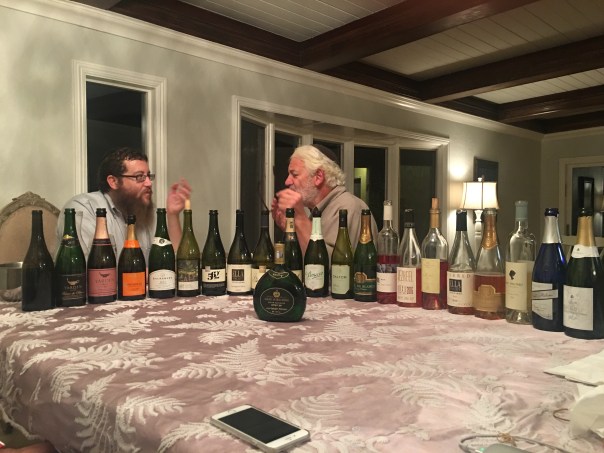
After all the tastings I have had for rose wines this year – I can say for now, that I am as far along as I can go without being in Israel, or asking people to schlep wines for me from Israel. I am still missing the new 2016 Elvi Wines Rose, the 2016 Terra de Seta Rose, the 2016 Matar Rose, and the 2016 Gvaot Rose. I guess that will have to be. When I get to Israel soon enough I will post again, but just on those wines.
In the end, my overall take on Israeli roses this year has been a huge and utter letdown. To me, there are few roses that I would waste my time drinking. In the end, the Netofa, Vitkin, Psagot, and Castel Roses are the only roses that I would buy this year, other than the untasted wines listed above (Matar and Gvaot), which may well be good.
The real saviors for us have indeed been Spain and USA. France has thrown in the La Vie Roubine, but it is not as good as the Ramon Cardova rose.
So, in closing, I will repeat what I listed the last posting. These wines are the best for each category, nothing I tasted in the last tasting has changed much around them, other than the sweet rose entry, which I would never buy, but is useful for those that like rose that way.
So, here are my recommendations based upon the wines I have tasted:
- 2016 Ramon Cardova Rose, is the best rose so far, but it is not a Provence style wine, it is more of a tweener.
- The 2016 Chateau Dubois is the best French rose I have tasted so far, but it is a clear non-Provence style rose.
- 2016 Chateau Roubine la Vie, is the best French classic Provence style rose.
- 2016 Ramon Cardova Rose is the best Spanish rose (that I have had the chance to taste so far, sadly I have yet to taste the new 2016 Elvi Rose)
- The 2016 Shirah Rose is the best USA rose. It is not a Provence style wine, it is a massive wine but a really fun one.
- The 2016 Netofa Rose is the best rose from Israel, it is as close to a Provence style wine I have found so far in Israel. Vitkin is right behind, along with Castel (but it is really expensive for the wine), and Psagot in the bigger/fuller rose category for Israel.
- The 2016 Psagot Rose (when it is on) is the best full bodied rose wine from Israel.
- The best sweet rose that is drinkable is the 2016 Contessa Annalisa Rose. Hopefully, a gateway rose to the drier and better options above.
Rose winemaking approaches
If you read the previous article, you would have read that there are classically three ways to make Rose; Maceration, Saignée, and blend.
The interesting thing we are seeing is a slight variation to the rose making – that is after they make the rose, using any of the aforementioned approaches, they are adding in some white wine! This is straight up genius! Why? Because as explained in the previous post, red grape juice has very few phenolics in it! The real phenolic powerhouse – for red wines, are the skins! White wine does not need skins to give it their phenolics, they have it innately from the juice alone. So, when you take red grapes and essentially crush them and bottle them, with minimal grape contact, what you get is a fun wine, that has very few phenolics in it. So, you have a few options, either let the liquid sit longer on the grape skins, thereby improving the phenolics, but that takes away from the classic rose look, as skin contact turns the juice darker. So, if you want more phenolics and less grape skin contact to keep the classic rose color, you can add in white wine!
The Ramon Cardova is a perfect example of this. As is the Elvi Rose (a wine I have not tasted), and the Jezreel Rose (see below). These three wines all added in different white wines, and it is a clear bump in the correct direction, but to the purists, it is not cool! I cannot speak to the purist’s issues, and yes, I can see that the Cardova is not a classic Provence wine, but it is a very enjoyable summer wine, and in the end, that is what rose to me, is all about!

 Wine Musings Blog