Blog Archives

The Best and Top 25 Kosher Wines of 2024, including the Wine of the Year, Winery of the Year, the Best Wine of the Year, the Best Mevushal Wines of the Year, and Best QPR Wine of the Year Awards
First, I must start this by saying I am sorry for this being two months late. The late tasting of the 2022 wines in Paris pushed all the dates forward. Such is life! It was worth tasting those wines in their correct place. As stated below, I love at KFWE, but it is not a place to taste wines for a blog or a post. It is a place to taste wine and know if I should taste it in the correct setting. It is an excellent filter to help fine-tune the wines to sit down with.
Like last year, I wanted to make this post short and sweet – so the criteria are simple. I could care less about price, color, or where it was made. All that matters is that it is/was available this year sometime to the public at large, that I tasted it in a reliable environment, not just at a tasting, and that it scored a 94 or higher. PLEASE NOTE the improved quality of the top wines this year! This is the best year – that I have posted about – in regards to scoring. All 25 wines are 94 or above. The closest we had before was the 2021 blog year, which had a fair number of 93+ scored wines.
We are returning with the “Wine of the Year,” “Best Wine of the Year,” “Winery of the Year,” “Best White Wine of the Year,” “Best QPR Wine of the Year”, along with the – “Best Mevushal Wine of the Year.” Wine of the Year goes to a wine that distinguished itself in ways that are beyond the normal. It needs to be a wine that is readily available, incredible in style and flavor, and it needs to be reasonable in price. It may be the QPR wine of the year, or sometimes it will be a wine that has distinguished itself for other reasons. The wines of the year are a type of wine that is severely unappreciated, though ones that have had a crazy renaissance over the past two years. The Best Wine of the Year goes to a wine well worthy of the title.
The Mevushal wine of the year is something I dread. I understand the need for a wine that can be enjoyed at restaurants and events. Still, when we start seeing Château Gazin Rocquencourt and Chevalier de Lascombes go Mevushal – we know we have a problem. As I have stated in the past, if this is what needs to happen, then please sell both options as many do with Peraj Petita/Capcanes, Psagot wines, and many others. Still, it is a wine; as such, it needs a best-of-the-year moniker, so we do it again!
This past year, I tasted more wines than I have ever, in the past. Now, to be clear, I tasted thousands of Israeli (and other) wines but did not write notes on them. At this point, I refuse to post notes that demean the Israeli wine situation. I understand that goes against my long-term stance, but the situation there also goes against any logical or even human stance. As such, if the wine is good, I post. Otherwise, I am not adding value. I still think, long-term, Israel needs to change its winemaking style. However, as long as folks buy the wines, they will stay as they are. Enough said.
I spent a fair amount of time tasting all the US, French, Southern Hemisphere, and European wines I could get my hands on, and I feel that is where I added the most value, IMHO. For those who like the Israeli wine style – other writers/bloggers can point you in some direction. Thankfully, the 2022 vintage did pull up the overall quality from Europe, so we have some good options.
There are wines from the 2018 and 2020 Bordeaux vintages that snuck in, along with many from the 2022 vintage. Also, there are wines from around the United States and Europe. There are even a couple from the 2021 Bordeaux vintage. This proves wrong the idea that all of the 2021 vintage was a waste of time.
Now, separately, I love red wines, but white wines – done correctly, are a whole other story! Sadly, in regards to whites, we still had no new wines from Germany, still. Thankfully, we have some fantastic entries from ESSA, Domaine de Chevalier, Marciano Estates, Chateau de Rayne Vigneau, Domaine Raymond Usseglio & Fils, Chateau Gazin Rocquencourt, and Le Nardian. Some of these wines that scored well were ONLY the French versions. The USA versions of Chateau Gazin Rocquencourt are Mevushal and the Domaine Raymond Usseglio & Fils – it is a very different animal than what I tasted/enjoyed in Paris. However, they all scored a 93 or lower, and I do not see the point in putting a white wine in – just to cover that base. Therefore, this year, I am going with the “white” 2021 Tokaj-Hetszolo Tokaji Aszu 6 Puttonyos, Tokaj. I hope to post a roundup soon of the top white wines out there like I did last year.
The wines on the list this year are all available here in the USA, and in Europe, and a few can be found in Israel, as well. The wine notes follow below – the explanation of my “scores” can be found here and the explanation for QPR scores can be found here:
The 2024 Kosher Winery of the Year
This award continues to get harder and harder each year. The sad, cold, hard truth is that there are too few great kosher wineries. When I started this award some five years ago, I thought it would only get easier. Sadly, there are a few truths that limit my ability to give out this award.
First, as much as we have been blessed with great Kosher European wines in the past 6 years, most of those blessings come under the auspices of single-run kosher wines. Chateau Leoville Poyferre, Château Smith Haut Lafitte, you name it, are all based upon kosher runs. What we have in Europe, kosher-winery-wise, is Terra di Seta, Cantina Giuliano, and Elvi Wines (including Clos Mesorah), Domaine Roses Camille, which only became 100% kosher in 2020. Still, for all intent and purpose, Domaine Roses Camille has been producing the vast majority of their wines in kosher since 2011.
The requirements to receive this award are simple, the winery must be kosher, not a kosher-run, the quality must be consistent, and the wines must be readily available. The last requirement is the main reason why Four Gates Winery has yet to win the award, but at this point, it is only a matter of time, as kosher wine availability is becoming less of an issue overall, given the sheer number of cult-like kosher wineries that exist today. Also, I may be forced to start playing with percentages instead of wholly kosher wineries if the people understand what I mean.
This year’s winner starts to break down one of my unspoken laws. Never give awards to one of your best friends, but Josh and Chana Rynderman have forced my hands. No, they have not done so physically or even by voice; it is all in their work. This award is worthy on so many levels. I have written about ESSA Wine before, as well as Kos Yeshuos Winery. Both are worthy of this award, and one could not exist without the other.
It is crazy to think that Kos Yeshuos started “unofficially” in 2015! I was not even scoring wines with numbers back then! Ten years ago, Kos Yeshuos made a lovely Vin Gris from Cabernet Sauvignon, and the game was afoot! From there, he made wine for sale in 2016, the first “official” vintage of Kos Yeshuos, with two reds, a Syrah and a Grenache (I had just turned over to numerical scores and started to dabble with QPR). The 2016 Syrah was excellent last year!
Read the rest of this entry
California Dreaming about the 2020, 2021, 2022, and early-2023 vintages – a retrospective
In May 2024, WOW, I have to get used to the new 2025 thing; I wrote a post about wines I had tasted in the past month or two. However, after tasting through so many excellent California wines from 2021, I decided it required a retrospective.
Some of these wines will be new to the blog, some will be reposts, and some will be reposts with a change in the scoring (I will denote those clearly).
The 2020 vintage was blighted by many fires, smoke taint, and a poor overall showing. The 2021 vintage was far more controlled, with almost no heat spikes. Though there was little rain before it, the vintage came out smelling like a rose. In the 2022 vintage, we saw far too many heat spikes. Add in many days of over 100-degree weather, and it is shocking that anything good came out. Still, I found some winners. The 2023 vintage is looking like the best of BOTH worlds: rich, layered, with incredible balance. The California whites from 2023 outshined all of Europe and Israel, and we wait now for the release of the higher-end red wines to make a conclusive decision.
As you read through this post about the Kosher wineries that reside in California, understand that California is not Napa Valley. It is a vast state with many wine regions. California is massive. It has four main wine-growing regions and 147 viticultural areas (AVA). If California were a country, it would be the fourth largest in regard to wine production.
At the start, in 1985, when Robert Parker and Michel Rolland took over the world and drove wine production toward a more fruit-driven approach, Napa Valley was the poster child for what a “proper” wine should be. The fruit was very prominent, the tannins were round, not astringent, and the alcohol levels were high. If you watch and listen closely to the videos of Peter Koff, MW, and Dr. Pat Farrell, MW, you will learn so much! Listening to them, they describe the wine critics at the tasting/judgment of Paris who were looking for the ripest fruit.
Looking at current wines, I feel such a tasting would have very different outcomes. First of all, Bordeaux’s ABV is climbing, and there is no end in sight. This is not a choice by the wineries; instead, it is a choice of nature. Secondly, Napa Valley, which was the California area of choice, is even riper than in those days, and I think they would stick out badly. Many Napa Valley wineries are trying to bring their approach back to the middle, but they run up against the same issues Bordeaux is facing, and really the entire world.
When you look at the notes below, you will find three camps. One is the tried-and-true camp of Alexander Valley, AKA Sonoma. It has continuously shown control and power, though at times lacking acidity and finesse.
Next, you will find Napa Valley split between two camps: the bid, bold, in-your-face Robert Parker dream, fruit-forward, powerful, fleshy, and alcoholic to the max. The other side of this camp is the more controlled, sinewy, and acidic, though showing Napa’s power, with a steady hand and clear horizon towards Old-world style wines.
Finally, you find the wild-wild-west at its greatest in areas like Santa Barbara, Paso Robles, and the other regions to the south. Here is where folks like Shirah Wines live. Wines that are more Rhone-style, off-the-beaten-path varietals, exciting, and not yet fully commercialized ideas that bring a smile to most who try them.
As you read through the notes, you will find that I look for balance. I like power; I do not crave it. I desire a wine with rich acidity, balance, clean lines, power or not, but a wine that makes you want to take another sip, because it is refreshing. Balance is the definition of a glass of wine that clears your palate not by giving you a headache but rather by having acidity and pop that can have power but more assuredly has an acidity that works in conjunction with the fruit.
To that point, you will find wines below that get high scores because they are balanced. Examples of wines I bought, which is the highest proof of a wine I like, are the 2021 and 2022 Marciano Estate, 2021 Covenant Cabernet Sauvignon, 2021 Covenant Cabernet Sauvignon, Lot 70, 2022 Covenant Cabernet Sauvignon, and the 2021 Herzog Alexander Valley Cabernet Sauvignon. The 2021 Napa Valley Cabernet, Reserve is a clear WINNER and one you should all seek out.
The 2023 Pinot Noirs from Herzog and Covenant prove that this vintage has potential, but again, we will not know where it lines up until after the full lineup of red wines is released across California.
Finally, the higher-end white Sauvignon Blanc wines from Marciano, Covenant, and Hagafen are worth finding – they are lovely! I wrote a separate post, mid-2024, about the top white wines from 2021 through 2023, which are well worth buying!
Pricing
I am fine with writing about kosher wines, but we cannot talk about Kosher Napa Wines without addressing the large elephant in the room, which is the elevated prices. I stress Napa Valley because there are no Kosher California Wines above 130 dollars outside of the Herzog Sonoma Clone Six and the new Herzog Double Creek. Please do not talk to me about Four Gates Wine. Respectfully, it is a drop in the bucket and does not move any needles, industry-wise, other than for its quality.
The number of bottles produced at the price range that raises eyebrows is starting to make people like me wonder. How many people are buying wines priced at 200 or more dollars? Many of the wines listed below are 300 or more dollars. How do you build a brand and a list of people for wines at that price?
Yes, there are more expensive wines out there, but that is one or two, and they are from storied old-world marks and vineyards, meaning they have a track record. Of course, runs at cult-like Napa Wineries have been going on underground for a very long time. Now, we are seeing Kosher Napa Wines selling in the 200-plus to 360-dollar range on store shelves, and it is all new for the kosher-wine-buying public.
There is a clear cost to everything that happens in making a wine kosher, and those people deserve to be paid. A few hands in there also need to be paid for fronting the money, marketing, and so on. However, the per-bottle “kosher tax” does not need to be commensurate with the cost of the non-kosher base price. Again, there is a cost for working in Napa and making Kosher wine there, but as proven by Hagafen and Herzog, wine can be produced without those high Kosher wine taxes.
Ultimately, I am at the mercy of those who feed me. As always, I openly state that I go and taste wines; when I do, I do not pay to taste those wines. At the same time, I post what I taste and never change a score because of the situation in which I may be placed. There is a clear reason for why I have stopped going to specific wineries and regions to taste – because the outcome was getting too awkward, and the posts were becoming a chore. I am always very thankful for the chance to taste wine, and I am always honest about what I taste, and for the most part, I stay out of wine business commentary. However, when everyone asks me the same question, I suppose I cannot just ignore the elephant.
Criteria and Process for this post
I thought long and hard about how I would manage this post. At first, I thought I would do a total dump of all the wines across wineries from both the 2021 and 2022 vintages. However, that would end up as a massive mess; there are far too many wines. So, I decided to list all the wines from all the California wineries I tasted, scoring a 91 or higher from the 2021 and 2022 vintages. There are still a lot of wines, but that is the only way to get a list in one post, and that is not insane.
I will leave the red wines from the 2023 vintage alone for now. There are too few wines from that vintage at this time. Still, I will post some 2023 white wines as they are showing well, and they were tasted at the same time! Also, Four Gates has yet to release their top 2021 or 2022 wines, so we may need yet another retrospective after that. LOL, I think not. There is one exception, Kasher Wines, which I first tasted in November, has a 2020 Cabernet Sauvignon.
You will not find Four Gates Winery here because they have yet to release the 2021 vintages, and they are so small that it is impossible to really compare them with these other players. You can look here if you want to find my posts on Four Gates Winery. Other wineries make Kosher Wines in California but I did not find their 2021 vintages that interesting to me to make it into this post.
Closing Thoughts
This post is massive and took a crazy amount of time, thought, effort, and tasting! People ask me about wines and respectfully never really think about the amount of effort it takes to put it down on paper. Of course, none of this could have happened without the kindness and generosity of the wineries in sharing their time and wines, which took them far more effort to make. Many thanks to Elk (Elchonon Hellinger from Elkwine) for helping set up a lot of this. David Edelman for sharing his time and wines as well. Many thanks to all the wineries, Marciano Estates, Ka.sher Winery, Hajdu Wines, Shirah Wines, Herzog Wine Cellars, Covenant Wines, Hagafen Cellars, Tench Vineyards, and Addax Wines.
Read the rest of this entry
California Dreaming – 2021 through 2023 vintages are showing well
It has been a long time since my last post and I am a good 100 wines behind, at this point, so these next few posts will be short and to the point.
Before Passover and after it, as well, I got into my car and drove to Covenant Winery, Hajdu Winery, Hagafen Winery, Marciano Estates, and Shadybrook Estates to get a bottle of kosher wine they made called Monetin. I also had many wines shipped to me from Herzog and Mayacamas. Finally, I had dinner with Gabriel Weiss and Alex Rubin and I tasted their wines as well. So, yeah this is a full California tasting. This is NOT a list and scores of each of these winery’s wines, but rather a set of tastings of what I have not yet had from these wineries.
The plan here is to list the wineries and their wines in the order I tasted them (mostly as I did taste some of the wines more than once).
My many thanks to each and every winery here for putting up with me and sharing their wonderful wines.
Marciano Estates (Feburary 2024)
Elk was in town that week and I drove through the pouring rain to pick him up, that was the craziest day of driving since my trip to Northern Israel in a carwash of rain on those mountainous hills, just nuts! Thankfully, we arrived at Marciano Estates, quite alive, almost on time, I will leave that part of the story for another time! However I must state that Elk should never be allowed to travel without his gear working. My hearing is still recovering! We were met by Michael McMillan, the General Manager at Marciano, and we were given the wines to open. The three wines were the 2022 Marciano Estates Blanc, the 2021 Marciano Terra Gratia, and the 2021 Marciano Estates. They were all stunning wines, and while the prices are high for these kosher wines, so is the cost of land, fruit, production, and so on in Napa Valley.
As always the time spent in Marciano Estates is always fantastic, the estate is stunning, as is the wine and the surrounding area. My many thanks to the entire Marciano team for putting up with us, along with the frequent time changes, and so on. The wines and the scores speak for themselves, I personally bought a few of the Marciano Blanc, the 2022 and 2021 vintages. The wine notes follow below – the explanation of my “scores” can be found here and the explanation for QPR scores can be found here:
2022 Marciano Estates Blanc, Napa Valley, CA – Score: 93 (QPR: GREAT)
The nose of this wine is lovely, and bready, with smoke, oak, brioche, peach, apricot, yellow plum, and orange blossom. The mouth of this full-bodied wine is really lovely and ripe, with intense acidity, lovely mouthfeel, plush-styled, a beautiful expression of French white, with intense peach, complexity, sweet oak, apricot, sweet yellow plum, intense loam, verve, and beautifully tense, with sweet tannin, grapefruit, lemon/lime, really lovely! The finish is long, intense, layered, concentrated, and richly extracted, with incredible sweet blossom, and sweet vanilla, on the long finish. Incredible! Drink from 2028 until 2034. (tasted February 2024) (in Napa Valley, CA) (ABV = 14.1%)
2021 Marciano Terra Gratia, Napa Valley, CA – Score: 93 (QPR: GOOD)
The nose of this wine is lovely, balanced, ripe, and rich, with raspberry, strawberry, blackcurrant, plum, iron shavings, squid ink, rich minerality, loam, sweet spices, roasted herbs, and sweet oak, impressive. The mouth of this full-bodied Napa Cab blend is ripe, layered, extracted, and balanced with great acidity, and concentration, with lovely blackberry, cassis, raspberry, ripe strawberry, milk chocolate, rich tension, nice extraction, lovely plushness, a theme throughout the three wines we tasted today. Lovely! The finish is long, ripe, rich, extracted, and tense, with freshness, sweet oak, sweet tobacco, and sweet vanilla. This wine is incredibly accessible but please stay away from it for at least 3 years. Drink from 2026 until 2032 (tasted February 2024) (in Napa Valley, CA) (ABV = 14.8%)
2021 Marciano Estates Cabernet Sauvignon, Napa Valley, CA – Score: 94 (QPR: GOOD)
The nose of this wine is incredible, purer than the Gratia, rich, expressive, but far more elegant, showing ripe, milk chocolate, milky, with blackberry, plum, raspberry, tar, smoke, and rich sweet spices. The mouth of this full-bodied wine is ripe, layered, and extracted, with great acidity, lovely tension, sweet tannin, blackberry, plum, sweet oak, sweet vanilla, raspberry, strawberry, juicy strawberry/raspberry, sweet spices, nutmeg, sweet earth, plum, and sweet loam. The finish is long, dirty, earthy, ripe, and elegant, with juicy and ripe strawberries, sweet oak, vanilla, and sweet tobacco. Drink from 2027 until 2033. (tasted February 2024) (in Napa Valley, CA) (ABV = 14.8%)

My top 25 kosher wines of 2021, including the Wine of the Year, Winery of the Year, the Best Wine of the Year, and the Best Mevushal wines of the year awards
Like last year, I wanted to make this post short and sweet – so the criteria are simple. I could care less about price, color, or where it was made. All that matters is that it is/was available this year sometime to the public at large and that I tasted it in a reliable environment, not just at a tasting, and that it was scored a 92 or higher. Also, there are a few lower-scoring wines here because of their uniqueness or really good QPR.
We are returning with the “wine of the year”, “best wine of the year” along with “Winery of the Year”, and “Best White wine of the year”, along with a new one – “Best Mevushal wine of the year”. Wine of the year goes to a wine that distinguished itself in ways that are beyond the normal. It needs to be a wine that is easily available, incredible in style and flavor, and it needs to be reasonable in price. It may be the QPR wine of the year or sometimes it will be a wine that so distinguished itself for other reasons. The wines of the year are a type of wine that is severely unappreciated, though ones that have had a crazy renaissance, over the past two years. The Best Wine of the year goes to a wine well worthy of the title.
The Mevushal wine of the year is something I personally dread. I understand the need for a wine that can be enjoyed at restaurants and events, but when we start seeing Château Gazin Rocquencourt and Chevalier de Lascombes go Mevushal – we know we have a problem. As I have stated in the past, if this is what needs to happen, then please sell both options as many do with Peraj Petita/Capcanes, Psagot wines, and many others. Still, it is a wine and as such, it needs a best-of-the-year moniker, so this will be the first year where we do it.
This past year, I tasted more wines than I have ever, in the past. Now to be clear here, I did not taste many Israeli wines as they have proven to me over and over again, even with the much-ballyhooed 2018 vintage that they are not worth me spending my money on. So, no I have not tasted as many Israeli wines as I have in the past, but overall, this is the largest number, for me. I spent a fair amount of time tasting all the French and European wines I could get my hands on and I feel that is where I added the most value, IMHO. For those that like the Israeli wine style – other writers/bloggers can point you in some direction.
IMHO, this past year brought the best wines I have seen in a long time.
IMHO, this past year brought the best wines I have seen in a long time. No, I do not just mean, the lovely 2019 Chateau Pontet Canet, but overall, the scores garnered this year are on keel with my top wines of 2017, which included the best wines from 2014 and 2015 vintages. Nothing has come close since that list, until this past year – so that really excites me as there are still a few wines from the 2019 vintage that I have yet to taste.
As I will talk about in my year in review post, 2014 will come out as the best vintage for the past decade in France. That is a hotly debated subject, but IMHO, in the world of kosher wine, there were FAR more best wine options in the 2014 vintage than any other vintage in the past decade. That may not be the case for non-kosher wines, but news flash, I do not drink non-kosher wines, or even taste them, and further this blog is about kosher wines. The 2018 vintage may well have some serious “best wine of the year” candidates, but sadly, not all of those wines are here and I could not travel to France to taste them all, as I do commonly. The 2019 vintage may have as many once we taste them all, but for now, the 2014 vintage across all wine producers has created a far more complete and consistent product than any of the years, up until 2019.
There are also interesting wines below the wines of the year, think of them as runner-up wines of the year. There will be no rose wines on the list this year. If last year, I thought the roses were pure junk, this year, you can add another nail in the coffin of rose wines, IMHO. Thankfully, the task of culling the bounty of great wines to come to these top wines was more a task of removing than adding. We are blessed with a bounty of good wines – similar to 2017. To highlight the last point, I scored 109 wines with a 92 or higher, and 66 of those were given the QPR score of WINNER (or WINNER in FRANCE).
The supreme bounty comes from the fact that Royal released the 2019 French wines a bit early! Throw in the incredible number of kosher European wines that are coming to the USA and being sold in Europe and this was truly a year of bounty for European kosher wines.
Now, separately, I love red wines, but white wines – done correctly, are a whole other story! Sadly, in regards to whites, we had no new wines from Germany, still. Thankfully, we have some awesome new entries, from the 2019 Chateau Malartic and the 2019 Château Gazin Rocquencourt (NON-Mevushal), and the new 2020 Meursault!
The wines on the list this year are all available here in the USA, in Europe, and a few can be found in Israel, as well. The wine notes follow below – the explanation of my “scores” can be found here and the explanation for QPR scores can be found here:
The 2021 kosher wine of the year – is new!
This is a new wine for the kosher wine market and it sits a bit above where I would like it, price-wise, but it is the best wine for a price that is still comfortable for the value. It is one of the rare wines that score a GREAT QPR – when priced above 100 dollars. Still, it fits right there to make it GREAT. There were so many to choose from this year – I am so happy to restate, but in the end, this award goes to a reasonably priced wine that garnered the highest score. The 2014 and 2015 Domain Roses Camille was an option, but the price pushed out of the competition. There was the 2017 Elvi Clos Mesorah, at a far better price than the LaGrange, but again, the LaGrange fit right in that space, barely above the Clos (quality-wise), and within the range of QPR. There was the 2018 Malartic and the 2017 Leoville, but they, like the DRC, were priced out. Finally, there was the 2019 Jean Luc et Paul Aegerter Nuits St. Georges 1er Cru, Les Vallerots, but that wine is almost impossible to find, sadly!
If there was a single QPR WINNER that blew me away – it would be the 2012 Château Cru Ducasse – in France, I can see no reason not to buy as much of this as humanly possible! Either way – the new Chateau LaGrange is a wonderful wine and one that is worthy of the 2021 wine of the year!
2019 Chateau LaGrange Grand Cru Classe En 1855, Saint-Julien – Score: 94+ (QPR: GREAT)
WOW, what wine for a 12.5% ABV wine, come on, the next time someone says I need to wait for the phenolics to talk with me, the answer is this wine! This wine is a blend of 80% cabernet Sauvignon, 18% Merlot, & 2% Petit Verdot.
The nose on this wine is lovely and perfumed with rich minerality, dense loam, graphite, smoke, roasted animal, clay, black and red fruit, all wrapped in more dirt, tar, and licorice, wow!
The mouth on this medium-plus bodied wine is beautiful, the acid is perfect, balanced and tart, elegant and layered, with lovely raspberry, plum, dark currants, hints of blue fruit, with ripe cassis, scraping mineral, dirt, loam, roasted herbs, menthol, with sweet vanilla, and lovely licorice.
The finish is long, with draping tannin, scraping mineral, and lovely tar, loam, nice leather, and rich garrigue, really lovely! Drink from 2031 until 2042. (tasted November 2021) (in Paris, France) (ABV = 12.5%)

Three 2018 California Napa Valley Wines
I know some of you are hoping for posts from my trip to France. However, I need to clean up some missing posts, I have a lot of wine that needed to be posted and now I will do those quickly. After that, I will start posting the wines I tasted in France.
In April Gabriel Geller and I went to Marciano Estate, along with Hagafen Cellars, both of them in Napa Valley, California. Then we went to Herzog Wine Cellars, Oxnard, California. Most of the wine notes from Hagafen and Herzog were posted in this blog post. Of the 2018 vintage, I am still a massive fan of the Sonoma County wines over the Napa Valley wines, in this case, the EPIC 2018 Herzog Wine cellars lineup. Though, the 2018 Herzog Forbearers Cabernet Sauvignon was quite nice but too expensive. Overall, the Napa Valley wines are all too expensive for the value, and really, I would stick 100% with the Sonoma County wines. That said, the Marciano wines are beautiful but at 350 dollars or 140 dollars, it really is a matter of value to me. Are they great wines? Yes, you can see that from the scores below. Napa Valley wines are not cheap, and the cost of labor and kosher wine supervision at such a small scale adds to the overall cost of the kosher product. This is just a matter of Napa Valley wines while being nice, are almost pricing themselves out in the kosher market, when there are better options available.
My thanks to all at Marciano Estate and to all at Herzog Wine cellars for hosting us and letting us taste the wonderful wines. The wine notes follow below – the explanation of my “scores” can be found here and the explanation for QPR scores can be found here:

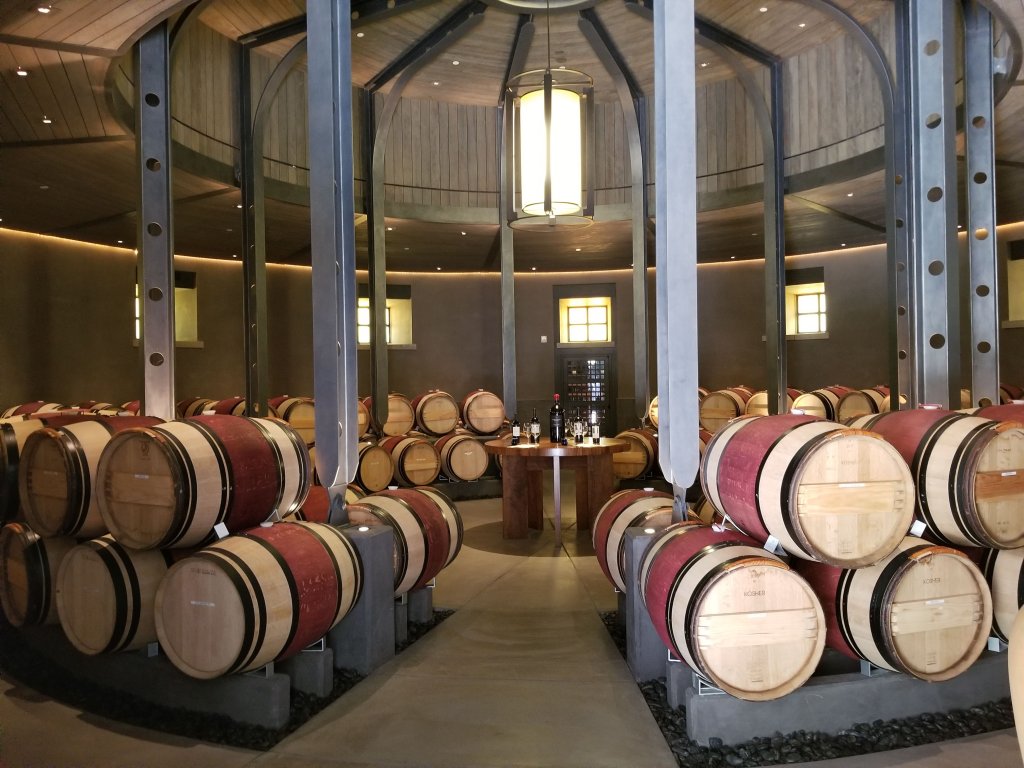
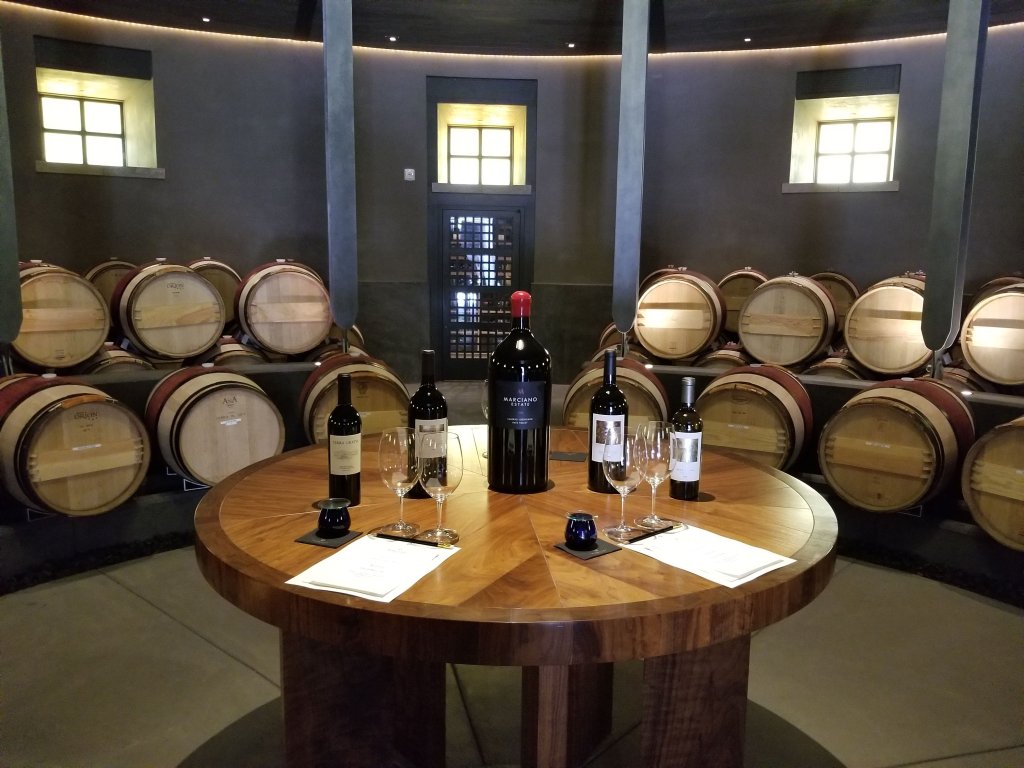

2018 Marciano Estate Cabernet Sauvignon, Napa Valley – Score: 93+ (QPR: POOR)
The wine is a blend of 82% Cabernet Sauvignon & 18% Cabernet Franc. The nose on this wine is so elegant it is crazy, with sweet oak, tar, graphite, roasted animal, spice, rich black currant, sweet cinnamon, and lovely floral lavender. The mouth on this full-bodied wine is incredible, richly layered, concentrated, extracted, deep fruit focus, crazy balance, with intense mineral, the graphite and saline are far more pronounced in the Marciano than in the Terra Gratia, with pure elegance, plum, dark cherry, smoke, and loads of earth. The finish is long, green, earthy, with sweet tobacco, vanilla, dark chocolate, sweet spices, more floral notes, and tannin that lingers forever. Drink from 2026 until 2034. (tasted April 2021)
2018 Marciano Terra Gratia, Napa Valley – Score: 92+ (QPR: POOR)
Lovely nose of black currant, roasted herb, rich mineral, serious smoke, star anise, tarragon, with rich saline. The mouth on this full-bodied, really impressive, with polish, plush, rich and concentrated, layered, elegant, with black currant, plum, incredible, rich smoke, raspberry, with menthol, intense acid, draping elegant tannin, green note, lovely, sweet Oak, Asian spice, and spices galore. The finish is super long and green and ripe and smoky and spicy, with elegance, roasted animal, and lovely chewing tobacco, and earth galore, and charcoal. With time the nose changes to sweet oak, sweet dill, smoke, green notes, garrigue, sweet mint, Oregano, tar, sweet black, and red fruit. The mouth is rich, extracted, layered, and elegant. Bravo! Drink from 2025 until 2032. (tasted April 2021)
2018 Herzog Generation IX Cabernet Sauvignon, Stags Leap, Napa Valley – Score: 93 (QPR: POOR)
The nose on this wine is ripe, balanced, and in control, with rich blackberry, anise, raspberry, with tar, smoke, roasted meat, lavender, rooibos tea, black tea, with dense forest floor, mineral, rich tilled earth, and loam. The mouth on this full-bodied wine is ripe, layered, concentrated, and a bit elegant, with a nice plushness, with ripe blackberry, dark cherry, raspberry, currant, plum, and lovely green note, mouth draping tannin, foliage, loam, and forest floor, with anise and tar. The finish is long, green, with chalk, graphite, black tea, dried rose petals, graphite, dried porcini mushroom, and smoke that is wrapped in rich extraction, and foliage galore, Bravo! Drink from 2028 until 2035. (tasted April 2021)

 Wine Musings Blog