Category Archives: Wine Tasting

A quick post of four new Covenant Wines releases – January 2025
I just published a different post and wanted to catch up on the rest of my California wine notes with this post. Covenant Wines continues to excel year after year with wines that show what California has to offer. They have been slowly expanding their portfolio with two new Mevushal wines, the Black Label Cabernet Sauvignon (that started in 2021) and the Black Label Pinot Noir, which they just released in 2023. Since the start, Covenant Wines, led by Jeff Morgan, Jonathan Hajdu, Jodie Morgan, and the rest of the awesome Morgan family, have been making wines since their inaugural 2003 release. Not all the family was working on this effort, from the start, but they all joined slowly. Now, this is a family-run operation that continues to push on what I would call QPR (Quality to Price Ratio) WINNERs. They continue to prove that California does not need to be expensive, and they continue to prove that California can excel at making balanced and refreshing wines. Those two statements – quality wines and wines sold at reasonable prices (compared to their peers) is the VERY DEFINITION of QPR (Quality to Price Ratio) winemaking.
The good news continues with their newly released 2023 Cabernet Sauvignon, Black Label. So far, and I am already late closing my blog year, this is the Mevushal wine of the year. It is a wine that pops, shows no boil/cooked notes, and is clean, alive, fresh, and exciting. The same can be said for the 2024 Sauvignon Blanc, Red C, and the 2024 Viognier, Red C. Both wines are varietally authentic, showing great pop, acidity, and balance for California wine.
Finally, the newly released 2022 Covenant Cabernet Sauvignon, Solomon, Lot 70. It is a ripe wine, but give it time. The wine finds its place and is quite lovely!
I know this is a rushed piece, but I wanted to get it out there and move on to some very large-format posts—hint, hint. Best wishes to all, and prayers for the Hostages and for those suffering down south in SoCal. Prayers go out to all!
My many thanks to Jeff, Zoe, and the rest of the clan for sharing these wines with me. They are listed in the order I tasted them. The wine notes follow below – the explanation of my “scores” can be found here, and the explanation for QPR scores can be found here:

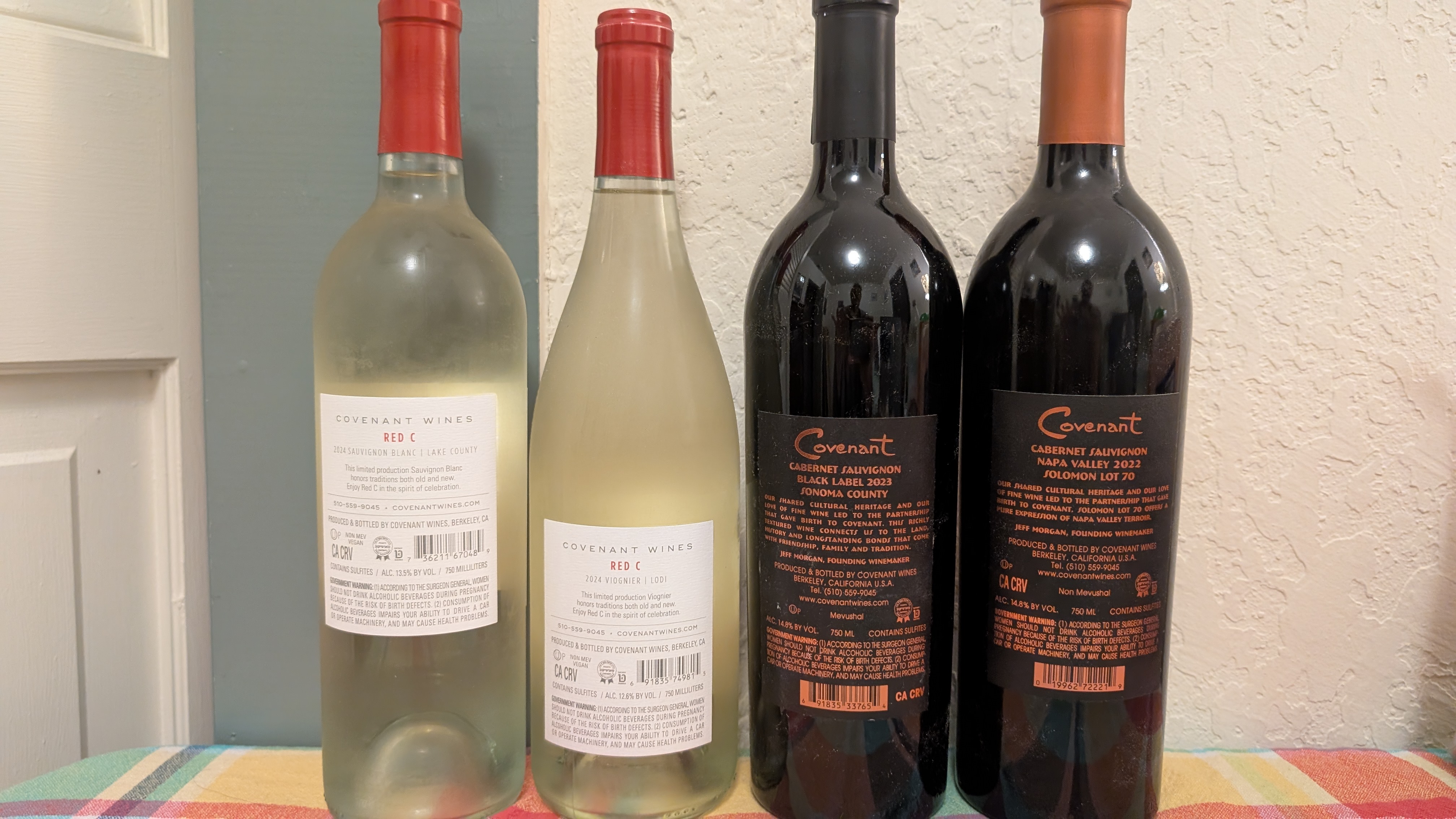
2024 Covenant Viognier, Red C, Lodi, CA – Score: 91+ (QPR: WINNER)
The nose of this wine is varietally true, with fresh and clean aromas of ripe and juicy yellow peach, lychee, grapefruit, and flint. The mouth of this medium-bodied wine is lovely, with almost no bitterness at all, refreshing and ripe at the same time, not too fussy, with great acidity, creamy with juicy peach, apricot, lychee, grapefruit, and slight tension. The finish is long, tart, ripe, and refreshing, with good ripe fruit and fruit-focused. Nice!. Drink now! (tasted January 2025) (in San Jose, CA) (ABV = 12.8%)
2024 Covenant Sauvignon Blanc, Red C, Lake County, CA – Score: 91+ (QPR: WINNER)
The nose of this wine is nice, showing notes of creamy lychee, grapefruit, gooseberry, passion fruit, and nice smoke.
The mouth of this medium-bodied wine is nice, but right out of the bottle, it has a bit of issues. Give this wine a few minutes, or it may be the bottle shock; either way, give this lovely wine a bit of time to breathe.
After 30 minutes, the wine has great acidity and a nice fruit focus; it has a creamier/fatter mouth than last year, with lemon/lime notes, nice gooseberry, loads of great flint, nice passion fruit, and lovely minerality, nice!
The finish is long, tart, and creamy, with lemongrass, flint, and lovely lemon/Lychee/flint notes lingering long. Nice! Drink now. (tasted January 2025) (in San Jose, CA) (ABV = 13.5%)
2023 Covenant Cabernet Sauvignon, Black Label, Sonoma County, CA (M) – Score: 93 (QPR: WINNER)
WOW! This is the third Mevushal (Black Label) Covenant Cabernet Sauvignon, and it is lovely! I am also getting used to the amalgamated corks, and I am happy.
The nose of this wine is lovely, controlled, ripe, California, creamy, and rich. It shows iron shaving, minerality, rich smoke, tar, anise, black pepper, ripe black and red fruit, lovely pop, and dirt. Bravo. This is the best Mevushal one so far.
The mouth of this full-bodied wine is lovely, showing great acidity, nice mouthfeel, creamy and rich, but with good pop, blackberry, plum, cassis, beautiful minerality, graphite, nice smoke, mouth-draping tannin, rich and layered. This is an impressive showing for a Mevushal wine, showing power, plush mouthfeel, finesse, almost elegant (though with all this power it is tough), some sweet oak, but it is not in your face, and nice dirt. Bravo!
The finish is long, dirty, ripe, balanced, with sweet tobacco, milk chocolate, graphite, and lovely tannin/acidity. Bravo!!! Drink until 2034. (tasted January 2025) (in San Jose, CA) (ABV = 14.8%)
2022 Covenant Cabernet Sauvignon, Solomon, Lot 70, Napa Valley, CA – Score: 93 (QPR: GREAT)
The nose of this wine is ripe, a bit more than I had hoped, but let’s watch this wine evolve over the next day or so.
The nose shows ripe notes of candied fruit, almost dried black fruit, with tar, anise, nice minerality, smoke, sweet oak, and dirt. The mouth of this full-bodied wine is ripe but not as candied as the nose. It has impeccable acidity, good pop, mouth-watering blackberry, cassis, and raspberry flavors, great salinity, minerality, rock, and graphite. The wine is mouth-draping, almost elegant, with nice black and red fruit and hints of green notes, while the heat/candied notes lurk.
Thankfully, with time, the fruit and heat calm, and the elegance comes out fully. The mouth is layered, rich, controlled, and elegant with mouth-draping tannin, good fruit, great focus, and refreshing, with more blackberry, cassis, and blackcurrant, all wrapped in sweet oak and lovely dirt. Bravo!
The finish is long, dark, brooding, smoky, and toasty, with dark chocolate, leather, smoke, and tobacco. Drink from 2028 until 2035. (tasted January 2025) (in San Jose, CA) (ABV = 14.8%)

Four Gates Winery’s January 2025 new releases
As you all know, I am a huge fan of Four Gates Winery, and yes, Benyamin Cantz is a dear friend. So, as is my custom, as many ask me what wines I like of the new releases, here are my notes on the latest wines.
I have often written about Four Gates Winery and its winemaker/Vigneron Benyamin Cantz. Read the post and all the subsequent posts about Four Gates wine releases, especially this post of Four Gates – that genuinely describes the lore of Four Gates Winery.
Other than maybe Yarden and Yatir (which are off my buying lists – other than SOME of their bubblies), very few, if any, release wines later than Four Gates. The slowest releaser may well be Domaine Roses Camille.
Four Gates grapes versus bought grapes
It has been stated that great wine starts in the vineyard, and when it comes to Four Gates wine, it is so true. I have enjoyed the 1996 and 1997 versions of Benyamin’s wines because of his care and control of his vineyard. The Cabernet Sauvignon grapes he receives from Monte Bello Ridge show the same care and love in the wines we have enjoyed since 2009. I recently tasted the 2014 Cabernet, and it is lovely while also being ripe, but the acidity there helps.
I have immense faith in Benyo’s wines, sourced from his and the Monte Bello Ridge vineyards. The other wines he creates from different sources are sometimes excellent, like the 2010 Four Gates Syrah I tasted recently. I would have sworn it was a Rhone wine, with crazy minerality, acid, and backbone, with fruit NOT taking center stage, though ever so evident, the way it is meant to be! While lovely on release, others may well not be the everlasting kind of Four Gates wines.
The wines in this release
This year, wines were missing, and you can blame the 2020 fires for that. Believe it or not, the 2020 fires affected Santa Cruz mountains as much as they did Napa Valley. In some ways, it was worse because the fires started earlier than in Napa.
This year, we have three Chardonnays, the PV, Malbec, and Pinot Noir, a Claret, and two Merlots. The Chardonnays are all very nice, some better than others, but I bought them all because I like aged Chardonnay with the kind of acidity that Four Gates has. As always, give these wines their time and due, and they will reward you for your patience.
The 2021 Petit Verdot and the Malbec are both from the Santa Cruz mountains but NOT from Benyo’s vineyards. These year’s wines almost tempted me to buy them, but I have too much wine and insufficient space. They are a step up from previous vintages, and most who buy them will appreciate them.
We have another vintage of the classic Four Gates fruit. The Chardonnays are from 2023. The Pinot Noir is from 2022. The Claret is from 2022, and it is okay, but give it some time to work itself out. The Pinot Noir is such a baby – good lord, give this time. The Merlot (the 2019 and 2021) are lovely wines, babies; leave them alone for a long time. The theme for Benyo wines made from his grapes (or the Cab, which is not for sale this year) is to leave them ALONE!
Prices and Quantities
I have heard it over and over again. That I and others caused Benyo to raise his prices. First of all that is a flat-out lie. I never asked for higher prices, but when asked about the value of his wines, the real answer I could give was more than 26 dollars.
Let us be clear, all of us who got used to 18/26 dollar prices and stocked up on his wines in those days should be happy. The fact that he raised prices, is a matter of basic price dynamics, and classic supply and demand. Four Gates has been seeing more demand for wines while the quantity of what is being made is slowing down.
The law of Supply and Demand tells you that the prices will go up, even if you beg for lower prices.
Four Gates Winery is one of the few cult wineries in the kosher wine world that releases wines yearly. Sure, there have been crazy cult wines, like the 2005 and 2006 DRC wines or some other rarities. His wines are in a class of their own, especially when it is his grapes, and there is less of it out there. This year, you can add more California wines like Tench, Addax, Yesod, and many others to the growing list of expensive California wines.
This year, the prices reached their highest Zenith again, and most of the wines sold out within minutes, with the highest-priced wines lasting a bit longer. Good wine has been working for Benyo in small quantities so far. No one knows how much longer this will go on. Until there is a clear successor, every year may well be the last one harvested. I am not trying to sound grim or load up on FOMO; this is just the apparent reality that all of us humans face throughout our lives.
The notes speak for themselves. Again, I did not buy the Malbec or Petit Verdot this year. The wine notes follow below, in the order they were tasted – the explanation of my “scores” can be found here, and the explanation for QPR scores can be found here:
2023 Four Gates Chardonnay, Ayala, Santa Cruz – Score: 92 (QPR: WINNER)
Ignoring labels, let’s talk wine! The nose of this wine is lovely, showing sweet pear, melon, sweet green apple, oak, lemongrass, and sweet garrigue. Lovely! The mouth of this plush, full-bodied wine is lovely, ripe, not candied, balanced with great acidity, sweet pear, melon, smoke, tart-ripe apple, lovely fruit attack with fruit focus, and so refreshing. With time, this will improve even more. The finish is long, ripe, and lovely, with sweet vanilla, sweet oak, and butterscotch on the long finish. It’s not an overly oaky wine at all; the acidity and balance are lovely! Drink from 2032 until 2036. (tasted November 2024) (in San Jose, CA) (ABV = 14.3%)

Incredible & Fresh new wines from Elvi Wines & Clos Mesorah in Montsant & Priorat – Dec 2024
In late November 2021, I flew to Barcelona to see Moises & Anne Cohen, and we tasted through almost every wine that they produced, minus a few. Well, fast forward to December 2024, and this time, Avi Davidowitz of Kosher Wine Unfiltered came with me! This trip was meant to be more about where the winery has come over the past 20 years than another full-tasting, though we did lots of tasting!
I have written many times about Elvi Wines, the first post I wrote about Moises and ElviWines can be found here. Truthfully, nothing has changed about that post in regards to Elvi Wines other than the labels and a few wines being dropped to streamline the marketing of the wines. My next main post on Elvi Wines was when I visited the winery with my wife. Before, in between, and after, I have consistently posted their wines in my QPR posts, wines of the year, and so on. Why? Because they make exceptional wines at reasonable prices and have a great selection of varietals under many labels. The labels have evolved, and some wines have been dropped, but overall, since I met Moises one day in San Francisco, tasting through the wines and listening to the story, the dream, nothing much has changed. Throughout it all, we have been blessed to watch the trajectory of the winery. It continues evolving, creating wonderful wines for a reasonable price while proving that Cabernet Sauvignon is not the only red wine that you can sell to the kosher wine buyer.
It is still more challenging to sell wines as diverse and different as Elvi does. There is no Cabernet, and there is no Merlot at Elvi (outside of the La Mancha wines). Sure they used to find their way into the EL26 blend (but that ended in 2017), but overall, Elvi is an expression of Spain – not an expression of the kosher wine palate. Elvi typifies Spain to the kosher buyer more than any other option and it has continued to excel in doing it. Sadly, we have seen Capcanes, which is a 5-minute drive from Clos Mesorah, take a significant step backward. They also showed Spain’s potential as a new-world wine in old-world clothing. Sadly, they have drunk from the same fountain of fruit that so many Israeli wineries have, and they have lost their way. Thankfully, Elvi Wines, Clos Mesorah, Herenza, and Vina Encina continue to execute great wines and improve and grow with new vineyards and winery plans.
Talking about new vineyards and expansion – that is what brought us to Priorat on a beautiful day in December 2024. Avi’s plane landed two hours after mine, but eventually, we found a way to meet up and then made our way to the Hertz rental desk, and off we went. Renting a car was so much better than taking the train or Uber, and it is the only way I will do it in the future. Getting OUT of the rental parking lot/area was insane, but things were fine after we were on the road. By now, Avi has already posted his take on this trip on his blog – Kosher Wine Unfiltered, but I have no desire to read that until AFTER I post this. So, if there are contradicting stories or statements, just know that mine are the truth!
Elvi Wines and Priorat
I think that people continue to see Clos Mesorah as the be-all wine for Elvi Wines, and while that may be true – on the outside – what they are missing is that Montsant essentially contains Priorat. In other words, Clos Mesorah (a winery and vineyard within Montsant) and EL26 (wine from Priorat vineyards) are twins. When the non-kosher world looks at Spain, the first region they talk about is Priorat, before they speak about Montsant, Cava, and others. Why? Because, not long ago, Priorat was almost dead. The entire story can be read on Wikipedia, and a shortened version can be read here on Jason Wilson’s recent post about Priorat wines. The takeaway is that while the region was almost dead in the late 1970s, it came storming back in the 1980s and became the darling of Spain in the 1990s. Of course, once again, Robert Parker was the person who “found” Priorat and the 100-point scores went to the most bombastic of wines.
At this point, one cannot talk about Priorat without talking about how it feels like Burgundy. Of course, not in regards to the grapes or even the wine styles, though many MWs have been tricked into thinking Grenache was a Pinot Noir. They share many characteristics, like their thin skins and light color. However, what is very interesting about Priorat is the incredible terroir, the magical steep slopes of mysterious Llicorella soil—reddish and black slate with quartz and mica particles that reflect and conserve the heat, along with clay, which holds water during the hot, dry summers. Here, Garnacha and Carignan thrive (again, Jason’s words). However, what is happening now in Priorat is that massive conglomerates are thrashing all over themselves to get a foothold into Priorat. The issue is there is just not much land out there. Priorat does not define itself by hectares or acres; it defines itself by vines. Each parcel is tiny, and they are owned by families dating far back in time. The more you read and study about the beauty and history of Priorat, the more you need to see it!
This and many other reasons brought Avi and I to Spain. I was lucky to drive up into the hills of the original Priorat vineyard, used to make EL26, with my wife in 2015, almost 10 years before this latest visit. I remember the drive up that mountain and trying to walk on it. It felt like the first time I tried walking around on a small boat in choppy waters. The experience is one you will not soon forget. The vines growing in, through, and around the magical Llicorella is just a sight to behold. The vines are literally crawling through rock, searching desperately for water. Once you taste your first EL26, you have some thoughts. Depending on the vintage, it is ordinarily HOT, ripe, almost candied; the heat of Spain is driven deep into the soul of that wine. However, given time, the heat and ripeness do calm, and the wine comes into its own. Still, this is not a wine that comes in below 14.5% ABV. Sometimes, this wine can hit 15.5% ABV. It is the nature of the beast and it is the nature of Priorat. It is this intense fruit, heat, and aging potential that captured the imagination of Robert Parker back in the early 1990s. You can get wines like the 2018 EL26, which may have been the best vintage until recently, and then you can get wines like what I had during this trip, and you start to think that there is something here, notwithstanding the incredible heat and elevated ABV.
Read the rest of this entry
California Dreaming about the 2020, 2021, 2022, and early-2023 vintages – a retrospective
In May 2024, WOW, I have to get used to the new 2025 thing; I wrote a post about wines I had tasted in the past month or two. However, after tasting through so many excellent California wines from 2021, I decided it required a retrospective.
Some of these wines will be new to the blog, some will be reposts, and some will be reposts with a change in the scoring (I will denote those clearly).
The 2020 vintage was blighted by many fires, smoke taint, and a poor overall showing. The 2021 vintage was far more controlled, with almost no heat spikes. Though there was little rain before it, the vintage came out smelling like a rose. In the 2022 vintage, we saw far too many heat spikes. Add in many days of over 100-degree weather, and it is shocking that anything good came out. Still, I found some winners. The 2023 vintage is looking like the best of BOTH worlds: rich, layered, with incredible balance. The California whites from 2023 outshined all of Europe and Israel, and we wait now for the release of the higher-end red wines to make a conclusive decision.
As you read through this post about the Kosher wineries that reside in California, understand that California is not Napa Valley. It is a vast state with many wine regions. California is massive. It has four main wine-growing regions and 147 viticultural areas (AVA). If California were a country, it would be the fourth largest in regard to wine production.
At the start, in 1985, when Robert Parker and Michel Rolland took over the world and drove wine production toward a more fruit-driven approach, Napa Valley was the poster child for what a “proper” wine should be. The fruit was very prominent, the tannins were round, not astringent, and the alcohol levels were high. If you watch and listen closely to the videos of Peter Koff, MW, and Dr. Pat Farrell, MW, you will learn so much! Listening to them, they describe the wine critics at the tasting/judgment of Paris who were looking for the ripest fruit.
Looking at current wines, I feel such a tasting would have very different outcomes. First of all, Bordeaux’s ABV is climbing, and there is no end in sight. This is not a choice by the wineries; instead, it is a choice of nature. Secondly, Napa Valley, which was the California area of choice, is even riper than in those days, and I think they would stick out badly. Many Napa Valley wineries are trying to bring their approach back to the middle, but they run up against the same issues Bordeaux is facing, and really the entire world.
When you look at the notes below, you will find three camps. One is the tried-and-true camp of Alexander Valley, AKA Sonoma. It has continuously shown control and power, though at times lacking acidity and finesse.
Next, you will find Napa Valley split between two camps: the bid, bold, in-your-face Robert Parker dream, fruit-forward, powerful, fleshy, and alcoholic to the max. The other side of this camp is the more controlled, sinewy, and acidic, though showing Napa’s power, with a steady hand and clear horizon towards Old-world style wines.
Finally, you find the wild-wild-west at its greatest in areas like Santa Barbara, Paso Robles, and the other regions to the south. Here is where folks like Shirah Wines live. Wines that are more Rhone-style, off-the-beaten-path varietals, exciting, and not yet fully commercialized ideas that bring a smile to most who try them.
As you read through the notes, you will find that I look for balance. I like power; I do not crave it. I desire a wine with rich acidity, balance, clean lines, power or not, but a wine that makes you want to take another sip, because it is refreshing. Balance is the definition of a glass of wine that clears your palate not by giving you a headache but rather by having acidity and pop that can have power but more assuredly has an acidity that works in conjunction with the fruit.
To that point, you will find wines below that get high scores because they are balanced. Examples of wines I bought, which is the highest proof of a wine I like, are the 2021 and 2022 Marciano Estate, 2021 Covenant Cabernet Sauvignon, 2021 Covenant Cabernet Sauvignon, Lot 70, 2022 Covenant Cabernet Sauvignon, and the 2021 Herzog Alexander Valley Cabernet Sauvignon. The 2021 Napa Valley Cabernet, Reserve is a clear WINNER and one you should all seek out.
The 2023 Pinot Noirs from Herzog and Covenant prove that this vintage has potential, but again, we will not know where it lines up until after the full lineup of red wines is released across California.
Finally, the higher-end white Sauvignon Blanc wines from Marciano, Covenant, and Hagafen are worth finding – they are lovely! I wrote a separate post, mid-2024, about the top white wines from 2021 through 2023, which are well worth buying!
Pricing
I am fine with writing about kosher wines, but we cannot talk about Kosher Napa Wines without addressing the large elephant in the room, which is the elevated prices. I stress Napa Valley because there are no Kosher California Wines above 130 dollars outside of the Herzog Sonoma Clone Six and the new Herzog Double Creek. Please do not talk to me about Four Gates Wine. Respectfully, it is a drop in the bucket and does not move any needles, industry-wise, other than for its quality.
The number of bottles produced at the price range that raises eyebrows is starting to make people like me wonder. How many people are buying wines priced at 200 or more dollars? Many of the wines listed below are 300 or more dollars. How do you build a brand and a list of people for wines at that price?
Yes, there are more expensive wines out there, but that is one or two, and they are from storied old-world marks and vineyards, meaning they have a track record. Of course, runs at cult-like Napa Wineries have been going on underground for a very long time. Now, we are seeing Kosher Napa Wines selling in the 200-plus to 360-dollar range on store shelves, and it is all new for the kosher-wine-buying public.
There is a clear cost to everything that happens in making a wine kosher, and those people deserve to be paid. A few hands in there also need to be paid for fronting the money, marketing, and so on. However, the per-bottle “kosher tax” does not need to be commensurate with the cost of the non-kosher base price. Again, there is a cost for working in Napa and making Kosher wine there, but as proven by Hagafen and Herzog, wine can be produced without those high Kosher wine taxes.
Ultimately, I am at the mercy of those who feed me. As always, I openly state that I go and taste wines; when I do, I do not pay to taste those wines. At the same time, I post what I taste and never change a score because of the situation in which I may be placed. There is a clear reason for why I have stopped going to specific wineries and regions to taste – because the outcome was getting too awkward, and the posts were becoming a chore. I am always very thankful for the chance to taste wine, and I am always honest about what I taste, and for the most part, I stay out of wine business commentary. However, when everyone asks me the same question, I suppose I cannot just ignore the elephant.
Criteria and Process for this post
I thought long and hard about how I would manage this post. At first, I thought I would do a total dump of all the wines across wineries from both the 2021 and 2022 vintages. However, that would end up as a massive mess; there are far too many wines. So, I decided to list all the wines from all the California wineries I tasted, scoring a 91 or higher from the 2021 and 2022 vintages. There are still a lot of wines, but that is the only way to get a list in one post, and that is not insane.
I will leave the red wines from the 2023 vintage alone for now. There are too few wines from that vintage at this time. Still, I will post some 2023 white wines as they are showing well, and they were tasted at the same time! Also, Four Gates has yet to release their top 2021 or 2022 wines, so we may need yet another retrospective after that. LOL, I think not. There is one exception, Kasher Wines, which I first tasted in November, has a 2020 Cabernet Sauvignon.
You will not find Four Gates Winery here because they have yet to release the 2021 vintages, and they are so small that it is impossible to really compare them with these other players. You can look here if you want to find my posts on Four Gates Winery. Other wineries make Kosher Wines in California but I did not find their 2021 vintages that interesting to me to make it into this post.
Closing Thoughts
This post is massive and took a crazy amount of time, thought, effort, and tasting! People ask me about wines and respectfully never really think about the amount of effort it takes to put it down on paper. Of course, none of this could have happened without the kindness and generosity of the wineries in sharing their time and wines, which took them far more effort to make. Many thanks to Elk (Elchonon Hellinger from Elkwine) for helping set up a lot of this. David Edelman for sharing his time and wines as well. Many thanks to all the wineries, Marciano Estates, Ka.sher Winery, Hajdu Wines, Shirah Wines, Herzog Wine Cellars, Covenant Wines, Hagafen Cellars, Tench Vineyards, and Addax Wines.
Read the rest of this entry
The 2024-2025 kosher wine-tasting event season is upon us
KFWE has been around since 2007 in NYC, and it keeps evolving. The Los Angeles version was initially called the International Food and Wine Festival (IFWF). It started in 2008. Neither of the KFWE (NYC/NJ or LA) is the oldest kosher wine-tasting event, which would be the now-defunct Gotham Kosher Wine Extravaganza. Sadly, they stopped hosting those tastings, such is life, their first one was in 2004, and it ran until 2014. In 2015, the first year that the IFWF became the West Coast KFWE, David Whittemore and the gang from Herzog Winery pulled out all the stops and created what I still think was the best KFWE, with the first-ever VIP session, which was copied in almost every KFWE version, and hey “Imitation is the sincerest form of flattery.” I was sad to see the L.A. KFWE move from the Petersen Automotive Museum, where it has been for three years, in 2016, 2017, and 2018. However, the 2019 and 2020 KFWE L.A. at the Palladium were freaking EPIC. Then we had COVID and no in-person events for 2021, though the innovative approach with those bottles, while flawed, was a hit. Today, Herzog is sending their club members a better version of those tiny bottles, which looks really cool! Followed by a KFWE – Jr in NJ, which I reviewed here. Then, the whole gamut of KFWE in 2023 is also reviewed here. The 2024 KFWE turned into a different beast; you can see my comments here.
As I have pounded on and on in these virtual pages, we need more wine education, and the wine education leader, IMHO, is also the kosher wine 800-pound guerilla, Royal Wines. Recently, I quickly checked my mind of the top kosher wineries or kosher wine runs worldwide, and Royal probably imports about 85% of them. Sure, there are tons of wineries they do not import, but they are also not wines I mainly buy and covet. It is just a fascinating fact, in my opinion. It is somewhat scary but also very telling. Here is a wine distributor and importer that gets what sells and what does not, has successfully found the better options out there, and keeps adding more.
Remember, once again, KFWE will be open to the wine trade ONLY in the USA. KFWE in London and Miami are the only ones open to the public. KWD will be returning again—links are down below. KFWE LA is returning again this year, only for the wine trade.
KFWE Miami 2024
The KFWE Miami, which happened last week or so on December 17th, 2024, was okay for me. I had tasted almost all the wines there, minus a few new 2022 French Bordeaux that arrived recently. The food options were once again a miss, either overcooked or tasteless. The only reasonable option, food-wise, was the sushi, and the long lines proved it.
Most of the wines were current, and the pouring was done well. There were a few misses, especially on the Israeli side. Regarding representation, Menahem Israelievitch was there to talk about French wines. Avi Feldstein was there for Feldstein and Barkan Wineries. Herzog Winery was represented by David Galzignato, and Covenant Winery was represented by Jeff and Jodie Morgan. If you were looking to be educated overall, I think they missed the opportunity, which was unfortunate, given this is the only KFWE in the USA open to the public! Again, KWD will act as the Public KFWE going forward, but that does not excuse this oversight. IMHO, Miami is the next NY/NJ in terms of sales and prospective buyers. LA continues to be a dream that Royal refuses to give up on, and while I appreciate that, the only value for KFWE LA is maybe a few caterers and restaurants and ONLY Mevushal wines. Which, for all intent and purpose, is the definition of Herzog wines. A winery that produces good to great Meuvshal Cabernet wines.
A few years ago, Jay Buchsbaum, the executive vice president of marketing and director of consumer education at Royal Wine, asked me to choose three wines I liked from the KFWE Miami event. Since that year, I have taken it upon myself to find good, new Israeli options, and once again, I was successful! As usual, I did so minus my usual crutches, like French and Italian wines from the usual suspects, and stuck to new to less-known wines. This was no easy task!
Also, I tasted every single Israeli wine they had at the event. One side was totally Israeli wine and the other side was everything else, including French, Italian, USA, and everywhere else.
So, for all intent and purpose, I tasted every wine at the event and these are the three I chose:
- 2021 Odem Mountain Volcanic Merlot
- 2021 Vitkin Old Vine Carignan
- 2023 Baron Rothschild Flechas De Los Andes Gran Malbec
So, there you go, Jay. It was great seeing you and hanging out for a bit, both at KFWE and the event the night before. Thanks for your continued work!
My disclaimer
To be clear, there were some lovely new 2022 French wines—a few winners. Four new Burgundies were also released, including the return of a Clos Vougeot! The 2022 wines showed well enough. There were a few misses and some nice QPR WINNERs as well.
However, as stated, I did not want to use French and Italian wines—those are too obvious a choice. Covenant continues to impress. They were my 2023 Kosher Winery of the Year, and they continue to excel. Their wines were all wonderful. Herzog also had a few solid QPR WINNERs, but I had already tasted them and posted them here. ESSA Winery also showed well and had a large selection to choose from. Elvi Winery was also a Winery of the Year winner in 2021, and they had their full lineup for tasting, minus the EL26, for reasons no one knows!
Overall, I think Florida needs more from Royal. The Wizo event is run by Wizo for the benefit of Wizo, and it is a worthy cause, indeed! However, I think Royal Wines needs to ensure that more winemakers represent the wineries at this event. Florida is becoming too large a buying public and only growing! Given this is the ONLY publicly accessible KFWE in the USA, the event can be improved. To start have a short trade event two hours earlier. This will allow for better winery representation, benefiting BOTH trade and the public. It needs better food options and a bit more marketing punch by Royal. Then, we are looking at a killer event and a winning opportunity for Royal Wines.
Read the rest of this entry
A tasting of Domaine Roses Camille’s latest releases and Taieb wines
After the tasting and the Herzog KFWE LA VIP Experience, I drove down to San Diego. When GG drives down it is easy to sit in the passenger seat, but doing the driving myself, with all that traffic, UGH! Still, once I was down in San Diego I made my way to Parisien Gourmandises, where I picked up a great lunch sandwich, some lovely Croissant, and a nice pear tarte. I enjoyed the Croissant with some Starbucks coffee (I hear you sneering Elk, be quiet, I have no time for your foo-foo coffee predilections). With all that said, if you are in the San Diego area, I would happily recommend Parisien Gourmandises. After my coffee fuel, I made my way to the home of Kosher Liquids, Andrew Breskin in sunny San Diego! Andrew and Shauna Breskin are the best hosts out there and I always feel at home in their surroundings. Mind you that is Dr. Shauna Breskin, or very soon, to be a Doctor, when at that point she will start taking over universities in desperate need of management and a conscience.
After a quick look around and a chance to enjoy my lunch sandwich, it was time to get to work, tasting through all the new wines.
Wines in the tasting
I continue to question the validity of the love and hype being heaped upon the 2022 Bordeaux vintage, at least among the kosher options, so far. Of what I have tasted it has not reached anywhere near 2019, 2016, or 2014, and even 2015. So, time will tell. At this tasting, we had a couple of 2022 Bordeaux from Taeib Wines, but the stars of the show and the stars of any wines I have tasted so far this year were the 2018 releases from Domaine Roses Camille. Still, there were some very nice 2022 options from Bordeaux.
My last post regarding the incredible Domaine Roses Camille highlighted some of the wines I tasted at this event, which, again, can be found here, those were the 2020 Chateau Les Graves de Lavaud, Lalande de Pomerol, and the 2020 Clos Lavaud, Lalande de Pomerol. These two wines continue to show the power of Pomerol, the right bank, and how we can get great wines for a reasonable price.
Next was the best QPR (Quality to Price Ratio) wine I have tasted so far this year, the 2018 Echo de Roses Camille, WOW, that is a wine that would have been the best wine of the year in 2022, when things were a bit slow. The 2019 Echo de Roses Camille was too closed for me to get a real sense of the wine and sadly, I could not return to taste it again, in the morning because of circumstances beyond my control. I hope to taste it again soon, so the score below is a temporary one and is not official. Andrew threw in a 2012 Echo, a wine I have not had in some time and that wine is in the window, for sure, but has loads of gas in the tank, no rush on that one!
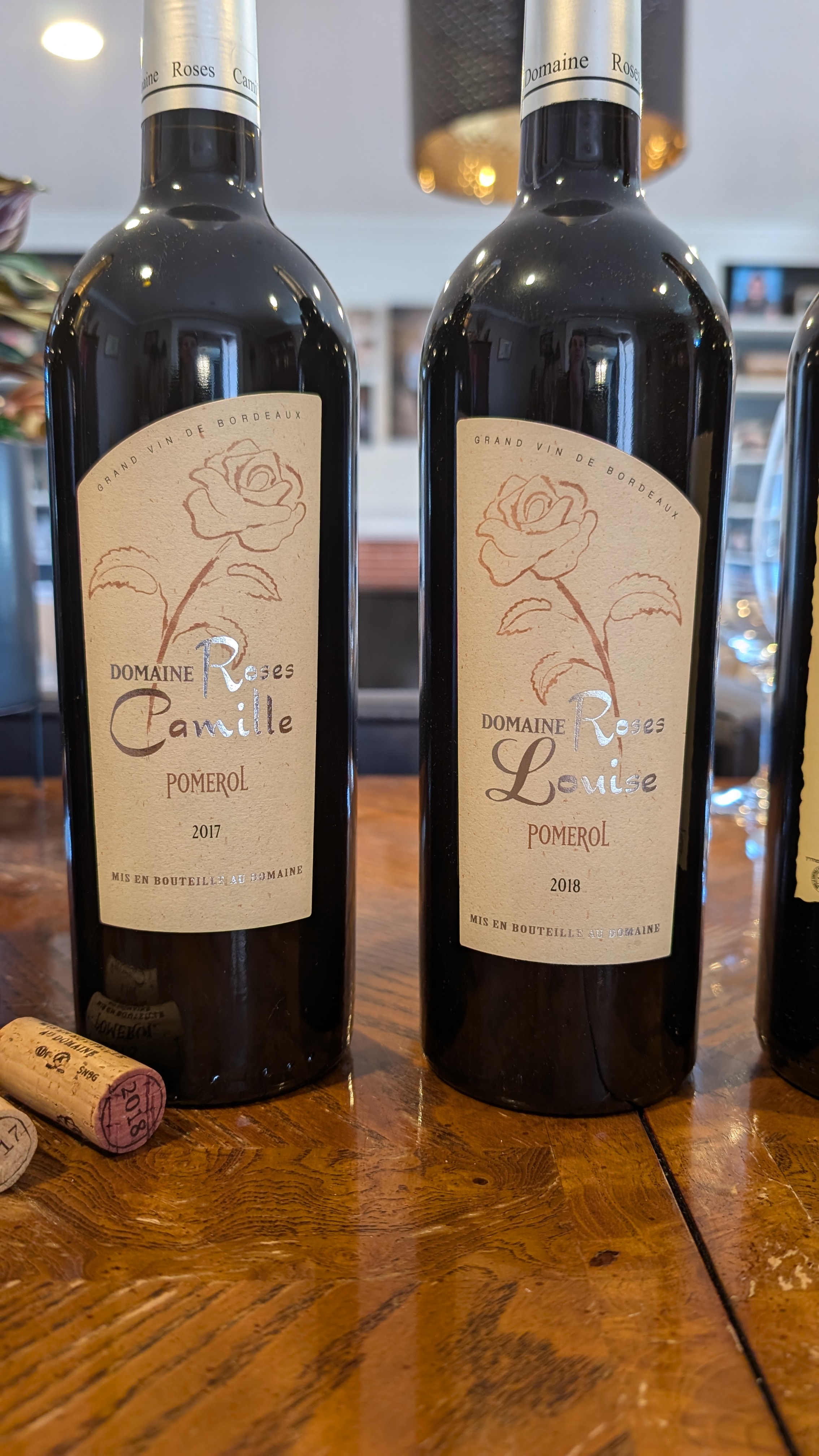
The best wine of the evening was the 2018 Domaine Roses Louise, the grapes for which are sourced from a different vineyard than those for the Camille. This wine is not new, it has been produced and sold non-Kosher for many years. This is the first vintage of a kosher Domaine de Roses Louise. We also tasted the 2017 Domaine Roses Camille, and while that wine was nice, it showed far riper than when we had it in January 2023. Still, it is a nice wine, though, at this point, from this tasting, I wonder about its longevity.
Next came the Taieb wines, and a couple of them I had already tasted in Paris, you can see those notes here and they tasted the same, which makes sense as it has only been a few months since late May. Those would be the two new wines from Chateau Tour Perey, the 2022 Chateau Tour Perey, and the 2022 Chateau La Fleur Perey. By the way, they are two QPR WINNER, so yeah, enjoy!!
After those two, we enjoyed four wines from the 2022 vintage, three of them are well-known producers from the Taieb wine portfolio and one is a new winery. The new wine is the 2022 Chateau de Come, a very nice wine indeed, and another option from Saint-Estephe, a region that has not been hitting it on all cylinders, in regards to Kosher wine production, but this one will help! The other three are the 2022 Chateau Castelbruck, the 2022 Chateau Haut-Breton Larigaudiere, and the 2022 Château Roquettes. These wines showed control and pop and are a good sign for the rest of the 2022 kosher wines from Bordeaux that are yet to be released.
After tasting the wines, the kids arrived from school, and then Elk and Alex Rubin made their entrance. It was fun tasting with Alex at Herzog Winery and it was interesting tasting with him again that night. Everyone has the things they like in wine but Alex has a very different approach to wine tasting and I enjoy tasting with him.
The evening continued with the appearance of the queen of the house, Doctor-to-be Shauna, and then Andrew cooked dinner. It was a truly enjoyable evening. After that more folks swung by and we moved outside. It was a lovely evening and a lovely day for all.
My thanks to Andrew and Shauna Breskin for hosting the tasting and for putting up with me and everyone else who crashed their home for an entire day! The notes speak for themselves.
The wine notes follow below in the order that they were tasted. The explanation of my “scores” can be found here and the explanation for QPR scores can be found here:


2020 Clos Lavaud, Lalnde de Pomerol – Score: 92 (QPR: WINNER)
The nose of this wine is crazy closed but lovely with rich cherry, raspberry, loam, dense violet, rich clay, rock, and gravel, lovely! The mouth of this full-bodied wine is dense, rich, layered, scraping, and refreshing but so astringent at this point that it is inhuman to taste, with rich loam, dirt, clay, minerality, intense acidity, black and red fruit, black plum, raspberry, cherry, and scraping graphite. The finish is long, dark, brooding, smoky, and earthy, with minerality, acidity, and fruit interplaying at all times. Fun! Drink from 2025 until 2030. (tasted September 2024) (in San Diego, CA) (ABV = 14%)
2020 Chateau Les Graves de Lavaud, Lalande de Pomerol – Score: 92 (QPR: WINNER)
The nose of this wine is deeply floral, with rosehip, violet, dense minerality, dense clay, rich gravel, and tart red fruit, really lovely. The mouth of this medium-plus bodied wine is lovely, tart, precise, floral, deeply acidic, fresh, and refreshing, with vibrant sour red cherry, raspberry, and rhubarb, with intense minerality, rich dense tannin, intense clay, gravel, and rich rock, lovely! The finish is long, tart, refreshing, grippy, gripping tannin, slate, rock, and graphite, Fun! Drink from 2025 to 2029. (tasted September 2024) (in San Diego, CA) (ABV = 14%)

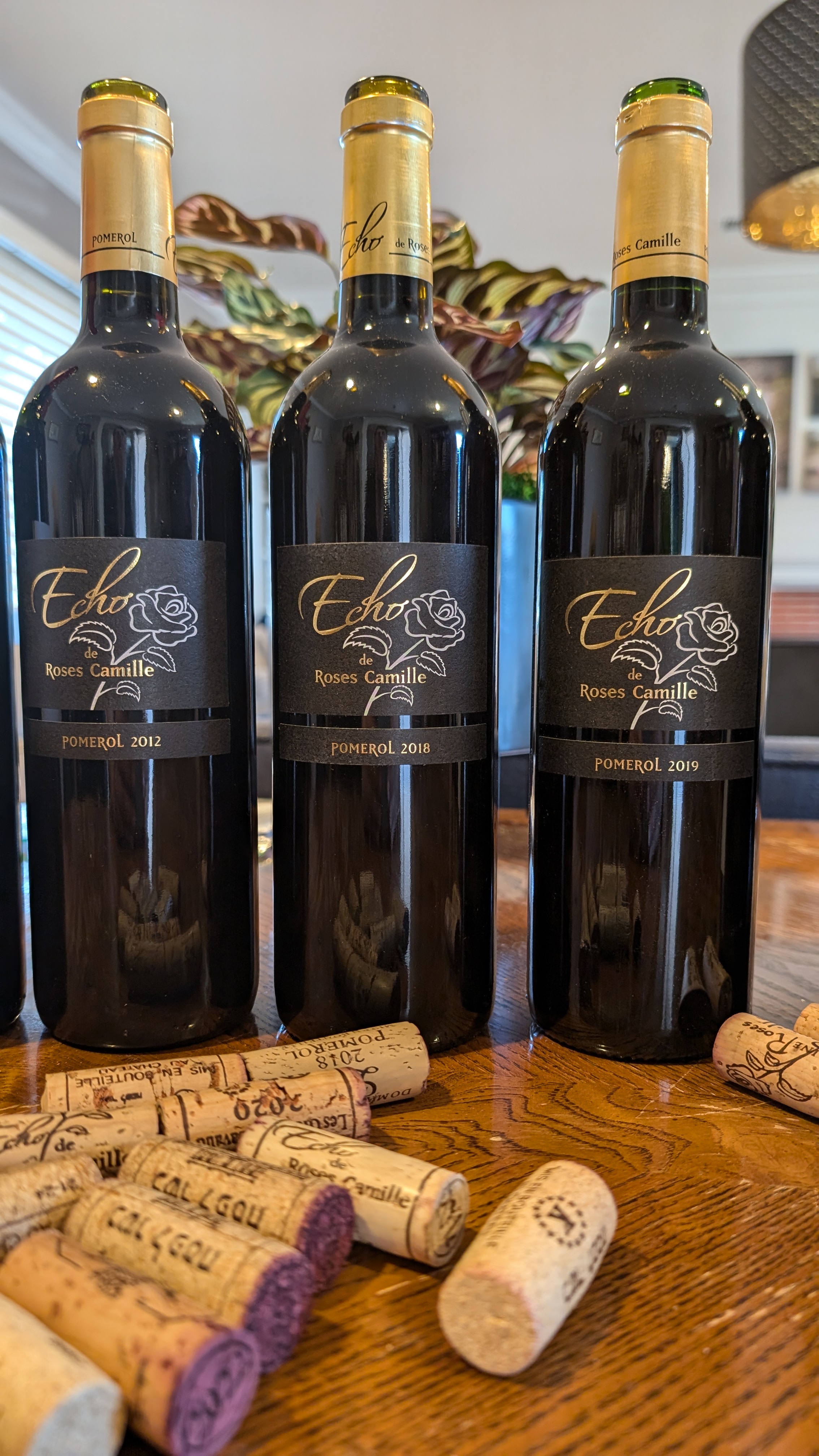
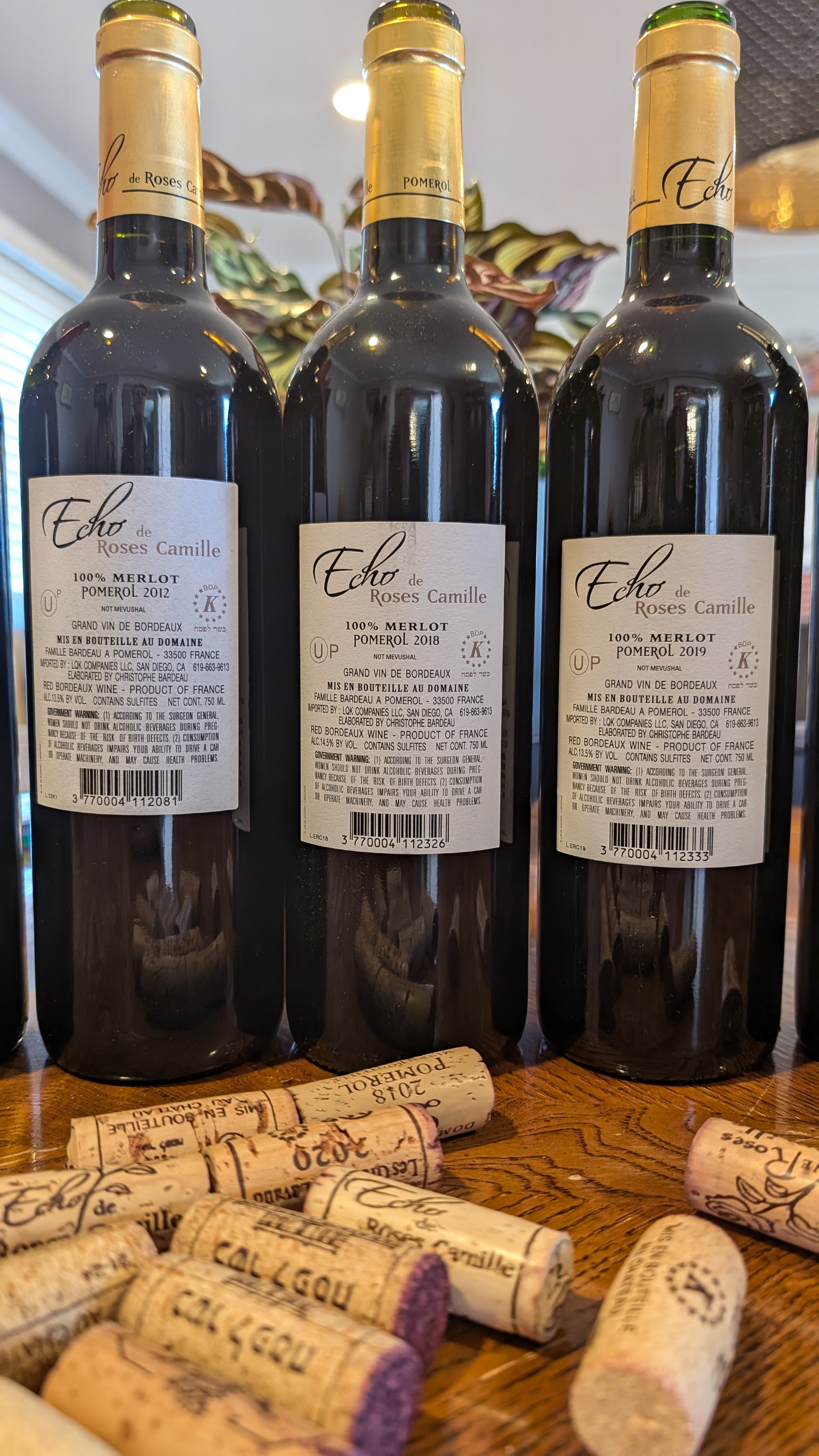
2018 Echo de Roses Camille, Pomerol – Score: 94 (QPR: WINNER)
The nose of this wine is lovely, with a classic Echo nose of wax, lanolin, and yellow flowers, some espresso chocolate, sweet oak, garrigue, loam, minerality, and roasted herbs. The mouth of this full-bodied wine has my attention, with intense acidity, gripping tannins, rich fruit, layers upon layers of concentrated and complex fruit, rich raspberry, plum, dark cherry, and strawberry, all wrapped in elegance, power, intense minerality, verve, and garrigue, wow! The minerality, tannin, acidity, and complex red fruit all work together to build a bombastic wine that is just impressive! So impressive to be doing with just red fruit. The finish is long, tannin, bold, big, and rich, with more coffee chocolate, graphite, pencil shavings, iron shavings, lovely salinity, green olives, and rich smoke. Drink from 2030 until 2040. (tasted September 2024) (in San Diego, CA) (ABV = 14.5%)

Four solid QPR WINNER from Portugal – imported by Allied Importers
Recently, I saw posts from Allied Wine Importers about Portuguese wines they were importing. I had tasted the 2022 Solar das Boucas Loureiro in Israel and posted it. I thought that would be the end of it and then I saw these posts from Allied and I had to try them. I emailed Shai Ghermezian and he was very kind to send me the wines. As always, I stated, in the email, I would post what I taste, but I already knew one of them was a WINNER.
I received the wines and let them sit for almost two weeks and then I opened them this past Shabbat. The last time I had a tasting where every wine won the QPR WINNER score, was Covenant. In the end, this is impressive and great work by Allied to get these wines here and price them well.
All four of these wines were great from opening until finishing and that is proof of a good wine. Further, these wines are not for keeping. The Alvarinho may evolve a bit more, but even if you leave it open for a few hours you will get much of what may or may not appear in a year. Buy these wines and enjoy them, leave other wines for the cellar.
My thanks to Shai Ghermezian for sending me the wines and letting me taste them. The wine notes follow below – the explanation of my “scores” can be found here and the explanation for QPR scores can be found here. The wine notes are in the order the wines were tasted:


2022 Godin Vihno Tinto, Red, Douro – Score: 91+ (QPR: WINNER)
This wine would be impossible in a blind tasting, buy it and test your friends, good luck! The nose of this wine wants to take you to Israel, no it is not date juice, at all, but is it ripe, yes! Still, the acidity, the minerality, the tart, the refreshment of it, it is just an obvious old-world wine, but go ahead and guess it! With floral notes, blue and red fruit, smoke, flint, graphite, rock, loam, and root beer, good lord!
The mouth of this full-bodied wine takes you to Israel, but then you run away, once the acidity and minerality slam you in the face, followed by rich boysenberry, plum, dark raspberry, hints of the dreaded blackcurrant, with rich tannin, acidity, and mouthfeel. The minerality is what saves this wine, along with the acidity, and red fruit. With time the tannin and acidity shine, the fruit is in balance, and then mango and red fruit pull you in, a really unique wine!
The finish is long, tart, mineral-driven, and refreshing, this is a wine that pulls you in and never lets go! Nice! Drink by 2026. (tasted September 2024) (in San Jose, CA) (ABV = 13.5%)
2023 Godin Branco, White, Douro – Score: 91+ (QPR: WINNER)
This wine is a blend of 25% Malvasia Fina, 25% Viosinho, 25% Rabigato, & 25% Fernao Pires. The nose of this wine is unique showing lemon, lime, intense minerality, orange blossom, classic beeswax, honeyed melon, orange peel, smoke, and flint. The mouth opens a bit slowly, but it shows a nice plush mouthfeel, with good acidity, and nice focus, very refreshing, and lacks complexity, but it makes up for that with the saline, minerality, lemon, lime, honeydew, beeswax, and rich saline. The finish is long, the fruit is balanced, and the minerality and salinity are really good. Drink now. (tasted September 2024) (in San Jose, CA) (ABV = 13%)
2022 Solar das Boucas Loureiro, Vinho Regional Minho – Score: 91 (QPR: WINNER)
This wine tastes just like what I had in January in Jerusalem, Israel, a very nice to enjoy! The nose of this wine is nice, showing good minerality, nice stone fruit, yellow plum, lemon blossom, and sweet tea. The mouth of this medium-bodied wine is nice, showing great acidity, nice tension, and good fruit focus of peach, apricot, yellow plum, lemon/lime/grapefruit, minerality, slate, flint, and good precision. The finish is long, tart, and refreshing, with nice fruit, acidity, slate, flint, and orange fruit lingering long. (tasted September 2024) (in San Jose, CA) (ABV = 11.5%)
2022 Solar das Boucas Alvarinho Old Vines White, Vinho Regional Minho – Score: 91+ (QPR: WINNER)
The wine has some slight effervescence and that blows off with time. The nose of this wine is very unique, the last Albarino wine we had was very different from this one, showing notes of petroleum, melon, sweet pear, almost tropical with pineapple, dried guava, dried stone fruit, and nutty oxidation. The mouth of this medium-bodied wine is balanced with great acidity, weighty, and almost plush, with more citrus, lemon, lime, petroleum, dried apricot, rich salinity, minerality, and more notes of nutty oxidation. The finish is long, and tart, with great minerality, saline, sea salt, sea spray, rock, and more roasted walnuts, very unique wine, and one I think can age and evolve a bit more. Drink until 2026. (tasted September 2024) (in San Jose, CA) (ABV = 13%)

Herzog Winery Visit and KFWE VIP Experience 2024 – another successful event
Six-plus months ago, Kosher Wine had its start to the wine-tasting season, for 2024. First, it was a trade-only KFWE (Kosher Food and Wine Festival in New Jersey), then the Jewish Link Grand Wine Tasting (also in New Jersey), and then A Wine & Food Night by KWD, in Brooklyn. I wrote about the three-day extravaganza here in this post. In the long post, I wrote that I thought it was time to move from the public-laden KFWE Kiddush to the more nimble area-based tastings. The scale of the three tastings, even the KFWE-trade tasting was far more in line with what people needed to taste and be educated. Still, there was no public option for Royal wines, but actually, the two tastings were better for Royal than KFWE could ever be. The point of the area-focused tastings was to make sure that the people who live in those areas are represented by what they may wish to taste. I hope that in the coming years, the wine stores will be allowed to weigh in on what wines should be showcased at these area-specific events, from massive portfolio distributors, like Royal.
In the post, I wrote that the ball was now in Herzog Winery’s court to bring back the IFWF of old. The vast majority of the people at the KFWE VIP Experience 2024 event at the Herzog Winery in Oxnard, this past week, came and left experiencing EXACTLY what I hoped for 6+ months ago. Herzog did exactly what it was supposed to do, it highlighted the quality of their wines and the quality of their restaurant, and it allowed Royal to curate the wines it wanted to promote to the folks in Southern Califonia, whether that was actually implemented or not.
I will say, that I hope Herzog Winery continues this idea, having a more intimate interaction/experience for their customers, by hosting the event at the winery. It showcases what they do/have best. The naming (AKA KFWE) I think is a mistake. The point here is that it was NOT a KFWE, it was a Wine and Tierra Sur Tasting at Herzog Wine Cellars, with a smattering of other wines. That overall approach used to be called IFWF (International Food and Wine Festival). However, that was also a misnomer, as the focus was more on Herzog and some French wines, even in 2008. In the end, trying to sell this event as anything more than Herzog and Tierra Sur undermines what Herzog sells. With that said, no one left there unhappy, to me, and from whom I spoke at the event, it was a hit and it should be continued!
Herzog Wine Tasting
A few hours before the KFWE event took place, Elchonon Hellinger, owner of Elk Wines, and I made our way to Herzog Wine Cellars to taste some Herzog wines I had yet to taste. Before Elk arrived I was speaking with Joseph Herzog (Vice President and Partner) and David Galzignato (Director of Winemaking and Operations) about many a thing and the California 2021 vintage came up. Up until this tasting, I had tasted all of the 2021 wines that were released, except for a few. With all of them, I was highly impressed and posted about them a few times, here, here, and here. The wines before me, other than a few 2021 wines, were all from the 2022 vintage. I can tell you now, the 2022 vintage does not show as well as the 2021. Simple. It is riper, less controlled, and feels like one that may not age as well. That said, at the end of the wine tasting I made this statement, the work you have done over these past two years clearly shows that you have raised the floor for Herzog Wine Cellars. The issue I have is that fewer wines push the ceiling, at least these past two years, than in previous years. I am sure that has a lot to do with the viticulture and the direction of the winery, as a whole, and I think that overall it is a win.
With that said Herzog Winery continues to win as the top Mevushal wine option every year. They also do very well with the QPR (Quality to Price Ratio) Wines. I expect them to be on those lists every year, Herzog Wine Cellars excel at the Mevushal Process and they excel at making quality wines for a reasonable price, across their portfolio, and with the work of David and his team, they have raised the floor of those wines over the past two years.
The Yesod Wines, a new wine label, does not show the name Herzog anywhere on them. It is their first foray into making some of the best wines in the world. While tasting them I said that while I feel the work in these wines, the clear effort to raise the floor of the overall wine approach, it lacked the pop for me. The best wines in the kosher world, when you smell them, make you salivate, they make you want to taste more, and the alcohol levels on them allow you to do that without feeling off-kilter. The Yesod wines, in my opinion, are well-made wines for the sort of Kosher wine drinkers that are targeting. Classic Napa wines with a big body, enough acidity, and loads of fruit.
The wines I oohed and aahed about were the 2023 Herzog Chenin Blanc, Clarksburg Reserve (mevushal), and the 2022 Herzog Cabernet Sauvignon, Napa Valley, Special Reserve. Why? Because, in the past, these two wines (Herzog white wines in general) and the Napa Blue Label Special Reserve Cabernet Sauvignon, were rarely on point. These two wines showed me the biggest change, the raising of the floor, and the focus, overall. A steady-eddy approach to winemaking, which may not garner you as many ceiling-pushing wines, at the start, but an approach that raises everything and one that I am sure will eventually get Herzog to even further heights.
My many thanks to Joseph Herzog, and David Galzignato for setting up the meeting, sharing your wines with us, and taking time out of your busy schedule (the day of the event!) to meet with us. The wine notes follow below in the order they were tasted – the explanation of my “scores” can be found here and the explanation for QPR scores can be found here:
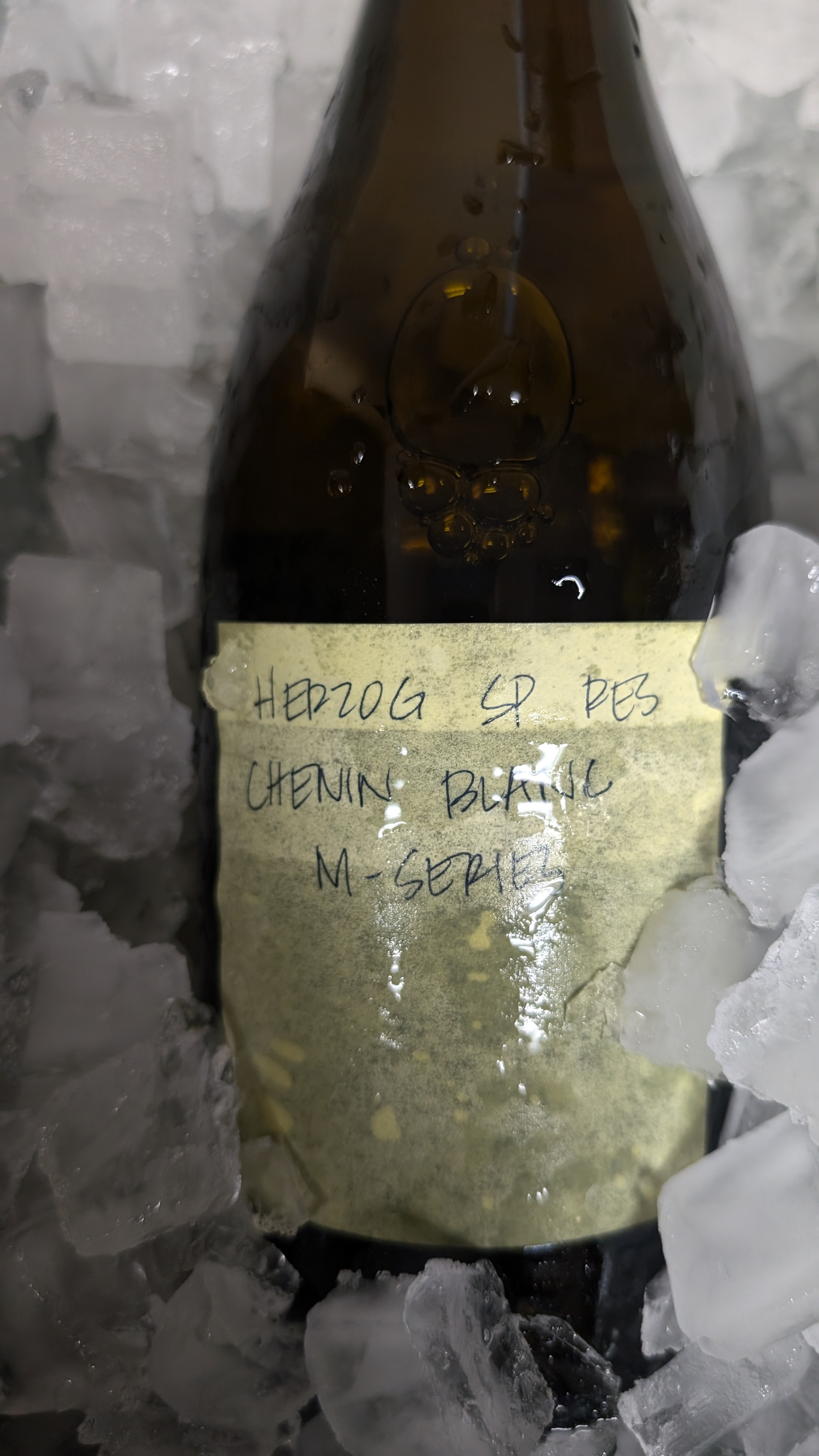
2023 Herzog Chenin Blanc, Clarksburg Reserve, Clarksburg, CA (M) – Score: 92 (QPR: WINNER)
The fruit had botrytis, modeled after Savennieres, old vines Chenin Blanc. The nose of this wine is lovely, showing white peach, pear, apricot, quince blossom, rich honeysuckle, pear blossom, sweet Lipton lemon tea, and sweet oak. The mouth of this medium-plus-bodied wine is fun, it is bone dry, showing great acidity, lovely mouthfeel, almost oily, with a lovely plush mouthfeel, starting with Lipton tea, honeysuckle, honeyed melon, pear, white peach, lovely mouthfeel, a true joy! The finish is long, tart, funky, and rich, with green notes, floral notes abound, and bone dry and rich sweet oak. Drink by 2028. (tasted September 2024) (in Oxnard, CA) (ABV = 14.50%)
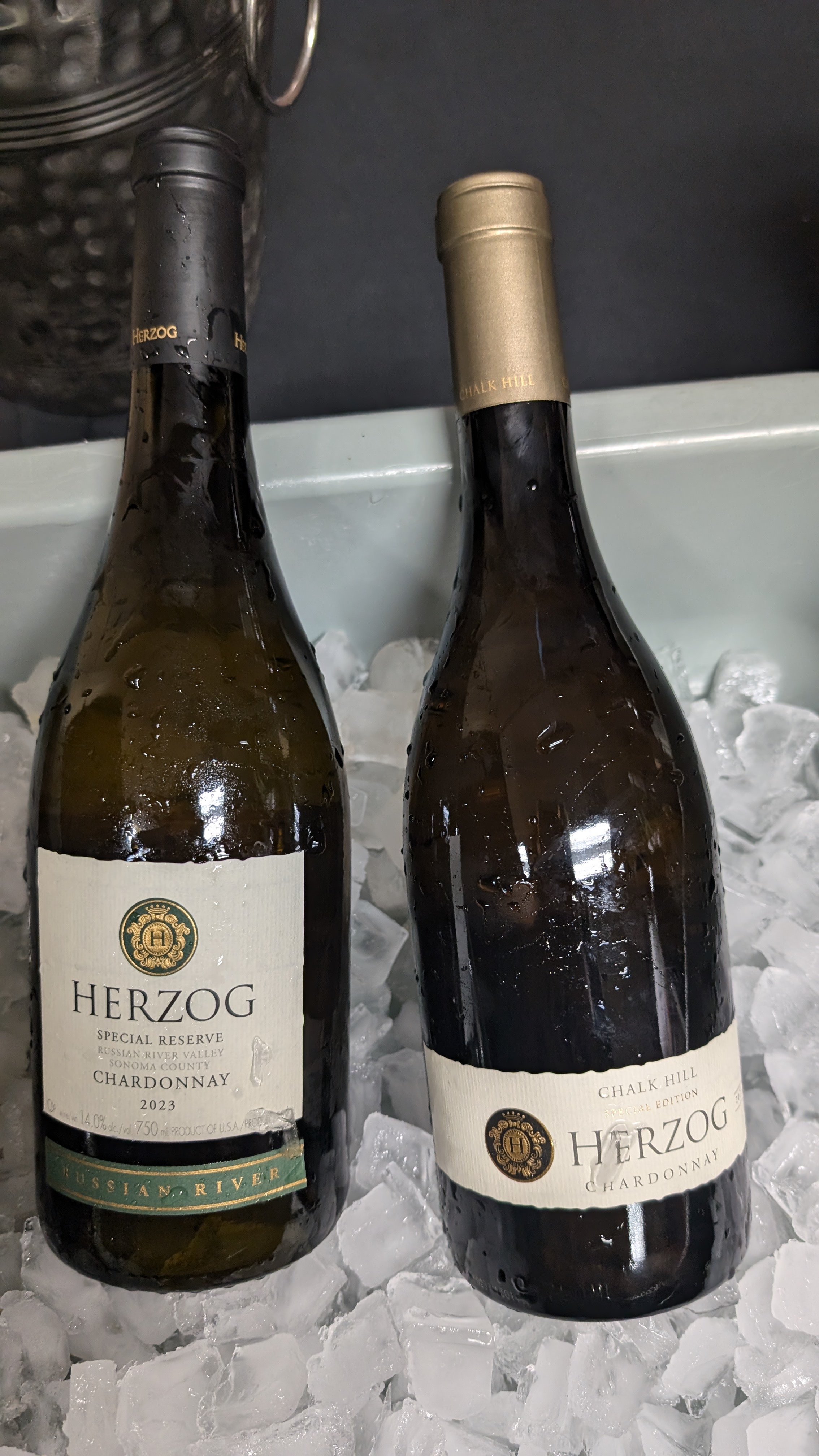
2023 Herzog Chardonnay, Russian River, Russian River, CA (M) – Score: 92 (QPR: WINNER)
The nose of this wine is lovely, tropical, fruity, smoky, and ripe, with hickory, sweet vanilla, butterscotch, sweet dill, and peach/pear. The mouth of this medium-bodied wine is ripe, and balanced, with lovely acidity, with rich pear, apricot, sweet oak, butterscotch, buttery brioche, and sweet dill, with rich sweet fruit that works with the American Oak. The finish is long, ripe, and a bit candied, but balanced with great acidity, smoke, rich vanilla, hints of banana, and oak. Drink by 2028 (tasted September 2024) (in Oxnard, CA) (ABV = 14%)
2023 Herzog Chardonnay, Chalk Hill, Special Edition, Chalk Hill, CA (M) – Score: 92 (QPR: WINNER)
The nose of this wine is nice with great bright fruit, lovely tart peach, pear, melon, and great sweet oak. The mouth of this medium-plus-bodied wine is lovely, tart, and balanced, with rich acidity, nice smoke, and good weight, showing pear, peach, melon, and hints of tropical, but balanced, and nice focus with good oak. The finish is long, and tart, with no butter here, great wine, more Chablis than Burg in style. Nice! Drink by 2028 (tasted September 2024) (in Oxnard, CA) (ABV = 14.50%)

KFWE VIP Experience 2024 is coming to Herzog Winery! Get your tickets!

I have written often about the need for wine education. People walk into wine shops or go online and they are offered an ever-growing list of kosher wine options. The dream is for those organizations to have local tastings, helpful employees, and wine managers. Some do, but then you are always left with the nagging question of whether that person is biased or if they are looking out for the customer? I am not talking of any one wine store, this exists in the world of kosher and non-kosher. Ultimately, the customer is best suited to find the wine that they want. The issue is how they can learn that without tasting the wines?
So, for the longest time, I have been telling folks to go to the larger wine tastings, like the ones that occurred earlier in the year. In the post wrapping up the week of wine tastings on the East Coast, I stated what was needed was a return of KFWE to LA, more akin to its early days, when it was called the IFWF (International Food and Wine Festival).
Some 12 years ago, Herzog Wine Cellars put on an event to commemorate their 25 years in the wine business, It was the IFWF but in August! Then they did it again in 2014, !! This year, Herzog is pulling out all stops, and once again, the IFWF (now called KFWE VIP Experience) is returning to Oxnard CA! I have always said, KFWE belongs at the winery. It is the best way to show off the wines, the winery, and the people so deeply connected with the wines that are produced!
From what I have read so far this is a limited event, much like the one in 2012, with just One Hundred and Fifty tickets, which are selling fast, and a lineup that will feel like KFWE, just in LA! The wines are all Royal Wine offerings. This VIP event will feature wines from the most prestigious areas around the globe, featuring Old World wines from Spain, Italy, France, and Portugal as well as New World favorites like Israel, Australia, South America, and The United States. Your ticket includes access to all the wines, spirits, and all-you-can-eat from a wide variety of treats prepared exclusively by Chef Austin and the Tierra Sur team.
Those wines will be paired with the wonderful food from the Tierra Sur restaurant, which will be producing dishes to pair with the wines. There will also be a long list of spirits to enjoy.
The event is taking place at the Herzog Winery (3201 Camino Del Sol Oxnard, CA 93030) on September 10th starting at 6 PM.

Four Gates Frere Robaire Vertical (2006 through 2016)
OK, like everything in my life, this is getting posted later than I would have liked. I have been running behind on many posts, but now, I feel I am almost there. I can see the finish line, though sadly, a good MONTH-plus late, but hey better late than never.
As you all know, I am a huge fan of Four Gates Winery, and yes Benyamin Cantz is a dear friend. I have often written about Four Gates Winery and its winemaker/Vigneron Benyamin Cantz. Read the post and all the subsequent posts about Four Gates wine releases, especially this post of Four Gates – that truly describes the lore of Four Gates Winery.
There is another post that will help comprehend the magnitude of this tasting – this was a post back in 2016! Eight years ago we did a partial vertical of the flagship wine of Four Gates Winery, known as Frere Robaire.
The Frere Robaire was a wine that was first released in 2006, when it was a blend of Cabernet Franc, Merlot, and Cabernet. It then went on a 3-year hiatus, when it was released again, but this time it was majority Cabernet Sauvignon from the Monte Bello Ridge vineyard, and fleshed out with a bit of Merlot. Since then, it has been released in all vintages (other than 2017). The 2006 is mostly Cabernet Franc, but the percentages change with the years, based on what best works together. The 2010 was mostly Cabernet Sauvignon. The 2011 and the 2012 are mostly Merlot in makeup, with differing amounts of Cabernet Sauvignon. Those three have 1% of Cabernet Franc. The wine’s name was created in honor of Benyo’s brother Robert Cantz.
Tasting
This post is late – the tasting took place in mid-February, 2024. It was a perfect day for Robert to make his way to Chez Benyo. I brought the meat and Benyo provided the wine. It was a very simple transaction. It was a ton of fun to cook on Benyo’s suitable but antiquated charcoal grill. I arrived via Uber early, cooked the food, and we were ready to start tasting.
The plan from the start was to get Robert up from L.A. to visit Benyo and then we could have dinner during an evening close to Shabbat so that they could enjoy the wines over Shabbat.
I brought a bottle of 2016 Chateau Malartic, and while it did not show well, that evening, compared to the other Frere Robaire. I have said often that the Frere Robaire reminds me of the Malartic.
We started the tasting, pretty much on time, and we were two or three wines in when in a classic LA move (arrive late and leave early – though they left later), in comes Gabriel Weiss and Alex Rubin. Gabriel Weiss is the winemaker at Shirah Wines. Alex Rubin is another winemaker who works with Gabriel at Shirah Winery and also produces his own wines. One is the 2022 Alex Rubin Riesling, which I raved about here, along with many Shirah whites, as well.
I will say it is always an experience when you taste with vocal winemakers. They have a very unique manner in which to taste wine and the notes they proclaim, while on point, can come out in weird manners, or verbiage. I say that all with the greatest of respect, the stuff they were chattering about, while again, on point, was almost in an entirely different language. It was great!!
They hauled up even more meat, which was overkill, but Benyo has more than enough now for a year! Remember, Benyo rarely eats meat, more like fish, veggies galore, and some occasional chicken. When the “bachurim” crash, then the meat comes out and overtakes his life. It is always entertaining to see Benyo being uncomfortable in his own skin and home. In the end, getting him out of his comfort zone is always good! While I always try my very best to keep him comfortable, I am sure I also push a bit too much.
The tasting lasted a few more hours, and then one by one, the gang went down. Benyo and I cleared the table (of course Robbie helped as well – but he was the guest). All the while making sure to leave enough of all the wines to taste again tomorrow and over Shabbat!
Methodology
I will say that the scoring changed often throughout the night and for that, I think we need to set the methodology straight for this tasting. First of all, I am not sure how many even have a 2006 Frere Robaire lying around, but if you do, drink now! I think that wine was never meant for 20 years and I doubt many kept it at the correct temperature. Still, the complete vertical from 2006 until 2016 (excluding the 3 years between 2006 and 2010) was a very unique and insane tasting!
Benyo also opened a GLORIOUS 2004 Chardonnay – it was luscious, rich, layered, and it tasted so much like a Burgundy it was crazy!
Now, people seeing my scores will wonder why are they all over the place – well that is what the wines tasted like, at this moment. The 2011 vintage just did not show well, I will need to taste one soon from my own collection to make a decision. Other than 2006 and 2011 – the outcome here is they are doing well and some are in the window and enjoyable now! They may improve more, but some are already showing the mushroom and the barnyard, not full-on evolution but close enough. I am hoping for a bit more but if you have a few I would read the notes and decide for yourself.
The Frere Robaire is a blend made to truly live up to Aristotle’s axiom; “The whole is greater than the sum of its parts.” In many ways, I find it reaches that lofty goal, because the sums are made up of wonderful parts, but the whole is another world. What I love about these wines is that they are new-world, but they have so many components that are more old-world than new-world.
The 2012 is a great example of this. Once the wine is given time to open and really show its inner sense, what comes out is an old-world soul, much akin to a 2005 Chateau Malartic. The wine shows its minerality, rich essence, and focus, but also richness from its dark fruit. Really impressive.
My sincere thanks to the boys from LA! Gabriel and Alex were a joy to taste with. My many thanks to Benyo and his love, care, and drive to build world-class wines and share them with us all! Finally, it was a blast, as always, to hang with Robbie! Sorry, it took so long to get this out, good sir! Always a great time!
Finally, there are no QPR scores here because these wines are not for sale and the “Price” ratio would not make much sense.
The notes speak for themselves. The wine notes follow below, in the order, they were tasted – the explanation of my “scores” can be found here and the explanation for QPR scores can be found here:
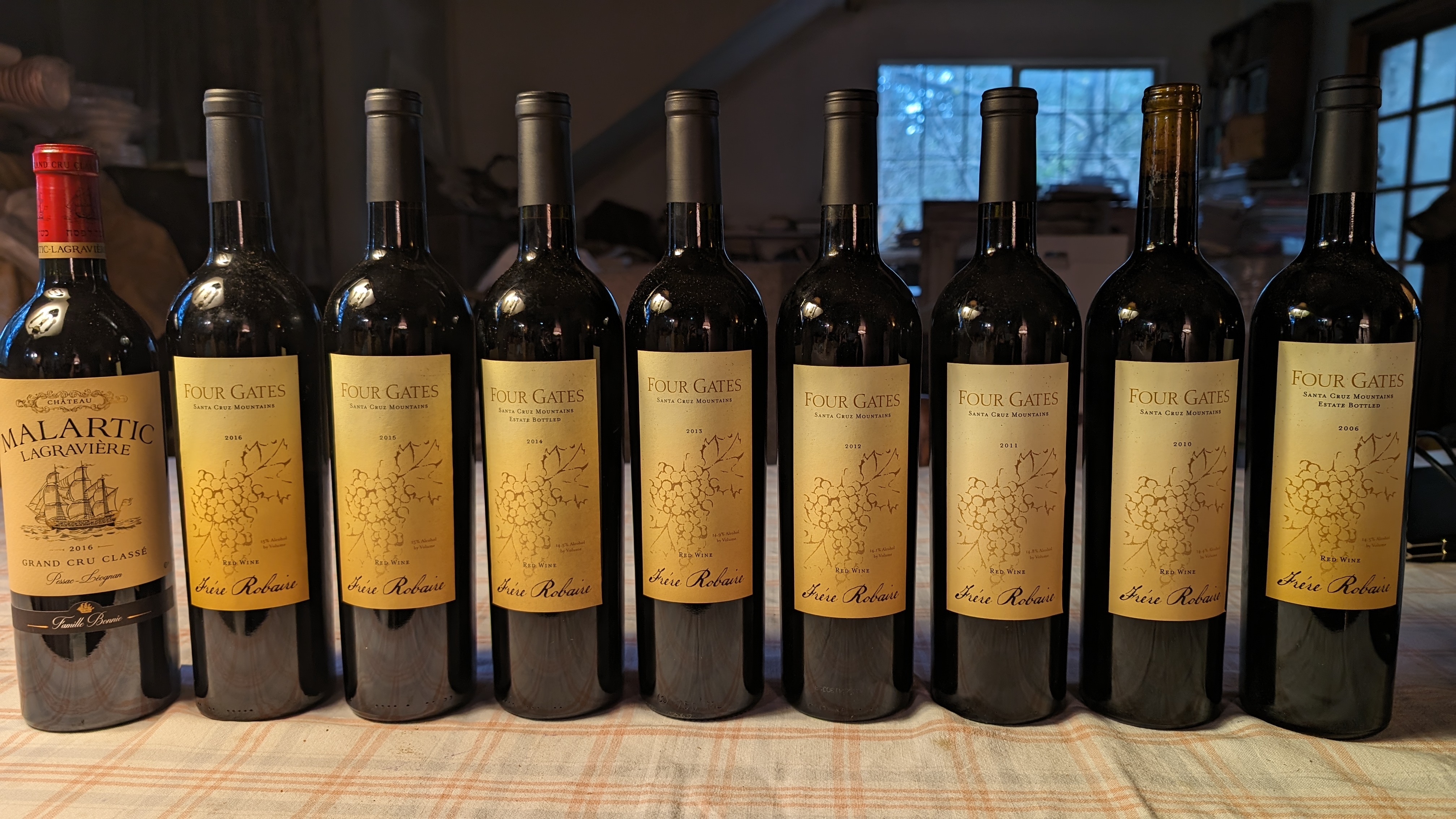
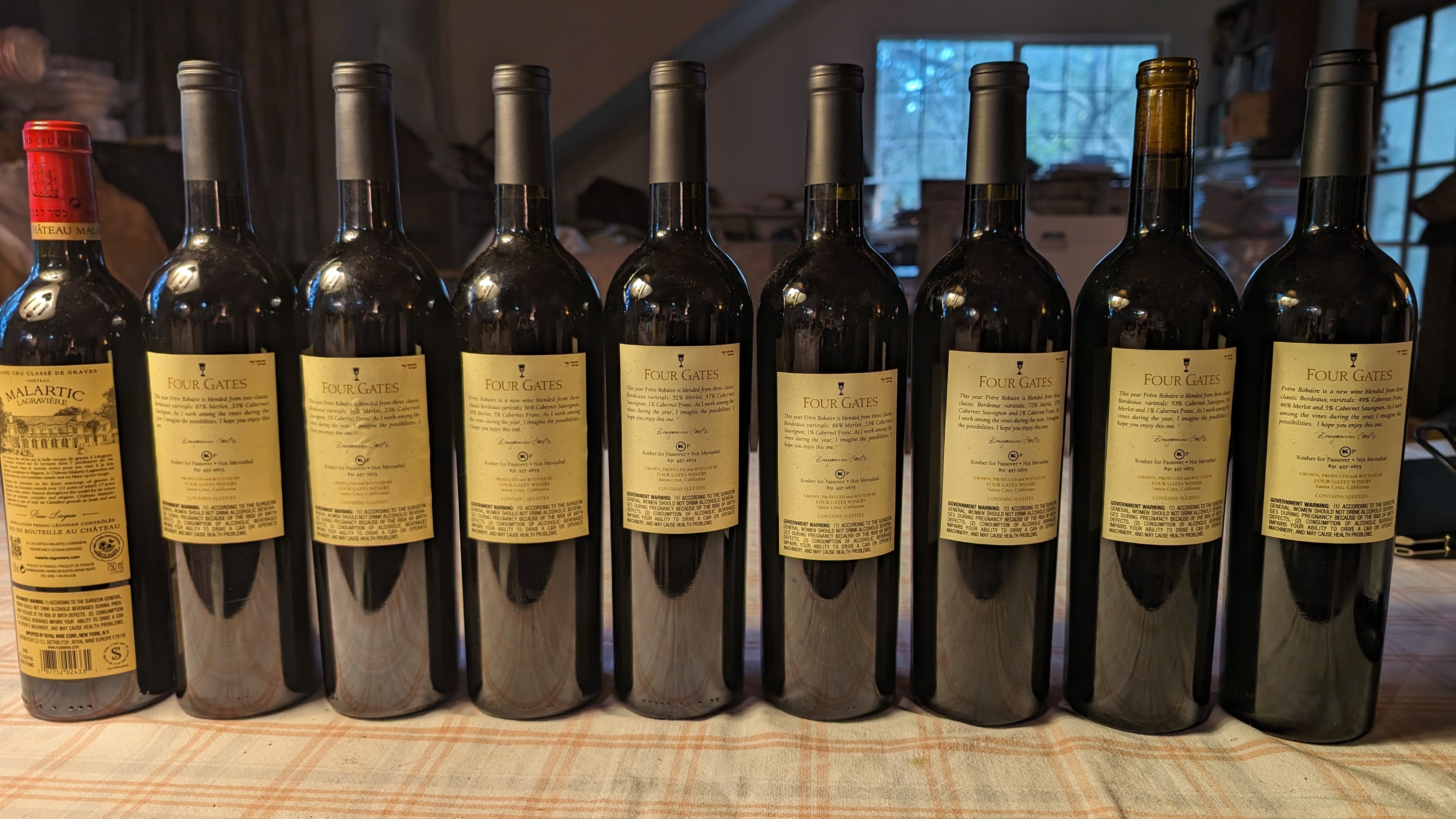
2004 Four Gates Chardonnay – Score: 94
The nose of this wine is lovely, understand please, that this wine is on the edge, this bottle was clearly stored well, but I would not have as much hope for another. The nose is rich with honeysuckle, butterscotch, pear, apple, and sweet spices.
The mouth of this medium-plus bodied wine is rich, layered, and plush in the mouth with rich acidity that helps to stand this wine up on its feet, the apple, pear, and citrus are present, along with the sweet oak, butterscotch, and sweet spices. The finish is long, balanced, and rich. Drink now!

 Wine Musings Blog