Blog Archives

The Top and Best 34 QPR Kosher Wine WINNERS of 2024
In May 2020 I wanted to drive home the need for QPR (Quality to Price Ratio) wines. So I set out to create what I thought a QPR metric should be! Gone were arbitrary price ranges and such. Instead, I let the market define what the QPR price range should be. I did this by grouping the wines by their type (white, red, rose, sparkling, and dessert) and then further refined the grouping by age-ability within the white and red wines. This gave me the following groups:
- Drink “soon” White Wine (Simple whites)
- Rose Wine (always drink soon)
- Drink “soon” Red Wine (Simple reds)
- Mid-range aging Reds (4 to 11 years)
- High-end Red wines (11 and more years)
- High-end White wines (7 and more years)
- Sparkling Wine (No need here for extra differentiation)
- Dessert Wine
I then made the mistake of trying to create an Orange wine range/group – that was a HUGE mistake. Again, the wines themselves were not the issue, the issue revolved around trying to group such a small sample set into its group. They will go into their respective white wine category, next year.
Throughout the year, I posted many QPR posts, for almost all of the main categories. I will continue down this road until I find a better way to categorize and track wines that are QPR WINNERS. Talk about WINNERS, that secondary QPR score was a 2.1 revision to my QPR scoring, and that is explained in this post. All the wines listed here are QPR WINNERS from my tastings in 2023.
Let us discuss the approach
I have heard from a few of you. I do not understand your QPR (Quality to Price Ratio) scoring. So, let us take another shot at this! Every time a customer comes into a shop or goes online to buy kosher wine, they have a choice of a few thousand wines, online, or many hundreds in a store. The question is how does a buyer differentiate one wine from the next?
If they like Terra di Seta wines, as I do, and it costs 30 dollars, then he/she will compare other wines to that wine, in regards to the wine and the price. That is the same for any wine they like and any wine they are looking at buying. Price matters! Now, the real question is how can you compare two wines to each other. Any two wines in the world of kosher wines? What characteristics can you use to compare them?
Let us say they like the 2022 Elvi Wines Clos Mesorah. It is a red wine from Montsant, Spain. OK, what other wine can you compare with it? You can compare other Montsant kosher wines, like the Cellar Capcanes wines. However, the Cellar Capcanes wines have an issue – they have been poor for many years! As the ratio states it is QUALITY to price! Quality is primary; once you have a good wine, you can compare it with similarly good wines.
OK, so we need equal or comparably equal quality and that is it??? So, let us say there exists a rose from Montsant that scores the same quality score as Clos Mesorah, are they comparable (by the way no such wine exists!)? What about a white wine – same? Can/should someone compare them? The answer is no, of course. People will compare similar items. OK, are we then forced to compare ONLY Montsant wines with Montsant wines? Of course not, that is NOT how people think. People will compare like-scored red wines with like-scored red wines. Further, there are literally SIX Monstant Kosher red wines on the market. How can one compare six wines to each other? It has no value.
So, the question remains how do we compare two wines? What criteria can we use to compare them? The first step is for us to agree that people will compare wines that are similar in style, but not in locale, region, or price. So what is that characteristic that they will use to compare two arbitrary kosher wines? Price IS NOT the answer.
So, let us recap – we have two similarly scored wines (AKA quality) but they are very different in many ways. Let us look at three of the wines below, two of which are from the greater Medoc region:
- 2022 Chateau d’Agassac Cru Bourgeois, Haut-Medoc – Score: 93+ (QPR: WINNER)
Drink until 2038 - 2022 Chateau Fourcas Dupre, Listrac-Medoc – Score: 93 (QPR: WINNER)
Drink from 2034 until 2040 - 2022 Chateau Royaumont, Lalande de Pomerol – Score: 93 (QPR: WINNER)
Drink from 2030 until 2038
These wines sell for between 38 dollars and 60 dollars. So, are these wines comparable? I would state they are, and further state that wine buyers compare them every time they read my lists and other lists that like these wines. Again, the primary requirement is quality – these all scored roughly the same quality score.
So, next, would you at least compare two Medoc wines to each other? The Chateau Fourcas Dupre and the Chateau d’Agassac? I would say yes for sure. Well, why is the Royaumont any different? Of course, they are very distinct wines, but in the end, what do oenophiles buy such wines for?? To store them and share them at a later date, meaning that wine buyers classify wines by regions, but ultimately they classify them by their ability to age gracefully or not! This means some wines age beautifully, and many will be good to enjoy in the coming years.
So, now you see the logic to the categories I use to compare wines – this is the list once again:
- Drink “soon” White Wine (Simple whites)
- Rose Wine (always drink soon)
- Drink “soon” Red Wine (Simple reds)
- Mid-range aging Reds (4 to 11 years)
- High-end Red wines (11 and more years)
- High-end White wines (7 and more years)
- Sparkling Wine (No need here for extra differentiation)
- Dessert Wine
Essentially, ignoring sparkling, rose, and dessert wines, there is white wine and red wine. Each of those two major categories is broken into their age-ability. Red wines have three age ranges while white wine has two. Then there are the other three aforementioned groups, rose, sparkling, and dessert wines.
Once you have scored a wine – IRRELEVANT to the price – this is KEY, you must place that wine into one of the 8 categories listed above. Once you have done that, any wine in that category is available for comparison. Using the median approach, wines are stacked and ranked by their price, within that category, and some rise above others, by having an equal or better quality for a lower or equal price. Please read more about this here and here.
The Summary
Before we get to the list of the best QPR wines for this past year, I wanted to give you some raw stats. I tasted more than 1200 wines this past year. In actuality, it is probably far more, I just did NOT care to write notes on hundreds more because all it would have said was NO. I made sure to taste all the Israeli wines at three KFWE, and while some were worthy of notes, none garnered these scores. The pain was all I remember. In the end, 188 wines were scored with a QPR score of WINNER, for the blog year 2024.
I have stated it over and over again now, there is no way we can buy all the good wines out there unless you have a local warehouse to store them and you drink two or more bottles a day. That is the excellent news about Kosher Wine today! I hope we have not yet hit peak QPR WINNER Wine.
This year, the list came to a total of 34 names, and none had to dip below 93 in the scores, which is a large number and better scores overall than last year, but again, the pool from where they are culled continues to grow, and the diamonds in the rough are getting harder and harder to find. This year, there are 34 or so QPR WINNERS who scored 93 this year but not in a single area.
The 4 regions that encompass the 34 WINNERS are in order of size, France (27), Spain (4), USA (2), and Hungary (1). Within France, it is not all Bordeaux! There are wines from Bordeaux, Burgundy, and Chateauneuf du Pape.
Of the 34 WINNER, 4 of them are white, 28 are red, and 2 are sweet. However, at the lower price and quality QPR WINNERS (think 20 dollars 91 scoring wines), you will find that white wines are the majority!
This year we have 9 wines that are a WINNER in Europe and the rest of the world and NOT in the USA.
- The 2020 Chateau Haut Brisson) is because of pricing here in the USA.
- The 2023 Domaine Raymond Usseglio & Fils Chateauneuf du Pape, Blanc is not the same here in the USA as it is in Europe. I have no idea what happened to it but the quality is vastly different.
- The 2021 Tokaj-Hetszolo Tokaji Aszu 6 Puttonyos is because of pricing here in the USA.
- The 2020 Chateau Haut Brisson is because of pricing here in the USA.
- The 2022 Chateau Royaumont is because the wine is Mevushal here and not as good, though still a WINNER, but not at the same quality.
- The 2022 Les Roches De Yon-Figeac is because the wine is Mevushal here and not as good.
- The 2022 Chateau Gazin Rocquencourt is because the wine is Mevushal here and not as good.
- The 2022 Chevalier de Lascombes is because the wine is Mevushal here and not as good.
- The 2022 Château Olivier Grand Cru Classe is because of pricing here in the USA.
- The 2022 Chateau Haut-Marbuzet is not available at all here in the USA.
Sadly, there were no new Sparkling or Rose wines to make it to the score of 93 and to meet its counterpart pricing. To me this is a HUGE issue in the kosher wine market! The kosher wine market has lifted up one of the previous sad wine categories, white wine! Which is HUGE! Sadly, we have not moved from there. We have a dominating red and white kosher wine scene. What is lacking sorely, is quality, sparkling wines! The rose wines will never reach the upper echelons, at least in the Kosher wine markets! However, there is actual demand for sparkling wines, and sadly, the products being sold are nice, but the prices are too high, or the quality is too low.
Maybe, Avi Davidowitz, from Kosher Wine Unfiltered, can create a list like that for Israel, this year, a bunch of wines became available there, and a proper QPR list would be worthwhile!
The wines on the list this year are all available here in the USA, and in Europe, and a few can be found in Israel, as well. The wine notes follow below – the explanation of my “scores” can be found here and the explanation for QPR scores can be found here:
2022 Elvi Wines Clos Mesorah Garnatxa, Montsant – Score: 95 (QPR: WINNER)
The nose of this wine is lovely. It pops with intense brightness, followed by a massive attack of ripe but controlled fruit, dense minerality, rich salinity, intense graphite, lovely cloves, cinnamon, warm spices, loam, dirt, earth, lovely raspberry, strawberry, and ripe/bright red berries. WOW! With time, the wine becomes even more complex, showing floral notes, ripe fruit, and lovely sweet spices. Bravo!
The mouth of this medium-bodied wine is so elegant, complex, and singular in grape, and there is nowhere to hide in this bottle; it is complex, lithe, rich, and layered but intensely refreshing. This wine is the Pinot Noir of the Rhone and Spain; there is nowhere to hide, and yet the wine is so impressive. This wine is pure black magic; it is ripe, lithe, tart, acidic, elegant, and dirty, all in the same glass, and yet this is a wine that does not exist in Kosher. Sure, there are lovely blends, but a wine this ripe that is also elegant, lithe, and smoky, you want to drink it all!
The mouth is lovely, ripe, layered, elegant, and toasty, with sweet spices, lovely raspberry, and strawberry, nice umami, really fun, expressive, and captivating; it is so unique and special, with umami, and mouth-drawing elegance, WOW! Bravo! The finish is long, dirty, earthy, smoky, and umami-dense, with great graphite and ripe, mouth-draining tannin. Dirt, minerality, graphite, ripe and tart red fruit, and intense acidity linger long. Drink from 2030 until 2036. (tasted December 2024) (in Clos Mesorah, Spain) (ABV = 15%)

The Best and Top 25 Kosher Wines of 2024, including the Wine of the Year, Winery of the Year, the Best Wine of the Year, the Best Mevushal Wines of the Year, and Best QPR Wine of the Year Awards
First, I must start this by saying I am sorry for this being two months late. The late tasting of the 2022 wines in Paris pushed all the dates forward. Such is life! It was worth tasting those wines in their correct place. As stated below, I love at KFWE, but it is not a place to taste wines for a blog or a post. It is a place to taste wine and know if I should taste it in the correct setting. It is an excellent filter to help fine-tune the wines to sit down with.
Like last year, I wanted to make this post short and sweet – so the criteria are simple. I could care less about price, color, or where it was made. All that matters is that it is/was available this year sometime to the public at large, that I tasted it in a reliable environment, not just at a tasting, and that it scored a 94 or higher. PLEASE NOTE the improved quality of the top wines this year! This is the best year – that I have posted about – in regards to scoring. All 25 wines are 94 or above. The closest we had before was the 2021 blog year, which had a fair number of 93+ scored wines.
We are returning with the “Wine of the Year,” “Best Wine of the Year,” “Winery of the Year,” “Best White Wine of the Year,” “Best QPR Wine of the Year”, along with the – “Best Mevushal Wine of the Year.” Wine of the Year goes to a wine that distinguished itself in ways that are beyond the normal. It needs to be a wine that is readily available, incredible in style and flavor, and it needs to be reasonable in price. It may be the QPR wine of the year, or sometimes it will be a wine that has distinguished itself for other reasons. The wines of the year are a type of wine that is severely unappreciated, though ones that have had a crazy renaissance over the past two years. The Best Wine of the Year goes to a wine well worthy of the title.
The Mevushal wine of the year is something I dread. I understand the need for a wine that can be enjoyed at restaurants and events. Still, when we start seeing Château Gazin Rocquencourt and Chevalier de Lascombes go Mevushal – we know we have a problem. As I have stated in the past, if this is what needs to happen, then please sell both options as many do with Peraj Petita/Capcanes, Psagot wines, and many others. Still, it is a wine; as such, it needs a best-of-the-year moniker, so we do it again!
This past year, I tasted more wines than I have ever, in the past. Now, to be clear, I tasted thousands of Israeli (and other) wines but did not write notes on them. At this point, I refuse to post notes that demean the Israeli wine situation. I understand that goes against my long-term stance, but the situation there also goes against any logical or even human stance. As such, if the wine is good, I post. Otherwise, I am not adding value. I still think, long-term, Israel needs to change its winemaking style. However, as long as folks buy the wines, they will stay as they are. Enough said.
I spent a fair amount of time tasting all the US, French, Southern Hemisphere, and European wines I could get my hands on, and I feel that is where I added the most value, IMHO. For those who like the Israeli wine style – other writers/bloggers can point you in some direction. Thankfully, the 2022 vintage did pull up the overall quality from Europe, so we have some good options.
There are wines from the 2018 and 2020 Bordeaux vintages that snuck in, along with many from the 2022 vintage. Also, there are wines from around the United States and Europe. There are even a couple from the 2021 Bordeaux vintage. This proves wrong the idea that all of the 2021 vintage was a waste of time.
Now, separately, I love red wines, but white wines – done correctly, are a whole other story! Sadly, in regards to whites, we still had no new wines from Germany, still. Thankfully, we have some fantastic entries from ESSA, Domaine de Chevalier, Marciano Estates, Chateau de Rayne Vigneau, Domaine Raymond Usseglio & Fils, Chateau Gazin Rocquencourt, and Le Nardian. Some of these wines that scored well were ONLY the French versions. The USA versions of Chateau Gazin Rocquencourt are Mevushal and the Domaine Raymond Usseglio & Fils – it is a very different animal than what I tasted/enjoyed in Paris. However, they all scored a 93 or lower, and I do not see the point in putting a white wine in – just to cover that base. Therefore, this year, I am going with the “white” 2021 Tokaj-Hetszolo Tokaji Aszu 6 Puttonyos, Tokaj. I hope to post a roundup soon of the top white wines out there like I did last year.
The wines on the list this year are all available here in the USA, and in Europe, and a few can be found in Israel, as well. The wine notes follow below – the explanation of my “scores” can be found here and the explanation for QPR scores can be found here:
The 2024 Kosher Winery of the Year
This award continues to get harder and harder each year. The sad, cold, hard truth is that there are too few great kosher wineries. When I started this award some five years ago, I thought it would only get easier. Sadly, there are a few truths that limit my ability to give out this award.
First, as much as we have been blessed with great Kosher European wines in the past 6 years, most of those blessings come under the auspices of single-run kosher wines. Chateau Leoville Poyferre, Château Smith Haut Lafitte, you name it, are all based upon kosher runs. What we have in Europe, kosher-winery-wise, is Terra di Seta, Cantina Giuliano, and Elvi Wines (including Clos Mesorah), Domaine Roses Camille, which only became 100% kosher in 2020. Still, for all intent and purpose, Domaine Roses Camille has been producing the vast majority of their wines in kosher since 2011.
The requirements to receive this award are simple, the winery must be kosher, not a kosher-run, the quality must be consistent, and the wines must be readily available. The last requirement is the main reason why Four Gates Winery has yet to win the award, but at this point, it is only a matter of time, as kosher wine availability is becoming less of an issue overall, given the sheer number of cult-like kosher wineries that exist today. Also, I may be forced to start playing with percentages instead of wholly kosher wineries if the people understand what I mean.
This year’s winner starts to break down one of my unspoken laws. Never give awards to one of your best friends, but Josh and Chana Rynderman have forced my hands. No, they have not done so physically or even by voice; it is all in their work. This award is worthy on so many levels. I have written about ESSA Wine before, as well as Kos Yeshuos Winery. Both are worthy of this award, and one could not exist without the other.
It is crazy to think that Kos Yeshuos started “unofficially” in 2015! I was not even scoring wines with numbers back then! Ten years ago, Kos Yeshuos made a lovely Vin Gris from Cabernet Sauvignon, and the game was afoot! From there, he made wine for sale in 2016, the first “official” vintage of Kos Yeshuos, with two reds, a Syrah and a Grenache (I had just turned over to numerical scores and started to dabble with QPR). The 2016 Syrah was excellent last year!
Read the rest of this entryThe top 25 QPR Kosher wine WINNERS of 2021
This past year I wanted to drive home the need for QPR (Quality to Price Ratio) wines. So I set out to create what I thought a QPR metric should be! Gone were arbitrary price ranges and such. Instead, I let the market define what the QPR price range should be. I did this by grouping the wines by their type (white, red, rose, sparkling, and dessert) and then further refined the grouping by age-ability within the white and red wines. This gave me the following groups:
- Drink “soon” White Wine (Simple whites)
- Rose Wine (always drink soon)
- Drink “soon” Red Wine (Simple reds)
- Mid-range aging Reds (4 to 11 years)
- High-end Red wines (11 and more years)
- High-end White wines (7 and more years)
- Sparkling Wine (No need here for extra differentiation)
- Dessert Wine
I then made the mistake of trying to create an Orange wine range/group – that was a HUGE mistake. Again, the wines themselves were not the issue, the issue revolved around trying to group such a small sample set into its group. They will go into their respective white wine category, next year.
Throughout the year, I posted many QPR posts, for almost all of the main categories. I will continue down this road until I find a better way to categorize and track wines that are QPR WINNERS. Talk about WINNERS, that secondary QPR score was a 2.1 revision to my QPR scoring, and that is explained in this post. All the wines listed here are QPR WINNERS from my tastings in 2021.
This year, the list came to a total of 25 names, and none had to dip below 91 in the scores, which is a large number and better scores overall than last year, but again, the pool from where they are culled continues to grow, and the diamonds in the rough are getting harder and harder to find.
I have added a few new things this year. The first is QPR for France, the prices for many wines there, are dirt cheap! Maybe, Avi Davidowitz, from kosher wine unfiltered, can create a list like that for Israel, this year, a bunch of wines became available there, and a proper QPR list would be worthwhile!
Shoutout to a GREAT wine that is just sitting around!
I am sorry to get on my soapbox before we get to the top QPR wines of 2021. But I have to ask what is wrong with the 2018 Vitkin Grenache Blanc??? Yes, it is a bit expensive, but it is also one of the best white wine on the market currently, hailing from Israel. It is incredible – funky, acidic, rich, and expressive – please folks – try the bottle and then once you find out how awesome it is, buy some!! As always, I get nothing for promoting/suggesting a wine, NOTHING, I am simply reminding folks – great wines still hail from Israel!
The wines on the list this year are all available here in the USA, in Europe, and a few can be found in Israel, as well. The wine notes follow below – the explanation of my “scores” can be found here and the explanation for QPR scores can be found here:
The 2021 Red QPR kosher WINNER
The 2017 Clos Mesorah is lovely! It is available in the USA and elsewhere. I tasted the 2018 and 2019 as well, and they are lovely, but I will taste them again on the release here in the USA.
2017 Clos Mesorah, Montsant – Score: 94 (QPR: WINNER)
This is a super elegant, floral, and feminine wine, bravo!! The nose on this wine is beautiful, showing floral notes of violet, white flowers, with blueberry, black fruit, smoke, roasted duck, earth, and loads of smoke, dirt, and loam. The mouth on this full-bodied wine is so elegant, layered, concentrated, earthy, fruity, smoky, and richly extracted, with boysenberry, lovely green olives, blackberry, dark cherry, plum, smoke, earth, loam, and lovely sweet cedar, with green notes, sweet tobacco, sweet basil, and lovely acid. The finish is long, green, with draping elegant tannin, showing a bit more acid than even 2019, sweet smoking tobacco, dark chocolate, white pepper, and anise. Bravo!! Drink from 2025 until 2035. (tasted November 2021) (in Montsant, Spain) (ABV = 14.5%)
The 2021 White QPR kosher WINNERS
These two wines were available before but I fear the 2019 Netofa Latour, White is sold out, and the 2020 vintage is not as good as the 2019 vintage. The 2018 Tel Qasser, White is lovely and available.
2019 Netofa Latour, White – Score: 93 (QPR: WINNER)
The nose on this wine is pure heaven, incredible, refined oak, with a refined approach to the fruit, straw, earth, pear, white apple, and smoke, with creme brulee, awesome! The mouth on this medium-bodied wine is truly impressive, with layers of acidity, elegance, sweet oak, with oak tannin, but the creme brulee and smoke are beautiful, with green notes, pear, tart guava, and sweet apple brioche, wow! The finish is long, green, tart, with sweet fruit, mineral, slate, and more freshly baked goods. Bravo! Drink from 2023 until 2030. (tasted January 2021)
2018 Netofa Tel Qasser, White – Score: 92+ (QPR: WINNER)
The 2018 vintage shows far more of the classic Roussanne reductive aspects than 2017 does today, but it is also far richer, deeper in intensity, and approachable, but I would let this lie. The nose on this wine, like 2017 starts closed, yes, it is open, but please there is so much more here, it is just covered in marzipan, almonds, walnuts, oak, smoke, orange, orange blossom, with rich salinity, big bold and bright fruit hiding, and lovely spice. The mouth on this full-bodied wine is incredible, just WOW, and that is with 10 minutes of air, this wine will improve with a couple of years, but I do see how approachable this wine can feel, and if you want to go ahead, but it will be better in a few years, with layers upon layers of smoke, ripe controlled fruit, with ripe peach, apricot, melon, incredible nutty notes, lovely tannin, green olives, wrapped in an unctuous and oily mouthfeel that feels like being wrapped in a sushi roll of oak, smoke, fruit, and nori – WOW! The finish is so long, I AM VERY HAPPY it was my last wine of the tasting, this is crazy, so incredible, with lingering notes that last forever of almonds, walnuts, nuts, smoke, grip, orange blossom, orange, tannin, acid, rock, hay, and more acid, incredible! BRAVO!! BRAVO to the master! Drink from 2023 until 2027. (tasted March 2021)
Rest of the top QPR Winners (in no particular order)
2019 Chateau LaGrange Grand Cru Classe En 1855, Saint-Julien – Score: 94+ (QPR: GREAT)
WOW, what wine for a 12.5% ABV wine, come on, the next time someone says I need to wait for the phenolics to talk with me, the answer is this wine! This wine is a blend of 80% cabernet Sauvignon, 18% Merlot, & 2% Petit Verdot.
The nose on this wine is lovely and perfumed with rich minerality, dense loam, graphite, smoke, roasted animal, clay, black and red fruit, all wrapped in more dirt, tar, and licorice, wow!
The mouth on this medium-plus bodied wine is beautiful, the acid is perfect, balanced and tart, elegant and layered, with lovely raspberry, plum, dark currants, hints of blue fruit, with ripe cassis, scraping mineral, dirt, loam, roasted herbs, menthol, with sweet vanilla, and lovely licorice.
The finish is long, with draping tannin, scraping mineral, and lovely tar, loam, nice leather, and rich garrigue, really lovely! Drink from 2031 until 2042. (tasted November 2021) (in Paris, France) (ABV = 12.5%)

Five new kosher Hungarian wines with some QPR potential
There are a few lovely old and pretty good Hungarian sweet wines from the old days, the last time I had them, they were nice, now they are dead. However, there are some new ones out, recently released which have yet to get to the USA. I tasted them by Andrew Breskin’s house – the founder of Liquid Kosher, along with Gabriel Geller, and he was tasting them to understand their potential here in the USA.
For full disclosure, these wines do not have an OU or OK, or such, they have off-brand supervision. I checked into it and I found it OK for ME, you need to do your research before trying them, IMHO.
There are a total of 5 of these new Hungarian wines, four of them are off-dry to sweet and one is a stunning dry wine, which in the USA will not garner a WINNER as the costs to get them here will evade the QPR price. However, the dry Furmint is awesome and exactly what I crave in a dry white wine.
Of the 4 off-dry to sweet sweet wines I tasted three of them, and I would only buy one of them. The five wines are:
- 2019 Tischler & Halpern Reserve Tokaji Dry Furmint (Dry)
- 2015 Tischler & Halpern Reserve Furmint Tokaji Félédes (Semi-Sweet) (NOT TASTED Yet)
- 2015 Tischler & Halpern Reserve Tokaji Late Harvest (Semi-Sweet)
- 2015 Tischler & Halpern Reserve Tokaji Szamorodni Édes (Sweet)
- 2015 Tischler & Halpern Reserve Tokaji Aszú 5 Puttonyos (Sweet)
The wines have not yet been imported in by Liquid Kosher, but they are available in Europe, my buddy Ari got some, and they are priced perfectly well for the European market. The Dry Furmint is a screaming WINNER there along with the 5 Puttonyos. The other two that I tasted are reasonable, for the price paid in Europe, but not worth the trouble. I have not yet tasted the Feledes.
The 5 Puttonyos is nice now, but I think it will evolve, even more, it has the fruit and the acidity to go to the next level. The Dry Furmint will be good for a year or so, but why wait – the wine is beautiful as it is – right now!
The wine notes follow below – the explanation of my “scores” can be found here:
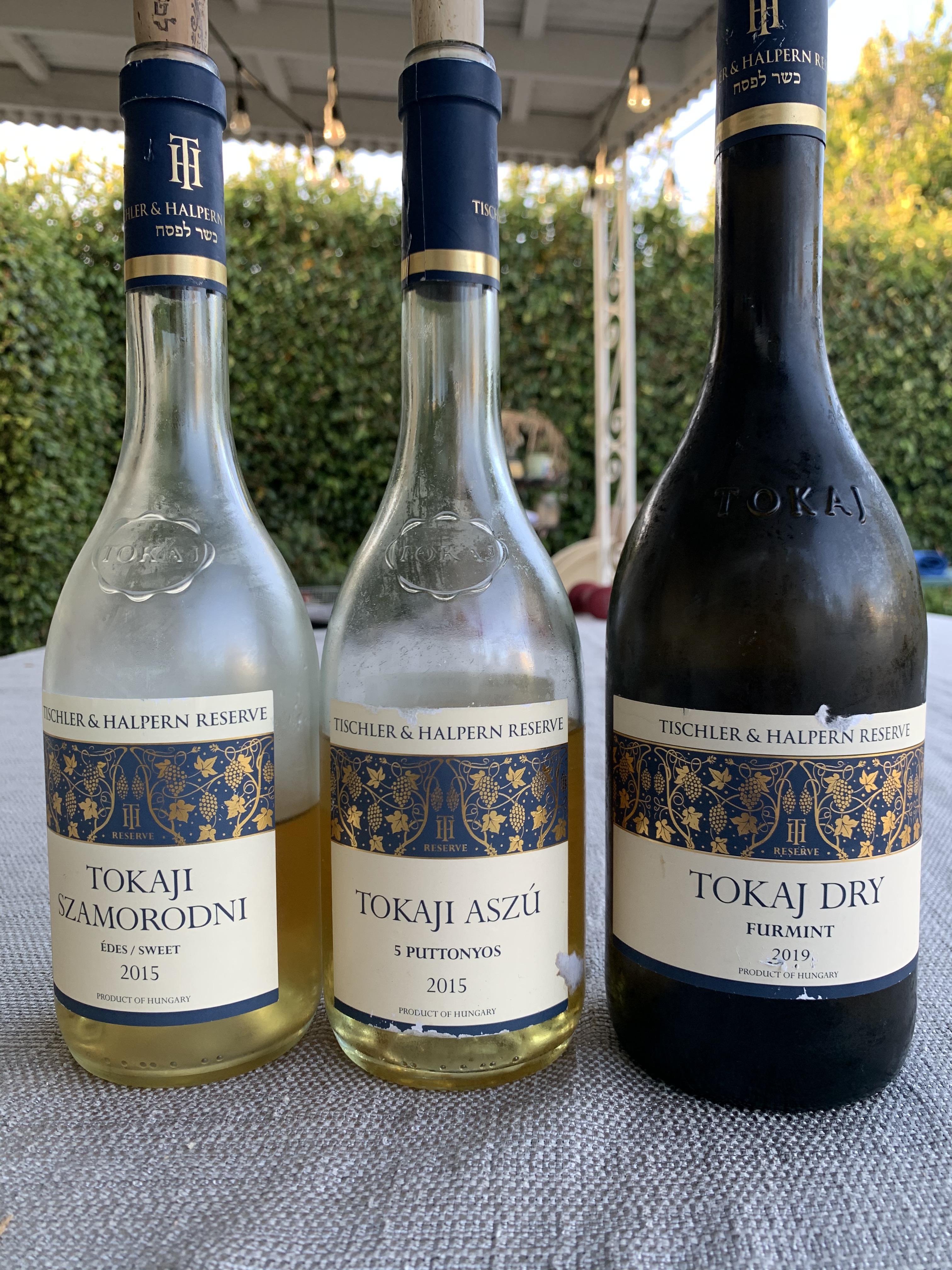
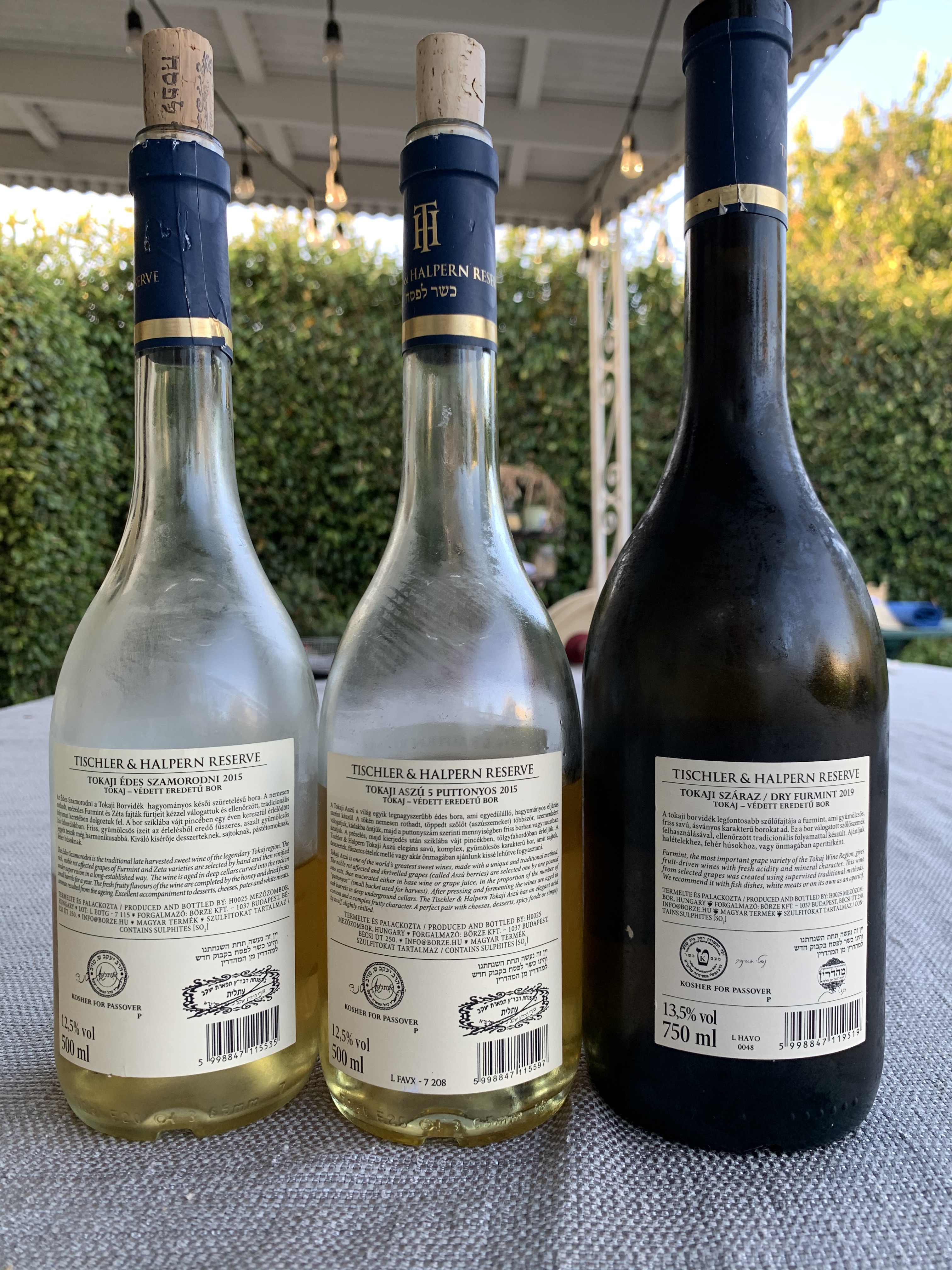
2019 Disznoko Tischler & Halpern Furmint Reserve, Dry Tokaji – Score: 91.5 (QPR: EVEN – USA, WINNER – EUR)
The nose on this wine is lovely, with beautiful floral notes of lemon blossom, honeydew, honeyed notes of Meyer lemon, wax, straw, lavender, and flint, lovely! The mouth on this medium-bodied wine is lovely, showing straw, Meyer lemon, green apple, incredible acidity, lovely tannin, ginger, with weight and density, showing rich saline, mineral, straw, and peppercorn. The finish is long, spicy, tart, with white pepper, ginger, smoke, flint, and mineral, wow! Bravo! Drink until 2023 (maybe more). (tasted April 2021)
2015 Disznoko Tischler & Halpern Tokaji Aszu, 5 Puttonyos – Score: 92.5 (QPR: GREAT – USA, WINNER – EUR)
While I think this wine is nice enough it is not as good as the previous vintages and it hits the point but this is missing a few steps. The nose on this wine is nice showing rich funk, brown sugar, sweet notes, guava, candied peach, apricot, candied ginger, lemon, and lemon zest. The mouth on this full-bodied wine is nice, with good enough acidity, lovely funk, good mouthfeel, plush, rich, concentrated, unctuous, with more citrus, lemon, mineral, and clay, nice and while I like it the wine lacks the punch, but still very nice, with intense pith, zest, funk, and acid lingering long. Very nice – Drink until 2030. (tasted April 2021)
2015 Disznoko Tischler & Halpern Tokaj, Late Harvest Furmint – Score: 90 (QPR: POOR – USA, EVEN – EUR)
This wine is fascinating as it has common notes to the dry younger wine. The nose on this is nice is off-dry, with wax, Meyer lemon, honeysuckle, sweet brown sugar, good enough acidity, and while I like it I want more acid. Drink by 2025. (tasted April 2021)
2015 Disznoko Tischler & Halpern Tokaji Szamorodni – Score: 90 (QPR: POOR – USA, EVEN – EUR)
Szamorodni, which takes its name from the Polish word ‘Samorodno’ meaning ‘as it comes’, is made from whole bunches that combine the treasured noble rot grapes and the healthy ones.
The nose on this wine starts with hints of funk with good saline, but after a few minutes, it explodes with pure funk, lovely socks, peach, guava, candied apricot, and Meyer lemon. It does show a nice blend of funk and fruit, but it has issues in the middle that may calm over time. The mouth on this full-bodied wine is rich, layered, but still showing a hollow with nice ripe and candied fruit, with good acidity, after a few minutes, and nice enough fruit, but it lacks the punch I crave. The finish is long and sweet with more acid, saline, mineral, slate, and lots of tannin and wax. Drink by 2025. (tasted April 2021)

 Wine Musings Blog