Blog Archives

Israeli White and Rose wines along with a few others thrown in
As the weather starts to warm up, it is time to start enjoying the white and rose wines that come from Israel. With that said, there is a lot of buzz recently that 2018 is the new year for white and rose Israeli wines, well I can personally attest that the noise is a red herring and a gross over exaggeration.
Are there a few more wines that work in 2018 than in 2017, 2016, or 2015? Yes, but the 2018 vintage is NOTHING like the epic 2014 vintage for Israeli white and rose wines. Still, I am happy to say that there are a few wines that I have enjoyed and I am posting them here.
I had a large tasting with the Israeli/French/American wine tasting group in Jerusalem, and there were a few winners. I am posting here wines that I tasted with them, along with a few that I have tasted before and after the event. Also, since we had many wines, we did not write long notes for wines I disliked and some wines I liked elsewhere are either missing notes or I cannot find them, but I do my best to describe those as well.
Thanks to Avi Davidowitz of Kosher Wine Unfiltered, and the rest of the French wine group on Facebook for helping with the tasting, and a big shout out to Joel and his company for letting us have the tasting at his office.
Finally, as always! PLEASE only drink 2018 roses and finish them by October 2018 or so. Also, if you wish to read how rose wine is made, please read this post from last year. Same can be said for many of these simple white wines, other than where I give an actual drinking window.
The wine notes follow below – the explanation of my “scores” can be found here:


2018 Tabor Sauvignon Blanc – Score: 90
The nose on this wine is pure gooseberry, slate, mineral, lemon, and cat pee. The mouth on this medium bodied wine is nice, dry, and very good, with floral notes, of orange blossom, and lovely control with good acidity, fruit focus, and lovely passion fruit. The finish is long, green, and slate, with good salinity, and blossom. Nice!
2018 Segal Chardonnay, Wild Fermentation – Score: 80
The nose on this wine is boring and closed, with bits of peach, orange blossom, and not much else. The front and middle of this wine are flat as a crepe, with hints of hay and slate, with a bit of acidity on the end.
2018 Shiran Semillon – Score: NA
The nose is 100% apple juice, and not much else. The mouth is offensive. Candied quince with lemon juice, all over the place and nasty.
2018 Yarden Sauvignon Blanc – Score: 90
This is a nice wine, yay, it is a nice SB, nice gooseberry, passion fruit, and citrus. The mouth on this medium bodied wine is nice, really acidic, well balanced, with good fruit structure, with nice weight and structure, showing peach, hints apricot, and nice hay, and orange blossom, and orange pith, with good structure and balance. Nice! Pith, acidity, salinity, and nice ripe but balanced fruit linger long.
2018 Flam Blanc – Score: 86
The nose on this wine is boring, flat, no life, with hints of orange, blossom, and not much else. The mouth on this wine is pure lemon/lime/orange juice, and not much else, very little complexity, but nice acidity. Nice enough.
2018 Ramat Negev Sauvignon Blanc – Score: 70
This is another bummer wine, big pass. The mouth on this medium bodied wine is acidic quince juice. Boring, move on.
2018 Vitkin Gewurztraminer – Score: 91 to 92
This wine is dry and lovely pineapple, with ripe melon, and green notes and lychee galore, with funk and hints of soap, incredible aromas, white pepper, smoke, flint, and redolence. The mouth on this wine is lovely, with grapefruit, citrus, lovely pith, with apple, pith galore, followed by complexity and bitter notes of melon, yellow Apple, lovely weight, slight tannin, with sweet notes honeysuckle, sweet pineapple, and balance. The finish is long and green and sweet and mineral balanced. Bravo! Drink by 2021. Read the rest of this entry

Top QPR Kosher wine winners of 2018
I continue to lament the lack of QPR wines. This past year, saw us with a better list of wines overall, but they are not actually QPR. I mean that 2018 saw fewer top wines and more wines at the next level down, but even those wines were not reasonably priced.
Take for example the lovely 2016 Montviel, it is a superstar wine, but it is not a pure QPR, given its 50+ dollar price. While the 100+ dollar wines abound, the 95+ score wines are nowhere to be found this past year.
So, I thought I would list the most recent QPR wines I have enjoyed over the past year. I wanted to catch up with wines I only had recently and with ones that are finally here in the USA.
My hope is that people will enjoy the wines and demand more of them. For instance, the lack of many of the QPR wines from Elvi Wines on the open market. I can find them on Royal’s website and on Elvi’s website, but sadly until recently, they were not available on the internet. Thankfully, Kosherwine.com has gotten the Elvi wines back, but Netofa wines are still not available here in the USA.
This list is not a list of wines that are meant for cellaring, though many can withstand a few years. The idea here is to enjoy these wines now while you let the long-term wines cellar and age. We all have that interest to drink interesting wines and while I agree with that, that is NO excuse to raid the cellar when u have a hunkering for a complex nose or flavor. Many of these wines will scratch the itch while the beasts’ lie and settle.
This year, the list came to a total of 20 names, which is a large number, but then again, the number of options has grown.
Finally, some of these wines are hard to find and they may have different siblings – but they are worth the effort. The wine notes follow below – the explanation of my “scores” can be found here:
QPR KINGs of 2018
The wines of the year, from my top 25 wines of 2018, are also the QPR kings of 2018.
2016 Chateau Larcis Jaumat, Saint-Emilion Grand Cru – Score: 92 (Crazy QPR)
This wine starts off open and then closes so tight like an oil drum, this thing is nuts. The wine is made of 90% Merlot and 10% Cabernet Franc, a classic right bank wine from Saint-Emilion. The nose on this wine is really bright, ripe, and intense, with rich intensity, mushroom, earth, but so much redolence, the nose is far more open than the mouth, showing rich blackberry, dark plum, and rich vanilla, followed by herb, mint, rosemary, and green notes galore. The mouth on this medium to full-bodied wine is crazy rich, it does at times remind me of Benyo’s Merlots with a fair amount of blackcurrant thrown in, which is never found on Benyo wines, but the mad acid, rich mouthfeel, closed tight fruit structure has me reminded often of a Four Gates wine, with intense notes, they scream because of the acid, that gives way to rich tannin structure that is searing and yet inviting, with rich cranberry, cherry, and crazy earth, that will give way to mushroom and forest floor with time. The finish is long, really long, lingering, and intense, with gripping tannin, acid, tobacco galore, mounds of blackcurrant, vanilla, herb, foliage, and green notes, that give way to a gripping mouthfeel that will crush anything, with tar, menthol, and more earth. OMG, this Benyo in France! Wow!! Drink from 2021 to 2030.
2015 Terra di Seta Chianti Classico – Score: 92 (Crazy QPR)
The nose on this wine is ripe, at first, the wine starts off with heat, but that blows off, but it is also well balanced, with lovely earth, mineral, dirt, with dark cherry, coffee, and lovely dark fruit. The mouth on this medium to full-bodied wine is beautiful, complex, well layered, with rich concentration, nice extraction, all balanced and plush, with rich blackberry, currant, lovely mouth draping tannin, with lovely foliage, and some nice earthy and fruit bite. With time, it shows its ripeness, but also intense minerality, saline, graphite galore, and lovely tannin structure. The finish is long, green, and ripe but balanced, with lovely acid, great texture, that gives way to more coffee, graphite, scarping mineral, and light almond bitterness on the long finish. Bravo!! Drink 2019 to 2023.
QPR top 19 Winners (in no particular order)
2016 Elvi Herenza Semi (blue label) – Score: 90 (mevushal) (QPR)
Lovely nose with great spice and lovely oak and with dark fruit, tart and refreshing while also being elegant. Really nice attack and really tart and tannic but accessible with great tart red fruit, classical in style with spice, green notes, and nice acid that gives way to coffee and nice cherry and tart and zesty currant. The finish is long and tart with great foliage, tart fruit, and earth. Bravo! Drink by 2020. (Available here in the USA, France, Israel, and other locations)
2015 Chateau du Grand Barrail, White – Score: 91 (Crazy QPR)
The nose on this wine shows smoke, flint, with lovely dry fruit, showing rich honeysuckle, white flowers, with honeyed apples, and lovely Asian pears. The mouth on this medium bodied wine shows riper fruit than the nose, showing more sweet fruit, with sweet melon, with a richer mouthfeel than I would expect, with rich acidity that shows a bit further in the mouth, with intense honeydew, melon, and lovely grapefruit, and Meyer lemon. The finish is long, truly searing with acid, and rich with more honeyed fruit, and lovely citrus fruit. Bravo! Drink now till 2023. (This is sadly only available in France)
2016 Koenig Riesling, Alsace – Score: 92 (mevushal) (Crazy QPR)
The nose on this wine is lovely, showing ripe peach, apricot, with great grapefruit, followed by petrol funk, lovely honeysuckle, more floral notes, and nice mineral. The mouth on this medium bodied wine is an acid bomb, and thank god, we really needed a dry, well priced, acid bomb, with petrol notes, and this one is mevushal to boot! The mouth is dripping with acid, followed by rich lanolin, with a nice weight, followed by sweet guava notes and tart Asian pear, impressive. The finish is long, tart, crazy acid, with wax, petrol, honeyed fruit, and more sweet notes lingering long! Bravo!!!! Drink by 2020. (Available in the USA and France)
2017 Ramon Cardova Albarino, Rias Baixas – Score: 91 (QPR)
Lovely nose of rich mineral, with loads of straw, with which salinity, and lovely peach and dry apricot, with honeysuckle, lemongrass, with green notes galore. Lovely! The mouth on this lovely green and acid-driven wine, showing rich salinity, green olives, with lovely dry quince, green apples, but also with lovely lime and grapefruit, with a bit of sweet fruit of guava and rich acid that comes at you in layers. The finish is long and green, with gooseberry, passion fruit, and lovely round and tart with freshness and orange pith, and incredible acidity lingering long. Drink until 2021.
Interesting note on this wine, there is a thermosensitive logo on the label that shows ONLY when the wine is at the correct temperature, on the bottom right-hand corner of the front white label. This is a lovely wine and one that is worth the effort to enjoy at the correct temp. Cool! (Available here in the USA, France, and other locations)

The 2018 Kosher rose season is open – part 3
Well, after the first post I stated that I would be doing this rose wine post a few times. The subsequent posts would have the original content, and the newly revised or added rose wines as well. Well, this is part 3, and I hope this is the last one! My schedule was insane, but it is now slowing down, thankfully, so I hope to be adding more posts as well!
It is still officially Summer, which means it is Rose time! Rose wine in the non-kosher market is exploding – especially Rose wine from Provence; a wine region of France. Sadly, in the kosher wine market – that is not quite the case. I did not stress my previous statement with a suffix of AT ALL, even though I am not allowed to open a bottle of rose on my Shabbos table with guests – why? Well, that is simple – no one will drink it!!
Even worse, is that wine manufacturers may well have jumped the shark! There will be some 50 dry-ish kosher roses available in the USA this year! That may not sound like a lot, but when all you had was Herzog White Zinfandel 10 years ago – it is insane. The first high-end rose was Castel’s 2009 rose and that was only 9 years ago. Back then, there were few to no real Rose wine options, other than a handful of Israeli wines and almost no French Rose made it here. Now we will have tons of Rose, and I really think the real question here is will people drink it all?
Wine Color
What is a rose wine? Well, simply said, a rose is a wine that can best be defined as the wine world’s chameleon. Where white wine is a pretty simple concept – take white grapes, squeeze them, and you get clear to green colored juice. Yes, the white grape juice is clear – well so is red grape juice, but more on that in a bit.
White wine is not about color – almost all color in a white wine comes from some oak influence of some sort. So, an unoaked Sauvignon Blanc or Pinot Gris can sometimes look almost clear, depending on the region and how the wine was handled. Now oaked Chardonnay, of course, is what most people use as an example of a dark white wine. As the Wine Folly linked above states, different wine regions oak their Chardonnay differently and as such, they are sold with different hues from the start. With age, the wine changes color and the light gold moves to darker gold shades.
The only real exception to the stated rule above – that white grape juice without the influence of oak is somewhere in the clear to green color spectrum, is – orange wines. We have spoken about orange wines – mostly thanks to Yaacov Oryah. Outside of Yaacov’s work there really is no orange wine in the kosher world to speak about. Orange wine is made exactly like red wine, which means that the clear grape juice is left to sit on the yellowish to dark yellow grape skins (depending upon what varietal is used to make the orange wine).
Red wine juice – straight from the grape comes out the same color as white grapes. You see the juice from grapes is mostly clear to greenish in color. The red wine color comes from macerating the juice on the grape skins. The longer the juice sits on the grape skins (wine must) the redder in color the wine becomes until it reaches its maximum red color potential.
The only real exception to the rule of a grape’s juice color is the Teinturier varieties. The grapes are called Teinturier, a French language term meaning to dye or stain. The list of grapes whose juice is actually red colored is long – but the list of kosher wine options that is a wine made from these grapes – is the Herzog Alicante Bouschet. The Gamay de Bouze is not a normal Gamay grape, it is one of those grape mutations that are very red in nature. Read the rest of this entry
Top kosher 2017 white wines from around the world
Ok, let’s start with the obvious, I have been so busy this year that I have had zero time to work on these posts. So, ahead of the High Holiday Crescendo, I wanted to post a quick note about the 2017 vintage and my hopes for a great new year, filled with joy, success, health, and lots of great wine to all.
2017 Vintage
So far the 2017 vintage has been much akin to the 2016 vintage – last year. The 2017 roses have been a letdown overall, much akin to the 2016 vintage of roses that were a letdown after the epic 2015 vintage. Sure, we have a few rose winners, like the lovely 2017 Les Lauriers de Rothschild Rose, and the nice 2017 Covenant Blue C Rose, and 2017 Netofa Latour Rosado.
Still, the whites have been a real letdown, much akin to what happened in the 2016 vintages. We have not had a GREAT vintage out of Israel since the INSANELY good 2014 vintage.
So, Israel has been a letdown white wine-wise and rose overall these past few years. But there are some winners as usual. I have yet to taste the 2017 Tzora wines. The Netofa whites are lovely, along with the fun and very enjoyable 2017 Covenant Israel Viognier. There is also some nice Dalton Sauvignon Blanc wines.
The true savior is once again, the old-world region. France has a few great whites! Yes, I said whites! Throw in California, and we have enough whites, just not a bounty.
I hope you enjoy these great white wines in your Succah and with your family. Wishing you all a healthy year signed and delivered!
The wine notes follow below – the explanation of my “scores” can be found here:


2017 Chateau Lacaussade Saint-Martin, Vieilles Vignes – Score: 90
The wine is a blend of Semillon and Sauvignon Blanc. This wine is very slow to open, it may need a quick decanting, for an hour or so. The nose is slightly tropical in nature with lovely with melon, guava, and hints of passion fruit to start, over time it recedes to show lemongrass, straw, mineral, grapefruit, citrus, and honeysuckle notes. Just like the nose the mouth also starts off with crazy tropical notes that also recede with time, to show a very different wine. After some time, the mouth on this wine is not complex, but very nice, with rich acidity, showing a good balance of fruit, green apple, heather, tart pear, and mineral. The finish is long, super long, with southern tea, and rich acidity, and lovely pith. Drink by 2021.
2017 Chateau Guiraud ‘G’, Sec – Score: 92
Finally, a French white I can really appreciate! This is really fun, the wine is a blend of Semillon and Sauvignon Blanc, showing notes of pure funk, wax, green notes, with cucumber, mineral, old-world notes, showing honeysuckle, and floral notes, with green apple, quince, lovely straw, and rich minerality. The mouth on this medium bodied wine is fun, with more funk, nice complexity, with rich salinity, followed by rich dry and tart Asian pear, with nice gooseberry, and graphite. The finish is long and green, with lemongrass, stone, rock, with more wax and flint. Bravo! Drink by 2021.
2017 Jean-Pierre Bailly Pouilly-Fume, Sauvignon Blanc – Score: 92
WOW! This wine has quite the nose, screaming with fresh orange blossom, ripe yellow grapefruit, with hints of nectarines, cat pee, and lovely citrus. The mouth on this unoaked Sauvignon Blanc is dry, bone dry, not quite a Sancerre, but impressive, with lovely weight, and great fruit focus with a crazy core of acid that keeps going long after the wine is gone, followed by rich mineral, slate, saline galore, and a lovely core of lie and lemon that mingle well and play with each other. The finish is long, crazy long, with more mineral, floral notes, lovely bitter notes of citrus pith, and just fun, tart citrus that lingers forever. BRAVO!!! Drink till 2021 Read the rest of this entry
The 2018 Kosher rose season is open – part 2
Well, after the first post I stated that I would be doing this rose wine post a few times. The subsequent posts would have the original content, and the newly revised or added rose wines as well. Well, this is part 2, and there will be at least a part 3 or maybe a part 4, such is life. My schedule is insane right now (not complaining in any way), so when I can grab a few moments to update the roses I have had, I take it with both hands!
It is still officially Spring, which means it is Rose time! Rose wine in the non-kosher market is exploding – especially Rose wine from Provence; a wine region of France. Sadly, in the kosher wine market – that is not quite the case. I did not stress my previous statement with a suffix of AT ALL, even though I am not allowed to open a bottle of rose on my Shabbos table with guests – why? Well, that is simple – no one will drink it!!
Even worse, is that wine manufacturers may well have jumped the shark! There will be some 50 dry-ish kosher roses available in the USA this year! That may not sound like a lot, but when all you had was Herzog White Zinfandel 10 years ago – it is insane. The first high-end rose was Castel’s 2009 rose and that was only 9 years ago. Back then, there were few to no real Rose wine options, other than a handful of Israeli wines and almost no French Rose made it here. Now we will have tons of Rose, and I really think the real question here is will people drink it all?
Wine Color
What is a rose wine? Well, simply said, a rose is a wine that can best be defined as the wine world’s chameleon. Where white wine is a pretty simple concept – take white grapes, squeeze them, and you get clear to green colored juice. Yes, the white grape juice is clear – well so is red grape juice, but more on that in a bit.
White wine is not about color – almost all color in a white wine comes from some oak influence of some sort. So, an unoaked Sauvignon Blanc or Pinot Gris can sometimes look almost clear, depending on the region and how the wine was handled. Now oaked Chardonnay, of course, is what most people use as an example of a dark white wine. As the Wine Folly linked above states, different wine regions oak their Chardonnay differently and as such, they are sold with different hues from the start. With age, the wine changes color and the light gold moves to darker gold shades.
The only real exception to the stated rule above – that white grape juice without the influence of oak is somewhere in the clear to green color spectrum, is – orange wines. We have spoken about orange wines – mostly thanks to Yaacov Oryah. Outside of Yaacov’s work there really is no orange wine in the kosher world to speak about. Orange wine is made exactly like red wine, which means that the clear grape juice is left to sit on the yellowish to dark yellow grape skins (depending upon what varietal is used to make the orange wine).
Red wine juice – straight from the grape comes out the same color as white grapes. You see the juice from grapes is mostly clear to greenish in color. The red wine color comes from macerating the juice on the grape skins. The longer the juice sits on the grape skins (wine must) the redder in color the wine becomes until it reaches its maximum red color potential.
The only real exception to the rule of a grape’s juice color is the Teinturier varieties. The grapes are called Teinturier, a French language term meaning to dye or stain. The list of grapes whose juice is actually red colored is long – but the list of kosher wine options that is a wine made from these grapes – is the Herzog Alicante Bouschet. The Gamay de Bouze is not a normal Gamay grape, it is one of those grape mutations that are very red in nature. Read the rest of this entry

Seven Kosher Viognier Wines
Viognier (pronounced Vee-Ohn-Yay) is a very special grape and one that must be handled with great care. The Viognier grape/wine is a special treat. It is a wine that has distinct characteristics: perfume, floral notes, and acidity, but it is also a very picky grape. It is very easy to lose to mold and because of this wineries will plant roses next to the grape vines to act as a canary for detecting mildew early on. The grape needs to be picked late otherwise; it does not generate the classic perfume that we are used to seeing in Muscat and Riesling wines. The winemaker has many choices with how he/she wants to manage the grapes. The winemaker can allow the wine to go through malolactic fermentation (to give it a bit more weight) or let the wine lie in the must (to give it more perfume) or to let it have a bit of wood to give it roundness. With all the choices and difficulties that Viognier wines have, they rarely meet expectations and are, therefore, not one of the current popular white wines. Finally, Viognier is not meant for long storage – hence the VERY early release dates on these wines, also the wine should have the acidity, fruit, and perfume to make it a real winner. By default, the Viognier grape is lower in acidity than other white varietals, which makes for a wine that is not meant for cellaring, at least not yet in the kosher market.
The most famous of Viognier wines come from Condrieu AOC and though they are highly desired, even there they are not always winners. The climate in Condrieu is colder than much of the Rhone, and its soil is made up of a porous, drainable granite, chalk, mica, and deposits of gneiss. The area is known as the original mother of Viognier and in the AOC, the only legal grape is Viognier.
While I really liked the 2016 Psagot Viognier last year, now it is losing its steam and it acid is falling off, making for a fetter more round wine. Dalton, in the past, threw so much oak at the wine that it was built to last longer. Psagot and Kos Yehuos both do not throw that much oak at the wines and they release them early on. Psagot has a fascinating way to get acidity and perfume. Yaacov Oryah, picks around 80% of the Viognier early, for acid, minerality and low alcohol, and 20% later in the season, for perfume.
I really enjoyed the 2017 Covenant Israel Viognier, it was varietally true, and really lovely. The sad fact was that I could not find it in Israel, the week before Passover, and I tried almost every wine store in and around Tel Aviv and Jerusalem! I had to come to the USA to taste it, and it is a lovely wine indeed!
Still, of all of them, the Kos Yeshuos Viognier is showing a more old world and mineral style than the perfume madness of the Israeli options. It is sad that there are so few options in the world of Viognier. Galil has some, and they are OK but pretty average. Same with the 2016 Yatir Viognier, it was muted to me. The 2016 Dalton Viognier was nice, but it is an oak monster, and that is an acquired taste.
Now I stated that there were 7 Viognier wines here in the title, and while there are 5 varietal Viognier wines, the other two are blends. The first of the blends is the 2017 Shirah Vintage Whites which is a blend of 55% Viognier and 45% Chardonnay, from the Murmur Vineyard in Santa Maria Valley. The last of the blends is the 2017 Teperberg Fermitage White, Inspire.
The wine notes follow below – the explanation of my “scores” can be found here:
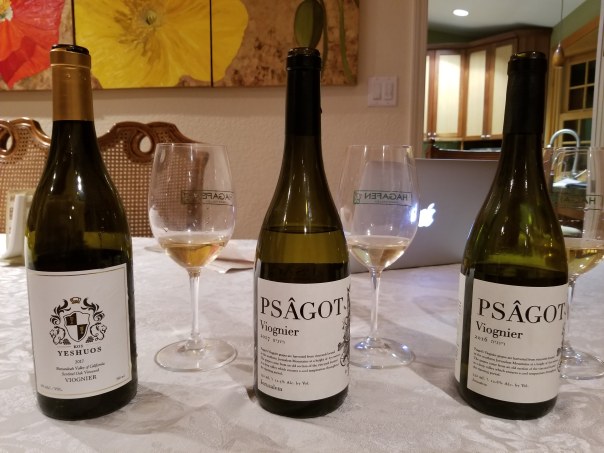
2017 Covenant Israel Viognier, Blue C – Score: 90
Classic viognier notes with crazy rich floral notes, with rich saline, lovely peach, and some oak. The mouth on this medium bodied wine is really fun and showing a lovely oily texture, with rich weight and more fun saline, followed by apricot rolled in the grass, with floral notes. The finish is sweet and ripe and fresh with tart notes of stone fruit, with lemongrass and flint. Bravo!
2017 Psagot Viognier: 89 to 90
This year’s vintage is leaner than last year’s vintage, but also more light in style and focus. The wine starts off very ripe and needs time to come around, give this wine time. The nose starts off with ripe fruit notes of pineapple juice, honeycomb, really ripe, with cloves, allspice, peach marmalade, and apricot, and stone fruit. With time the nose turns to nice mineral notes, backed by peach marmalade, wonderful peach jam, and lovely hay, quince jam. The mouth is more round and fat than I would have hoped, with orange and nectarines, still, it is well structured. With slate, saline, and pith galore. Nice.
2017 Kos Yeshuos Viognier – 92 (QPR)
Do not cool this wine too much, it likes 30 min in the fridge and no more.
This wine has evolved over the past 6 months. Gone is the fruity nose and now the nose is pure flint, yeast, smoke, and really fun straw and mineral, with peach and honey in the background. The mouth on this medium bodied wine is ripe for sure, but really well balanced and showing lemongrass, with a rich oily coat that covers the mouth, well focused with rich acidity, nice mineral, great fruit pith, apricots, peach, and lemon, with rock, and grass. The finish is long and acidic, with enough complexity to grab your attention and keep it throughout the finish with lovely white rose tea, sweet spices, notes of fresh lavender, crazy saline lingers super long, with cinnamon, and cloves. Bravo!
2016 Psagot Viognier – Score – 88
So last year this wine was very ripe, now the nose is showing nice funk, with hay, straw, and honeyed notes. last year this wine was an acid bomb, now the wine has lost that rich acidity and now it is well balanced, with good fruit pith, and green notes, and not much else. Sadly, this wine is losing its grip and should be drunken ASAP. DRINK UP!
2017 Teperberg Destitage White, Inspire – Score: 89
This wine is a blend of Viognier, Sauvignon Blanc, and French Colombard. The nose on this wine is very floral and classically inclined to Viognier with its intense peach bomb notes, with white cherry notes, and sweet Oak. The mouth on this medium bodied wine is oily and tactile, with a rich weight from the Viognier and Colombard fruit, with sweet Guava and nectarines, followed by with orange notes, The finish is sweet and tart and fun overall, with good acid and floral notes. Nice!
2017 Shirah Vintage Whites – Score: 91 (QPR)
Another winner from Shirah with a blend of 55% Viognier and 45% Chardonnay. The nose on this wine starts off really fun and funky, showing straw and rich mineral, with sweet peach, rich ripe guava, and apricot. The mouth on this wine is really fun, rich, layered, well balanced, oily and textured, and so professionally made, with lovely smoke, oak, with rich apple, dried quince and with fresh focus and lovely weight and viscosity. The finish is crazy and dry, with sweet notes of fig, sweet lemon tea, with intense mineral and lovely pith with a citrus background. Bravo!!
2016 Dalton Viognier, Reserve – Score: 89
The nose is classic Viognier, with peach, too much oak, showing good apricot, sweet rose hips, and a perfume of honeysuckle, and orange blossom. The mouth is medium bodied, with a nice almost oily mouthfeel, showing nice weight, with good notes of summer fruit, with just enough acid, wish there was more, with lovely pear and nectarines. The finish is long and balanced with less acid than before, still too much oak, lovely mineral, slate, and more floral notes. Drink up!

The 2018 Kosher rose season is open
It is officially Spring (though it snowed in Chicago for Passover – so I will hold judgment on that fact for a bit), which means it is Rose time! Rose wine in the non-kosher market is exploding – especially Rose wine from Provence; a wine region of France. Sadly, in the kosher wine market – that is not quite the case. I did not stress my previous statement with a suffix of AT ALL, even though I am not allowed to open a bottle of rose on my Shabbos table with guests – why? Well, that is simple – no one will drink it!!
Even worse, is that wine manufacturers may well have jumped the shark! There will be some 50 dry-ish kosher roses available in the USA this year! That may not sound like a lot, but when all you had was Herzog White Zinfandel 10 years ago – it is insane. The first high-end rose was Castel’s 2009 rose and that was only 9 years ago. Back then, there were few to no real Rose wine options, other than a handful of Israeli wines and almost no French Rose made it here. Now we will have tons of Rose, and I really think the real question here is will people drink it all?
Wine Color
What is a rose wine? Well, simply said, a rose is a wine that can best be defined as the wine world’s chameleon. Where white wine is a pretty simple concept – take white grapes squeeze them and you get clear to green colored juice. Yes, the white grape juice is clear – well so is red grape juice, but more on that in a bit.
White wine is not about color – almost all color in a white wine comes from some oak influence of some sort. So, an unoaked Sauvignon Blanc or Pinot Gris can sometimes look almost clear, depending on the region and how the wine was handled. Now oaked Chardonnay, of course, is what most people use as an example of a dark white wine. As the Wine Folly linked above states, different wine regions oak their Chardonnay differently and as such, they are sold with different hues from the start. With age, the wine changes color and the light gold moves to darker gold shades.
The only real exception to the stated rule above – that white grape juice without the influence of oak is somewhere in the clear to green color spectrum, is – orange wines. We have spoken about orange wines – mostly thanks to Yaacov Oryah. Outside of Yaacov’s work there really is no orange wine in the kosher world to speak about. Orange wine is made exactly like red wine, which means that the clear grape juice is left to sit on the yellowish to dark yellow grape skins (depending upon what varietal is used to make the orange wine).
Red wine juice – straight from the grape comes out the same color as white grapes. You see the juice from grapes is mostly clear to greenish in color. The red wine color comes from macerating the juice on the grape skins. The longer the juice sits on the grape skins (wine must) the redder in color the wine becomes until it reaches its maximum red color potential.
The only real exception to the rule of a grape’s juice color is the Teinturier varieties. The grapes are called Teinturier, a French language term meaning to dye or stain. The list of grapes whose juice is actually red colored is long – but the list of kosher wine options that is a wine made from these grapes – is the Herzog Alicante Bouschet. The Gamay de Bouze is not a normal Gamay grape, it is one of those grape mutations that are very red in nature. Read the rest of this entry

Kosher Wine Tasting in Jerusalem – take 2
As I have been posting so far, I enjoyed my last trip to Israel and Europe. Last we left off, we had just had a kosher wine tasting at DD house. Instead of posting about the next three wineries we visited, which I will post soon, I wanted to post the other wine tasting, which was also at DD’s house. That man is a gluten for punishment!
There were some winners, a lovely bottle of Carignan from Carmel (another QPR winner), the 2013 Dalton Semillon, Single Vineyard Elkosh – still going nice, but getting close to drink-up. For this tasting, I brought a bottle of the fantastic 2014 Hagafen Riesling, IMHO, every tasting needs a Riesling! Sadly, that was about it. The 2014 Yaacov Oryah Alpha Omega was nice as well. The shockers were once again the pushed nature of the Mia Luce reds. We had all the Mia Luce reds, from 2012, 2014, and 2015 and they did not show well. The last 2012 Mia Luce from the other tasting was corked, so they brought another one, and this was not corked but man was it pushed and overripe at this point. I am not sure – Carignan is not a wine that I am finding can last long in Israel. At least so far from the wines I have tried, either the Recanati Carignan or the Mia Luce Carignan (sourced from the same vineyards).
I did have a horizontal of many Carignan last year, and Mia Luce was the clear winner. They were older bottles and they were lovely, maybe these were bad bottles as well, I do not know. I will be tasting my older ones to double-check soon.
My many thanks to our friend DD for hosting us in his lovely home! To be honest, after all the wine tastings I had up until this point, I was done for, so my notes were not very good this time. The wine notes follow below – the explanation of my “scores” can be found here:


2016 Midbar Unoaked Chardonnay: Score: 84
Nice sweet nose of candied melon, peach, dried apple, and straw. The mouth is medium bodied with too much sweetness and not enough balance, with not enough acid, good enough fruit, but no focus, showing more stone fruit, sweet quince, nice grapefruit, with good sweet spices, and herb. The finish is long and spicy with peach, with tart and sweet quince lingering long.
2016 Har Bracha Gewurtztraminer: Score: 75
Wow, this is a sweet and dried fruit disaster, with tons of notes of oxidation and no joy – sorry. Very sweet pass, tropical, and insane melon/guava, dry flower madness, no balance.
Kosher Rose wines of 2017 – final take
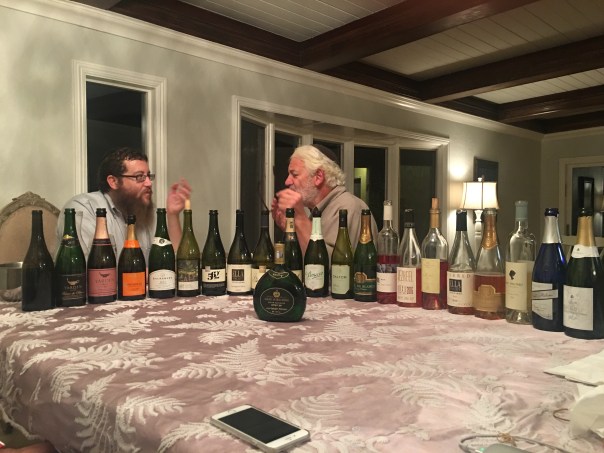
After all the tastings I have had for rose wines this year – I can say for now, that I am as far along as I can go without being in Israel, or asking people to schlep wines for me from Israel. I am still missing the new 2016 Elvi Wines Rose, the 2016 Terra de Seta Rose, the 2016 Matar Rose, and the 2016 Gvaot Rose. I guess that will have to be. When I get to Israel soon enough I will post again, but just on those wines.
In the end, my overall take on Israeli roses this year has been a huge and utter letdown. To me, there are few roses that I would waste my time drinking. In the end, the Netofa, Vitkin, Psagot, and Castel Roses are the only roses that I would buy this year, other than the untasted wines listed above (Matar and Gvaot), which may well be good.
The real saviors for us have indeed been Spain and USA. France has thrown in the La Vie Roubine, but it is not as good as the Ramon Cardova rose.
So, in closing, I will repeat what I listed the last posting. These wines are the best for each category, nothing I tasted in the last tasting has changed much around them, other than the sweet rose entry, which I would never buy, but is useful for those that like rose that way.
So, here are my recommendations based upon the wines I have tasted:
- 2016 Ramon Cardova Rose, is the best rose so far, but it is not a Provence style wine, it is more of a tweener.
- The 2016 Chateau Dubois is the best French rose I have tasted so far, but it is a clear non-Provence style rose.
- 2016 Chateau Roubine la Vie, is the best French classic Provence style rose.
- 2016 Ramon Cardova Rose is the best Spanish rose (that I have had the chance to taste so far, sadly I have yet to taste the new 2016 Elvi Rose)
- The 2016 Shirah Rose is the best USA rose. It is not a Provence style wine, it is a massive wine but a really fun one.
- The 2016 Netofa Rose is the best rose from Israel, it is as close to a Provence style wine I have found so far in Israel. Vitkin is right behind, along with Castel (but it is really expensive for the wine), and Psagot in the bigger/fuller rose category for Israel.
- The 2016 Psagot Rose (when it is on) is the best full bodied rose wine from Israel.
- The best sweet rose that is drinkable is the 2016 Contessa Annalisa Rose. Hopefully, a gateway rose to the drier and better options above.
Rose winemaking approaches
If you read the previous article, you would have read that there are classically three ways to make Rose; Maceration, Saignée, and blend.
The interesting thing we are seeing is a slight variation to the rose making – that is after they make the rose, using any of the aforementioned approaches, they are adding in some white wine! This is straight up genius! Why? Because as explained in the previous post, red grape juice has very few phenolics in it! The real phenolic powerhouse – for red wines, are the skins! White wine does not need skins to give it their phenolics, they have it innately from the juice alone. So, when you take red grapes and essentially crush them and bottle them, with minimal grape contact, what you get is a fun wine, that has very few phenolics in it. So, you have a few options, either let the liquid sit longer on the grape skins, thereby improving the phenolics, but that takes away from the classic rose look, as skin contact turns the juice darker. So, if you want more phenolics and less grape skin contact to keep the classic rose color, you can add in white wine!
The Ramon Cardova is a perfect example of this. As is the Elvi Rose (a wine I have not tasted), and the Jezreel Rose (see below). These three wines all added in different white wines, and it is a clear bump in the correct direction, but to the purists, it is not cool! I cannot speak to the purist’s issues, and yes, I can see that the Cardova is not a classic Provence wine, but it is a very enjoyable summer wine, and in the end, that is what rose to me, is all about!


 Wine Musings Blog