Blog Archives

Vitkin, Tzora, and Flam Winery tastings along with 2015 rosé and whites from Israel
 Well, I am back, landing the day before the Shabbat preceding Shavuot. I was there for my Nephew’s wedding and we stopped off in Paris for two days – that post can be read/seen here. From there we jumped on an EasyJet plane and we were in Israel, but those kind of things do not just happen. In hindsight I would use EasyJet again – simply because there really were few other options. The direct flights were these (listed in cost order); Transavia (I wonder if the count sleeps in luggage), EasyJet, Arkia (Israel’s second largest airline), El Al, and Air France. I tried to use miles on AF – but they were crazy high. So, in the end, EasyJet it was.
EasyJet is one of those airlines that will nickel and dime you all the way to and in the plane. But the best plan (since I had no checked luggage), is to pay for seat assignment and then you get a roll on and backpack. I was stressing about my rollon, it was a bit heavy, and I was worried they would nickle me to death. In the end, the dude at the counter was very nice and they took the rollon – asking to check it, which was fine with me. The trip was fine, as there is a lounge in the CDG terminal, and what we really wanted was just a place to be normal in a land of madness.
Once we got to the gate they were boarding us only to leave us in the gateway for a good 25 minutes – no idea why. Once we boarded, I was asleep, which was a blessing. I had lots to watch – but sleep was what I craved. Once I awoke we pretty much landed, with maybe 20 minutes or so before landing anyway. Once we landed we disembarked quickly, and then well – no one was there at security check. There were loads of people backing into the anteroom. It would be another 20+ minutes before folks actually arrived and started to cut through the backlog.
Once we got through our bags were there already and we were off to get our car – or try! Look I like Budget in Israel, they normally treat me well, but this trip was horrible! They made us wait 1 hour or more and then they treated us in classic Israeli style and gave us a car that was smaller than what we ordered/paid for and then told us to leave them alone! Love people like that!
Anyway, we were off and really that is what I cared about – I wanted to be home! After that, I can say that the trip was really about tasting late 2014 released wines and 2015 wines. Before, I get into that – let’s recap the state of 2015. As stated here, this is what happened in 2015 and after tasting some 40+ wines from 2015 – nothing has changed my opinion.
Well after two world-class vintages in 2001 and 2008, 2015 was a huge letdown. The white and rose are for the most OK, and nice. The white and rose wines are not at the level of 2014 (more on that below), but they are very respectable. The 2015 reds on the other hand is an entirely different subject.
Shmita 2015
A few things going on here – first of all the weather was perfect through August – looking like yet another blockbuster Shmita vintage. Wet winter, tons of rain and no deep freezing, followed by very moderate spring (making for good bud formations). This was followed by temperate highs and nice cool evenings throughout the summer, except for a few spikes here and there, that was all until August! In August nature took a very dark view on Israel – starting with some of the worst highs in the history of Modern Israel, and power consumption that peaked for an entire week that broke record after record. August continued with crazy heat – but it was early September when all hell broke loose. September saw a return of the epic sandstorm – but this time it reached almost biblical proportions in September. Just look at these satellite images – they are crazy!

Overall, the season was not what it was meant to be. The sand storms brought even higher temps, it all unravelled at the end. The funny thing is that – the wineries that pull early, AKA do not produce date juice, were affected far less – like Recanati and Tabor. The ones who pull later or pull from the Galilee – even if they are great wineries – were affected. In some ways it will mean that lower level wines at wineries will have normally better fruit. It will also mean that many wineries will have less of their flagship wines. Of course this is all from what winemakers and wineries have told me so far. Only time will tell to see what really comes out, but agriculturally, it was not a great year. Read the rest of this entry

Last days of Passover – wines and all
Well I am back from Israel again, this trip was all about Passover and not wine trips. It was beautiful in Jerusalem for Passover, other than two scorching hot days. Other than them, the days were temperate, and really quite enjoyable.
The access to wine in Israel, is abundant, and when u are shooting for whites, roses, and bubbly, you really cannot go wrong. The reds were limited to the very safe options, Tzora, Netofa, and Matar.
Food wise, my in-laws did most of the cooking, but for me, it was cheese and matzah for almost every meal, along with lunches on Yom Tov. Dinners were meatballs, brisket, and fish (not in that order).
Overall, the wines were fantastic in the second round of options – better than the first round which included a dud. Sadly, the wines I enjoyed are not available here in the SUA yet – and may not even get here. Many of them are Royal’s and they are not embracing the white/rose wine revolution that is taking over Israel as much as I would have hoped. Which means I will need to hand import a few more of these beauties.
A special thanks to SB and DF for hosting us for a dinner. We brought over the two rose and we enjoyed them along with some great food and two lovely wines, which I sadly have no notes for. One was the 2011 Tzora Misty Hills – a great wine for sure. The other was the 2010 Recanati Cabernet Franc Reserve. The wine is still kicking nicely and has another year or two left in the tank.
We did not get to the 2014 Matar Sauvignon Blanc/Semillon wine – I had it at the winery and will post it here – but I did not taste it over Passover.
So, without further ado – here are the wine notes:


My top kosher 25 wines of 2015
 Well, I have posted my year in review, and now I wanted to get to my top wines for 2015. Please beware that I know I missed many wines and that this list does not include wines that I have tasted that are not available on the open market – like older Covenant Wines and the sort.
I wanted to make this post short and sweet – so the criteria are simple I could care less about price, color, or where it was made. All that matters is that it is/was available this year sometime to the public at large and that I tasted it in a reliable environment, not just at a tasting, and that it was scored an A- or higher. Anything less would not be on my list.
On an aside, there continues to be a whole mess of madness around wines notes and scores, even the Jewish Week weighed in on the matter. So, let me explain this really simply – go look at some of my recent blog posts – they talk about some nice enough wines, but wines I would not specifically buy. They have all the nice words and such, which were all true and to the point. But without the final value score, I can tell you a Cabernet is full bodied with good fruit and spice – and you may say cool I want that – but then I would say well, yeah but it was not complex or layered. You could try to reason that out of the words I wrote, because the words complex and layered are missing. However, the simple fact that it was scored a B+ or whatever, would have told you that it is not always a wine worth going after (unless it is the Terrenal or such where it gets a QPR moniker).
My point being that wine notes – without a proper context (AKA a real score) – is like looking at a wedding hall through a slit in the window. Sure you can “see” the hall, but are you really sure you want to get married there? I never scored wines to tell people to listen to my score. I score wines to set the context and to always read the notes to see if that sort of wine works for you!
OK, enough of the darn score rant for the day, back to the matters at hand, being wines of the year. The list is long – get over it. It is a list of wines that I would buy, have bought, and will buy again – simple enough I hope. I did not differentiate by another other criteria or aspect – if it was solid (A- or higher) it made the list. I hope you enjoy!
2013 Elvi Wines Clos Mesorah – Score: A- to A
This is the flagship wine of Elvi Wines (though the Herenza Reserva may have a word to say about that) and it is a blend of 50% Carignan, 30% Grenache, and 20% Syrah. Elvi Wines makes 7K of these bottles. The wine was sourced from vines that are 20 to 100 years of age. The nose on this wine is insane and intoxicating with aromas of watermelon, root beer, ripe boysenberry, blueberry, along with chocolate and black fruit. The mouth on this full bodied wine hits you with layers of concentrated fruit, with an attack of blue and black fruit, balanced perfectly, showing great elegance, along with mad mineral, graphite, slate, rich and freshly tilled earth, along with deeply concentrated black fruit. The wine is the perfect example of elegance and balance with ripe fruit that flows into a plush mouth made from mouth coating tannin and rich fruit structure. This is truly a wine speaks for itself. The finish is long and intense, showing rich roasted animal, lovely mushroom, and floral notes. With time, the wine shows mad barnyard, mushroom, and even more loamy dirt. Bravo!!!
2010 Elvi Wines Herenza Rioja Reserva – Score: A- to A
There are only 4K of these bottles made and each one is a true gift! The wine is closed and slow to open, but with time and a fair amount of decanting, the nose shows of mad soy sauce (like the 2009 Herenza Reserva), chocolate, richly tilled earth, loam, along with crazy mushroom and mad mineral. This wine is the epitome of umami, showing intense layers of umami with white summer fruit, cranberry, craisins, blackberry, pomegranate, and tart cherry in the background with mounds of earth. The finish is intensely long and dirt filled, with dark chocolate, licorice, blueberry and red fruit. BRAVO!!!!
2012 Chateau Haut Condissas, Medoc – Score: A- (and much more)
The 2011 was very nice, but the 2012 a slight step up. The nose on this wine is rich and redolent with lovely dirt, dark black fruit, barnyard, earth, and mushroom. The mouth on this full bodied wine is rich, ripe, and in your face with nice chocolate, mad toast, mouth drying tannin, all wrapped in crazy acid, but bigger and riper than the 2011, almost Israeli in nature, but classically French-controlled, with blackberry, raspberry, plum, with mineral and graphite. The finish is long and dirty, with hits of herb, along with layers of concentrated fruit, more mad mineral/earth/dirt/mushroom with dried raspberry, and rich garrigue. WOW! BRAVO!
2010 Chateau Fourcas Dupre, Listric – Medoc – Score: A- (and more) (CRAZY QPR)
This wine is on the list for its insane value and its goto ability above all wines from France for the price! The 2010 was a nice wine – but the 2012 is even better! The nose on this wine is lovely with rich dirt, cherry, crazy tart and juicy raspberry, followed by more dirt and mineral galore. The mouth on this medium bodied wine is lovely and still young but give it time, the acid is impressive along with nice spice, mouth coating tannin that is gripping along with lovely blackberry, cassis in the background, along with crazy mushroom, and layers of fruit and earth and forest floor that come at you and do not give up. The finish is long, with insane acid and more mouth drying tannin, more earth, dirt, tart lingering fruit, and lovely mineral/graphite. The fruit and mineral lingers long – BRAVO!!!! Read the rest of this entry
My top 25 kosher wines of 2014
Well, 2014 has come and gone and my top wines of the past year were too many to limit to 10. Now these wines comprise a list of wines I enjoyed over the year. Some were released in 2014 and many were released a long time ago. Either way these are wines that made an impression upon me and that is the only characteristic that I used to define this list.
Some of these wines may not score a solid A, but they deserve to be here because of their trail blazing characteristics Take for instance – the 2012 Recanati Marselan. It is the only kosher Marselan and it is very good. The 2013 Yarden Sauvignon Blanc, one of the best whites to come out of Israel along with the 2012 Tzora Shoresh White, a wine that I believe is better than the 2013 Shoresh white, were both on my list last year, so they are not on it this year. The 2013 Tzora Shoresh is on this year’s list and if you have not gotten any – you are making a huge mistake. I had both in 2014, and even though I liked the 2012 a bit more, the 2013 is an epic white wine, in its own right. The best rose, hands down, was the 2013 Hajdu Pinot Gris rose. It is tied for best ever kosher rose with the 2012 Shirah rose, but that was already enjoyed in 2013. The next white wine was the epic 2013 Dalton Viognier, a wine that is worthy, once again, of the Dalton reserve label. It beats the 2012 hands down, and reclaims the title as the best kosher Viognier that is available in the US or Israel. There may be a French Viognier that is available there, but I do not know of them. The final non red wine was the 1996 Four Gates Chardonnay, which while never released officially, it was an awesome wine indeed! I tasted while tasting an entire vertical of all of Benyamin’s Chardonnay wines and this was the best of the bunch. Many others were solid A- and maybe a bit more wines, but the 1996 was a A- to A wine that was truly epic.
The rest of the wines are red, and there are many special wines there including the fantastic 2012 Recanati wild Carignan and Syrah/Viognier wines. BRAVO! There were many more French wines, but they will have to fall till next year, when I get a chance to sit down and enjoy them over a long meal. The 2012 Chateau Giscours, the 2012 Pavillon de Leoville Poyferré, and the 2012 Roches de Yon Figeac are lovely wines and may well get on the list next year. In the end, California, France, and Spain continue to be my sweet spot. There are a few exceptional wines from Israel, like the epic and insane 2000 Yarden Katzrin and others. Along with current releases from Tzora Winery, Recanati Winery, and Yatir Winery. In the end, Israel will improve by having 2009, 2010, and 2011 in their rear view mirror, all the while enjoying the new 2012, 2013, and from what I hear 2014 vintages.
The wine notes follow below:
Wines of Spain
2012 Capcanes Peraj Habib (Crazy QPR) – Score: A- to A
Before I talk about this epic wine, I must sadly say that one of the wines that was on my list last year – the 2012 Capcanes Carignan – never made it into its own bottle. Sadly, it was not deemed worthy of a leading role. Thankfully, it found its place here, in this fantastic 2012 Peraj Habib! The wine blend for 2012 is not far off from 2011, consisting of 40% Grenache, 30% Carignan, and 30% Cabernet Sauvignon, sourced from very old vines.
The nose on this dark and impenetrable purple colored wine is redolent with roasted animal, intense black fruit, and mounds of dirt and mineral. The mouth on this full bodied wine hits you with an intensely inky structure, filled with layers of of rich concentrated fruit, ripe freshly squeezed black berries, cassis, plum, along with tart fruit, spice, and mouth coating tannins that may well make some people think that this is the best Capcanes Peraj Habib ever made. The finish is long and purely mineral based to start, like sucking on a salt and graphite stick, as it recedes, you sense the incredible balancing acid, which is then immediately replaced with richly roasted coffee, sweet and herbal spices, more black fruit, a sense of animal fats, leather, hints of tobacco, and finally followed by bitter notes on the long finish. BRAVO!!!! Read the rest of this entry
More kosher Rhone varietals over Shavuot and afterwards
Over the Holiday of Shavuot, and weeks that followed, I have been continuing my love for all things Rhone, meaning Syrah, Grenache, Mourvedre, and things like Petite Sirah and others. Over Shavuot we had one half of the Weiss Brothers with us, and it was a great time to break out my last bottle 2007 Brobdingnagian Grenache! We had a few other bottles as well, of course, but that was the winner of the night for sure.
Many of the wines we have had over the past few weeks are still available now, while some are those MUST keep wines that I hope you all start to build from great 2009/2010/2012 wines (yeah 2011 was a tough one).
Over Shavuot we served rib eye and some brisket, and it went so well with the sweet Syrah and bold wines that we enjoyed. I hope you all enjoyed the Shavuot time with wine, learning, and friends!
Over the following weeks after that we opened Summer wines, many were rose and white, which I will post separately, and many were perfect BBQ wines, like the 2011 Chabad Cuvee Zinfandel. Along with the 2011 Netofa Red made of 60% Syrah and 40% Mourvedre. We truly enjoyed the 2012 Landsman Syrah, which is good news, as some of the other Landsman have been OK but not as good as this one.
We also enjoyed a few lovely Israeli blend wines, with a mixture of Cabernet, Syrah, and other varietals. Like the 2009 Kitron Reserve LIKA, a wine named after one of his children. The wine is a blend of Cabernet Sauvignon, Shiraz, and Merlot. The Tzora Shoresh was awesome, and the 2011 Trio was nice, but not great. I hear the 2012 Trio Grenache, a wine only available in Israel, is really impressive, look for that when in Israel next time.
Finally, the 2012 Capcanes Peraj Petita continues to blow me away, and the mevushal version of it is also very good and is actually more accessible now than the non mevushal version, which feels too tight still.
The wine notes follow below:


2007 Brobdingnagian Grenache, Santa Barbara County – Score: A
The name comes from the colossal, gigantic, extremely tall, and giant creatures discovered by Gulliver in his travels on the Northwest coast of California and is used today (although not by anyone I know) to describe anything of colossal size. That said, the wine does in many ways follow the moniker. The wine has a 16.3% alcohol, is massive in the mouth, and in the bottle! The bottle (empty) is one of the heaviest I have ever seen, quite extreme. The name of the winery, though unpronounceable by me, is one you already know by association. The wine is made by Jonathan Hajdu, the associate wine maker for Covenant Wines, owned and operated by Jeff Morgan.
The last time we opened this wine, the wine was inaccessible for many hours. However, this time the wine was immediately accessible with concentrated dried red fruit, raspberry, toast, smokey aromas, roasted animal, sweet cedar, insane and mad milk chocolate, and spice. The mouth on this browning colored wine is super concentrated, almost laser focused, and layered with dried strawberry, cranberry, raspberry, blueberry, root beer, and plum. The attack is what makes this wine; it is clean lined with heft and power, yet focused on delivering not a single but many blows of dried fruit and oak. The mid palate flows from the mouth with acidity to balance the beast, along with still searing tannins, cedar oak, and tobacco. The finish is super long and concentrated with more mouth coating tannin, sweet herb, licorice, white pepper, cloves, lovely acidity, sweet watermelon, and more spice – BRAVO!!!!
This wine has a year or so left – but I would start drinking them now for another year – drink UP mode.

Tzora Winery continues to shine as one of the very best wineries in Israel
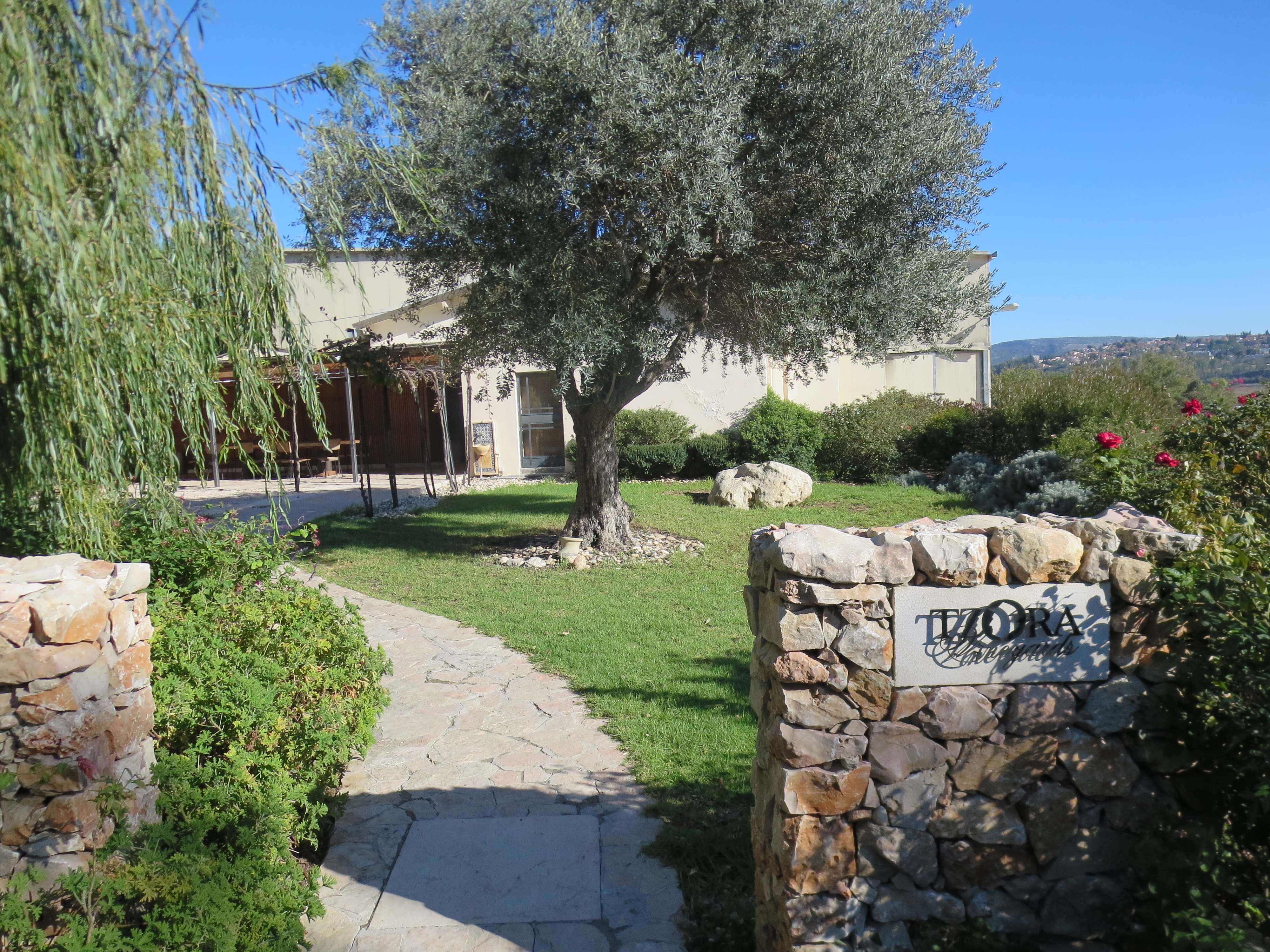 If one says terroir and Israel at the same time, many would snicker and laugh, but when it comes to Tzora Winery they continue to impress. I have written a few times about the Tzora Winery, it is a winery that proves that even in Israel, and even in 2010 and 2011 GREAT and controlled wines can be created.
This winery tasting was not a tasting like the previous ones on the trip, you see, we were not “officially” invited to this one. We arrived for the tail end of Nicolas Daniel Ranson and Christophe Bardeau (from Domaine Roses Camille Winery) wine tasting day. Previously to Tzora, they had gone to Flam Winery and Castel Winery, two wineries we had been to a few days earlier.
So, when we heard they were going to Tzora as well, we asked them both at the DRC tasting if we could piggy back on the tasting, and they agreed. Of course, in hindsight, in all of the enthusiasm and excitement of the DRC tasting, we forgot to ask Eran and the Tzora Winery if they were OK with it! You see, if you have been keeping up with the blog, we had braved the snow and all, and made our way to the Scala Restaurant, in the David Citadel hotel. We enjoyed the DRC wines with Messrs.’ Ranson and Bardeau. However, at the end of the tasting they were discussing where they were going the next day. We had Ella Valley on the books, but nothing else after that. Since Tzora Winery is a stone throw away Ella Valley Winery, we asked if we could piggyback and they said sure. Well, what we forgot to do was follow-up with Tzora Winery the next day. We deeply apologized for being so unprofessional, but Eran Pick, the head winemaker at Tzora Winery, and consummate professional, was so kind and was easy-going about the whole affair, and so we joined the tasting in mid run.
 If you want the true history and write-up on the Tzora Winery – please go here and read it all the way through – what a winery. To me the Tzora winery is one of the five best wineries in Israel, and Mr. Pick is one of Israel’s best winemakers.
We arrived and they were working their way through the white wines, and what wines they were. The wines showed richness, layers, and ripeness all in perfect control of both fruit and oak. Sure there is oak on the wines, but the oak does not dominate and nor does the fruit feel overripe. Instead, the wines show a harmony of fruit, oak, extraction, and expression – quite unique for Israel. The 2011 and 2010 vintages have been hit and miss in the Judean Hills, where most of the wines are sourced for all of Tzora’s wines. However, these wines were neither overly sweet, uncontrolled, or just unbalanced, like many of the 2010 and 2011 wines from the Judean Hills, with a few exceptions (Flam, Tzuba, Castel, Teperberg, and Yatir).
 This is not the first visit we have made to Tzora Winery, we have had a few, and most recently a few months before this visit. However, at that visit, the wines, or me, were having a bad day, and I did not think it would be correct to write about them. Even then, the wines were not out of kilter or uncontrolled, but rather they were showing lighter and with less expression.
This time, the wines, or I, or both were in the zone! The 2012 Tzora Neve Ilan was showing like a classic Burgundian Chardonnay and was killing it. Bardeau was raving about it but the one he loved the most of the two whites was the 2012 Tzora Shoresh White, a 100% Sauvignon Blanc wine which was aged in oak for 7 months and was tasting rich, layered, but tart and ripe all at the same time – wonderful. Read the rest of this entry

Tzora Winery – the founding terroir estate of the Judean Hills
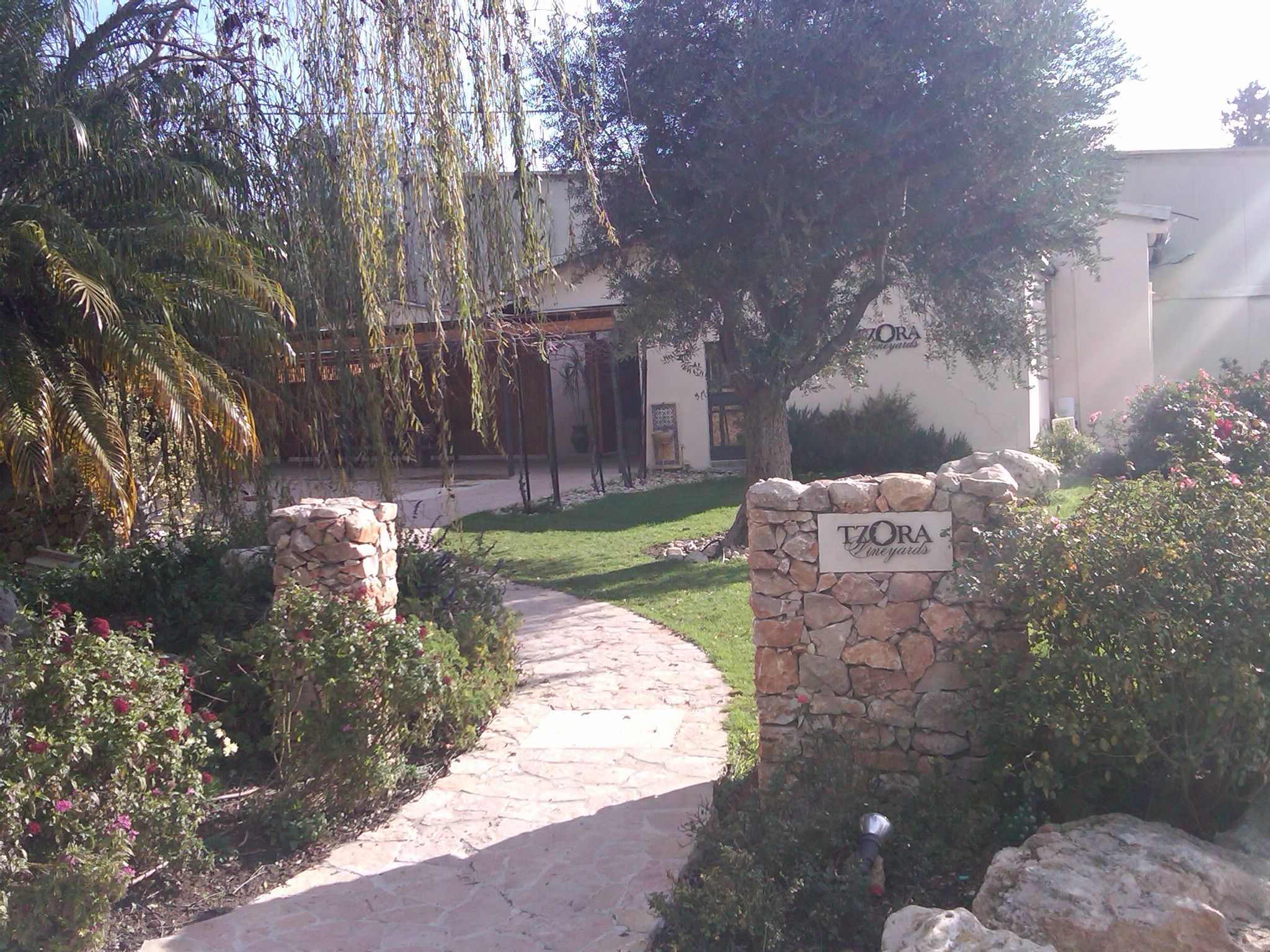 Say the word terroir and most folk’s thoughts would consciously, or maybe sub-consciously jump to France, heck the word is French after all. Still, ask what does it mean, and now we are off the races. Why? Because other than its literal translation; land or sense of place, there is no real translation for terroir. I think that is fitting in a way, as the word has really just started its long and obviously complicated journey. According to the incomparable Harold McGee and Daniel Patterson, it all started in the 17th century, when used to describe a wine, in a non-complementary way. My! Fast forward to 1831, when it was first used as a compliment! From there, it has evolved over and over, like clay, or silt, or maybe rocks, in the hand of a potter, changing and evolving to meet the needs of place and/or time.
 While researching this article I spent a good few hours, heck days, searching the real meaning of the word terroir. I almost felt like Indiana Jones on the search for the Ark of the Covenant. No matter how hard I searched, no matter the words I typed into the oracle of the web, all I got were old and stale answers. Finally, I fell upon the father of wine tasting, Eric Asimov’s, blog posting on the fore mentioned article, and I screamed Eureka (yeah my wife was not impressed)! On an aside, Harold McGee is my generation’s original scientific foodie, his books are the bible to many of our nowadays chef demi-gods gastronomical feats. It comes as no shock to me that he would be my knight in shining armor, remember wine may well be romantic in verse and scripture, but it is a chemical at its most base, in other words, dead center in Mr. McGee’s wheelhouse!
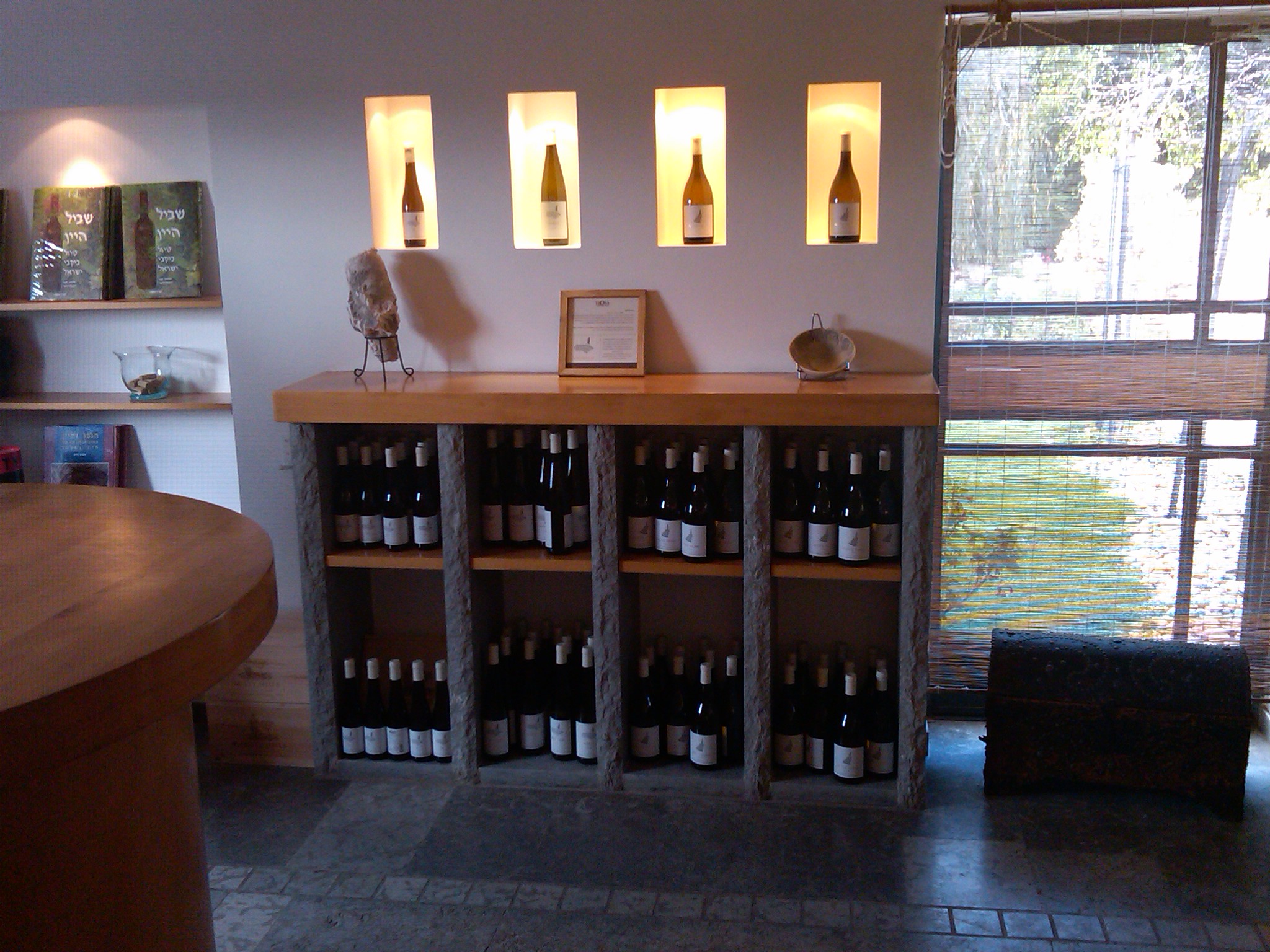 So, after reading more and more on this subject, it became even clearer to me, that the word may well be derived from the Latin meaning “earth”, but that is just the beginning of its true essence. Flash forward to a lovely early spring day in the Judean Hills, where my friend and I walk into the newly appointed Tzora Winery, sited on Kibbutz Tzora, and surrounded by sumptuous foliage and landscaping. Tzora Winery is the handiwork of one of Israel’s original and unique winemakers, who truly understood terroir, and saw Israel’s and the Judean Hill’s potential to become a world class wine region. In 1978, there was no Yarden winery, there was just a single Carmel Cabernet success, and Israel was just in its infancy, in terms of wine making, but to the visionary viticulturist Ronnie James, it was a path as clear as day. Mr. James was the Messiah to your average vintner. In his 30 years of service to the vine, Mr. James, will always remain the pioneer, not only at Tzora but also on the Israeli wine scene. Among Mr. James contributions were his enormous respect and passion for terroir and his insistence that his wines reflect that passion. James, known as “Dr. Terroir,” was the first to make wine from his own grapes and the first to introduce the vineyard name on a label. He recognized that the character of a wine comes from the site rather than the grape. Read the rest of this entry
2009 Jerusalem Wine Festival – Pictures and Wine Notes
Our story begins in 2003 and bombs are exploding up and down the state. Residents are worried to leave the house, and the wine industry is taking a severe hit, as overall morale is down. As the state steps up, and brings its considerable weight to bear on the problem, private individuals start to wonder how to remove the malaise from among the populace. Up steps Avi Ben, an owner of a successful chain of wine stores, who comes up with an idea to kill two birds with one stone. So Avi sat down with a few local wine marketers, and organized the first Jerusalem Wine festival. In his own words, as described by Jerusalemite.net – We decided to organize a fair that would bring wine distributors to Jerusalem. We picked a great location, the Israel Museum, and once they agreed to house the festival, all the planning became easier. People loved the location, they loved the idea, and it was a huge success. Under this backdrop, my friend and I were more than happy to attend the 6th annual Jerusalem Wine festival, which was once again located in the Israel Museum, Jerusalem.
 As we gave our tickets to the attendant (previously bought at the Nahalat Shiva Avi Ben store for 60 NIS) and slowly walked our way to the sculpture garden in the back, we could already take in the night’s air. It was filled with the smell of olive trees, pine trees, open wine bottles, and the initial sense of excitement. As we got closer to the open air arena, that hosts the 33 wineries that were presenting their wares for the evening, we were greeted by a table of glasses. The glass was ours to use during the evening, one that would be our ever present partner to the evening’s soiree, and one that we could take home after the long evening. I paused at the opening to the garden, and took in the spectacle that was in front of me. Beyond the dim lights, the 33 wineries that rimmed the garden and the center as well, essentially creating a pair of concentric circles, what was evident was the lightness of the evening. This was not going to be a wine snob event, or an event that would require heavy wine talk. Instead it was a casual affair, accentuated by the dress code of many of the attendees – shorts, tee shirt, and flip flops. But even more evident was the electricity, the life, the joy (even if alcohol fueled), that powered the evening and lit up the night’s sky. It was almost ethereal yet real, and one of the most exciting aspects of the evening.
<slight tangent about kosher issues>
Unfortunately, I must take a moment to talk about what I can only now explain as a kashrut problem surrounding the whole evening. As much as I loved the festival, those of us who are Orthodox practicing Jews, had a few problems that we faced that evening. They were:
- Shmitta wines for those of us who live in the Diaspora. The 2008 vintage is a shmitta year, and many of the wineries use a loophole called heter mechira, where they sell the grapes to non-jews. This is a not so accepted practice in the modern era, and so most Orthodox Jews do not drink those wines. The only way to know is to pick up the bottle and read the back label, where things of this nature are spelled out. The wines from Yarden, Galil, and some others, use a more accepted practice called Oztar Beit Din, and so I happily enjoy Yarden and Galil wines from the 2008 vintage.
- As lovely as the Spieglau glasses were, they were not “toveled” – ritually immersed, which Orthodox practicing Jews do, before making use of the utensil.
- 99% of the wines served that night, were non-mevushal wines. Meaning they were not pasteurized, which sounds great, because why would you want to pasteurize wine for goodness sakes, this is not milk with volatile bacteria. Well, because “mevushal” wine can be handled by non Jews, while non-mevushal wines cannot be. Furthermore, if a non Jew were to touch my wine glass or bottle, I cannot drink that wine anymore. The law is not very PC to say the least and truly requires a long post to analyze it better (which I will be doing soon God willing), but my belief system is based on faith and not one that I can turn on and off when it suits me or my friends. Now, I do not bring this up to disparage the Jewish lineage of those that were pouring the wines. Rather, I bring it up because the rules around the open bottle were lax to say the least. The open bottles, from which the wine was being poured was touched by many a passerby, and of their lineage, I have no idea.
My feeling is that the next time I go to this event; I would probably attend, but not drink any wines.
</end tangent 🙂 >
 Once we were finished taking in the scene/madness that was swirling before us, we moved our way to the booth of one of Israel’s most exciting wineries – Yatir Winery. It has captured the imagination and attention of many wine lovers including myself. I have been lucky to visit the winery twice before, and each time I am in awe of their progress and continual assault at the wine world’s malaise and opinion of Israel’s wine industry. Just this past year they were awarded one of the highest scores for their flagship wine by Robert Parker and Mark Squires of the Wine Advocate. There I had what can only be described as a brain freeze, when I tasted one of the best white wines of Israel – the 2008 Yatir Sauvignon Blanc, before I realized that the wine was produced using heter mechira. I was mistaken at that time, and once more unfortunately, and is the main reason that I did not enjoy more of the whites that evening, as they were either produced by non kosher wineries, or because they were the 2008 vintage and used heter mechira. That said the 2008 Sauvignon Blanc was wonderful, but was clearly not opened long enough to get its legs under it. Still, it showed a nice tropical fruit flavor along with a bit of cut grass and some lychee. From there we moved on to the Galil Mountain Winery‘s booth, where we were hoping to be able to taste the highly acclaimed Galil Meron. Unfortunately, it was not available for tasting till 9PM, so we were “forced” to partake of their other showings until the hour passed. I was happily distracted by the Galil Pinot Noir, which is a more classical take on a French Burgundy, than those recently produced by Israeli wineries. Still, the wine has enough facets – like its soft oak and coffee flavors to throw you off the French scent. The other two wines I tasted while waiting for the grand moment, were less than enthralling. The 2008 Galil Rose, was bland and flat, and the 2007 Galil Barbera was but a glimpse of its older brother’s power and depth. Where the others disappointing, the Galil Meron did not. It was a wine well worth the wait and one that I highly recommend for those in Israel (the US allotment will not be available till 2010, probably for Passover).
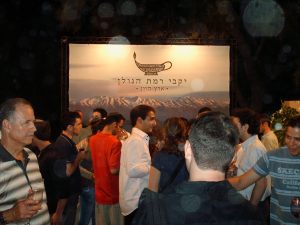 We next visited the booth of Dalton Winery, where we tasted a dud of a wine and a real nice winner. The Dalton Rose, made of 100% Cabernet Sauvignon grapes was an average quaffer, with a rose petal flavored mouth and a raspberry nose. Nothing to write home about or post about. The winner was the 2007 Dalton Shiraz – WOW! A solid blockbuster of a wine and one worthy or your attention. We then weaved our way on over to the booth of the Binyamina Winery, where we took in a nice 2006 Cabernet Sauvignon Reserve. While some booths had massive and expressive signs – note the Yarden Golan Heights Winery’s sign, other small wineries had zero signage. Yarden being one of the biggest wineries in Israel had a sign to match their importance and prestige. Heck, forget the sign, they had a whole platform. The sculpture garden is lovely and expansive, but the floor is rock and dirt, which while native to Israel and Jerusalem, is a bit too native for many of the folks standing and walking around for the 4 to 5 hours that the event was open for. Yarden and another winery had a lovely platform, with soft padding, great lounge chairs, a few tables, and awesome wines (which is obvious). I cannot seem to find a picture of the platform, but take my word for it :-). Anyway, we once again weaved around and through the crowd, and moseyed on over to the booth of Tzuba Winery. We have spoken before about Tzuba, and we had the extreme pleasure of visiting their lovely winery before. They are a winery with a long lineage of managing vineyards of the Judean Hills. The wines were a nice selection of the wines available from the winery, within Israel, and yet another reason for us of the Diaspora to do Aliyah! Yes, they export some wines, but the vast majority sells fine within Israel. We enjoyed a lovely 2007 Belmont (55% Sauvignon Blanc and 45% Semillon) which showed nice dirt, lychee, grapefruit, and peach. The 2006 Tel Tzuba Merlot was also quite nice. The 2006 Tel Tzuba Cabernet was a bit off, so I did not write it up, the bottle tasted over ripe or oxidized.
 We were off again, and moving towards a booth with a large sign, the Tishbi Winery Booth. It was mostly a waste of a trip, this time around, except to prime the pump for a return trip later in the evening, to taste their wonderful desert wine, when my evening of tasting was done, and my evening of drinking began, but we are jumping the gun! I digress again! After the awful and overripe 2006 Tishbi Shiraz tasting, we ran into a bunch of acquaintances from Rogov’ forum. The inner circle of wine booths did not take up all the possible space, so they filled the empty space with some nice standing tables. I rolled up to the table to augment my wine notes, and as I am of to do, I struck up a conversation with the people around me. Standing there as well was Zvi and his lovely wife. He overheard the conversation I was having (which is shocking given my quiet personality), and quickly surmised that it was I that had blown him off earlier in the evening. We were supposed to meet up at the booth of Assaf Winery. Well that never happened, because we could NOT find the bloody booth! It was one of those booths that had almost no signage, and so made it a bit hard to find, given the swarms surrounding the booths. Anyway, after talking a bit, Zvi pipes up asking “did you get to taste the 2003 Magnum Yarden Merlot”? Well no I say, heck I had yet to stroll over to the booth/platform at all. Given the opportunity, I bid my adu, and head on over to the Yarden “booth”. I nicely asked for a bit of the Merlot, and was rewarded with what can only be described as a drunkard’s convention sized glass of the dark garnet gold! Keeping in the new Hebrew and non-sequitur slang the Merlot was chaval al ha zman (translated literally — it’s a waste of time” in slang — fantastic, wonderful, out of this world, great). I lingered long at the booth while I slowly enjoyed my glass of wine. The Merlot was fat yet not over ripe, red fruit, with a ton of chocolate and tobacco. It almost felt like you were drinking ripe fruit and wood, while smoking a fat cigar and inhaling boxes of dark chocolate – quite a trip to say the least – like I said – chaval al ha zman.
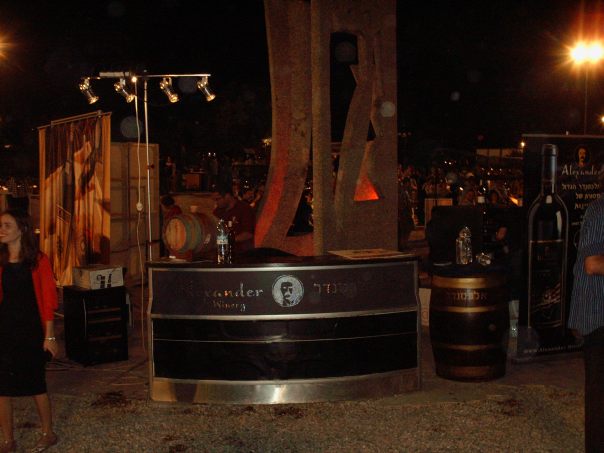 Once I had my chance to talk with the Yarden crowd and enjoy my wine, I found my way over to the booth of Tzora Winery. We have spoken about this winery before, and have also had the pleasure of going to their lovely winery, just before the untimely passing of their founder Ronnie James. Well, the wine has not missed a beat, with the new winemaker Eran Pick. The 2006 Neve Ilan was dirty and lovely. The 2006 Shoresh was a bit lighter, but still quite enjoyable. As I continued my trip around the inner circle, I hit upon Alexander Winery’s booth. The winemaker Yoram Shalom was pouring and his marketing agent was talking – quite a show! The wine that was pouring was the 2007 Sandro (named after Shalom’s brother). We were fortunate enough to meet Shalom the last time we visited his winery in Moshav Beit Yitzchak. The booth was abuzz with the recent award they won in a Spanish Wine Contest (missed the name – sorry) for their top star – 2005 Alexander The Great – Cabernet Sauvignon. The 2007 Sandro was overripe, as I have said before. The wines in the Golan and Upper Galilee can tend towards overripe flavors if not picked at the correct time. The Sandro is a blend of 70% Cabernet Sauvignon and 30% Merlot. We meandered around a bit, and we found ourselves at the Agur Winery’s booth. There I made my second faux pas, and tasted the 2008 Agur Blanca – which was also a shmitta wine and they use Heter mechira. The Blanca was really nice, though there are critics out there that do not like it as much as I did, oh well :-). I was not as impressed by the 2007 Agur Kessem (40% Cabernet Sauvignon, 30% Merlot, 20% Petit Verdot, and 10% Cabernet Franc), still a nice wine with a mix of black and red flavors, along with nice toasty oak, earth, and mouth coating tannins.
My friend disappeared by now, and I was moving around alone by now. I swung by the Yarden booth again, to get a taste of the 2004 Yarden Ortal Merlot, which was stunning (I had not tasted this one before). At this point, my palate was shot and I swung by the Tishbi booth once more, to get a taste of the stunning 2006 Jonathan Tishbi Barbera-Zinfandel Fortified Dessert Wine. I absolutely loved it and it reminded me of the Carmel Vintage – which is another desert wine that is quite impressive as well. The evening ended and I picked up some wines to go, in an outside pavilion.
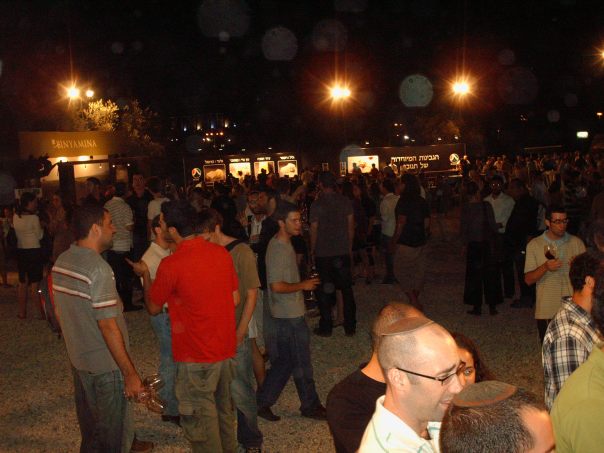 My take away overall was that the festival was well run, while most of the wine purveyors were pushing some light weight wares that met the interest of the majority of the festival customers. There is nothing wrong with that, the average wine consumer likes their wine smooth and easy to drink. Given that trend, the wineries were pouring wines that met the consumer’s interests. The wineries that I highlighted were pouring wines that were quite enjoyable and highly unexpected (Galil and Yarden). Finally, ignoring the wines for a second, the festival’s attendees were all very amiable, courteous, and joyous. Yes they were imbibing alcohol, but alcohol can bring out the worst in people, and that was NOWHERE to be seen, and I stayed to the closing on Tuesday night. There is a lovely saying in Jewish Lore that goes something like this; When alcohol enters the person’s true self comes out. That was more than evident Tuesday night, under the full moon’s sky, the beauty that is Israel, was open for all to see and enjoy.
So, thank you so much to the Israel Museum, Avi Ben and all the wineries that were pouring their wares, the wine notes follow below:
2008 Yatir Sauvignon Blanc – Score: B+
The nose on this straw colored wine is filled with lychee, grapefruit, and tropical fruit, along with a strong sense of brightness, and almost clean steel smell. The mouth on this medium bodied wine is super bright with lychee, grapefruit, and tropical fruit, along with some nice balancing green flavors. The mid palate is bright which leads into a long and crisp finish of more tropical fruit. A really nice crisp Sauvignon Blanc with just a hint of roundness that comes from a bit of time in French barrels.
2007 Galil Pinot Noir – Score: B+
The nose on this dark ruby colored wine is classical in nature with nice terroir notes, along with cherry, cranberry, and raspberry. The nose was hot out of the bottle, and I did not stick around long enough to see when it dissipated. The mouth on this medium bodied wine follows the nose with more cherry, raspberry, and not yet integrated tannins. The mid palate is still tannic and hot, along with coffee and bright acidity. The finish is long and spicy with bright red fruit and an almost toasty flavor
2007 Galil Barbera – Score: B
The nose on this light garnet colored wine is filled with cranberry, plum, oak, and coffee. The mouth on this medium bodied wine has nice light and integrating tannins that work well with the mouth’s plum and cranberry. The mid palate is almost smooth with light tannins, coffee, and oak. The finish is long with bright acidity, coffee, and red fruit. This is not the winner that the 2006 vintage was, and may be too early to really tell where this wine is going.
2006 Galil Meron – Score: A-
The nose on dark garnet to black colored wine is popping with blackberry, raspberry, ripe plum, chocolate, coffee, and rich oak. The mouth on this full bodied and complex wine has layers of blackberry, tar, coffee, and rich plum. The mid palate is layered with oak and integrating tannins that come at you in layers. The finish is super long with tar, pepper, blackberry, and chocolate. This is a real winner and one that is sure to please almost anyone at the table.
2007 Dalton Shiraz Reserve – Score: A-
The nose on this dark garnet to purple colored wine is filled with ripe fruit, plum, blackberry, tar, and pepper. The mouth on this full bodied wine with complex layers hits you often with wave after wave of blackberry, ripe plum, and cassis. The mid palate is filled with tar, oak, and coffee. The finish is long and spicy, with oak, tar, blackberry, and chocolate. Quite a nice Shiraz indeed.
2006 Binyamina Cabernet Sauvignon Reserve – Score: B – B+
The nose on this dark garnet colored wine was hot out of the bottle, with ripe fruit, cranberry, blackberry, and oak. The mouth on this medium to full bodied wine has cassis and blackberry flavors. The mid palate is balanced and spicy with oak and bright acidity. The finish is bright and spicy with blackberry, coffee, and oak.
2007 Tzuba White Belmont (55% Sauvignon Blanc and 45% Semillon) – Score: B+
The nose on this bright light straw colored wine has mineral qualities, along with lychee, grapefruit, peach, and an almost toast aroma. The mouth has very ripe flavored fruit that mingles nicely with earthy and mineral flavors, along with grapefruit and peach. The mid palate is tart and earthy. The finish is long with more tart fruit and clean mineral flavors.
2006 Tzuba Tel Tzuba Merlot – Score: B+
The nose on this dark ruby colored wine has nice earthy notes along with raspberry, cranberry, cherry, oak, and vegetal notes. The mouth is medium bodied with integrating tannins, cranberry, and raspberry. The mid palate is balanced with oak and acidity. The finish is accompanied by earth, spices, and round red fruit. This is a wine that can use more air in and out of the bottle and one that will serve you well.
2003 Yarden Magnum Merlot – Score: A-
The nose on this black colored wine (not showing any hint of slowing down or brown), is ripe with rich red fruit, slightly hot, plum, raspberry, cassis, rich oak, and mounds of dark chocolate. The mouth on this complex and full bodied wine was throwing sediment, and comes at you with layers of with rich plum, blackberry, and chocolate. The mid palate is bright and balanced with acidity, integrating tannins, and coffee. The finish is long with tobacco, chocolate, and nice tannins. It almost felt like you were drinking ripe fruit and wood, while smoking a fat cigar and inhaling boxes of dark chocolate, quite a treat indeed.
2006 Tzora Neve Ilan (70% Cabernet Sauvignon & 30% Merlot) – Score: B+
The nose on this dark garnet colored wine is filled with rich earth, blackberry, cranberry, oak, and coffee. The mouth on this medium bodied wine follows the nose with cranberry, raspberry, roasted oak flavors, and something akin to toffee. The mid palate has integrated tannins that flow into a long finish with spice, dirt, and red fruit.
2006 Tzora Shoresh (100% Cabernet Sauvignon) – Score: B+ – A-
The nose on this dark garnet colored wine filled with plum, raspberry, earth, and toasted coffee beans, and oak. The mouth on this medium to full bodied wine is spicy with somewhat gripping tannins that have yet to integrate, plum, cassis, and raspberry. The mid palate is bright with acidity and oak, and leads into a long and earthy finish with rich oak, coffee, and nice spice.
2007 Alexander Sandro – Score: B – B+
The nose on this garnet colored wine is perfumed with almost overripe fruit, toasted oak, blackberry, and raspberry. The mouth on this full bodied wine is gripping with powerful tannins, cassis and plum. The mid palate is filled with toasted oak and balancing acidity. The finish is long with cassis and plum fruit, and chocolate.
2008 Agur Blanco (65% Viognier & 35% Riesling) – Score: B+
The nose on this electric straw colored wine is perfumed with rich and lively grapefruit, honeydew melon, and peach. The mouth on this medium bodied wine is rich and almost glycerol and oily with ripe peach and honeydew. The mid palate is balanced with bright acidity that leads into a long and rich finish of tart fruit.
Tzora, Goose Bay, and Rothberg Cellars – Oh my Oh my!
This past week some friends from out of town came by, as did some from around town. It was a really nice time. Dinner started with a dense black bean soup – from the classic Moosewood Cookbook from Mollie Katzen. It has been modified to protect the innocent, but the core recipe stands strong. Dinner was sweet roasted summer vegetables, succulent hot pepper lemon roasted chicken, and a mushroom and onion Quinoa side dish.
To keep the dinner within reach we stayed with some robust yet tasteful wines. The first was a 2007 Goose Bay Viognier, followed by the 2004 Rothberg Cellars Cabernet Sauvignon, and finally the 2004 Tzora Single Vineyard Shoresh (100% Merlot). In case people are not so up on Viognier – I thought I would add would re-post a description and contrast of Viognier and other white wines:
Viognier is a white grape that it is closer in style to a Chardonnay than to a Sauvignon Blanc. All wines can be operated on – but classically these are the styles that the white wines have:
1) The Sauvignon Blanc – can be as clean lined and crisp as a Sancerre and become fat and a bit ugly like in California, and everything in between. Still the classic lines of a Sauvignon Blanc are crisp clean lines, with intense fruit and floral flavors. If picked early there is more green, if picked too late there is more of a fruit bomb which winemakers turn into a fat wine because of all the sugars – or manipulate it by decreasing the alcohol. It is commonly high in acid and is not meant for a long shelf life – though many a Sancerre have lived long lives – mostly because of the crazy acid and mineral characteristics that come from the Terroir.
2) The Chardonnay is the wine that we all know and can have many different lines. It is a grape which by its nature is screaming to be modified. The grape loses its crispness early on as it ripeness but in its place comes the weight, fruit, and body. The more oak that is applied the more toast, espresso, smoke, and spice flavors get introduced. The grape has less acid as it ripeness but gains more fruit. This is the real quandary with Chardonnay – when do you pick it? When it sits on the vine for too long you get a ton of fruit, little or no acid and high alcohol. To counter act that wineries will dealcoholize the wine and add pH as well. Again – Chardonnay is a grape that is screaming to be managed. However, when done correct you can either get nice green and floral wine with less acidity than Sauv Blanc, but still enough to hold the wine up and enough fruit to carry the day. Or you can make it California style and lose the acid but gain nice weight and body (from the fruit, alcohol, and oak) – but pH added still tastes fake to me.
3) The Viognier grape/wine is a different beast. It is a wine that has distinct characteristics: perfume, floral notes and acidity, but it is a very picky grape. It is very easy to lose to mold and because of this wineries will plant roses next to the grape vines to act as a canary for detecting mildew early on. The grape needs to be picked late otherwise, it does not give the classic perfume that we get from the Muscat and Riesling grapes. Depending on if the wine maker puts the wine through malolactic fermentation (to give it a bit more weight) or let the wine lie in the must (to give it more perfume) or to let it have a bit of wood to give it roundness. In the end, the wine is not meant for long storage – hence the VERY early release dates on these wines and the wine should have the acidity, fruit, and perfume to make it a real winner.
Now back to the wines…
The unfortunate part is that my friends are not white wine drinkers – and this kills me! As I am trying to grow my knowledge of wines and trying to be more open minded about white versus red wines – my friends are not following along for the ride! So when I want to pop a white bottle to see what a Sancerre, Chardonnay, Chablis or a Viognier tastes like – I feel like a party pooper on my own table. This is an issue that I hope to find a remedy to soon.
The thing is that to me the Viognier stole the show. At first open it was nice – but the heady perfume that would soon be gracing our olfactory receptors was still closed up in the wines cold embrace. However, as the wine opened up so did the oohs and ahs around the room. They still did not appreciate the white wine, but they were able to discern that this was not just another white. The Rotherberg Cellar was the red winner around the room. It was heady with its own enveloping sensations. The nose was just over the top. The second we opened the bottle till some hours later the nose was still pumping and quite nicely as well. Beyond the nose, the mouth was smooth, full, and round – like a California Cabernet. The oak was NOT over the top, it accented the wine – it did not define it. The ripe fruit was obvious and maybe too obvious – but still a very nice showing. The Shoresh was raw, young and quite tannic. It was a stark contrast to the smooth Viognier and Cabernet. It was not a hit on the table and again – I disagree. The wine is more like a tiger ready to pounce and one that I think has not yet hit its peak. The Rothberg Cellar and Goose Bay are awesome specimens – but are in my eyes – at their peak. When Shoresh reaches its peak – in a year or so, it will have its day in the sun. Finally, I has tasted the Shoresh in Israel at the winery and the wine has made a clear shift from then. It is still as tannic – but I swear I had a double take when I realized that it tasted a lot like a cab – except for the clear and present licorice in the mid palate. The score is a bit lower, but one I am sure will return when it reaches its peak.
Tzora Single Vineyard Shoresh 2004 – Score A-
The nose on this garnet colored wine (100% Merlot) is laden with red berries, mineral aromas, cherry, and wood. The mouth on this medium bodied wine starts with tight tannins – though integrating and a strong and slightly complex attack of black cherry, and blackberry. The middle is filled with green, earth, and licorice. The finish is long and woodsy. This has changed since I last tasted it. If tasting blindly – I would have thought this to be a Cabernet Sauvignon. The licorice was a giveaway that it was not a cab – but still the earth, dense fruit, and cab like fruit – makes made do a double take.
Rothberg Cellars Winemakers Reserve Cabernet Sauvignon 2004 – Score: B+
The nose on this muddied reddish purple wine is crazy and may well be the wine’s best feature. It is an enveloping nose and one that lasts all night. The nose is filled with strong ripe fruit fragrance along with cranberry, pomegranate, and fig aromas. The mouth on this very smooth and full bodied wine is fruit forward with ripe fruit, blackberry and black plum notes. The mid palate is acidic in its core along with soft tannins and a hint of chocolate and tobacco. The finish is long lasting with fig and cranberry.
Beyond the technical details the things that stand out to me when thinking about this wine are:
- its acidic core
- its smooth nature
- its soft and integrated tannins
- the lack of overpowering oak – this wine is assisted to by the oak, it does not define it
- the muddied color and over ripe fruit flavors throw me a bit and lower the score
- the wine is at or just over its peak – drink up and really enjoy. This is not one to lay down for even a few more months.
- The wine felt like it was aged in French oak – no smoke or toasted spice just a nice and round fullness
Goose Bay Viognier 2007 – Score: B+ to A-
This is an awesome and fun white. When we first opened it I was hoping for the perfume to overpower me and take control of my senses. However, the nose did not open up right away, instead the mouth was full of the perfumed fruit while the nose was hiding behind the mask of fruit and oak. The nose would open and so I will say that the notes here are from an hour or two in – with the difference being the deep and almost striking perfumed nose that showed itself later.
The nose of this light yet bright straw colored wine was filled with classic Viognier perfume, grapefruit, apricot and citrus aromas. The mouth of this medium bodied wine is strikingly fruity while also being infused with the perfume quality. The mid palate is strongly acidic and laced with grapefruit, lemon, and green flavors. The finish is acidic in an almost puckering way. This in contrast to a previous post, where the acid was overpowering and not well integrated with the wine.
Beyond the technical details – this wine too has some nice take aways for me:
- The wine has oak but again in a supporting role – like it should be
- The wine is acidic to its core and here the acid truly integrates and lends a large assist to the wine
- The wine is perfumed in a way that also balances well with the oak and acid
- Finally, this too is a wine to enjoy now and for a few more months.
Tzora Winery
We made an unplanned stop at the Tzora Winery on a cold winters day and we are so happy we did. We arrived in the late afternoon and there was quite a party going on. A bunch of kids from America had arrived and they were making the most of the winery’s insanely kind hospitality. When we arrived the party was in full swing and we did not want to bother them or the winery staff. As we were getting ready to leave (please folks – always make reservations in advance – do not expect to be as lucky as we were), the staff was super kind and was able to squeeze us into the wine tasting that was in progress. The sad aspect is that though Tzora has increased the volume of wine – the best wines will continue to stay in Israel and not be imported abroad.
The thing that makes Tzora such a special winery are their vineyards. Ronnie James tends to the vines, and it is a labor of love. Unfortunately, as we write this article we are told that Ronnie has passed away. Ronnie and Tzora wines were built on the ideal that terroir makes the wine. The land that the vineyards sit on are the names given to the wines (Shoresh, Neve Ilan, Givat Hachalukim).
Ronnie was growing grapes since the 50s for himself and many other wineries. We will all miss him and his wine and vines will continue to pay tribute to him and his legacy.
We would like to thank the staff at the winery for allowing us to join in and enjoy the tastings. Following are the tasting notes which we sampled at the winery.
Tzora Judean Hills 2004 – Score: B+
The nose on this ruby red colored wine (60% Cabernet Sauvignon and 40% Merlot) is laden with raspberry, cherry, and oak notes. The mouth on this medium bodied wine fat with tannins and cherries. The finish is medium long and quite enjoyable.
Tzora Givat Hachalukim 2006 – Score: B+
The nose on this garnet colored wine (100% Cabernet Sauvignon) is laden with red berries and cherry. The mouth on this medium bodied wine is smooth and balanced with oak and soft tannins giving way to cherry and spice. The finish is not so long, but the wine lingers long on your palate after the wine is gone.
Tzora Shoresh 2004 – Score: A
The nose on this garnet colored wine (100% Merlot) is laden with red berries, mineral aromas, and cherry. The mouth on this medium bodied wine is balanced with integrated tannins giving way to red berries and oak. The finish is medium long with cherry and spice.
Tzora Or 2006 – Score: A+
This wine has quite a story around it as Robert Parker gave it one of the highest scores in a recent Israeli wine expose that he conducting along with Mark Squires. We were able to taste the end of the bottle and it was still quite impressive – none the less. Gewurztraminer grapes are harvested and then deep frozen for two months. Then they are extracted for 24 hours and only the first drips of the grape juice become Or. The nose of this golden wine is filled with honey and tropical fruit. The mouth of this full bodied and almost syrupy wine is fruity with citrus, pineapple and a touch of mint.

 Wine Musings Blog