Blog Archives

California Dreaming about the 2020, 2021, 2022, and early-2023 vintages – a retrospective
In May 2024, WOW, I have to get used to the new 2025 thing; I wrote a post about wines I had tasted in the past month or two. However, after tasting through so many excellent California wines from 2021, I decided it required a retrospective.
Some of these wines will be new to the blog, some will be reposts, and some will be reposts with a change in the scoring (I will denote those clearly).
The 2020 vintage was blighted by many fires, smoke taint, and a poor overall showing. The 2021 vintage was far more controlled, with almost no heat spikes. Though there was little rain before it, the vintage came out smelling like a rose. In the 2022 vintage, we saw far too many heat spikes. Add in many days of over 100-degree weather, and it is shocking that anything good came out. Still, I found some winners. The 2023 vintage is looking like the best of BOTH worlds: rich, layered, with incredible balance. The California whites from 2023 outshined all of Europe and Israel, and we wait now for the release of the higher-end red wines to make a conclusive decision.
As you read through this post about the Kosher wineries that reside in California, understand that California is not Napa Valley. It is a vast state with many wine regions. California is massive. It has four main wine-growing regions and 147 viticultural areas (AVA). If California were a country, it would be the fourth largest in regard to wine production.
At the start, in 1985, when Robert Parker and Michel Rolland took over the world and drove wine production toward a more fruit-driven approach, Napa Valley was the poster child for what a “proper” wine should be. The fruit was very prominent, the tannins were round, not astringent, and the alcohol levels were high. If you watch and listen closely to the videos of Peter Koff, MW, and Dr. Pat Farrell, MW, you will learn so much! Listening to them, they describe the wine critics at the tasting/judgment of Paris who were looking for the ripest fruit.
Looking at current wines, I feel such a tasting would have very different outcomes. First of all, Bordeaux’s ABV is climbing, and there is no end in sight. This is not a choice by the wineries; instead, it is a choice of nature. Secondly, Napa Valley, which was the California area of choice, is even riper than in those days, and I think they would stick out badly. Many Napa Valley wineries are trying to bring their approach back to the middle, but they run up against the same issues Bordeaux is facing, and really the entire world.
When you look at the notes below, you will find three camps. One is the tried-and-true camp of Alexander Valley, AKA Sonoma. It has continuously shown control and power, though at times lacking acidity and finesse.
Next, you will find Napa Valley split between two camps: the bid, bold, in-your-face Robert Parker dream, fruit-forward, powerful, fleshy, and alcoholic to the max. The other side of this camp is the more controlled, sinewy, and acidic, though showing Napa’s power, with a steady hand and clear horizon towards Old-world style wines.
Finally, you find the wild-wild-west at its greatest in areas like Santa Barbara, Paso Robles, and the other regions to the south. Here is where folks like Shirah Wines live. Wines that are more Rhone-style, off-the-beaten-path varietals, exciting, and not yet fully commercialized ideas that bring a smile to most who try them.
As you read through the notes, you will find that I look for balance. I like power; I do not crave it. I desire a wine with rich acidity, balance, clean lines, power or not, but a wine that makes you want to take another sip, because it is refreshing. Balance is the definition of a glass of wine that clears your palate not by giving you a headache but rather by having acidity and pop that can have power but more assuredly has an acidity that works in conjunction with the fruit.
To that point, you will find wines below that get high scores because they are balanced. Examples of wines I bought, which is the highest proof of a wine I like, are the 2021 and 2022 Marciano Estate, 2021 Covenant Cabernet Sauvignon, 2021 Covenant Cabernet Sauvignon, Lot 70, 2022 Covenant Cabernet Sauvignon, and the 2021 Herzog Alexander Valley Cabernet Sauvignon. The 2021 Napa Valley Cabernet, Reserve is a clear WINNER and one you should all seek out.
The 2023 Pinot Noirs from Herzog and Covenant prove that this vintage has potential, but again, we will not know where it lines up until after the full lineup of red wines is released across California.
Finally, the higher-end white Sauvignon Blanc wines from Marciano, Covenant, and Hagafen are worth finding – they are lovely! I wrote a separate post, mid-2024, about the top white wines from 2021 through 2023, which are well worth buying!
Pricing
I am fine with writing about kosher wines, but we cannot talk about Kosher Napa Wines without addressing the large elephant in the room, which is the elevated prices. I stress Napa Valley because there are no Kosher California Wines above 130 dollars outside of the Herzog Sonoma Clone Six and the new Herzog Double Creek. Please do not talk to me about Four Gates Wine. Respectfully, it is a drop in the bucket and does not move any needles, industry-wise, other than for its quality.
The number of bottles produced at the price range that raises eyebrows is starting to make people like me wonder. How many people are buying wines priced at 200 or more dollars? Many of the wines listed below are 300 or more dollars. How do you build a brand and a list of people for wines at that price?
Yes, there are more expensive wines out there, but that is one or two, and they are from storied old-world marks and vineyards, meaning they have a track record. Of course, runs at cult-like Napa Wineries have been going on underground for a very long time. Now, we are seeing Kosher Napa Wines selling in the 200-plus to 360-dollar range on store shelves, and it is all new for the kosher-wine-buying public.
There is a clear cost to everything that happens in making a wine kosher, and those people deserve to be paid. A few hands in there also need to be paid for fronting the money, marketing, and so on. However, the per-bottle “kosher tax” does not need to be commensurate with the cost of the non-kosher base price. Again, there is a cost for working in Napa and making Kosher wine there, but as proven by Hagafen and Herzog, wine can be produced without those high Kosher wine taxes.
Ultimately, I am at the mercy of those who feed me. As always, I openly state that I go and taste wines; when I do, I do not pay to taste those wines. At the same time, I post what I taste and never change a score because of the situation in which I may be placed. There is a clear reason for why I have stopped going to specific wineries and regions to taste – because the outcome was getting too awkward, and the posts were becoming a chore. I am always very thankful for the chance to taste wine, and I am always honest about what I taste, and for the most part, I stay out of wine business commentary. However, when everyone asks me the same question, I suppose I cannot just ignore the elephant.
Criteria and Process for this post
I thought long and hard about how I would manage this post. At first, I thought I would do a total dump of all the wines across wineries from both the 2021 and 2022 vintages. However, that would end up as a massive mess; there are far too many wines. So, I decided to list all the wines from all the California wineries I tasted, scoring a 91 or higher from the 2021 and 2022 vintages. There are still a lot of wines, but that is the only way to get a list in one post, and that is not insane.
I will leave the red wines from the 2023 vintage alone for now. There are too few wines from that vintage at this time. Still, I will post some 2023 white wines as they are showing well, and they were tasted at the same time! Also, Four Gates has yet to release their top 2021 or 2022 wines, so we may need yet another retrospective after that. LOL, I think not. There is one exception, Kasher Wines, which I first tasted in November, has a 2020 Cabernet Sauvignon.
You will not find Four Gates Winery here because they have yet to release the 2021 vintages, and they are so small that it is impossible to really compare them with these other players. You can look here if you want to find my posts on Four Gates Winery. Other wineries make Kosher Wines in California but I did not find their 2021 vintages that interesting to me to make it into this post.
Closing Thoughts
This post is massive and took a crazy amount of time, thought, effort, and tasting! People ask me about wines and respectfully never really think about the amount of effort it takes to put it down on paper. Of course, none of this could have happened without the kindness and generosity of the wineries in sharing their time and wines, which took them far more effort to make. Many thanks to Elk (Elchonon Hellinger from Elkwine) for helping set up a lot of this. David Edelman for sharing his time and wines as well. Many thanks to all the wineries, Marciano Estates, Ka.sher Winery, Hajdu Wines, Shirah Wines, Herzog Wine Cellars, Covenant Wines, Hagafen Cellars, Tench Vineyards, and Addax Wines.
Read the rest of this entry
Herzog Winery Visit and KFWE VIP Experience 2024 – another successful event
Six-plus months ago, Kosher Wine had its start to the wine-tasting season, for 2024. First, it was a trade-only KFWE (Kosher Food and Wine Festival in New Jersey), then the Jewish Link Grand Wine Tasting (also in New Jersey), and then A Wine & Food Night by KWD, in Brooklyn. I wrote about the three-day extravaganza here in this post. In the long post, I wrote that I thought it was time to move from the public-laden KFWE Kiddush to the more nimble area-based tastings. The scale of the three tastings, even the KFWE-trade tasting was far more in line with what people needed to taste and be educated. Still, there was no public option for Royal wines, but actually, the two tastings were better for Royal than KFWE could ever be. The point of the area-focused tastings was to make sure that the people who live in those areas are represented by what they may wish to taste. I hope that in the coming years, the wine stores will be allowed to weigh in on what wines should be showcased at these area-specific events, from massive portfolio distributors, like Royal.
In the post, I wrote that the ball was now in Herzog Winery’s court to bring back the IFWF of old. The vast majority of the people at the KFWE VIP Experience 2024 event at the Herzog Winery in Oxnard, this past week, came and left experiencing EXACTLY what I hoped for 6+ months ago. Herzog did exactly what it was supposed to do, it highlighted the quality of their wines and the quality of their restaurant, and it allowed Royal to curate the wines it wanted to promote to the folks in Southern Califonia, whether that was actually implemented or not.
I will say, that I hope Herzog Winery continues this idea, having a more intimate interaction/experience for their customers, by hosting the event at the winery. It showcases what they do/have best. The naming (AKA KFWE) I think is a mistake. The point here is that it was NOT a KFWE, it was a Wine and Tierra Sur Tasting at Herzog Wine Cellars, with a smattering of other wines. That overall approach used to be called IFWF (International Food and Wine Festival). However, that was also a misnomer, as the focus was more on Herzog and some French wines, even in 2008. In the end, trying to sell this event as anything more than Herzog and Tierra Sur undermines what Herzog sells. With that said, no one left there unhappy, to me, and from whom I spoke at the event, it was a hit and it should be continued!
Herzog Wine Tasting
A few hours before the KFWE event took place, Elchonon Hellinger, owner of Elk Wines, and I made our way to Herzog Wine Cellars to taste some Herzog wines I had yet to taste. Before Elk arrived I was speaking with Joseph Herzog (Vice President and Partner) and David Galzignato (Director of Winemaking and Operations) about many a thing and the California 2021 vintage came up. Up until this tasting, I had tasted all of the 2021 wines that were released, except for a few. With all of them, I was highly impressed and posted about them a few times, here, here, and here. The wines before me, other than a few 2021 wines, were all from the 2022 vintage. I can tell you now, the 2022 vintage does not show as well as the 2021. Simple. It is riper, less controlled, and feels like one that may not age as well. That said, at the end of the wine tasting I made this statement, the work you have done over these past two years clearly shows that you have raised the floor for Herzog Wine Cellars. The issue I have is that fewer wines push the ceiling, at least these past two years, than in previous years. I am sure that has a lot to do with the viticulture and the direction of the winery, as a whole, and I think that overall it is a win.
With that said Herzog Winery continues to win as the top Mevushal wine option every year. They also do very well with the QPR (Quality to Price Ratio) Wines. I expect them to be on those lists every year, Herzog Wine Cellars excel at the Mevushal Process and they excel at making quality wines for a reasonable price, across their portfolio, and with the work of David and his team, they have raised the floor of those wines over the past two years.
The Yesod Wines, a new wine label, does not show the name Herzog anywhere on them. It is their first foray into making some of the best wines in the world. While tasting them I said that while I feel the work in these wines, the clear effort to raise the floor of the overall wine approach, it lacked the pop for me. The best wines in the kosher world, when you smell them, make you salivate, they make you want to taste more, and the alcohol levels on them allow you to do that without feeling off-kilter. The Yesod wines, in my opinion, are well-made wines for the sort of Kosher wine drinkers that are targeting. Classic Napa wines with a big body, enough acidity, and loads of fruit.
The wines I oohed and aahed about were the 2023 Herzog Chenin Blanc, Clarksburg Reserve (mevushal), and the 2022 Herzog Cabernet Sauvignon, Napa Valley, Special Reserve. Why? Because, in the past, these two wines (Herzog white wines in general) and the Napa Blue Label Special Reserve Cabernet Sauvignon, were rarely on point. These two wines showed me the biggest change, the raising of the floor, and the focus, overall. A steady-eddy approach to winemaking, which may not garner you as many ceiling-pushing wines, at the start, but an approach that raises everything and one that I am sure will eventually get Herzog to even further heights.
My many thanks to Joseph Herzog, and David Galzignato for setting up the meeting, sharing your wines with us, and taking time out of your busy schedule (the day of the event!) to meet with us. The wine notes follow below in the order they were tasted – the explanation of my “scores” can be found here and the explanation for QPR scores can be found here:
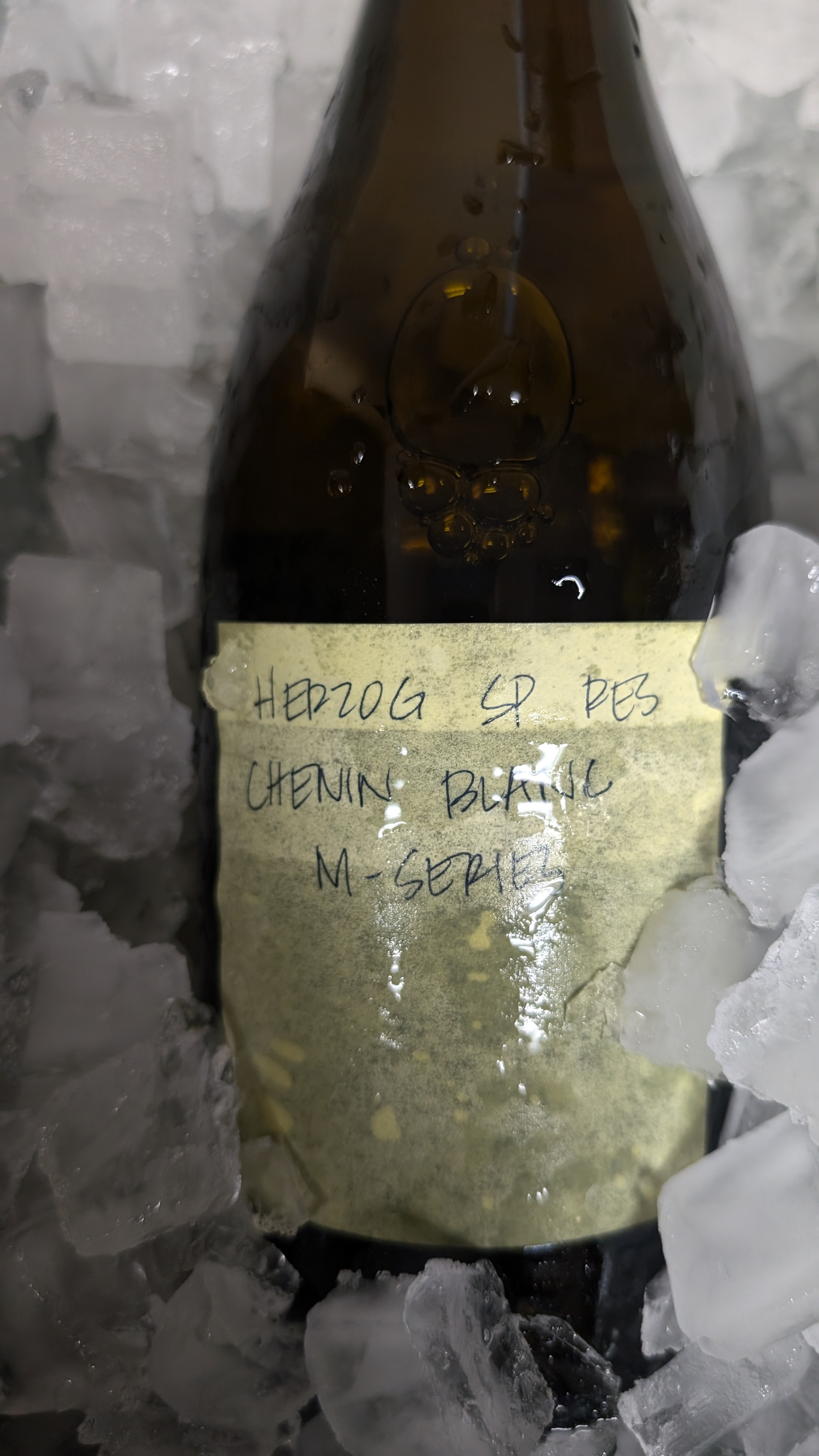
2023 Herzog Chenin Blanc, Clarksburg Reserve, Clarksburg, CA (M) – Score: 92 (QPR: WINNER)
The fruit had botrytis, modeled after Savennieres, old vines Chenin Blanc. The nose of this wine is lovely, showing white peach, pear, apricot, quince blossom, rich honeysuckle, pear blossom, sweet Lipton lemon tea, and sweet oak. The mouth of this medium-plus-bodied wine is fun, it is bone dry, showing great acidity, lovely mouthfeel, almost oily, with a lovely plush mouthfeel, starting with Lipton tea, honeysuckle, honeyed melon, pear, white peach, lovely mouthfeel, a true joy! The finish is long, tart, funky, and rich, with green notes, floral notes abound, and bone dry and rich sweet oak. Drink by 2028. (tasted September 2024) (in Oxnard, CA) (ABV = 14.50%)
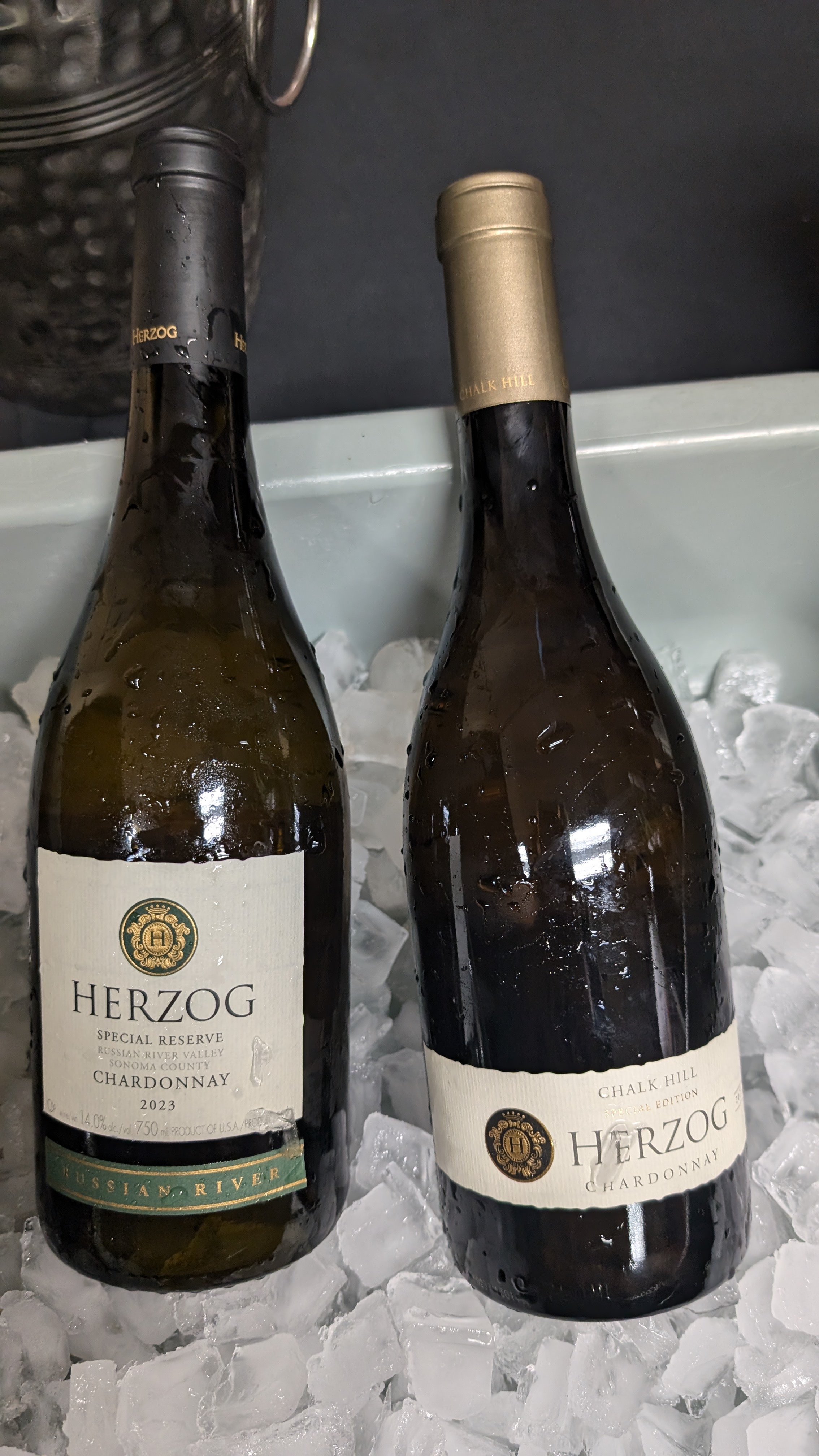
2023 Herzog Chardonnay, Russian River, Russian River, CA (M) – Score: 92 (QPR: WINNER)
The nose of this wine is lovely, tropical, fruity, smoky, and ripe, with hickory, sweet vanilla, butterscotch, sweet dill, and peach/pear. The mouth of this medium-bodied wine is ripe, and balanced, with lovely acidity, with rich pear, apricot, sweet oak, butterscotch, buttery brioche, and sweet dill, with rich sweet fruit that works with the American Oak. The finish is long, ripe, and a bit candied, but balanced with great acidity, smoke, rich vanilla, hints of banana, and oak. Drink by 2028 (tasted September 2024) (in Oxnard, CA) (ABV = 14%)
2023 Herzog Chardonnay, Chalk Hill, Special Edition, Chalk Hill, CA (M) – Score: 92 (QPR: WINNER)
The nose of this wine is nice with great bright fruit, lovely tart peach, pear, melon, and great sweet oak. The mouth of this medium-plus-bodied wine is lovely, tart, and balanced, with rich acidity, nice smoke, and good weight, showing pear, peach, melon, and hints of tropical, but balanced, and nice focus with good oak. The finish is long, and tart, with no butter here, great wine, more Chablis than Burg in style. Nice! Drink by 2028 (tasted September 2024) (in Oxnard, CA) (ABV = 14.50%)

 Wine Musings Blog