Blog Archives

Final Tasting from my trip to Paris – November 2023
As stated in my previous post, I was in Paris in November, with Avi Davidowitz from Kosher Wine Unfiltered. The number of boxes in our room was not nearly as insane as last year. Last year, we had some 80 wines, this year we were at a measly 62. Of those 62, Avi did not get a chance to taste all of them, as he had to get back to Israel. It was a miracle he was even able to come in the first place and I really thank him and his family for him making it to Paris with all that was going on in Israel.
We were in Paris for a week and during that time Avi not only got to finally see some of Paris but we had three organized tastings and we had some Hotel time to taste other wines. Given the constraints, we sadly, did not have time to do these blind. I hope next year, we will make it a priority. Heck, at this point Avi has seen as much of Paris as I have, though he really does need to go to the Musée de l’Orangerie and some more of Musee d’Orsay. Heck, even a bit of the Centre Pompidou will not hurt him, but we have next time! B”H!!!
Like last time, I wanted to break up the normal approach, or taste wines from the distributor or wine producers and instead taste the wines in their respective groups. So the wines listed below are in the order we tasted them and in the groups, we tasted them.
Rhone & White Wines
Red Rhone wines were the first round of wines we tasted. I will take the blame here. I normally get rid of the white wines first, but I wanted to stick to regions and we did not have all the wines at the start, so yeah, the tasting order, at the start is a bit wonky.
Most of these wines were from Cedev, but a few also came from Yavine.fr. There were ten reds and three whites. The overall impression of the 13 wines was not impressive, though there were two nice wines from Yavine and Les Vins de Vienne and one from Domaine de Corps de Loup.
To start, the prices of some of these wines in France are outrageous and they are no better here in the USA (though some of these are only available in Europe). The others are barely OK wines and the price really is irrelevant. The best was the Yavine Les Vins de Vienne Crozes-Hermitage (white and red). The Domaine de Corps de Loup’s price was outrageous but it is a nice enough wine.
The Cedev wines rated OK to poor. The showing may be their best yet, but I have no need to buy any of them. They do have some interesting wines, like a Kosher red Vacqueyras, I just wish they tasted better.
In the end, the relationship between Yavine and Les Vins de Vienne continues to produce good wines.
Finally, if someone had asked me the day I came home, what was the best NEW wine I tasted on your trip – the answer would have been very simple – that is the 2021 Chateau Olivier Blanc. DONE. I would then have dropped the mic and walked away. It is an incredible wine! The 2020 vintage was nice enough, but the 2021 is shockingly incredible. It is clear that the 2021 vintage is really not good for Cabernet-based wines or even for some Merlot-based ones. It feels a bit like 2013 when the whites were incredible. We had no kosher white 2013 wines, but we had the 2013 Piada, yeah it is white, but it is sweet, and yeah, that was/is incredible!
2021 is a tough vintage for Bordeaux and 2022 is NOT what folks have hyped it – so far
This section is going to be tough. The 2021 vintage is a lost cause. Sadly, a large number of Bordeaux wines were made in 2021. There were no red wines made in 2021 from the wines we tasted in the hotel that were QPR WINNERs. There are four 2022 QPR WINNER wines but I continue to stress, that in the kosher world, for me, so far, 2022 is not the panacea or quality that the non-kosher world is hyping. Sure, we have not yet tasted the Chateau Pontet Canet. LOL! My real hope is that the 2020 Moulin Riche, Montviel, Royaumont, and so on, will NOT be like the 2018 vintage! NO! Please no! We want more of the 2014/016 vintage. Sadly, from what we have seen so far in the kosher wines, it is not what those on the outside are talking about. But, the final answer will be when we get to taste the big boys in November and Feb 2025. Yeah, 2025!!
Of this group, the standouts were the Taieb 20222 wines. No surprise here, Taieb continues to prove that great wine does not need to come from the Grand Cru names. Still, there were 2022 wines that were a ripe mess, but that happens with every vintage. My main issue here is that outside of these four wines we have found no other 2022 vintage that we liked enough to give it a QPR WINNER score. As stated, time will tell.
Other regions tasted with Avi
Literally, nothing here to talk about – next! So much pain!!
Elvi Wines
Elvi has another two QPR WINNER wines, while the 2020 Rioja Crizana (Mevushal and not) is not my cup of tea. The 2021 Clos Mesorah and the 2022 Herenza White are lovely wines. Sadly, because Royal can not sell the Herenza White (AKA Invita), the only place I get to taste the current vintage is in Paris or Europe. It is pathetic, that the USA cannot appreciate the joy and happiness of the Herenza white, but hey, that is OK! They sell out in Europe anyway, this is just the loss to those of us living in the USA!
The 2021 Clos Mesorah is another WINNER and yeah, lovely wine, ripe, bold, and concentrated, but with lots of soy sauce and umami. Great stuff and it shows the complexity that so many other wines we tasted lacked.
Other regions tasted without Avi
This is mostly a press release for the Terra di Seta wines I have yet to taste! JOKING, I do not do a press release wine posts, but yeah, the wines are nice. Look, something has changed at Terra di Seta since 2019, I do not know what it is. Sure, the 2019 Chainati Classico was not bad, it was a bit short, but ok. The 2020 vintage was OK as well, while the 2021 vintage was a real mess. The 2019 Riserva was a hard pass for me at the start. It took a couple of days and then I came around to like it enough but even there, the Riserva did not meet what I expected from TDS. Time will tell what is happening or if the Riserva or Assai are good in the later vintages. I have always felt that the Riserva wines were the real age-worthy wine. I have had my issues with the Assai. Still, something is amiss in the last three years. I am hoping that things will change back soon!
I tasted a bunch of wines in June of 2023. They were at a wine event and they were imported by BAM Imports. I wrote about them here. Well, it turns out I had them again, without Avi in Paris and they showed far better. This can always be an import issue, bottle variation, or who knows what. Still, the concern is clear and the wines were not evil in Paris, so who knows!
Finally, I had a couple of wines in the hotel after Avi left and the WINNER of those was a lovely Ribeauville Pinot Noir! I know the joke, Kosher Alsace Pinot Noir is too cheap to clean the car with. Still, this vintage was a SOLID QPR WINNER. Of course, import it to the USA, and goodbye QPR! Still, for those in Europe, ENJOY! This is a daily quaffer HOMERUN!
Where can you buy these wines?
So, the Cedev wines are in the USA, I have no idea what stores are selling their wines sorry. The Olivier and others from Mercier are imported by M&M (AKA Ralph) and sold by Kosher Wine Direct. The Taieb wines will make their way to the USA soon, and should be available by Liquid Kosher, and Elk (you can contact Elk, listed to the right on the desktop view of this page) has/should have them as well. Finally, the TDS and Elvi wines will get to the USA soon or are already here. The biggest issue I find, outside of Royal Wine produced wines, is distribution for the kosher wine buyer. It is almost impossible for the average Kosher wine-buying Joe, to know where to buy each and every SKU/wine, it is crazy!
Thoughts on this tasting
OK, so overall, this tasting was a disaster, much like most of our hotel wine tastings. Look, Kosher plonk exists in spades in all regions of the world! The USA may have the largest availability to them, but Paris is not far behind! That is the MAIN takeaway! Followed by that is the horrible 2021 vintage (other than white wines). Finally, 2022 is not all it has been cracked up to be. OK, that is a wrap for Paris 2023! Looking forward to my next trip over the pond!
Before I forget – Avi took all the pictures from this trip so if you dislike them, blame him. If you love them disregard the previous sentence! Thanks, buddy!! Finally, while most of these deliveries were to the hotel this time, my man Ari Cohen, AKA El-Presidente of Bakus Wines, still put up with our many deliveries. Thanks as always! These hotel tastings could never happen with you, my man!!!
The wine notes follow below – the explanation of my “scores” can be found here and the explanation for QPR scores can be found here:


—————————— Rhone & White Wines ———————————————-
2022 Domaine La Martinelle Cotes du Rhone Villages Visan, Cotes du Rhone – Score: 78 (QPR: POOR)
This wine is painful, it smells hot, it tastes hot, and it feels painful, literally. It also tastes like the wine came out of the wine vat early, AKA, hard pass! The wine has no acidity, loads of astringent, and uncontrolled tannin. Next! (tasted November 2023) (in Paris, France) (ABV = 14.5%)
2022 Vignobles Vuillemin de Valois Bonne Etoile, Cotes du Rhone Villages – Score: 87 (QPR: EVEN)
This wine is a blend of 70% Syrah, 15% Grenache, and 15% Carignan. This is a solid wine for a good price the wine has nice acidity, showing blue, red, and green notes, and earthy, smoky, dirty, and loads of graphite. The mouth of this medium-bodied wine is solid is nice, with good acidity, nice tannin, good fruit, herbs, nice blueberry, raspberry, roasted herbs, soft tannin, and graphite. The finish is nice, tannic, fruity, simple, and not asking for much. Drink now. (tasted November 2023) (in Paris, France) (ABV = 14%)

The Kosherwine.com French wine options
With the new year, I wanted to repeat my rules of engagement with wine. Also, with the continued plethora of people writing about wine and selling them as well, I decided to remind my readers, I DO NOT shill. I do not take money or free wines. I pay for my wines and I write about them, no matter what others think. I do go to wine tastings and yes, at that time I do not pay for the wines, but neither does anyone else at the wine tasting. So, yes, I bought these wines from kosherwine.com and I am posting my notes about them. I am also adding my notes about a few wines that I tasted at YC’s house when he had a few Kosherwine.com wines as well. Those notes and the tasting can be found here, and I will post them at the end, just for completeness.
Many of these wines are produced by Louis Blanc, a producer that makes lower level wines at very reasonable prices. Sadly, when they get here, the prices are somewhat elevated. Depending on the location you can find the Brouilly below for 10 euro or so, but here in the USA, it goes for 23 dollars or so. Figure in the shipping, the extra hand (AKA extra person/company) in the mix and you get the price you get. Still, some of the wines are nice enough to buy, IMHO.
Sadly, the best reasonably priced French Bordeaux wine, that I have tasted so far, that costs, in France some 11 euro, would be the 2014 Chateau Grand Barrail, Prestige, Red. It is far better than any of these wines listed here, other than the crazy good 2016 Chateau Guimberteau, Lalande de Pomerol, but that is 4x the price!
I wanted to keep this simple, so the wine notes follow below – the explanation of my “scores” can be found here:


2012 Louis Blanc La Gravelle Chinon, Cuvee Terroir – Score: 90 (QPR)
This wine has changed since the last time I had it. It is showing far better than the clearly bad bottle I had in Israel. This wine is made from 100% Cabernet Franc. The nose on this wine starts off a bit funky, with time it opens to show lovely barnyard, mushroom, with a rich garden of green notes, earthy, foliage bomb, with crazy raspberry, red fruit, showing loads of floral and tart notes. The mouth on this medium bodied wine is nice and layered, and restrained, with nice elegance, showing green notes, soft tannin, and bell pepper, lovely with lovely balancing acid! The finish is long and green, with hints of leather, tobacco, and rosemary. Nice! Drink now through 2019!
2012 Louis Blanc Duc de Serteil Coteaux Bourguignons – Score: 86
This wine is a blend of 60% Gamay and 40% Pinot Noir. The nose on this wine is a bit closed, but with air, it opens to cherry notes, Kirshe, with olives, green notes, herbs, and strawberry, with currant, and foliage. The mouth on this medium bodied wine is a bit too simple, it shows great acidity, with nice enough notes, but the metallic notes and soft tannins make it a bit too simple. The finish is average and nice enough, with more herb, and cherry red notes. Drink UP!

Kosherwine.com’s recent kosher French wine selection
As you can tell, I am finally getting to posting on my blog again. A few months ago, I had the opportunity to taste through Kosherwine.com‘s new French wine imports.
Look, I get it, most people do not care who imported what, they want to know what wine is available where. All, I am adding here is that these wines are kosherwine.com’s work and effort to import them.
A few of these names (like Louis Blanc) were imported in the past by either Victor Wines, out of Hollywood, FL, or others. To most, the only difference will be the change of the name on the back of the wine label.
I enjoyed the range of wines brought in, and I really enjoyed that many of them are reasonably priced, even if they are not crazy wines. Also, I liked the magnum sized wine they brought in, allowing for enjoying a casual dinner with friends and family, without needing to be pretentious and snooty, at the same time!
The wine notes follow below – the explanation of my “scores” can be found here:


2014 Louis Blanc Beaujolais, Moulin-A-Vent – Score: 88
This wine is made from 100% Gamay. The wine shows a nice nose of earth, red fruit, spice, and rich loam, with some good smoke. The mouth on this medium bodied wine is nice, light in weight, but with good acid and lovely sweet tannin, that is backed by good herb, menthol, foliage, and floral notes. The finish is nice with coffee, earth, red fruit, and spice. Drink till 2019
2015 Louis Blanc Beaujolais, Julienas – Score: 89
This wine is made from 100% Gamay. This is the next level in terms of Gamay, with really good bright fruit, red raspberry, currant, with smoke, loam, and great fruit. The mouth on this medium bodied wine is fuller in the mouth than the Moulin-A-Vent, with ripe red fruit, raspberry, black plum, and good nice tannin structure, with nice sweet strawberry, and crazy floral notes. The finish is long and sweet, with good fruit, tannin, and rich earth. Nice. Drink till 2020. Read the rest of this entry

Vignobles David Le Mourre de L’Isle Cotes du Rhone and Cotes du Rhone Villages Reserve
 On a warm winter day in January, I had the opportunity to sit down with the head winemaker and owner of Vignobles David, and Shai Ghermezian, executive vice president of Allied Importers, who imports the wine into the country. The winery’s 114 acres of vineyards are located on the southern side of the Rhone Valley, in front of the famous Pont du Gard, within the triangle-shaped area of Avignon, Nîmes and Uzès.
The name of the winery is given for the name of its owner, Fred David, who can been seen partially obscured behind his wine, in the picture to the right. However, it is also very apropos to the work that the David does full time, that being a vigneron for his Vignoble, or in English a wine maker manicuring his vineyard. A vigneron in its purest sense, means a person who not only makes wine, but one who also tends to his vineyards. There really are very few true vigneron left out there, simply because of the sheer effort and time required to do it. Of course, Fred has people who help him, but he runs an independent family owned winery whose vines are all tended to in an organic manner.
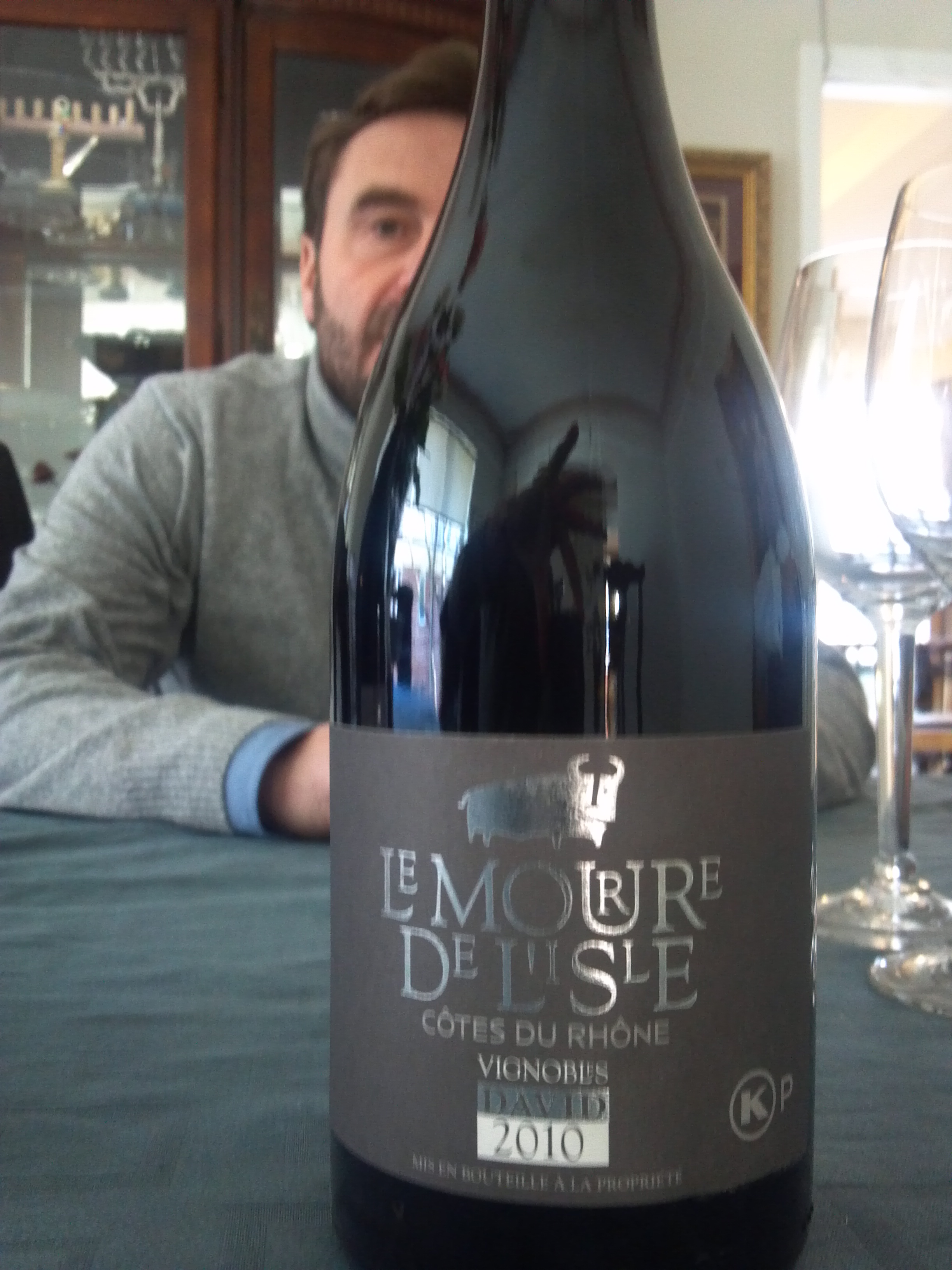 Most people know this winery by the name of the kosher wine it sells here in the US: Le Mourre de l’Isle. Actually, the name of the winery, as we said above, is Vignobles David. Please keep the real winery’s name in mind, so you can be on the lookout for the other kosher wines that Allied will be importing from them in the near future.
As larger conglomerates are buying up more and more wineries, wineries like Vignobles David are standing their ground and producing wonderful wines in an ecologically friendly manner to boot. The winery has been around since 1991 and has been producing kosher wines since 2005. The winery also produces a kosher Rose but that is sold exclusively in Europe. This year, David has added a reserve wine to both his kosher and non-kosher lineup that he is going to release here in the US sometime in February.
As we were sitting around Ghermezian’s table, the conversation moved in many different directions. I could not help but ask questions about the wine business from two people whose very life depends on it. As I listened to the conversation I was fascinated by the way that Mr. David reminds me of another true vigneron, who is also a very good friend, Benyamin Cantz of Four Gates Winery. They both create kosher wines with rich intensity; they both mind their vines and care deeply about their craft. Obviously, David’s operation is many times larger than Four Gates, and one is in the US and the other in France, but I could not help but take notice of the common threads in their lives and the wines that they produce from their vines.
Discussing terroir with a Frenchman is truly enjoyable, but doing it in French is even more fun. I dabble in the romantic language and it was a joy talking with David in his native tongue, even if I did mangle a few of the words. As the discussion moved to his wines, I asked why he does not sell his Rose here in the US? Mr. Ghermezian showed interest and yet, Mr. Davis explained that while the US market enjoys his wines, he is able to sell his entire stock in Europe, whether kosher or not. Actually, the majority of his wine is not kosher and it sells out in Europe, with his customers asking for more. Yet, he creates kosher wine because of his religious beliefs. The cost of the kosher wine is slightly higher than the non-kosher variation, simply because of the extra costs that the kosher wine production entails, and yet I could not help but sense his pride in its production as we were talking.
The complexity of creating a kosher blend comes down to a tradeoff between cost or quality. The reason comes down to the rate of ripening of different grape varietals, Grenache does not ripen at the same time as Syrah or Mourvedre. So if one wants a kosher blend, he must have kosher supervisors there for three pickings to maximize the blend’s potential, or pick once and hope for the best. With great pride and precision, Mr. David explained that he had kosher supervisors at his winery for some thirty or more days! From the first picking all the way to the last picking, then through the fermentation, and finally culminating with the wine’s internment into concrete or oak. Each step requires the supervision and it also requires his constant focus, which is not his only task or distraction, as he must still create his other non-kosher wines that are all coming ripe at the same time.

 Wine Musings Blog